
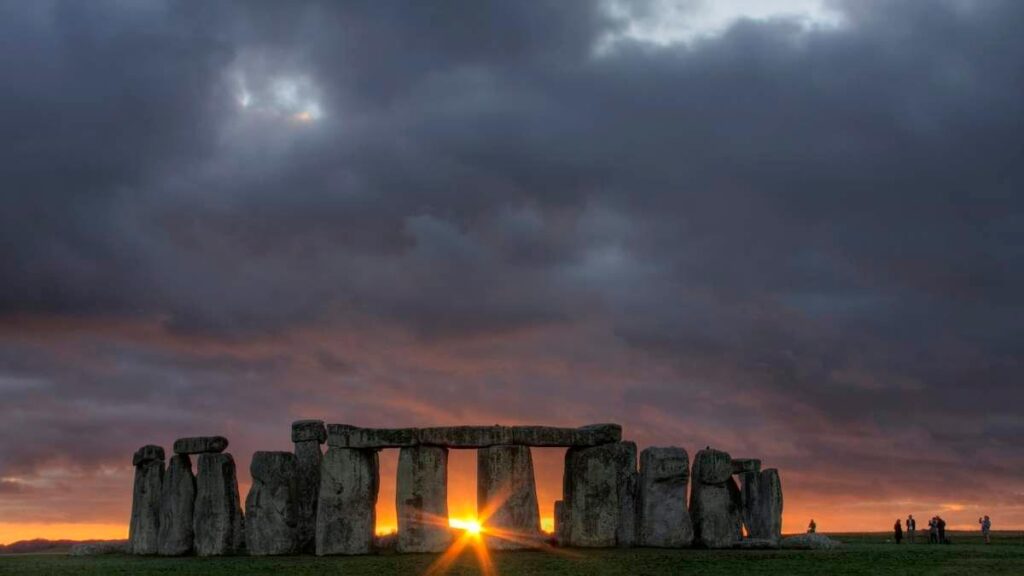
Image: from 93.7 NOW X @937NOW_
By Open Chronicle with agencies
LONDON — Archaeologists have uncovered a remarkable prehistoric structure near the iconic Stonehenge that may have served as a precursor to the world-famous monument, offering new insights into the spiritual and astronomical practices of Britain’s early inhabitants.
Researchers from Wessex Archaeology announced the discovery of a site consisting of two large wooden posts positioned approximately 120 meters apart. The structure was carefully aligned with the summer solstice sunrise and the winter solstice sunset, suggesting that ancient communities were observing and tracking the movement of the Sun centuries before Stonehenge was constructed.
Based on the depth of the postholes, archaeologists estimate that the timber posts originally stood between three and four meters high.
The excavation was led by renowned British archaeologist Phil Harding, widely known for his long-running involvement in Channel 4’s archaeological television series Time Team. Harding believes the site may have functioned as a ceremonial gathering place roughly 500 years before the earliest phases of Stonehenge.
Simpler, older version of Stonehenge found three miles from famous site
Archaeologists believe they have discovered an earlier, much simpler version of Stonehenge about 3 miles (5km) away from the prehistoric monument.
The site has been dated to about 5,000 years old, which… pic.twitter.com/EsTz5k2tS7
— Chronocivilis (@Chronocivilis) June 20, 2026
“This is probably a once-in-a-career opportunity,” Harding said. “I am likely in the latter stages of my career, and I am delighted that I have remained in archaeology long enough to be part of this discovery. It is undoubtedly the highlight of my professional life.”
Among the artifacts recovered from the site were pottery fragments, animal bones, and several tools, including a rare disc-shaped flint knife. Researchers believe the object may have held symbolic significance connected to solar worship or ritual practices.
The findings were released on the eve of the summer solstice, a period when thousands of visitors gather annually at Stonehenge to celebrate the longest day of the year in the Northern Hemisphere.
Located on Salisbury Plain in southern England, Stonehenge was constructed in several phases beginning around 3000 BC and remains one of the United Kingdom’s most visited archaeological landmarks. The site is recognized as a UNESCO World Heritage Site and continues to attract scholars and visitors from around the world.
Although debate continues over Stonehenge’s precise purpose, the monument’s alignment with the solstices is widely accepted as one of its most important features. The newly discovered timber structure strengthens the theory that solar observation and seasonal ceremonies played a central role in the beliefs of Neolithic communities in Britain.
The excavation took place near Bulford between 2015 and 2017, with several years of analysis required before the results could be published. The work formed part of a broader archaeological survey linked to a UK Ministry of Defence program designed to accommodate British troops returning from Germany after decades of deployment there.
Researchers believe the discovery offers a rare glimpse into a previously unknown chapter of Britain’s prehistoric past and may help explain the origins of the traditions that eventually culminated in the construction of Stonehenge.