
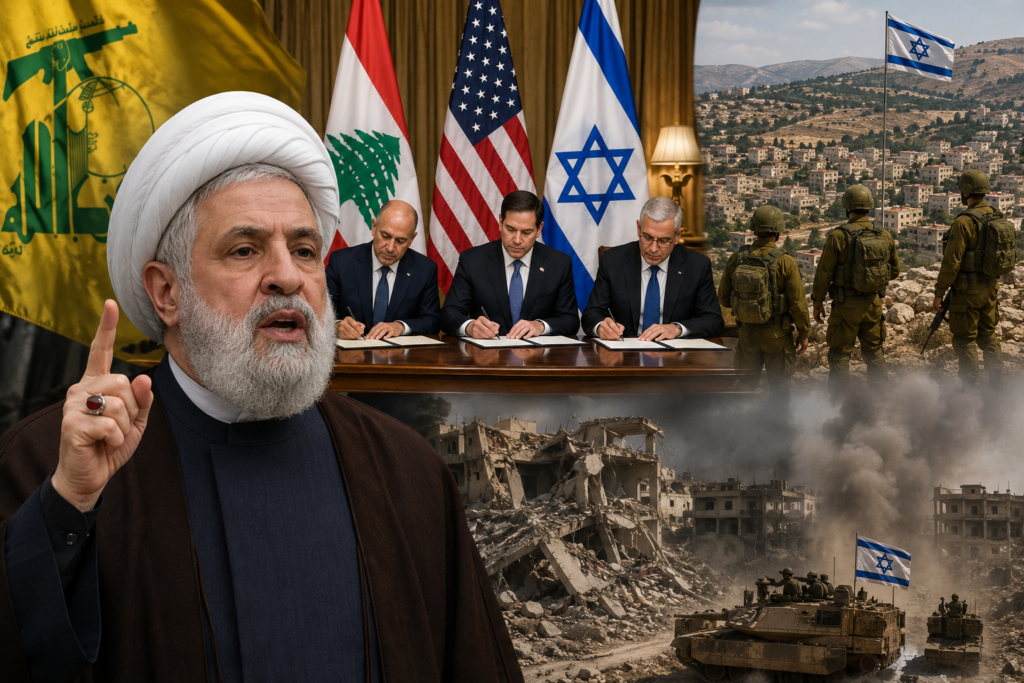
Image Credentials: Image Title: Hezbollah Rejects Lebanon-Israel Framework Agreement, Demands Immediate Israeli Withdrawal. Source: (chatgpt.com) Date: June 2026. Attribution: This image was created using AI-generated imagery (chatgpt.com) by Open Chronicle and does not depict a real-world scene.
By Open Chronicle News Desk with Agencies
BEIRUT — Hezbollah Secretary-General Naim Qassem has rejected the newly signed Lebanon-Israel framework agreement brokered by the United States, declaring the deal “null and void” and insisting that Israeli forces must withdraw from Lebanese territory without linking the move to the group’s disarmament.
Speaking on Saturday in his first public comments since the agreement was signed in Washington, Qassem argued that the framework contradicts the terms of the Iranian-American memorandum of understanding and warned against any attempt to condition Israel’s withdrawal on Hezbollah surrendering its weapons.
“This agreement is null and void, and the provisions of the Iranian-American memorandum of understanding must be implemented,” Qassem said in a statement.
The Hezbollah leader strongly criticized proposals requiring the movement to disarm throughout Lebanon before Israel completes its withdrawal from the occupied areas. He described such conditions as “a very dangerous proposal that crosses all red lines,” arguing that they would leave Lebanon vulnerable to Israeli influence and undermine the country’s security.
Qassem said that forcing the resistance movement to relinquish its weapons before an Israeli withdrawal would turn Lebanon “into a plaything in the hands of the Israeli enemy.”
The framework agreement was signed on Friday in Washington following the fifth round of negotiations between Lebanese and Israeli representatives under US mediation. The deal seeks to establish a structured process aimed at resolving long-standing disputes, restoring stability along the border, strengthening the authority of the Lebanese Armed Forces, and creating conditions for Israel’s eventual withdrawal once security objectives are achieved.
The agreement has generated mixed reactions across Lebanon. Supporters have described it as a historic opportunity to restore stability, rebuild state authority, and revive the country’s struggling economy. Critics, however, argue that the framework places excessive pressure on Lebanon while offering concessions to Israel without sufficient guarantees.
The negotiations followed months of escalating violence. According to Lebanese authorities, Israeli military operations since March 2 have killed more than 4,000 people and injured another 4,000 across Lebanon.
Despite the signing of the agreement, Hezbollah’s rejection highlights the significant political and security challenges facing its implementation, raising fresh uncertainty over whether the framework can bring a lasting reduction in hostilities along the Israel-Lebanon border.