
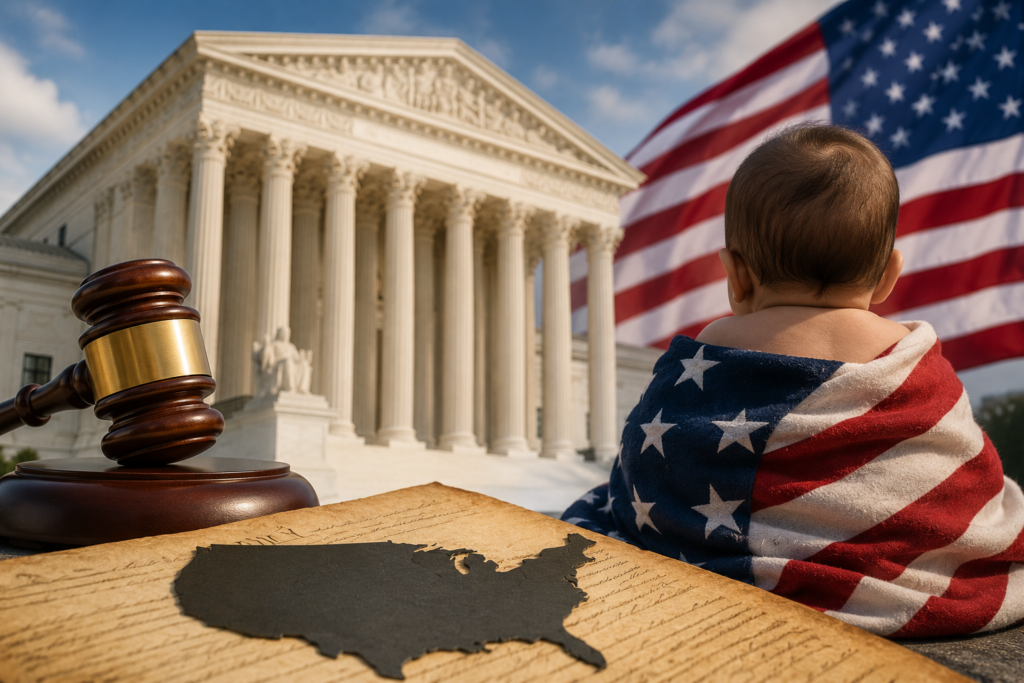
Image Credentials: Image Title: US Supreme Court Upholds Birthright Citizenship in Landmark 6,3 Ruling. Source: (chatgpt.com) Date: June 2026. Attribution: This image was created using AI-generated imagery (chatgpt.com) by Open Chronicle and does not depict a real-world scene.
By Open Chronicle News Desk with Agencies
The United States Supreme Court has reaffirmed the constitutional principle of birthright citizenship, ruling 6,3 that children born on American soil are citizens regardless of their parents’ immigration status, rejecting President Donald Trump’s executive order that sought to restrict the long-established interpretation of the 14th Amendment.
In a decision expected to shape immigration law for decades, Chief Justice John Roberts, writing for the majority, concluded that the executive order violated the Constitution’s Citizenship Clause, which guarantees citizenship to nearly everyone born in the United States, subject only to a limited number of exceptions.
Roberts emphasized that the 14th Amendment was designed to ensure equal citizenship rights for all people born in the country following the Civil War.
“Citizenship, then and now, was the right to have rights, to freely participate in our political community,” Roberts wrote. “We keep that promise today.”
The ruling preserves the citizenship status of an estimated 250,000 children born each year who would have been affected by the executive order.
Trump criticizes the decision
President Donald Trump described the ruling as “too bad for our Country,” while arguing that Congress could still pursue legislation to restrict birthright citizenship without requiring a constitutional amendment.
Trump urged lawmakers to begin work immediately on new legislation, pledging his full support for any effort to change existing immigration law.
House Speaker Mike Johnson also expressed disappointment, arguing that birthright citizenship encourages what critics describe as “birth tourism,” in which foreign nationals travel to the United States to give birth and secure citizenship for their children.
Republican Senator Eric Schmitt announced plans to introduce a constitutional amendment that would redefine citizenship based on allegiance and permanent membership in the nation.
Several conservative commentators and immigration advocacy organizations also condemned the ruling, arguing that it weakens immigration enforcement and places additional pressure on public services.
Civil rights organizations celebrate constitutional victory
Democratic leaders and civil rights organizations welcomed the decision as one of the most significant constitutional rulings in recent years.
House Democratic Leader Hakeem Jeffries described the judgment as a rejection of what he called an unconstitutional attempt to rewrite the Constitution through executive action.
The American Civil Liberties Union, which argued the case before the Supreme Court, called the ruling a major victory for constitutional protections.
“The Constitution’s guarantee of birthright citizenship stands strong,” said ACLU National Legal Director Cecillia Wang.
Immigrant advocacy organizations also praised the decision.
Krish O’Mara Vignarajah, president of Global Refuge, said the ruling prevented what she described as a constitutional crisis by preserving protections that have existed for more than 150 years.
Maria Teresa Kumar, president of Voto Latino, said the court had defended “the soul of this country” by reaffirming that every child born in the United States is an American citizen.
The League of United Latin American Citizens (LULAC), one of the plaintiffs challenging the executive order, welcomed the decision, stating that no president has the authority to override constitutional guarantees by executive decree.
The National Association for the Advancement of Colored People (NAACP) also described the judgment as a powerful reaffirmation of equality under the Constitution.
A defining constitutional ruling
Legal scholars are already describing the judgment as one of the most consequential constitutional decisions in modern American history.
While opponents of birthright citizenship are expected to pursue legislative and constitutional alternatives, Tuesday’s decision firmly maintains more than a century of legal precedent interpreting the 14th Amendment.
The ruling also represents a major setback for one of the central immigration initiatives of the Trump administration, while reinforcing the Supreme Court’s role in protecting constitutional rights from executive action.