
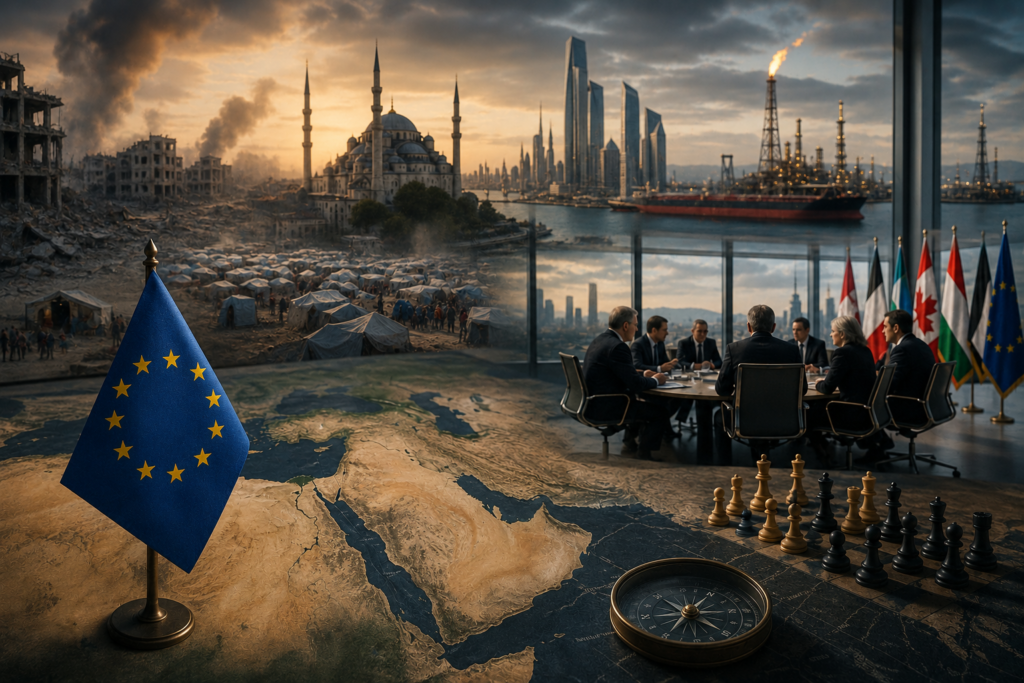
Image Credentials: Image Title: Europe’s Middle East Reset: Why Strategic Autonomy Can No Longer Stop at Ukraine Source: (chatgpt.com) Date: June 2026. Attribution: This image was created using AI-generated imagery (chatgpt.com) by Open Chronicle and does not depict a real-world scene.

Strategic Analysis | By Open Chronicle
For nearly two decades, Europe’s geopolitical debate has been dominated by one central question: how to respond to Russia. Since 2022, that question has become even more urgent as the war in Ukraine transformed European security thinking.
Yet another strategic reality is emerging.
The Middle East is once again becoming a defining theatre for European security, not simply because of conflict, but because the assumptions underpinning European foreign policy are beginning to collapse.
The combination of the Gaza war, renewed confrontation between the United States and Iran, instability across the Red Sea, energy insecurity, and growing doubts over American strategic priorities has forced Brussels to confront a question it has largely postponed for years:
Can Europe continue outsourcing its Middle East strategy to Washington?
The debate has become increasingly prominent as the European Commission prepares a new Middle East Strategy intended to redefine Europe’s long-term approach to its southern neighbourhood.
The End of Strategic Comfort
Since the Oslo Accords, Europe’s role has largely been defined by three pillars:
- financial support for Palestinian institutions,
- economic integration through Euro-Mediterranean partnerships,
- Political alignment with successive American diplomatic initiatives.
This framework assumed gradual regional stabilization.
That assumption no longer exists.
The collapse of the Oslo framework, the destruction of Gaza, repeated regional conflicts involving Iran, Lebanon and Syria, together with declining confidence in American predictability, have exposed the limitations of Europe’s existing policy architecture.
The Geography Europe Cannot Escape
Unlike the United States, Europe cannot simply “pivot” away from the Middle East.
Its exposure is structural.
European interests intersect with the region through multiple strategic dimensions:
Energy Security
Although diversification has accelerated since Russia invaded Ukraine, Europe remains vulnerable to disruptions around the Strait of Hormuz and Red Sea maritime routes.
Even temporary interruptions immediately translate into inflationary pressure, higher industrial costs, and slower economic growth. Recent assessments have warned that simultaneous geopolitical shocks involving the Middle East could significantly weaken the eurozone economy.
Migration
Every major regional conflict creates refugee flows that primarily affect Europe rather than North America.
Migration, therefore, remains not simply a humanitarian issue but a long-term geopolitical variable influencing European domestic politics.
Trade
Approximately one-fifth of global maritime energy flows transit through Hormuz.
The Suez Canal remains indispensable for European commerce with Asia.
Instability along these corridors immediately affects European supply chains.
Europe’s Strategic Contradiction
The European Union increasingly speaks the language of “strategic autonomy.”
Defense industrial policies…
Joint procurement…
Military mobility…
Support for Ukraine…
All reflect a growing recognition that Europe must assume greater responsibility for its own security.
Yet this logic has often stopped at the Middle East.
While European leaders increasingly question American reliability regarding Russia, they have remained significantly more cautious in developing independent approaches toward Israel, Iran, Syria, or the Gulf.
This inconsistency weakens European credibility across the broader Global South.
Why the Region Is Changing
The geopolitical landscape of the Middle East itself has shifted dramatically.
Several long-term developments stand out:
The Gulf States
Saudi Arabia, the United Arab Emirates, and Qatar increasingly pursue autonomous foreign policies rather than acting solely within traditional American security structures.
Their diplomacy now balances relations with:
- Washington
- Beijing
- Moscow
- New Delhi
- Europe
This creates opportunities for broader European engagement.
Turkey
Türkiye has become an increasingly independent regional military and diplomatic power whose influence extends from Libya and Syria to the Caucasus and the Black Sea.
Any future European regional strategy necessarily involves Ankara.
Iran
Regardless of political disagreements, Iran remains central to Gulf security, energy markets and regional stability.
Ignoring Tehran does not remove its geopolitical importance.
The Palestinian Question Remains Strategic
One of the strongest arguments emerging in recent European strategic discussions is that Israel-Palestine remains the region’s central geopolitical issue.
Not because it explains every regional conflict.
But because it continues to shape:
- Arab public opinion
- Iranian regional influence
- European credibility
- relations with Gulf partners
- broader perceptions of Western international law.
Many analysts argue that any comprehensive European Middle East strategy that avoids addressing this issue directly risks lacking strategic coherence.
The Declining American Monopoly
Perhaps the most important long-term trend is not American withdrawal.
It is American prioritization.
Washington increasingly views:
- China,
- the Indo-Pacific,
- advanced technology competition,
as its principal strategic priorities.
The Middle East is becoming a secondary theatre that the United States seeks to stabilize at minimum cost whenever possible.
For Europe, however, the region remains a permanent neighbourhood.
This asymmetry creates fundamentally different interests.
Recent analysis suggests European governments are increasingly reassessing how much they can depend on U.S. strategic leadership, both in Eastern Europe and across the Middle East.
A New European Grand Strategy?
If Europe wishes to become a genuine geopolitical actor rather than primarily an economic power, several priorities emerge.
First, develop an integrated Mediterranean and Middle East strategy rather than treating migration, energy, defence and diplomacy as separate policy areas.
Second, deepen strategic partnerships with Gulf countries beyond hydrocarbons, including maritime security, infrastructure, technology and defence cooperation.
Third, maintain engagement with Israel while demonstrating that international law remains central to European foreign policy.
Fourth, accelerate reconstruction and institutional support for Syria and Lebanon where political conditions permit.
Finally, strengthen Europe’s own diplomatic identity rather than simply reacting to American initiatives.
Strategic Outlook
The coming decade will likely determine whether Europe evolves into a genuine geopolitical power or remains primarily an economic actor dependent upon others for strategic leadership.
The Middle East may prove to be the ultimate test.
Europe cannot relocate its geography.
It cannot outsource the security of its southern neighbourhood.
Nor can it separate energy security, migration, maritime trade, terrorism, technological competition, and regional diplomacy into isolated policy debates.
The lesson emerging from the past several years is increasingly clear.
Strategic autonomy is not only about producing more tanks or increasing defence budgets.
It is about possessing an independent geopolitical vision.
Whether Brussels can transform that vision into coherent policy may become one of the defining questions of European foreign policy throughout the remainder of this decade.
Continue Exploring Strategic Analysis
This article is part of The Grand Strategy Institute, Open Chronicle's research centre dedicated to geopolitics, international security, military strategy, intelligence, technology and the evolving balance of global power.
Return to The Grand Strategy Institute →The Grand Strategy Institute
Continue Exploring Strategic Analysis
Return to The Grand Strategy Institute for strategic assessments, long-form analysis and research examining geopolitics, military affairs, international security, emerging technologies and the changing international order.
← Back to The Grand Strategy Institute