
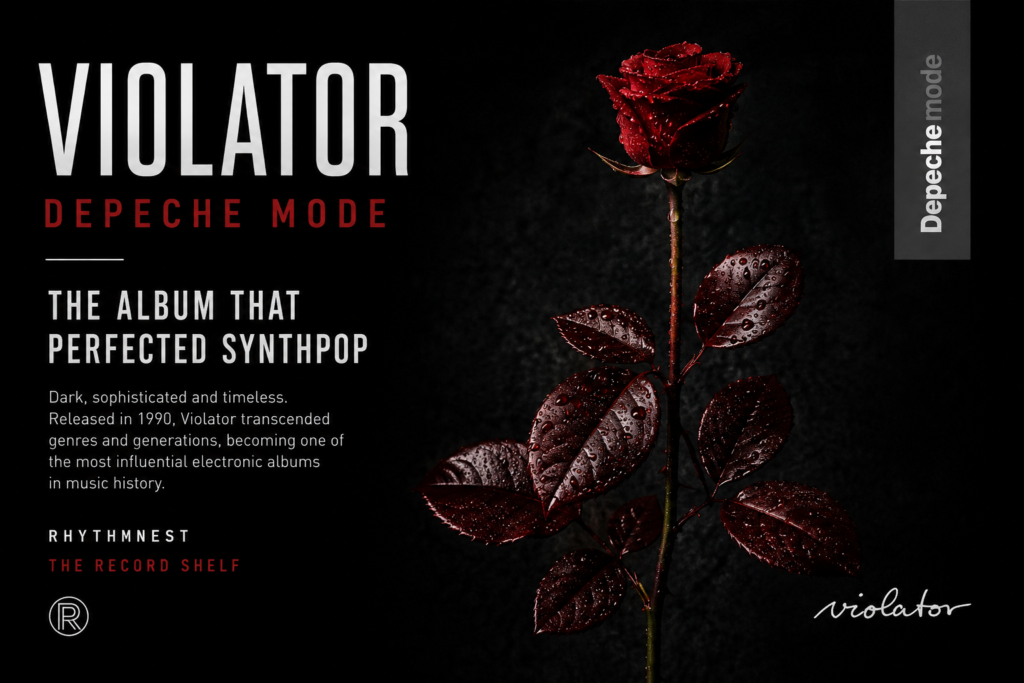
Image Credentials: Image Title: Violator: The Album That Perfected Synthpop Source: (chatgpt.com) Date: July 2026. Attribution: This image was created using AI-generated imagery (chatgpt.com) by Open Chronicle and does not depict a real-world scene.
By RhythmNest
Some albums define a genre.
Others redefine an artist.
Only a handful manage to reshape the future of music itself.
Released on 19 March 1990, Violator was not simply another Depeche Mode album. It represented the moment when electronic music achieved a rare balance between accessibility and artistic ambition, producing a record that could dominate radio stations, fill stadiums and still earn the admiration of musicians, producers and critics decades later.
More than thirty-five years after its release, Violator remains one of the most influential electronic albums ever recorded. Its songs continue to appear in films, television series, and live performances around the world, while its production techniques still inspire contemporary artists working in synthpop, industrial, futurepop, darkwave, and electronic rock.
This is not merely an album that survived its era.
It became timeless.
The Road to Violator
By the end of the 1980s, Depeche Mode had already travelled a remarkable path.
Emerging from Basildon, England, in the early years of synthpop, the band initially stood alongside acts such as Yazoo, OMD, and The Human League. Yet with every new release, they moved further away from straightforward electronic pop.
Albums such as Black Celebration and Music for the Masses revealed a growing fascination with darker atmospheres, emotional complexity, and increasingly sophisticated sound design.
By the time work began on Violator, the band faced an enormous challenge.
Could they become bigger without compromising their artistic identity?
The answer would exceed every expectation.
Less Really Became More
One of the greatest strengths of Violator lies in what it deliberately avoids.
Unlike many late 1980s productions, overloaded with digital effects and dense arrangements, Violator embraces restraint.
Producer Flood, together with the band’s meticulous creative process, understood that space could be as expressive as sound itself.
Every synthesizer enters with purpose.
Every drum machine serves the song rather than dominating it.
Silence becomes part of the composition.
The result is an album that sounds remarkably modern even today.
Rather than feeling trapped in the technology of its era, it feels almost outside time.
The Voice of Desire and Doubt
Much of Violator‘s emotional power comes from the contrast between Martin Gore’s songwriting and Dave Gahan’s vocal performance.
Gore rarely writes in absolutes.
His lyrics leave room for interpretation, exploring themes of faith, temptation, love, guilt, desire and vulnerability without offering definitive answers.
That ambiguity gives the songs remarkable longevity.
Listeners often discover new meanings depending on where they are in life.
Dave Gahan delivers these words with extraordinary control.
Instead of theatrical excess, his voice projects confidence while quietly revealing emotional fractures beneath the surface.
Few singers have managed to sound simultaneously intimate and monumental.
Song by Song, A Masterclass in Electronic Music
World in My Eyes
The album opens with confidence.
Its hypnotic groove immediately announces that this is a different Depeche Mode.
Minimalist sequencing, subtle textures, and one of Dave Gahan’s finest vocal performances create a seductive invitation into the album’s world.
Personal Jesus
▶ Listen: Personal Jesus
Perhaps the band’s most recognisable riff.
Built around a blues-inspired guitar pattern placed inside an electronic framework, Personal Jesus demonstrated that synthesizers and rock instrumentation could coexist naturally.
Its influence extends far beyond synthpop, inspiring artists across alternative rock, industrial, and metal.
Enjoy the Silence
▶ Listen: Enjoy the Silence
If Violator has a centrepiece, this is it.
Originally conceived as a slow ballad, the song was transformed into an elegant electronic anthem after producer Flood suggested increasing the tempo.
The decision proved revolutionary.
Built upon one of the most memorable synthesizer melodies ever written, Enjoy the Silence remains one of electronic music’s defining compositions.
It is both melancholic and uplifting.
Intimate yet enormous.
Simple yet endlessly sophisticated.
Few songs achieve such emotional balance.
Policy of Truth
A perfect demonstration of rhythm-driven storytelling.
The groove constantly moves forward while Martin Gore’s lyrics explore honesty, guilt, and the consequences of revealing uncomfortable truths.
Waiting for the Night
Perhaps the album’s emotional heart.
Gentle synthesizer pads, restrained vocals, and almost sacred simplicity transform the song into a moment of reflection before the album resumes its darker momentum.
Halo
One of the album’s hidden masterpieces.
Layer upon layer of electronic textures creates a hypnotic atmosphere where desire, spirituality, and temptation become almost inseparable.
Clean
The closing track offers resolution without certainty.
Instead of ending with triumph, Violator concludes quietly, leaving the listener suspended somewhere between redemption and uncertainty.
Production That Changed Electronic Music
Technically, Violator remains astonishing.
Rather than relying on technology for its own sake, every production choice serves emotion.
Analogue synthesizers sit alongside digital sampling.
Percussion sounds organic despite being largely electronic.
Reverb is used sparingly.
Compression never overwhelms the music.
The stereo image feels expansive without becoming artificial.
Every sound has its place.
This clarity explains why the album continues to impress listeners more than three decades after its release.
Many productions from the same period now sound dated.
Violator rarely does.
Beyond Synthpop
Although commonly described as a synthpop album, Violator reaches far beyond genre labels.
Its DNA can be heard in industrial rock, futurepop, darkwave, electronic body music, trip hop, and even modern alternative rock.
Artists such as Nine Inch Nails, VNV Nation, Covenant, Apoptygma Berzerk, and countless contemporary electronic musicians have acknowledged its influence.
Even today’s cinematic electronic productions often borrow from the album’s careful balance between melody and atmosphere.
Its legacy continues to evolve rather than remain frozen in nostalgia.
Why Violator Still Matters
The music industry has changed beyond recognition since 1990.
Streaming dominates.
Algorithms shape discovery.
Attention spans have shortened.
Yet Violator continues to attract new listeners every year.
Why?
Because great records are built on timeless foundations.
Exceptional songwriting.
Thoughtful production.
Authentic emotion.
Rather than chasing contemporary trends, Depeche Mode created something deeply human.
That humanity continues to resonate regardless of changing technology.
RhythmNest Essential
Artist: Depeche Mode
Released: 19 March 1990
Genre: Synthpop, Alternative Dance, Electronic Rock
Label: Mute Records
Producer: Flood, Depeche Mode
Essential Tracks
- Enjoy the Silence
- Personal Jesus
- World in My Eyes
- Policy of Truth
- Waiting for the Night
If You Enjoy This Album…
Explore:
- Substance by New Order
- Behaviour by Pet Shop Boys
- Twisted by Delirium
- Future Perfect by VNV Nation
- The Great Divide by Beyond Borders
Final Thoughts
Some albums become successful because they capture a particular cultural moment.
Others transcend their era entirely.
Violator belongs firmly in the second category.
It is a record that rewards careful listening, revealing new details with every return. Beneath its polished electronic surfaces lies an extraordinary collection of songs exploring love, faith, temptation, loneliness, and hope with uncommon subtlety.
More than three decades after its release, Violator remains not only Depeche Mode’s defining achievement but one of the greatest electronic albums ever recorded.
It is difficult to imagine modern synthpop, futurepop, darkwave, or electronic rock without its influence.
Few albums deserve the word essential.
Violator earns it without question.
RhythmNest Rating: ★★★★★
Record Shelf Essential