
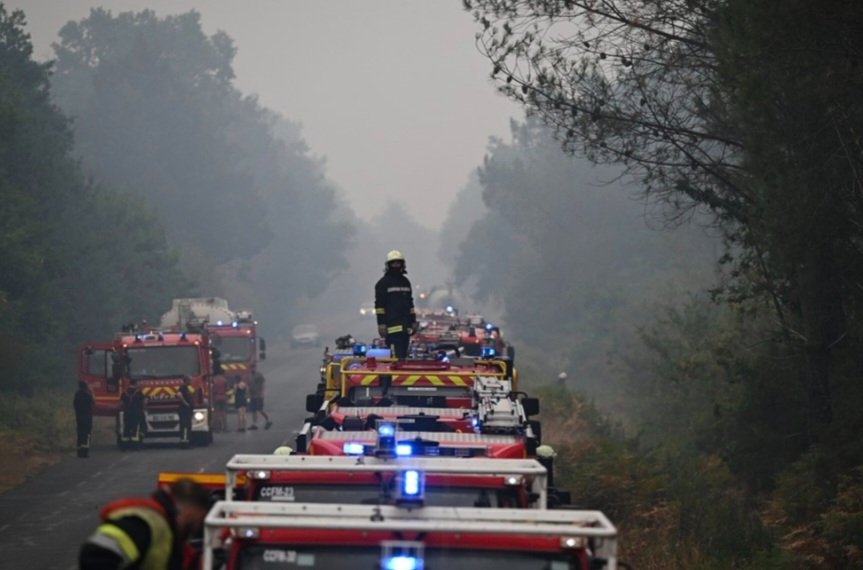
Image: from GeoInsider X @InsiderGeo
By Open Chronicle News Desk with Agencies
Spain is facing one of its most severe wildfire emergencies in recent years, with massive blazes sweeping across central regions and forcing tens of thousands of people to evacuate or remain confined to their homes as firefighters struggle to contain fast-moving flames.
The Spanish government has declared a national emergency as wildfires continue to burn across the regions of Madrid, Ávila, Toledo and Castellón, while officials warn that weather conditions remain highly favorable for further fire outbreaks.
🔥 EUROPE ABLAZE: Three Wildfires Merge Into a 22,000-Hectare Inferno Outside Madrid
Spain’s Madrid region is confronting a massive wildfire emergency after three separate blazes around Villa del Prado, San Martín de Valdeiglesias and Almorox merged into one fire raging across… pic.twitter.com/PYlhwnAVVA
— Jewish Breaking News (@JBreakingNews) July 26, 2026
Tens of thousands displaced
According to the latest official figures, approximately 91,000 people have either been evacuated or ordered to remain indoors across the Madrid region, the neighboring province of Ávila and parts of Toledo.
The fires have already burned or severely damaged around 45,000 hectares in Madrid and Ávila alone, destroying forests, farmland and threatening numerous communities.
Authorities say the scale of the disaster has made it one of the largest wildfire emergencies the country has experienced in recent decades.
“Worst fire in the region’s history”
Madrid regional president Isabel Díaz Ayuso described the emergency as the “worst fire in the history of the region.”
Wildfires continued to burn throughout Saturday despite slightly cooler overnight temperatures, with firefighters facing difficult conditions caused by strong winds and extremely low humidity.
Spanish Interior Minister Fernando Grande-Marlaska acknowledged the scale of the challenge.
“The situation is complex,” he said, adding that it “has not been a positive day” for emergency crews because of the exceptionally difficult weather conditions.
Fires spread across multiple regions
The Madrid and Ávila fires are only part of a wider national wildfire crisis.
Major fires continue to burn in the eastern province of Castellón, while earlier this month catastrophic fires in Almería claimed 13 lives, making them among Spain’s deadliest wildfire disasters in recent memory.
According to the European Forest Fire Information System (EFFIS), nearly 130,000 hectares have burned across Spain since the beginning of the year, highlighting the exceptional intensity of the 2026 wildfire season.
Massive emergency response
Thousands of emergency personnel have been deployed throughout the affected regions.
The response includes firefighters, police officers, Civil Protection teams, military personnel and members of Spain’s Military Emergency Unit (UME), which continues to play a central role in protecting communities, critical infrastructure and assisting regional firefighting agencies.
Authorities have concentrated resources on defending populated areas as rapidly changing fire conditions have made direct attacks on some fire fronts impossible.
European partners provide assistance
Spain has activated the European Union Civil Protection Mechanism, allowing several European countries to reinforce the national response.
Greece and Italy have each offered two Canadair water-bombing aircraft together with additional support aircraft.
Italian firefighting aircraft were already participating in suppression operations over Madrid and Ávila on Saturday.
International assistance also includes:
- 33 Greek emergency personnel
- 14 Italian emergency personnel
- 129 Portuguese firefighters and emergency workers
- 41 Portuguese emergency vehicles, including fire engines, ambulances, bulldozers and command vehicles.
The multinational operation reflects the growing severity of wildfire seasons across southern Europe.
Extreme weather fuels explosive fire behavior
Meteorologists say the fires have developed under nearly ideal conditions for rapid wildfire spread.
According to Javier Armeteros, Madrid delegate of Spain’s State Meteorological Agency (AEMET), firefighters encountered what is commonly known as the “30-30-30 rule.”
This dangerous combination consists of:
- Temperatures above 30°C
- Relative humidity below 30%
- Wind speeds exceeding 30 km/h
During the latest outbreaks, temperatures surpassed 32°C, humidity fell below 30%, while wind gusts reached between 50 and 60 km/h, creating exceptionally dangerous fire behavior.
Firefighters forced to change strategy
The intensity of the fires has forced emergency crews to abandon direct attacks on the most dangerous sections of the blaze.
José María Bermúdez, spokesperson for Madrid’s Forest Rangers Corps, said firefighters could not safely attack the head of the fire.
“Going directly against the head of the fire would be going straight to death,” he explained.
Instead, crews have focused on containing the flanks of the fires, protecting towns, infrastructure and evacuation routes whenever weather conditions permit.
Israel Naveso, spokesperson for Madrid firefighters’ union, described the current crisis as “a perfect storm.”
He said abundant vegetation following a wet winter, three major heatwaves in just six weeks and persistent strong winds combined to produce ideal conditions for multiple fast-moving wildfires.
High wildfire risk continues
Authorities warn that the danger is far from over.
Spain’s latest national wildfire risk assessment indicates that large parts of central, southern and eastern Spain remain under high or extreme wildfire risk, meaning new fires could ignite easily and existing blazes could continue spreading rapidly.
Emergency services remain on high alert as weather forecasts show that hot, dry and windy conditions are likely to persist in the coming days.
With nearly 100,000 people displaced in central Spain, almost 130,000 hectares burned nationwide this year and international firefighting resources now assisting Spanish authorities, the country continues to face one of the most challenging wildfire seasons in its modern history.