
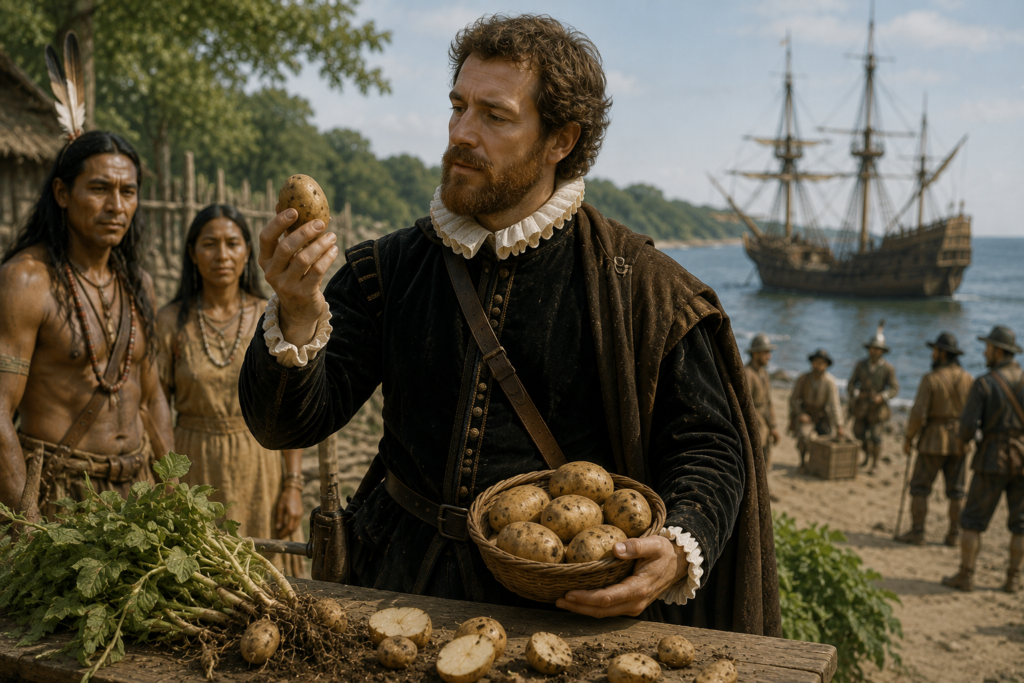
Image Credentials: Image Title: Today in History, July 28: Sir Thomas Harriot Introduces Potatoes to England After Returning from North America. Source: (chatgpt.com) Date: July 2026. Attribution: This image was created using AI-generated imagery (chatgpt.com) by Open Chronicle and does not depict a real-world scene.
By Open Chronicle
26 July 1586
In July 1586, English scientist, mathematician and explorer Sir Thomas Harriot returned to England from the failed Roanoke expedition in North America, bringing with him detailed observations of the region’s people, plants and resources. Among the crops he helped introduce to English audiences was the potato, a plant that would eventually transform agriculture, nutrition and population growth across Europe.
Although the potato had already reached parts of continental Europe through Spanish explorers following their conquests in South America, it remained virtually unknown in England. Harriot’s return from the English colony on Roanoke Island marked one of the earliest documented introductions of the crop into English society and contributed to growing interest in plants from the New World.
Harriot had joined Sir Walter Raleigh’s ambitious colonial project to establish a permanent English settlement along the Atlantic coast of present-day North Carolina. Unlike many members of the expedition, Harriot was not primarily a soldier or adventurer. A gifted scholar with interests in astronomy, navigation, mathematics, and natural science, he was tasked with observing the region’s geography, climate, flora, fauna, and Indigenous peoples.
The expedition reached Roanoke Island in 1585 under the leadership of Sir Richard Grenville and later Ralph Lane. During his stay, Harriot carefully documented the customs, languages and agricultural practices of the Algonquian-speaking communities. His scientific curiosity extended to the crops cultivated by Indigenous peoples, many of which were unfamiliar to Europeans.
Among these plants was the potato, which Indigenous communities in the Americas had cultivated for centuries. Harriot recognised its potential as a nutritious and productive food source. He also studied maize, tobacco, beans, pumpkins and other crops that would later become important parts of European agriculture.
When worsening relations with local communities and shortages of supplies forced the English colonists to abandon Roanoke in 1586, Harriot returned home aboard ships commanded by Sir Francis Drake. Along with his notes, maps, and scientific observations, knowledge of several New World plants accompanied the expedition back to England.
In 1588, Harriot published A Briefe and True Report of the New Found Land of Virginia, one of the earliest detailed English descriptions of North America. The work described the land’s natural resources, Indigenous societies, and agricultural products. His account encouraged further English exploration while introducing readers to unfamiliar crops that could benefit Europe.
Although historians continue to debate exactly when the first potatoes were physically planted in England, Harriot’s observations and the Roanoke expedition are widely associated with the crop’s earliest introduction into English awareness. Other explorers and merchants also contributed to its spread during the late sixteenth century.
Initially, potatoes were regarded with suspicion. As a member of the nightshade family, the plant was unfamiliar to many Europeans, and some believed it to be unhealthy or unsuitable for human consumption. In some regions, it was grown primarily as a botanical curiosity or as animal feed before gradually gaining acceptance as food.
During the seventeenth and eighteenth centuries, however, the potato proved exceptionally valuable. It produced abundant harvests, thrived in relatively poor soils and contained high nutritional value. Farmers across Britain, Ireland and much of continental Europe increasingly adopted the crop, recognising its ability to support growing populations.
The potato became especially significant in Ireland, where it developed into a dietary staple for millions of people. While this dependence later contributed to the devastating Great Irish Famine of the 1840s after potato blight destroyed successive harvests, the crop had previously supported dramatic population growth throughout Europe.
Harriot himself continued to enjoy a distinguished scientific career. Beyond his contributions to exploration, he conducted pioneering work in astronomy, optics and mathematics. He made some of the earliest telescopic observations of the Moon shortly after the invention of the telescope and produced important research that influenced later scientists.
Today, Thomas Harriot is remembered not only as an explorer and scholar but also as one of the earliest English observers to recognise the agricultural potential of New World crops. His role in introducing knowledge of the potato to England forms part of the broader Columbian Exchange, the vast movement of plants, animals, technologies and ideas between the Americas and the Old World that reshaped global history.
The humble potato, once an unfamiliar American crop, would become one of the world’s most important food sources, illustrating how a single botanical introduction could profoundly influence agriculture, economies and human societies for centuries to come.