
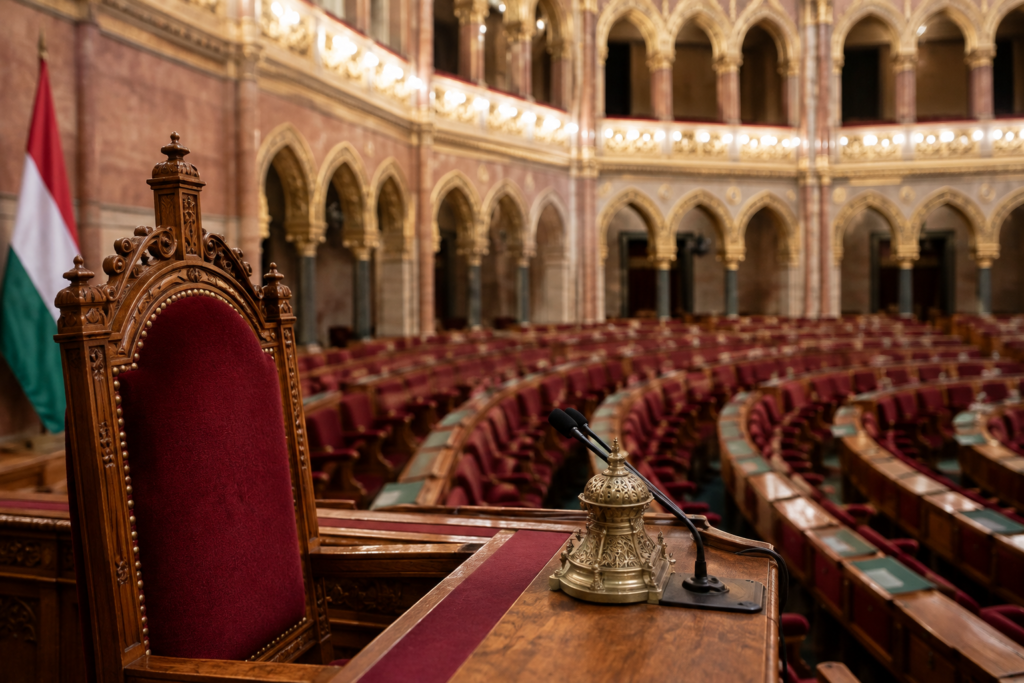
Image Credits: Hungary Prepares to Elect New President as Attention Turns to Péter Magyar’s Choice. AI-generated illustration created by Open Chronicle using ChatGPT (OpenAI). August 2026. This image is illustrative and does not depict a real-world scene.
By Open Chronicle with agencies
Hungary’s Parliament is set to vote next Tuesday on the country’s next president, but with no official candidate yet nominated, political attention remains firmly focused on Prime Minister Péter Magyar and the choice expected from his governing Tisza Party.
The presidential election marks another milestone in Hungary’s political transition following April’s general election, in which Tisza secured a decisive victory, ending Viktor Orbán’s 16-year tenure as prime minister.
Although the presidency is largely ceremonial, the appointment has taken on considerable symbolic importance as Magyar seeks to reshape key state institutions after years of Fidesz rule.
Presidency vacant after constitutional change
The office became vacant after Magyar’s government approved a constitutional amendment in July that removed former President Tamás Sulyok from office.
Magyar had repeatedly criticised Sulyok as being too closely aligned with the previous administration, describing him as a political appointee who failed to act independently of Orbán’s government.
Until Parliament elects a new head of state, Speaker of Parliament Ágnes Forsthoffer has been serving as acting president.
Judit Polgár declined the nomination
One of the most widely discussed developments in recent weeks came when Magyar offered the presidency to former world chess champion Judit Polgár.
Polgár declined the proposal, explaining that Hungary’s deeply polarised political climate made accepting the position inappropriate at the present time.
Her decision generated significant public debate and prompted criticism from opposition politicians and civil society organisations, some of which argued that the nomination process lacked the broad public consultation Magyar had previously promised.
Magyar promises an independent president
Responding to the criticism, Magyar clarified that his government had invited recommendations rather than conducting a formal national consultation.
He argued that the final decision ultimately belongs to Tisza’s parliamentary group together with the National Assembly.
Speaking on social media, the prime minister said Hungary’s next president should represent national unity rather than partisan politics.
“We do not want to choose the country’s next president behind closed doors,” Magyar said, encouraging political parties, civic organisations, public figures and ordinary citizens to submit recommendations.
According to Magyar, the successful candidate should have no active party-political background and should be capable of serving all Hungarians equally.
Several prominent names considered
Although no official nominee has yet emerged, Magyar has reportedly held discussions with several respected public figures.
Among those mentioned are constitutional law professor and former Supreme Court president András Baka, historian Ignác Romsics, and lawyer Botond Fülöp, whose investigation into a secret presidential pardon played a central role in the political controversy that ultimately contributed to the resignation of former President Katalin Novák in 2024.
None of those individuals has been formally nominated.
Opposition boycotts the vote
Orbán’s Fidesz party has announced that it will not participate in the parliamentary vote.
Party leaders argue that the removal of Tamás Sulyok was unconstitutional and therefore refuse to recognise the legitimacy of the presidential election process.
The boycott is expected to have little practical effect, however, given Tisza’s parliamentary majority following its landslide election victory earlier this year.
A symbolic test for Hungary’s new government
Although the Hungarian presidency carries relatively limited executive authority, the office retains important constitutional responsibilities.
The president formally signs legislation into law, may refer bills to the Constitutional Court for review and possesses the power to grant presidential pardons.
The election therefore represents more than a ceremonial appointment. It offers Prime Minister Magyar an opportunity to demonstrate how his administration intends to govern after promising greater transparency, institutional independence and political renewal.
With Parliament due to vote within days, attention now centres on whether Magyar will reveal his preferred candidate before lawmakers convene or keep the decision until the final moment.