
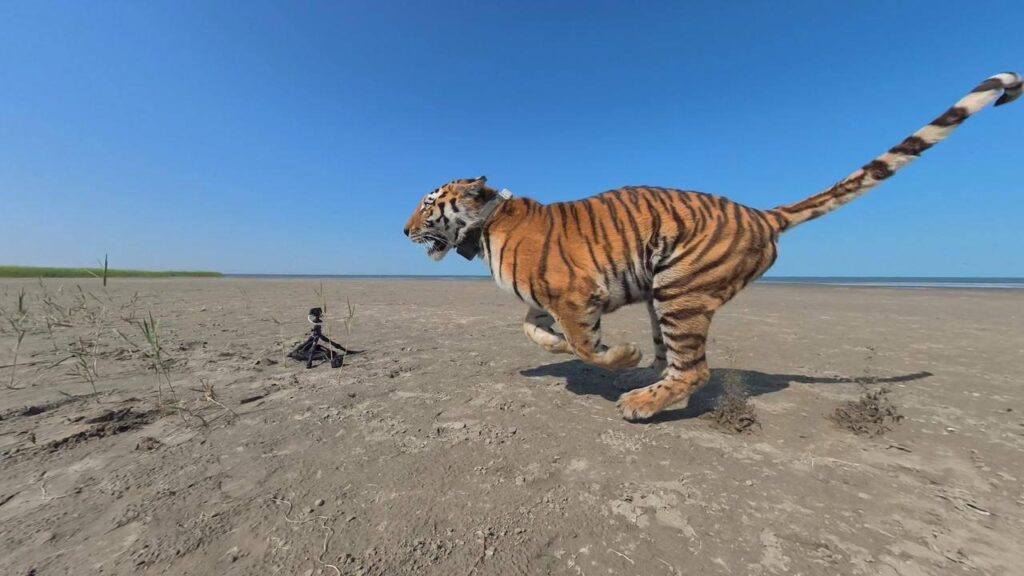
Image: from Newslive 24×7 🅧︎ X @kanpurtak
By Open Chronicle with agencies
Kazakhstan has taken a major step toward restoring one of Central Asia’s most iconic predators by releasing an Amur tiger into the wild for the first time in more than seven decades.
The female tiger, named Umit, which means “hope” in Kazakh, was released into the Ile-Balkhash Nature Reserve as part of an ambitious international conservation programme aimed at re-establishing a self-sustaining wild tiger population in a region where the species disappeared during the mid-twentieth century.
Conservationists describe the release as a landmark moment for wildlife restoration, representing years of habitat preparation, ecological research and international cooperation.
Kazakhstan has released an Amur tiger, Umit, into the wild for the first time in over 70 years 🐅🇰🇿 This step forward marks real progress in restoring the species to its historic habitat through a long-term reintroduction program in the Ile–Balkhash State Nature Reserve. 🌿… pic.twitter.com/HQssVYnpbK
— Kazakh Embassy 🇰🇿 to UK 🇬🇧 (@KazakhEmbassyUK) August 5, 2026
A symbol of hope
Umit was released into the vast, unfenced Ile-Balkhash Nature Reserve after undergoing extensive preparation to ensure she could adapt successfully to life in the wild.
To help researchers monitor her progress, wildlife specialists fitted the tiger with a GPS/GSM tracking collar, allowing conservation teams to follow her movements, study her hunting behaviour and respond quickly should she approach populated areas.
The data collected will play a crucial role in assessing the success of the reintroduction programme and guiding future releases.
Returning tigers to Central Asia
Wild tigers once roamed large parts of Central Asia, but habitat destruction, hunting and declining prey populations led to their disappearance from the region more than 70 years ago.
The current initiative seeks to reverse that loss by restoring suitable habitat and gradually rebuilding a viable tiger population in Kazakhstan.
The Ile-Balkhash Nature Reserve has undergone extensive ecological restoration in recent years, including efforts to increase populations of natural prey species and strengthen protection against poaching.
Scientists believe the reserve offers one of the best opportunities to establish a stable tiger population outside the species’ remaining strongholds in eastern Russia and parts of Asia.
Careful and gradual reintroduction
The project is proceeding cautiously.
An adult male Amur tiger remains under close observation while experts evaluate whether he is ready for release into the reserve.
Meanwhile, two tiger cubs that arrived at approximately six months of age are continuing to receive specialist care. Conservationists plan to release them only after they reach around 18 months old, when they are expected to possess the skills needed to survive independently.
The phased approach is intended to maximise the animals’ chances of adapting successfully to their new environment.
Balancing conservation and community safety
Authorities have introduced several measures designed to minimise potential conflicts between wildlife and local communities.
Residents living near the reserve will receive alerts if a tiger comes within five kilometres of a village, allowing precautionary measures to be taken while reducing unnecessary risks for both people and animals.
Officials say community engagement remains an essential part of the long-term conservation strategy, ensuring local residents remain informed and involved as the tiger population gradually returns.
A milestone for global conservation
The release of Umit represents more than the return of a single tiger.
It marks an important chapter in one of the world’s most ambitious species restoration programmes, demonstrating how habitat recovery, scientific management and international cooperation can help reverse decades of biodiversity loss.
If successful, the initiative could become a model for future large predator reintroduction projects elsewhere in the world, offering renewed hope for ecosystems that have lost their apex predators.
For Kazakhstan, Umit’s first steps into the wild symbolise not only the return of an iconic species but also a long-term commitment to restoring one of Central Asia’s most important natural landscapes.