
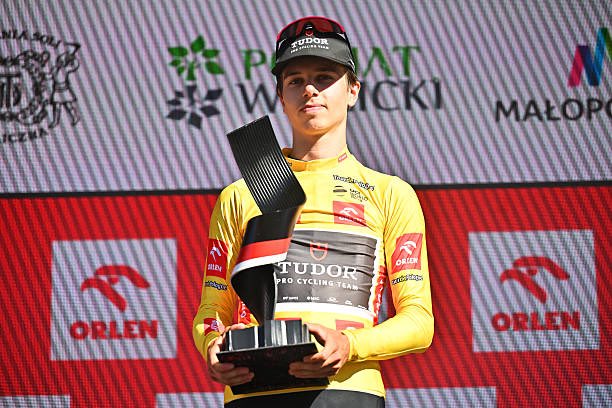
Image: from Eugenio Muñoz Fernández X @eugemf7
By Open Chronicle Cycling
Marco Brenner emerged as the overall winner of the 2026 Tour de Pologne after a dramatic final individual time trial in Wieliczka brought seven days of racing across Poland to a spectacular conclusion.
The 23-year-old German delivered one of the most important performances of his career on the final day, producing a 14:37 ride over the 12.5-kilometre course around the Wieliczka Salt Mine.
It was enough to transform his position in the General Classification and secure the biggest prize of the week.
Brenner did not win a stage.
Instead, the Tudor Pro Cycling Team rider built his victory through consistency, climbing strength and an exceptional final performance against the clock.
The result gave Tudor an extraordinary conclusion to the 83rd edition of Poland’s WorldTour stage race.
Brenner won the General Classification and the points competition, while teammate Stefan Küng won the final time trial.
Así quedó el podio del Tour de Polonia 2026 tras la última etapa: El alemán Marco Brenner (Tudor Pro Cycling) se proclamó vencedor. El podio final fue completado por el británico Finn Fischer-Black (Red Bull-Bora) segundo, y el español Iván Romeo (Movistar) tercero. 📹Eurosport pic.twitter.com/8Zxql5wtXK
— ⚡MazaCiclismo⚡ (@RuedaPedal) August 9, 2026
From the Baltic to Wieliczka
The 2026 Tour de Pologne was constructed around a distinctive north to south journey across Poland.
The race began on 3 August with a demanding 234 kilometre opening stage from Gdynia to Koszalin before travelling progressively south through seven stages.
The opening half provided opportunities across flatter and rolling terrain.
Then the character of the race changed.
Karpacz introduced the first serious mountain examination on Stage 4.
Kocierz Resort followed on Stage 5.
The queen stage around Bukowina Tatrzańska provided another major climbing test on Stage 6.
Finally, there was nowhere left to hide.
The General Classification would be settled through a 12.5 kilometre individual time trial starting and finishing beside the historic Wieliczka Salt Mine.
That final stage ultimately belonged to Tudor.
Marco Brenner opera reviravolta para vencer a Volta à Polónia! 🏆🇵🇱
O contrarrelógio de 12,5 km em Wieliczka decidiu tudo a favor da Tudor Pro Cycling Team, que ganhou a etapa com Stefan Kung e conquistou a classificação geral com Brenner. pic.twitter.com/157yWDSxKZ
— Portuguese Cycling Magazine (@PCMPTMag) August 9, 2026
A Race That Remained Open
One of the defining characteristics of the 2026 Tour de Pologne was the absence of one rider capable of establishing complete control before the final weekend.
The first stages allowed different types of riders to influence the race, while the mountain stages continually reshaped the General Classification.
That uncertainty became increasingly important as the peloton moved south.
Rather than producing an overwhelming favourite, the mountains created a collection of riders separated by relatively small margins.
The eventual champion was among them.
Brenner remained consistently close to the front without needing to dominate individual stages.
That approach became increasingly valuable as the race progressed.
The Mountains Begin to Decide the Race
The fourth stage from Żagań to Karpacz represented the first true mountain examination.
The 175.5 kilometre route gradually climbed towards the difficult finale at Orlinek, with approximately 2,500 metres of elevation gain during the day.
It marked the transition from the opening phase of the Tour de Pologne into the General Classification battle.
But even Karpacz did not provide a definitive hierarchy.
There were still two major climbing stages ahead.
And Brenner continued to position himself for them.
Christen Strikes at Kocierz Resort
Stage 5 from Opole to Kocierz Resort became one of the decisive days of the race.
At 218.9 kilometres, it combined distance with an increasingly difficult finale.
The breakaway was eventually neutralised with approximately four kilometres remaining before a series of attacks transformed the closing kilometres.
Jan Christen made the decisive move.
The UAE Team Emirates XRG rider attacked with around 1.6 kilometres remaining and opened a small advantage.
Behind him, Brenner recognised the danger.
The German launched a powerful counterattack inside the closing hundreds of metres and came remarkably close to catching Christen.
He could not quite reach him.
Christen held on for the stage victory.
But Brenner’s second place became enormously important.
It was one of the performances that kept him within striking distance of overall victory.
The Queen Stage Changes Everything Again
The sixth stage took the riders into the Tatras for the traditional mountain battle between Bukovina Resort and Bukowina Tatrzańska.
Only 126 kilometres long, the stage was packed with climbing.
The peloton repeatedly tackled the BUKOVINA Wall in Gliczarów before another uphill finish.
Louis Barré took the stage victory.
Christian Scaroni emerged as the new race leader.
But the gaps remained close enough to make the final time trial decisive.
For Brenner, the situation was becoming increasingly interesting.
He had survived the mountains.
He had demonstrated his climbing strength.
And one individual race against the clock remained.
Only then did he begin to believe that overall victory was genuinely possible.
Everything Comes Down to Wieliczka
Stage 7 was only 12.5 kilometres.
It decided the Tour de Pologne.
The course started and finished around the Wieliczka Salt Mine, one of Poland’s most recognisable landmarks.
Conditions were excellent.
Sunshine.
Almost no wind.
A pure battle against the clock.
Stefan Küng established the benchmark.
The Swiss time trial specialist completed the course in 14 minutes and 25 seconds, averaging approximately 51.9 km/h.
Finn Fisher Black and Callum Thornley came extraordinarily close.
Both finished just four hundredths of a second behind Küng.
But the biggest story was developing further down the stage classification.
Brenner Produces the Ride of His Life
Brenner completed the course in 14:37.
It gave him seventh place on the stage.
Normally that would represent an excellent but relatively unremarkable result in a WorldTour time trial.
In the context of the General Classification, it changed everything.
Brenner had produced precisely the performance required.
The German moved through the standings and into the Yellow Jersey on the final day.
The Tour de Pologne was his.
Brenner later described the effort as the time trial of his life.
It is difficult to disagree.
He had entered the stage with an opportunity.
Twelve and a half kilometres later, he was a WorldTour stage race winner.
Winning Without Winning a Stage
There is something particularly interesting about the way Brenner won the Tour de Pologne.
He never crossed the finish line first during an individual stage.
Yet he won the race.
That is one of the purest expressions of stage racing.
Overall victories are not necessarily built through spectacular individual triumphs.
They can be constructed through consistency.
Avoiding disastrous days.
Remaining close on the climbs.
Taking seconds when opportunities appear.
Recovering from crashes.
And producing the best performance when the race reaches its decisive moment.
Brenner did exactly that.
His second place behind Christen at Kocierz Resort became particularly important.
So did his ability to remain among the strongest riders through the mountain stages.
Then Wieliczka completed the job.
Tudor’s Perfect Final Day
Brenner’s overall victory would already have made Stage 7 an exceptional day for Tudor Pro Cycling Team.
Küng made it even better.
The Swiss rider’s 14:25 gave Tudor the stage victory.
Brenner’s 14:37 delivered the General Classification.
The team therefore left Wieliczka with both the final stage and the overall title.
For Küng, the victory carried additional personal significance following a difficult period recovering from a serious injury.
For Brenner, it represented confirmation that his combination of climbing and time trial ability can translate into victories at WorldTour level.
Stage 7 Top Five
| Rank | Rider | Team | Time |
|---|---|---|---|
| 1 | Stefan Küng | Tudor Pro Cycling Team | 14:25 |
| 2 | Finn Fisher Black | Red Bull BORA hansgrohe | 14:29 |
| 3 | Callum Thornley | Red Bull BORA hansgrohe | 14:29 |
| 4 | Iván Romeo | Movistar Team | 14:30 |
| 5 | Magnus Sheffield | Netcompany INEOS | 14:34 |
Brenner finished seventh in 14:37, the performance that secured the overall victory.
Brenner Takes Two Classifications
The German did not leave Poland with only the Yellow Jersey.
His consistency across the seven stages also delivered victory in the Lang Team Points Classification.
That double underlined the nature of his performance.
Brenner was not dependent on one exceptional day.
He remained competitive across different types of terrain throughout the week.
General Classification: Marco Brenner
Points Classification: Marco Brenner
Team: Tudor Pro Cycling Team
Calzoni Takes the Mountains
Walter Calzoni of Pinarello Q36.5 Pro Cycling Team finished the race as winner of the PZU mountains classification.
The competition rewarded the riders who accumulated points across the increasingly demanding terrain as the race travelled south.
Calzoni secured the distinctive white jersey with blue polka dots.
Frątczak Named Most Active Rider
Poland also had a classification winner.
Radosław Frątczak of the Polish National Team secured the LOTTO Most Active Rider classification and the Blue Jersey.
Meanwhile, Filip Gruszczyński finished as the highest placed Polish rider in the General Classification.
Gruszczyński completed the race in 25th overall, an encouraging performance against a WorldTour field.
Visma Wins the Team Classification
Team Visma | Lease a Bike completed the race as winner of the team classification.
It provided another illustration of how widely the honours were distributed during the week.
Tudor produced the overall champion and final stage winner.
Brenner won the points classification.
Calzoni took the mountains.
Frątczak won the most active competition.
Visma claimed the team classification.
The 2026 Tour de Pologne produced success across several teams rather than being controlled by one dominant formation.
Final Classification Winners
| Classification | Winner | Team |
| General Classification | Marco Brenner | Tudor Pro Cycling Team |
| Points Classification | Marco Brenner | Tudor Pro Cycling Team |
| Mountains Classification | Walter Calzoni | Pinarello Q36.5 Pro Cycling Team |
| Most Active Rider | Radosław Frątczak | Polish National Team |
| Team Classification | Team Visma | Lease a Bike | |
| Best Polish Rider | Filip Gruszczyński | Polish National Team |
Seven Stages Across Poland
The 83rd edition covered seven competitive days between 3 and 9 August.
Stage 1: Gdynia → Koszalin, 234 km
Stage 2: Międzyzdroje → Szczecin, 151 km
Stage 3: Gorzów Wielkopolski → Zielona Góra, 193.5 km
Stage 4: Żagań → Karpacz, 175.5 km
Stage 5: Opole → Kocierz Resort, approximately 218.9 km
Stage 6: Bukovina Resort → Bukowina Tatrzańska, 126 km
Stage 7: Wieliczka → Wieliczka, 12.5 km individual time trial
The north to south concept gave the race a natural progression.
The opening stages introduced the race across northern Poland.
The central stages gradually increased the difficulty.
The mountains determined who could still win.
The clock decided who actually would.
Race at a Glance
Race: Tour de Pologne
Edition: 83rd
Dates: 3 to 9 August 2026
UCI Classification: 2.UWT
Stages: 7
Overall Winner: Marco Brenner
Winning Team: Tudor Pro Cycling Team
Final Stage Winner: Stefan Küng
Points Winner: Marco Brenner
Mountains Winner: Walter Calzoni
Most Active Rider: Radosław Frątczak
Best Polish Rider: Filip Gruszczyński
Team Classification: Team Visma | Lease a Bike
A Breakthrough WorldTour Victory
For Brenner, the importance of the victory extends beyond one week in Poland.
Stage races reward completeness.
A rider must climb.
He must position himself correctly.
He must survive unpredictable days.
He must recover.
And when a time trial arrives, he may need to produce something exceptional.
Brenner did all of those things.
He came close to a stage victory at Kocierz Resort.
He survived the decisive mountain stages.
He entered Wieliczka with a chance.
Then he produced the performance that converted possibility into victory.
There was no stage win beside his name.
There did not need to be.
Marco Brenner left Poland wearing yellow.
Poland Delivers a Race to the Final Kilometres
The 2026 edition also demonstrated why the Tour de Pologne occupies an important position on the WorldTour calendar.
The race moved from the Baltic coast through central Poland and eventually into the mountains before finishing at Wieliczka.
Different terrain produced different protagonists.
The leadership remained uncertain.
And the final winner was not known until the last riders had completed the final time trial.
That is exactly what a one week stage race is designed to produce.
Seven days.
Several leaders.
Mountains.
Sprints.
Attacks.
A final race against the clock.
And one rider who put all the pieces together better than anyone else.
Marco Brenner is the winner of the 2026 Tour de Pologne.