
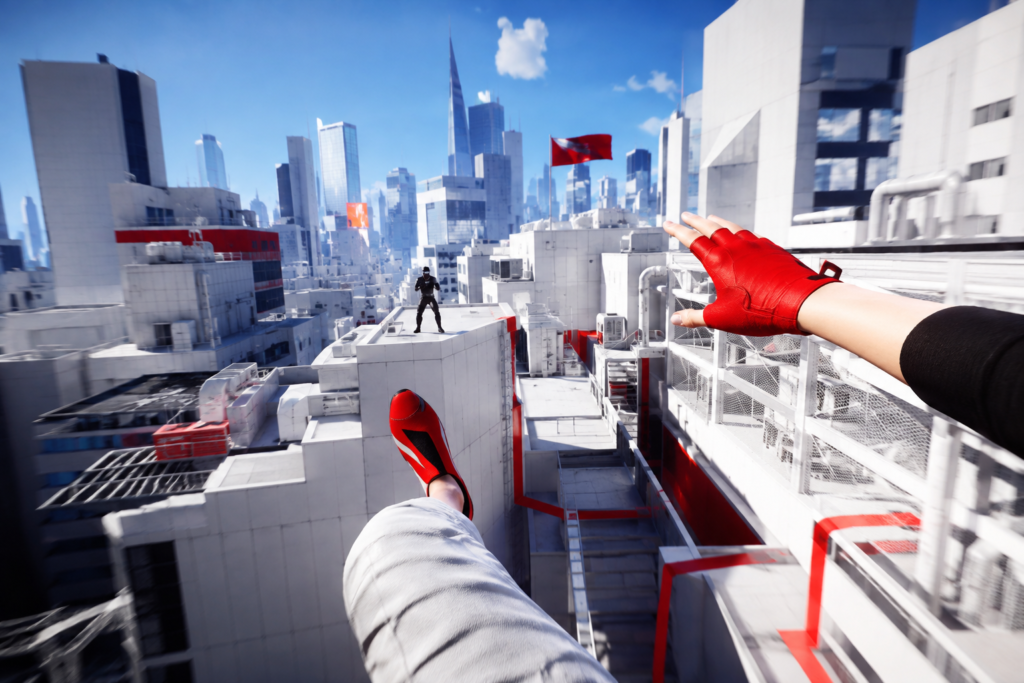
Image Credits: Mirror’s Edge Gets a Surprise Update 18 Years After Its Original Release. AI-generated illustration created by Open Chronicle using ChatGPT (OpenAI). August 2026. This image is illustrative and does not depict a real-world scene.
By Open Chronicle Technology
Eighteen years after players first raced across the gleaming rooftops of a dystopian city as Faith Connors, Mirror’s Edge has unexpectedly received a new update.
The 2008 cult classic developed by DICE and published by Electronic Arts has been updated on Steam, bringing proper support for Valve’s Steam Deck and earning the game Steam Deck Verified status.
It is a small technical update, but a remarkable development for a game approaching its second decade and belonging to a franchise that has effectively been dormant since Mirror’s Edge Catalyst arrived in 2016.
The update also offers longtime fans another reason to revisit one of the most visually distinctive and unconventional games of its generation.
An unexpected return for a 2008 classic
Mirror’s Edge originally launched in 2008 for PlayStation 3 and Xbox 360 before reaching PC.
It arrived during an extraordinary year for video games. Major releases included Grand Theft Auto IV, Fallout 3, Metal Gear Solid 4, Dead Space, Left 4 Dead, Gears of War 2, Persona 4 and LittleBigPlanet.
Against that competition, Mirror’s Edge nevertheless managed to establish an identity entirely its own.
Rather than relying on the conventional shooting mechanics that dominated first-person games, DICE built the experience around movement.
Players controlled Faith Connors, a Runner who transported information across a heavily monitored city. Rooftops became pathways as Faith sprinted, jumped, slid, climbed and vaulted through environments designed around maintaining momentum.
The first-person perspective made those movements unusually immersive.
Steam Deck Verified after 18 years
The new update gives the PC version proper Steam Deck support.
More importantly, the game has now received Valve’s Steam Deck Verified designation.
The classification indicates that Valve has tested the title and determined that it provides an appropriate experience on the handheld, including compatibility across the game rather than simply the ability to launch it.
That gives Mirror’s Edge a new opportunity to reach players on contemporary hardware long after the PlayStation 3 and Xbox 360 generation for which it was originally designed.
The timing is particularly surprising because there has been little significant activity surrounding the franchise in recent years.
DICE stepped outside Battlefield
Mirror’s Edge was unusual within the history of DICE.
The Swedish studio is primarily associated with large-scale shooters, particularly the Battlefield franchise, and later worked extensively on Star Wars Battlefront.
Mirror’s Edge demonstrated a very different side of the developer.
Combat existed, but movement was the defining mechanic. Players were frequently encouraged to avoid confrontations entirely and use speed, positioning and parkour to escape enemies.
That philosophy gave the game a character that remains difficult to compare directly with other major releases.
A visual identity that has aged remarkably well
The game’s art direction was equally distinctive.
Instead of filling its dystopian city with darkness and industrial decay, DICE created an almost unnaturally clean urban environment.
White buildings dominated the landscape, punctuated by intense reds, blues, greens and yellows.
Colour was not merely decorative. It frequently guided players through environments, helping them identify routes and interactive objects without covering the screen with conventional navigation markers.
That minimalist approach is one reason Mirror’s Edge continues to look surprisingly modern.
Technical details inevitably reveal its age, but its strong visual direction has proved far more durable than many games built around the graphical conventions of the late 2000s.
Faith became a memorable gaming protagonist
Faith Connors also became one of the most recognisable protagonists introduced during that generation.
She was not presented as a heavily armed super soldier. Her principal advantages were agility, knowledge of the city, and the ability to keep moving.
That helped reinforce the game’s broader philosophy.
The player was not meant to dominate every environment through overwhelming firepower. Survival often depended on recognising a route and executing it quickly enough to escape.
The result was a protagonist and gameplay system closely connected.
A franchise that never reached its full potential
Despite its originality, Mirror’s Edge never developed into the major franchise some players expected.
The first game sold several million copies and earned generally positive critical reviews. ComicBook notes that it holds an 81 Metacritic score and, as of its report, an 86 percent positive user rating on Steam.
DICE eventually returned to the concept with Mirror’s Edge Catalyst in 2016.
Rather than functioning as a straightforward sequel, Catalyst reimagined Faith’s story and expanded the concept into a more open environment.
The game offered larger spaces for traversal and significantly refined movement mechanics, but it did not generate the critical or commercial momentum necessary to turn Mirror’s Edge into a continuing series.
No new instalment has followed.
By 2026, the franchise has been inactive for approximately a decade.
Why the original still matters
The enduring reputation of Mirror’s Edge comes partly from how unusual it remains.
Parkour mechanics have subsequently appeared across numerous franchises, but few major games have made first-person movement the centre of the entire experience in the same way.
The game also anticipated broader changes in game design.
Fluid traversal became increasingly important during subsequent generations. Developers began treating movement itself as a source of entertainment rather than simply the mechanism used to travel between combat encounters.
Mirror’s Edge was already exploring that idea in 2008.
Its environments were essentially three-dimensional obstacle courses designed around rhythm, momentum, and rapid decision-making.
When everything worked correctly, running through the city became the game.
The Steam Deck is a natural home for older PC games
The update also demonstrates another important aspect of modern PC gaming.
Valve’s Steam Deck has given thousands of older titles a new context.
Games originally designed for desktop computers can now function as portable experiences without requiring publishers to develop entirely new console versions.
For older games with modest hardware requirements, the platform can be particularly effective.
Official verification also removes some uncertainty for players who might otherwise need to experiment with settings or community fixes.
For a game released eighteen years ago, receiving that level of contemporary hardware compatibility is notable.
Does the update mean Mirror’s Edge is returning?
Fans will inevitably wonder whether renewed attention to the original game signals something larger.
At present, there is no evidence in the reported update that it represents the beginning of a new Mirror’s Edge project.
Steam Deck support should therefore not be interpreted as confirmation of a sequel, reboot or remaster.
The franchise remains dormant.
Nevertheless, keeping the original game accessible is significant because preservation has become an increasingly important issue across the games industry.
Older titles frequently become difficult to purchase or run as hardware, operating systems, and digital storefronts change.
Updating an eighteen-year-old game to work properly on a modern platform moves in the opposite direction.
A glimpse of what made 2008 special
The update also arrives at a moment when many of the games released in 2008 are increasingly being viewed as classics.
It was a remarkable period of experimentation.
Large publishers were willing to introduce expensive new intellectual properties alongside established franchises, producing games such as Dead Space and Mirror’s Edge that attempted to build completely new audiences.
Not all of those experiments became permanent franchises.
Some, however, became influential precisely because they were different.
Mirror’s Edge belongs to that category.
Its sterile city, first-person parkour, and emphasis on uninterrupted movement still give it an identity that feels remarkably distinct eighteen years later.
An old game with a surprisingly modern future
The new Steam update does not revive Mirror’s Edge as a franchise.
It does something simpler.
It makes the original easier to play on one of today’s most important PC gaming devices.
For longtime players, that provides another opportunity to return to Faith’s rooftops.
For younger players who never experienced the game during the PlayStation 3 and Xbox 360 era, Steam Deck verification makes an influential piece of gaming history more accessible.
Eighteen years after its release, Mirror’s Edge remains a reminder that technological age and creative age are not necessarily the same thing.
Its graphics may belong to another generation and its franchise may have been silent for a decade, but the central idea still feels unusually fresh: see a rooftop, find a route and never stop running.