
World | Africa | Politics & Security
By Open Chronicle with agencies
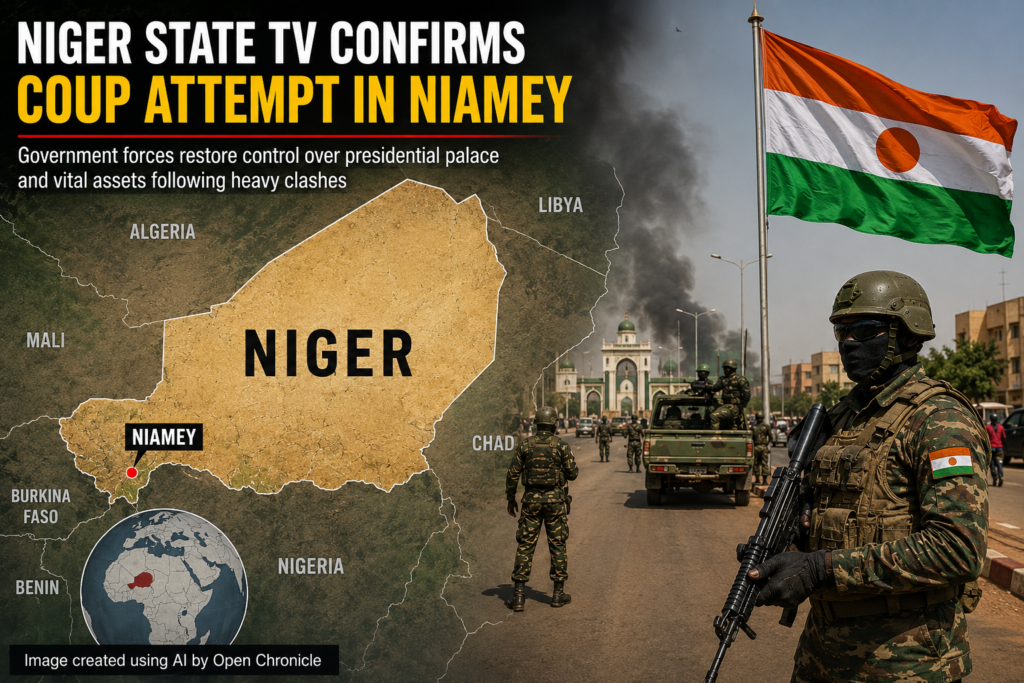
Nigerien authorities said government forces had restored control over key institutions in the capital Niamey on Saturday after rebel soldiers launched an attempted military coup, triggering heavy fighting around the presidential palace and the city’s international airport.
State television confirmed the attempted takeover, while Defence Minister Salifou Modi said loyalist defence and security forces had intervened rapidly to repel the assault and secure strategic government installations.
Authorities urged residents to remain calm as security forces continued operations across parts of the capital to locate remaining insurgents and restore full security.
🔴 Heavy gunfire and explosions erupted across Niamey overnight, including near the Presidential Palace, airport, and Air Force Base 101.
• Niger’s government claims mutinous soldiers are behind the attack and that forces are gradually regaining control.pic.twitter.com/6yIjTiNCtd— Open Source Intelligence (@osint42) August 29, 2026
Fighting Erupts Around Strategic Sites
The attempted coup involved heavy gunfire and explosions around several strategically important locations in Niamey.
Clashes were reported near Diori Hamani International Airport and around the outer perimeter of the presidential palace, suggesting that the soldiers behind the uprising had sought to seize infrastructure essential to controlling the capital.
State radio and television broadcasts were also briefly disrupted during the unrest. Loyalist forces subsequently regained control of broadcasting facilities, allowing the government to communicate publicly about the situation.
Military units established a security perimeter around the international airport as operations continued against what authorities described as remaining pockets of resistance.
The extent of casualties or damage resulting from the fighting was not immediately clear.
New Challenge to Tiani’s Government
The attempted coup represents a serious challenge to the military government headed by General Abdourahamane Tiani.
Tiani emerged as Niger’s leader following the July 2023 coup that removed President Mohamed Bazoum. Since then, the military authorities have sought to consolidate their control while fundamentally reshaping Niger’s foreign and security relationships.
Saturday’s events suggest that tensions may remain within elements of the country’s security establishment despite three years of military rule.
The ability of loyalist forces to rapidly regain control of the presidential palace, broadcasting infrastructure and other strategic facilities could prove crucial to preventing the uprising from developing into a broader confrontation.
Niger Already Faces Major Security Pressures
The unrest comes as Niger continues to confront armed groups operating across parts of the Sahel.
Militants affiliated with both Al Qaeda and Islamic State have remained active in areas near Niger’s borders, placing significant pressure on the country’s armed forces and exposing communities outside the capital to persistent insecurity.
That broader security environment makes instability within the military itself particularly significant. Niger’s armed forces are simultaneously responsible for maintaining political authority in Niamey and conducting counterinsurgency operations across large areas of the country.
Any prolonged division within the security establishment could therefore have consequences extending well beyond the capital.
Political Stability Back in Focus
Although authorities said the immediate assault had been defeated, the attempted coup raises new questions about the cohesion of Niger’s military leadership and the durability of the political system established after the 2023 takeover.
Security operations in Niamey are likely to remain closely watched in the coming hours, particularly for signs of further arrests, military defections or additional confrontations.
For General Tiani’s government, restoring physical control of the capital is only the immediate challenge. Determining who organised the uprising, how extensive the network behind it was and whether divisions remain inside the armed forces could ultimately prove more important for Niger’s political future.