
By Open Chronicle Newsdesk with agencies
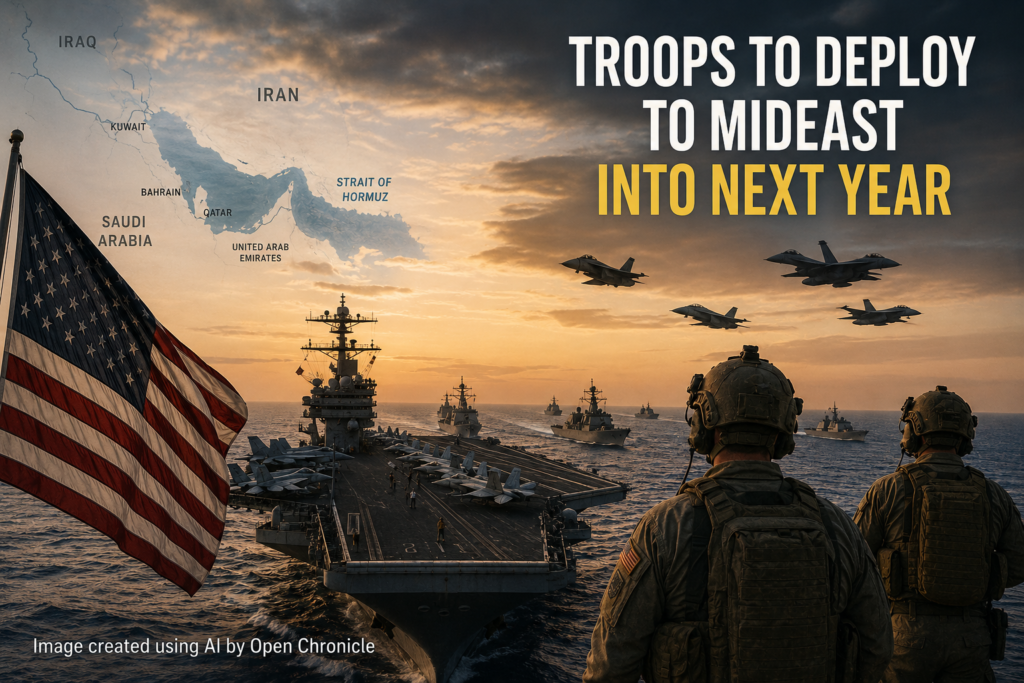
The United States is extending military deployments across the Middle East as the Pentagon prepares for the possibility that the war with Iran could continue well into next year, increasing pressure on troops, warships and military equipment after six months of sustained operations.
Around 50,000 US military personnel are currently deployed across the region alongside 19 warships, fighter aircraft, air defence units and elements of the Army’s airborne forces, according to people familiar with the deployments cited by The Wall Street Journal.
Several units that initially expected shorter assignments are now being told to remain in the Middle East for longer periods. Some Army air defence deployments have reportedly been extended from nine months to 12 months, while elements of the 82nd Airborne Division could remain in the region into 2027.
The expanding timetable contrasts with expectations at the beginning of the conflict that Washington could conduct a relatively rapid and decisive campaign against Iran.
Instead, the Pentagon is maintaining a large military presence intended to give President Donald Trump options ranging from continued defensive operations and economic pressure to a potentially broader military offensive.
50,000 US troops remain in the region
American forces are currently performing several missions simultaneously.
Air defence units are intercepting Iranian ballistic missiles and drones, while US naval forces are protecting commercial shipping around the Strait of Hormuz and enforcing Washington’s blockade of Iranian ports and coastal areas.
At the same time, fighter aircraft, naval strike groups and ground forces remain positioned to support additional offensive operations should Trump authorize them.
Maintaining that range of options requires tens of thousands of personnel and significant quantities of increasingly scarce military equipment.
The Pentagon has consequently extended some deployments and redirected units originally intended for assignments elsewhere.
Some formations diverted to the Middle East from planned deployments in Europe and the Pacific have already spent more than a year away from their normal bases.
Air defence forces face mounting pressure
Army air defence units are among those experiencing the greatest operational strain.
These formations have been heavily involved in intercepting Iranian missiles and drones targeting American forces and regional installations.
Standard nine month deployments for some units have reportedly been extended to 12 months.
The pressure comes at a time when the United States is attempting to balance air and missile defence requirements across several theatres, including Europe and the Indo Pacific.
Sustained missile warfare in the Middle East has increased both operational demands and the consumption of expensive interceptor missiles.
The challenge is therefore not limited to keeping personnel deployed. The Pentagon must also maintain radar systems, launchers, interceptor inventories and the logistics networks required to keep them operational.
US Navy maintains 19 warships
The naval commitment is equally substantial.
The United States currently has 19 warships operating in the region, including two aircraft carriers and 13 guided missile destroyers, according to a Navy official cited in the report.
Several destroyers deployed during the opening phase of the war remain involved in enforcing the blockade.
Among them are USS Delbert D. Black and USS Spruance, each carrying crews of roughly 300 sailors.
Instead of receiving regular breaks after approximately a month at sea, some ships are remaining underway for several months at a time.
The tempo is contributing to some of the longest US Navy deployments in decades.
Aircraft carrier deployments lengthen
The aircraft carrier fleet has been particularly affected.
USS Gerald R. Ford returned home in May after approximately 11 months at sea, making its deployment the longest by a US aircraft carrier since the collapse of the Soviet Union.
USS Abraham Lincoln is also returning home following an unusually long deployment.
Attention is now shifting towards USS Theodore Roosevelt, which is preparing for what could become another extended deployment.
Navy officials have indicated that the carrier could eventually be sent to the Middle East, although its final destination has not been officially announced.
Should Theodore Roosevelt join operations connected with Iran, the carrier could remain in the region into the spring.
The pattern demonstrates how sustaining a major naval presence over many months can place pressure not only on individual crews but on the wider carrier rotation system.
Logistics becoming increasingly difficult
The conflict is also complicating the Navy’s ability to supply its vessels.
Operational conditions around the Middle East have reduced opportunities for conventional resupply and port visits, forcing the Navy to rely more heavily on Diego Garcia, the joint US and British military facility in the Indian Ocean.
For sailors, the consequences include fewer opportunities to leave their ships as well as disruptions to mail and care packages.
There are longer term consequences too.
Warships operating continuously at high tempo accumulate maintenance requirements that eventually have to be addressed in shipyards.
Analysts warn that the current deployments could therefore produce maintenance backlogs lasting years, potentially reducing the number of vessels available for operations elsewhere.
82nd Airborne could remain into 2027
The Army is also preparing some families for longer deployments.
Elements of the 82nd Airborne Division could remain in the Middle East well into 2027, according to a letter military commanders sent to relatives of deployed personnel.
“We do not share that lightly, and we understand that a longer tour weighs heavily on every household, including our own,” the letter said.
Extended deployments can affect retention, training cycles and military families, particularly when units were initially prepared for shorter assignments.
They also complicate Pentagon planning because personnel and equipment committed to the Middle East cannot simultaneously fulfil requirements in Europe or the Pacific.
Trump considers whether to declare the war over
The military preparations come as Trump appears to be considering a different political direction.
US officials say the president has privately discussed with senior advisers whether he should declare the war over and increasingly emphasize economic pressure on Tehran.
Trump has suggested that Iran’s deteriorating economic situation could eventually force its leadership to dismantle the country’s nuclear programme or contribute to internal political upheaval.
“I like our position now much better, with almost total control of the Hormuz Strait, and their economy totally collapsing,” Trump wrote on social media.
He subsequently questioned when Iranians would “rise up and fight”.
Iran, however, has shown little indication that it intends to capitulate.
American and Iranian forces continue to exchange fire as both countries contest the security environment surrounding the Strait of Hormuz.
Pentagon maintains options for further escalation
Even while Trump considers presenting the conflict as effectively concluded, military planners are maintaining forces capable of rapidly escalating operations.
The president was reportedly briefed last month on additional military options.
Those possibilities included expanded air strikes, operations involving US ground forces to seize Iranian islands near the Strait of Hormuz and an attack against a fortified location known as Pickaxe Mountain that American officials suspect could support covert nuclear activity.
Whether any of those operations will be authorized remains uncertain.
Their existence nevertheless helps explain why the Pentagon is reluctant to reduce its regional military presence.
Removing aircraft, ships, air defence systems and ground forces would limit the president’s ability to escalate quickly should diplomacy or economic pressure fail.
A short war becomes a long military commitment
The expanding deployment schedule illustrates one of the central problems now confronting Washington.
The United States can attempt to reduce direct combat operations while still remaining militarily committed to containing Iran, protecting regional bases, defending shipping and enforcing the blockade.
That posture could persist even if Trump formally declares the main phase of the war complete.
It also carries strategic costs.
Every destroyer operating around Iran is unavailable for another mission. Every air defence battery committed to protecting Middle Eastern bases cannot simultaneously reinforce Europe or the Indo Pacific. Every extended deployment increases pressure on personnel, equipment and military families.
Six months after the war began, the Pentagon is therefore preparing not simply for another round of strikes, but for the possibility of a prolonged military commitment whose effects could extend far beyond the Middle East.
The increasingly important question for Washington is no longer only how the war with Iran ends.
It is how long the United States can sustain the enormous military presence required to keep all of its options open.