
By Open Chronicle with agencies
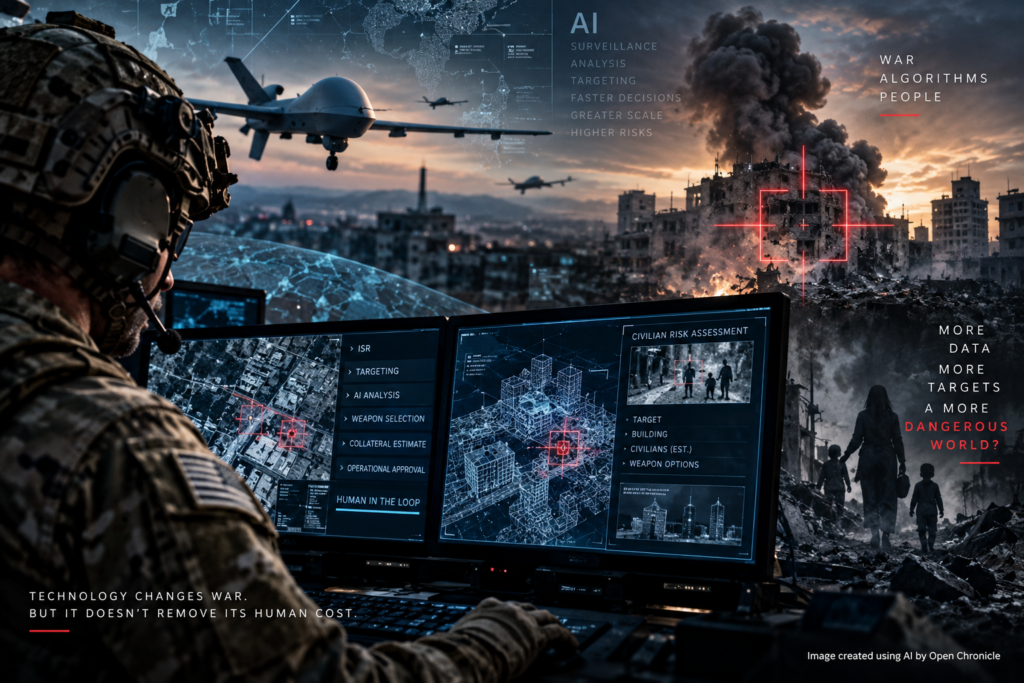
Artificial intelligence is becoming embedded in the machinery of modern warfare, promising faster intelligence analysis, more precise targeting and, according to its strongest advocates, fewer civilian casualties.
But as AI-assisted military operations move from experimentation to real battlefields, that promise is facing growing scrutiny.
At a congressional hearing in Washington on September 16, experts in artificial intelligence, human rights and military affairs questioned whether there is sufficient evidence that AI-enabled targeting actually reduces civilian harm. The hearing, convened by the Tom Lantos Human Rights Commission, examined the implications of increasingly powerful decision-support and autonomous technologies for warfare and human rights.
The debate has acquired new urgency because these systems are no longer theoretical. The United States has used Palantir’s Maven Smart System extensively during its 2026 military campaign against Iran, with AI helping military personnel process intelligence, identify potential targets and select weapons.
According to an April White House accounting cited by Arms Control Today, U.S. forces struck more than 13,000 targets during the first 38 days of the Iran campaign. Maven played an important role in analysing information and supporting targeting decisions.
The extraordinary scale and speed of those operations have brought a fundamental question to the forefront: does AI make warfare more precise, or does it simply allow militaries to conduct far more strikes in far less time?
The promise of fewer civilian casualties
Supporters of military AI have repeatedly argued that technology can improve the precision of military operations.
Palantir CEO Alex Karp made that case publicly in 2024, arguing that technological improvements should dramatically reduce civilian casualties and collateral damage.
The reasoning appears straightforward. If an artificial intelligence system can analyse satellite imagery, surveillance feeds, signals intelligence and other information faster than a human team, military commanders could potentially identify targets more accurately and avoid mistakes.
AI could also calculate expected blast effects, identify nearby civilian infrastructure, recommend different weapons and continuously update intelligence as conditions change.
Representative Jim McGovern, Democratic co-chair of the Tom Lantos Human Rights Commission, summarised the argument during Wednesday’s hearing: the U.S. government has maintained that AI could improve assessments of military operations and reduce risks to civilians.
But several witnesses challenged the assumption that greater technological accuracy necessarily produces fewer civilian deaths.
Precision is not the same as civilian protection
Steven Feldstein, director and senior fellow at the Carnegie Endowment for International Peace, questioned claims about the accuracy of military AI systems.
Some systems have been described as achieving accuracy levels approaching 90 percent. Feldstein argued that real-world performance can be substantially lower and, more importantly, that technical accuracy alone does not determine civilian casualties.
The distinction is crucial.
An AI system might become significantly better at locating an intended target while simultaneously enabling a military to identify and attack vastly more targets.
“Even if there is more accuracy, because the number of targets is so much vaster, the ultimate number of civilians harmed is likely far higher as well,” Feldstein told lawmakers, according to the material provided to Open Chronicle.
That concern is particularly relevant to the speed at which modern AI systems can process battlefield information.
Carnegie researchers reported in August that computer vision used within Maven helped increase targeting processes from fewer than 100 per day to around 1,000. After Anthropic’s Claude was integrated into the system to streamline operators’ workflows, that figure reportedly rose as high as 5,000.
The potential transformation is therefore not simply from inaccurate targeting to accurate targeting. It is also from human-scale targeting processes toward industrial-scale data processing capable of generating thousands of potential targets.
Palantir’s Maven moves to the centre of the debate
Project Maven began in 2017 as a Pentagon effort to use machine learning to analyse the enormous quantities of imagery generated by military surveillance systems.
The technology has since evolved considerably.
Palantir’s Maven Smart System now functions as a broader intelligence and decision-support platform, combining information from different sources and helping military personnel organise, prioritise and interpret battlefield data.
During the Iran campaign, senior U.S. officials said Maven was used to identify priority targets and assist in determining which weapons should be employed against them.
That does not mean an AI system independently decided to launch individual attacks. Human personnel remain involved in targeting and strike decisions.
But witnesses before Congress warned that retaining a human formally inside the decision chain does not automatically resolve the problem.
As AI dramatically accelerates intelligence processing, military personnel may have increasingly limited time to independently verify recommendations before acting. The concern is that human approval could become procedural rather than genuinely deliberative when thousands of possible targets are moving through a system at high speed.
The Minab school strike raises difficult questions
One incident has become particularly important in the debate.
On February 28, an attack struck the Shajareh Tayyebeh Primary School in Minab, Iran. More than 170 people were reported killed, most of them students.
Arms Control Today reported that a U.S. investigation determined American forces were responsible for the strike, citing reporting based on U.S. officials.
The incident has generated questions among lawmakers about whether AI-assisted targeting played any role in the process leading to the attack.
The available public evidence does not establish that Maven selected the school as a target or independently caused the strike, and responsibility for a military targeting decision cannot be assigned to an AI platform merely because that technology was being used in the broader campaign.
Nevertheless, the episode illustrates the accountability problem surrounding AI-assisted warfare.
If an algorithm contributes to identifying a target, another system evaluates intelligence, software recommends a weapon and a human ultimately authorises the strike, determining where responsibility lies when something goes catastrophically wrong can become increasingly complicated.
Gaza provides another warning
Experts at the congressional hearing also pointed to Israel’s experience in Gaza.
Israeli forces have used AI-assisted systems including Lavender, which has been reported to help identify suspected militants. The Israeli military has disputed some published descriptions of how these systems operate and has maintained that analysts conduct independent examinations before strikes are approved.
Reporting by The Guardian in 2024 described Lavender as having identified approximately 37,000 Palestinians as suspected militants at one stage of the Gaza conflict.
According to that reporting, intelligence sources described significant pressure to generate additional targets and said tolerance levels for civilian casualties varied depending on the perceived importance of the intended target.
That illustrates another fundamental limitation of artificial intelligence.
An algorithm does not independently establish the moral or legal framework governing military operations.
Humans do.
AI follows the rules humans give it
Even a highly accurate system can operate within rules of engagement that tolerate substantial civilian casualties.
Feldstein illustrated the problem during the hearing by describing a hypothetical policy under which military commanders considered the deaths of five civilians acceptable for every suspected target.
An AI system optimising operations within those parameters would not necessarily reduce civilian harm. It could instead make the implementation of that policy faster and more efficient.
The same problem applies to proportionality.
Amanda Klasing, national director of government relations and advocacy at Amnesty International USA and one of the congressional witnesses, argued that extraordinary targeting accuracy cannot by itself resolve questions about the scale of force used against a target.
A system might correctly identify someone inside a residential building, for example, while the decision to attack that building with a large explosive weapon could still expose civilians to significant danger.
AI can potentially improve information. It cannot eliminate the legal and human judgement required to decide whether an attack should occur.
Human Rights Watch calls for meaningful human control
Deborah Brown, deputy director for technology and human rights at Human Rights Watch, told Congress that military AI raises concerns extending from targeting and accountability to privacy, discrimination and the fundamental right to life.
Human Rights Watch distinguishes between fully autonomous weapons, which can select and engage targets without human intervention, and AI decision-support systems that provide information used by humans to make targeting decisions.
Both can present risks.
Brown called for meaningful human control over military AI and argued that systems influencing the use of force should be predictable, reliable, explainable and traceable.
She also urged Congress to demand greater transparency about how the U.S. military uses artificial intelligence in targeting operations.
That transparency remains limited in part because many military AI systems and the data used to evaluate them are classified.
The Pentagon therefore possesses substantially more information about the performance of its systems than independent researchers, journalists or the public.
That creates another problem for claims that AI is reducing civilian casualties: outsiders often lack the evidence needed to independently test them.
Pentagon civilian protection capacity faces pressure
The debate is unfolding as the Pentagon’s institutional infrastructure for civilian protection has undergone significant reductions.
The Civilian Protection Center of Excellence exists under U.S. law as the Defense Department’s focal point for preventing, mitigating, tracking and responding to civilian harm from American military operations.
Its staffing has fallen sharply.
Reporting and Pentagon oversight findings cited by Stars and Stripes indicated that the center’s workforce declined from roughly 40 personnel to nine. A Defense Department inspector general investigation also found reductions in staffing and funding associated with congressionally mandated civilian-harm mitigation efforts.
The contrast is significant.
As the Pentagon invests heavily in technologies capable of dramatically accelerating targeting and battlefield decision-making, its specialised capacity for studying and mitigating civilian harm has contracted.
The speed problem
Perhaps the most consequential change brought by artificial intelligence is not autonomy itself.
It is speed.
Military AI can ingest enormous quantities of satellite imagery, drone feeds, communications intelligence, radar information and battlefield reports and transform them into recommendations faster than teams of human analysts.
That capability has obvious military advantages.
A mobile missile launcher detected by surveillance might disappear within minutes. A drone operator may have seconds to respond to a threat. Commanders facing hundreds of simultaneous signals need tools capable of identifying which ones matter.
But increasing speed can create a paradox.
The more rapidly AI produces recommendations, the harder it may become for humans to scrutinise each one.
Witnesses at the September 16 congressional hearing warned that AI-assisted targeting could eventually move faster than humans can meaningfully authenticate the information behind recommendations.
The critical question is therefore not simply whether a human remains “in the loop.”
It is whether that human has enough information, authority and time to challenge what the machine recommends.
A technological revolution without a settled answer
There is no simple evidence that artificial intelligence inevitably increases civilian casualties.
Nor does the evidence currently available establish that military AI inevitably makes warfare safer.
AI can potentially improve surveillance, recognise objects faster, detect patterns invisible to human analysts and provide commanders with information that prevents mistakes.
The same technology can also dramatically increase the number of targets a military can process and compress the time available for human deliberation.
The congressional hearing exposed the central tension surrounding AI warfare.
Technology companies and military planners see artificial intelligence as a way to make battlefield decisions faster and potentially more precise. Human rights specialists warn that precision alone is not civilian protection, particularly when the technology enables military forces to expand the scale and tempo of operations.
The question confronting governments is therefore becoming less about whether artificial intelligence will enter warfare. It already has.
The more difficult question is whether the rules, oversight mechanisms and human judgement surrounding these systems can evolve as quickly as the technology itself.