
By Open Chronicle with agencies
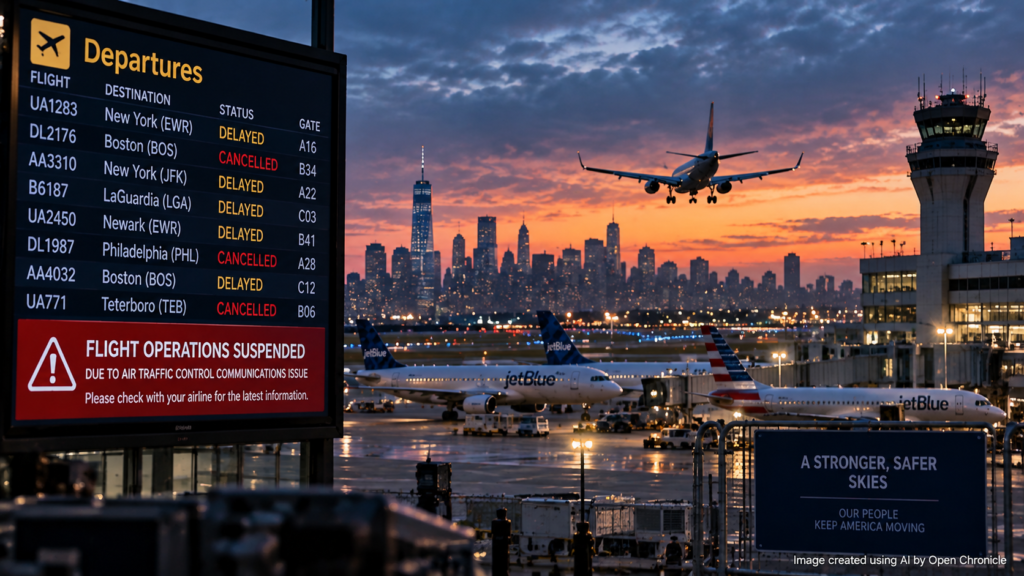
A major air traffic control communications failure disrupted flights across several of the busiest airports on the United States East Coast on Monday, September 21, prompting the Federal Aviation Administration (FAA) to suspend operations at key aviation hubs in New York, Boston and New Jersey.
The disruption affected John F. Kennedy International Airport and LaGuardia Airport in New York, Boston Logan International Airport in Massachusetts, and Teterboro Airport in New Jersey. Newark Liberty International Airport and Philadelphia International Airport also experienced significant operational difficulties.
According to the FAA, the disruption was linked to a damaged fibre optic cable in New Jersey, which reportedly caused a communications failure affecting air traffic control systems.
The incident comes as approximately 130 world leaders are arriving in New York for the United Nations General Assembly, adding pressure to an already busy period for air travel in the region.
Damaged fibre optic cable disrupts air traffic control
The FAA said the communications problem was believed to have originated when a fibre optic cable was accidentally severed at a construction site in New Jersey.
The failure affected critical communications infrastructure used by air traffic controllers, forcing aviation authorities to impose temporary restrictions while engineers worked to restore the affected systems.
FAA Administrator Bryan Bedford confirmed that the agency was working to establish a replacement communications circuit but did not provide a definitive timetable for lifting the restrictions.
The situation became more complicated when technicians discovered that the backup communications system had also been damaged.
According to Bedford, the agency initially attempted to switch to its backup infrastructure but found that the reserve fibre optic connection was unavailable.
Repairs to the damaged backup cable were expected to take approximately 13 hours.
Bedford described the situation as a major technical failure, adding that a new communications circuit was ready to be installed.
The FAA said normal arrival operations would not resume at affected airports until officials were satisfied that the airspace could be operated safely.
Thousands of flights delayed or cancelled
The communications failure caused widespread disruption across the American aviation network, with thousands of passengers facing delays, cancellations and unexpected changes to their travel plans.
Several aircraft were diverted to alternative airports as air traffic controllers worked to manage the restrictions and maintain safe separation between flights.
According to flight tracking service Flightradar24, Newark Liberty International Airport experienced average delays of approximately 112 minutes during the disruption.
More than 1,000 flights at Newark were reported delayed or cancelled.
Across the United States, nearly 4,000 flights experienced delays, while approximately 500 were cancelled, according to the figures available during the incident.
The disruption extended beyond the airports directly affected by the communications failure, as aircraft and flight crews were unable to operate according to their original schedules.
Delays at major aviation hubs can affect connecting flights and subsequent departures at airports throughout the country, even after the initial technical problem has been resolved.
UN General Assembly adds pressure to New York airports
The timing of the incident presents an additional challenge for aviation authorities as New York prepares to host the annual high level meetings of the United Nations General Assembly.
Approximately 130 world leaders are expected to arrive in the city for the diplomatic gathering, accompanied by government delegations, security personnel and international media representatives.
The event traditionally places additional demands on New York’s airports and surrounding airspace because of the arrival of official aircraft and the security arrangements associated with visiting heads of state and government.
The communications failure has introduced further uncertainty into an already complex period for air traffic management.
Authorities have not indicated whether the disruption has directly affected the arrival schedules of individual world leaders or their delegations.
FAA prioritises safety before restoring operations
The FAA has emphasised that restoring communications infrastructure is essential before normal flight operations can resume.
Bedford said the agency would not restart the affected arrival systems until officials were confident that the airspace was safe.
The administrator explained that engineers were preparing to install a replacement communications circuit after discovering the damage to both the primary and backup fibre optic connections.
Although the new circuit was reportedly ready for installation, the FAA had not announced when all restrictions would be lifted.
The incident highlights the operational dependence of modern aviation on reliable communications infrastructure and the difficulties that can arise when primary and backup systems become unavailable simultaneously.
For passengers travelling through the affected airports, the disruption could continue to affect flight schedules even after the technical failure is resolved, as airlines work to reposition aircraft and crews and accommodate travellers whose journeys have been interrupted.
Passengers are advised to check directly with their airlines and consult official FAA airport status information before travelling.
The FAA continues to work on restoring normal operations across the affected airports.
This is a developing story. Information about flight restrictions, delays and cancellations may change as operations are restored.