
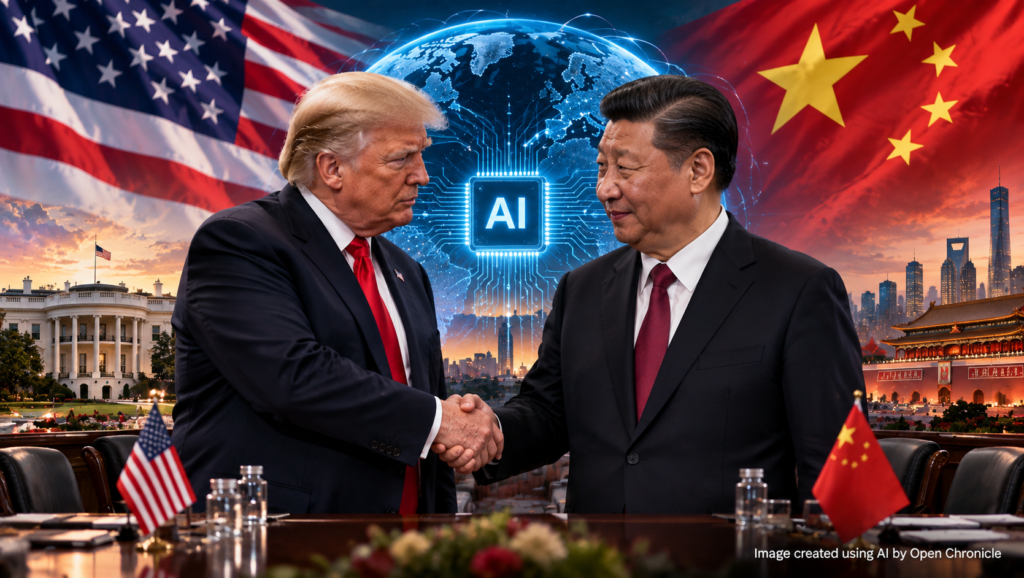
Washington says the United States and China will establish a bilateral channel for handling artificial intelligence incidents, one of the clearest practical outcomes of President Donald Trump and President Xi Jinping’s three day summit. The two governments also extended their trade truce and committed to further high level talks later this year.
By Open Chronicle with agencies | September 26, 2026
WASHINGTON, The United States and China have agreed to establish a bilateral communication channel for artificial intelligence incidents following three days of talks between President Donald Trump and Chinese President Xi Jinping in Washington.
The White House announced the agreement on Friday after a state visit that covered artificial intelligence, trade, Taiwan, the Middle East, Ukraine, the Korean Peninsula and the war in Iran.
The new mechanism represents one of the more concrete outcomes of a summit that otherwise produced limited major breakthroughs between the world’s two largest economies.
There was no immediate public response from Beijing to the White House announcement concerning the AI channel.
The two leaders also confirmed plans for further meetings this year, maintaining direct presidential dialogue despite continuing disagreements between Washington and Beijing.
A direct channel for AI incidents
Details about exactly how the bilateral AI communication channel will operate were not immediately provided.
The agreement nevertheless signals that Washington and Beijing increasingly regard artificial intelligence as an area where strategic competition needs mechanisms capable of preventing misunderstandings or unintended escalation.
Both countries are investing heavily in advanced AI systems while competing over semiconductors, computing infrastructure, research and the development of increasingly capable models.
Xi presented artificial intelligence as an area where the two powers have responsibilities extending beyond their national competition.
Describing China and the United States as leading nations in AI, Xi said they share both the capability and responsibility to develop and manage the technology for beneficial purposes.
The initiative could provide officials with a direct means of communication when significant AI related incidents occur, although the White House did not disclose the scope of incidents that would fall under the mechanism.
Trump and Xi discuss broader strategic competition
Artificial intelligence formed part of a much broader agenda during Xi’s state visit.
Trump and Xi discussed trade relations as well as several of the major geopolitical crises confronting both governments.
The talks included the continuing conflict involving Iran, the war in Ukraine, tensions surrounding the Korean Peninsula and Taiwan.
Xi called for what he described as healthy competition between the two countries rather than a confrontation in which one side must defeat the other.
He also sought assurances that China would receive fairer treatment in future dealings with Washington and outlined principles Beijing wants to shape upcoming negotiations.
Taiwan remained among the most sensitive subjects.
Xi urged Trump to handle the issue prudently, maintaining Beijing’s longstanding emphasis on Taiwan as a central question in relations with Washington.
Despite those disagreements, both governments appeared determined to preserve high level communication.
Trade truce extended
The two governments also agreed to extend their existing trade truce, which had been scheduled to expire in November.
The new deadline has been pushed into January, providing additional time for negotiations.
Trade tensions have remained one of the defining features of relations between Washington and Beijing, with both governments using tariffs and other restrictions as instruments of economic policy.
Under agreements announced following the summit, China is expected to import at least 10 million metric tonnes of American coal during 2027 and 2028.
The two countries also agreed to more favourable tariff arrangements covering approximately $30 billion in non sensitive goods moving in both directions.
The measures fall short of resolving the wider commercial disputes between the two economies but provide additional time for negotiators to address them.
Trump highlights relationship with Xi
Trump described the visit in positive terms and emphasised his personal relationship with the Chinese president.
“We’ve had a tremendous visit from two spectacular people, and we really enjoyed it, and I think we’ve made tremendous strides,” Trump said.
“We’ve made great strides, very positive for both countries.”
The president has repeatedly presented his relationship with Xi as an important component of his approach to China, arguing that direct communication between the two leaders can help manage disagreements.
Xi used different language, focusing on the need to establish principles capable of managing long term competition between the two powers.
The summit demonstrated that significant differences remain, but also showed that neither government currently appears willing to allow those disagreements to eliminate direct dialogue.
Iran, Ukraine and the Korean Peninsula enter discussions
The summit took place against a backdrop of continuing international conflicts.
Trump and Xi discussed the war involving Iran as diplomatic efforts continue to seek a possible route toward reducing hostilities.
Ukraine was also part of the discussions as attempts continue to establish conditions for negotiations between Moscow and Kyiv.
The Korean Peninsula formed another component of the talks.
China remains an important diplomatic and economic actor in relation to North Korea, while the United States maintains extensive security commitments to South Korea and Japan.
The inclusion of these issues demonstrated how relations between Washington and Beijing increasingly extend beyond bilateral trade and technology competition.
Both countries possess significant influence over the international political and economic environment, even when their interests differ considerably.
Ceremony accompanies limited breakthroughs
Xi’s visit included extensive ceremonial elements alongside the political negotiations.
The programme featured a state banquet, a military parade and a visit to the National Archives.
During the National Archives tour, the leaders viewed the Declaration of Independence and the United States Constitution.
Trump contrasted the approaching 250th anniversary of the United States with China’s much longer historical tradition.
The visit also produced a softer diplomatic gesture, with two pandas expected to arrive at an American zoo.
Such cultural exchanges have historically played a symbolic role in relations between Washington and Beijing.
Behind the ceremony, however, the summit left many of the most difficult strategic disputes unresolved.
More Trump Xi meetings planned
The continuation of direct dialogue could ultimately prove one of the most significant results of the Washington summit.
Trump and Xi are expected to meet again at the APEC summit in Shenzhen in November.
Another meeting is planned around the G20 summit in Miami in December.
Those encounters would represent the third and fourth meetings between the two presidents this year.
The unusually frequent schedule provides both governments with opportunities to address unresolved questions surrounding trade, technology, Taiwan and international security.
It also creates a mechanism for managing tensions at the highest political level.
AI becomes a new field of diplomatic risk management
The decision to establish an AI communication channel illustrates how artificial intelligence is moving from primarily technological and commercial discussions into international security diplomacy.
As AI systems become more capable and increasingly integrated into government, defence, communications and critical infrastructure, incidents involving the technology could carry consequences beyond the digital sphere.
Washington and Beijing remain competitors in the development of advanced artificial intelligence.
The latest agreement does not remove that competition.
Instead, it suggests that both governments recognise an interest in maintaining communication when AI related events create potential risks between them.
Much will depend on how the mechanism is structured, what types of incidents are covered and whether both governments use it during moments of tension.
For now, the agreement stands as a practical outcome of a summit in which continued dialogue itself emerged as one of the central themes.