
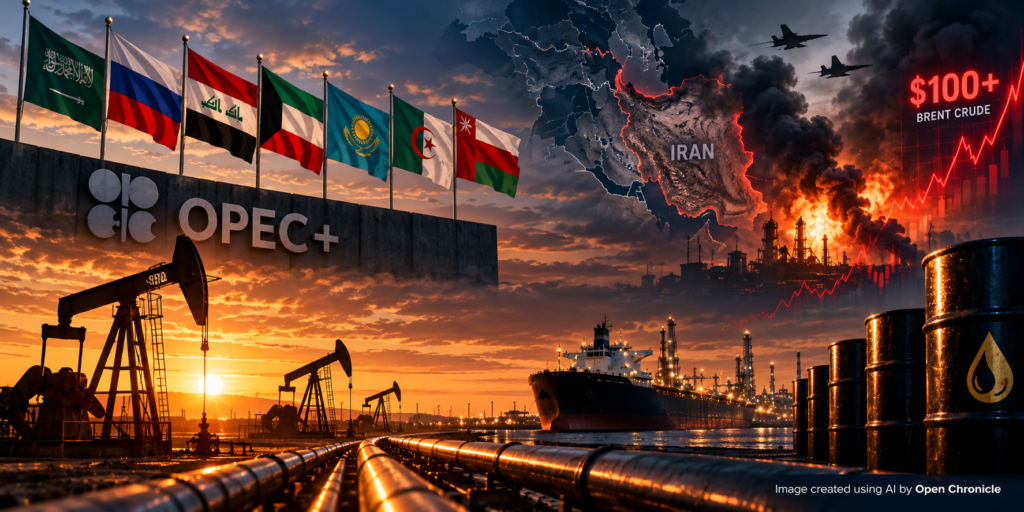
Seven major oil producing countries have agreed to maintain current production levels in November as disruption caused by the Iran war keeps global energy markets under pressure and Brent crude trades above $100 a barrel
By Open Chronicle with agencies
Seven major oil exporting countries agreed on Sunday to keep oil production steady in November, opting against increasing supply as the Iran war continues to disrupt global energy markets and drive prices higher.
The group, operating within the wider OPEC+ framework, includes Saudi Arabia, Russia, Iraq, Kuwait, Kazakhstan, Algeria and Oman.
The seven countries are scheduled to meet again on November 1 to assess conditions in the global oil market and determine their next production policy.
OPEC+ Holds Production Steady
The decision comes at a particularly sensitive moment for international energy markets.
Benchmark Brent crude has risen above $100 a barrel as the conflict involving Iran disrupts global oil supplies and increases uncertainty surrounding major energy routes and producers.
Rather than responding with an immediate production increase, the seven OPEC+ countries have chosen to maintain existing output levels through November.
Their next meeting will provide another opportunity to reconsider production depending on supply conditions, demand and the wider impact of the conflict.
Iran War Disrupts Global Oil Supplies
The sharp deterioration in energy market conditions follows the beginning of fighting with Iran on February 28, when US and Israeli attacks marked the start of the current conflict.
The war has since disrupted global oil supplies and contributed to rising crude prices.
With Brent above $100 a barrel, pressure is spreading through economies that depend heavily on oil and refined petroleum products.
The disruption has become particularly significant for diesel markets.
G7 Turns to Emergency Reserves
The Group of Seven wealthy democracies announced on Friday that its members plan to release 100 million barrels of oil and fuel products from reserves in the coming weeks.
The intervention will begin with substantial quantities of diesel.
The G7 described the plan as a frontloaded substantial release, with the initial diesel supplies expected to enter the market within the next 20 days.
The remainder of the 100 million barrels is expected to be released over approximately four months.
The measure is intended to increase available supply at a time when the Iran war is placing significant pressure on international energy markets.
Diesel Prices Hit Record Levels in the United States
Diesel has become one of the most immediate areas of concern.
Prices recently reached record highs in the United States, increasing costs for farmers, trucking companies and consumers who depend directly or indirectly on diesel fuel.
Unlike gasoline, diesel plays an especially important role across the wider economy because of its use in freight transport, agriculture and other commercial activities.
Higher diesel prices can therefore spread through supply chains, increasing transportation and production costs well beyond the fuel market itself.
Two Different Responses to the Energy Shock
The OPEC+ decision and the G7 emergency release illustrate two different responses to the same global energy disruption.
The seven oil producing countries have chosen to leave their November production levels unchanged.
The G7, meanwhile, is attempting to increase near term availability by drawing on emergency reserves, with particular emphasis on diesel.
Both decisions reflect the growing economic consequences of a war that is increasingly affecting markets far beyond the immediate conflict zone.
November Becomes the Next Key Date
Attention will now turn to November 1, when the seven OPEC+ producers are expected to meet again.
By then, policymakers will have more information about the effect of the G7 reserve release, the direction of crude prices and the extent of continuing supply disruption caused by the Iran war.
For now, the world’s major producers are holding production steady while some of the largest consuming economies turn to strategic reserves.
With Brent above $100 a barrel and diesel prices under intense pressure, energy markets remain highly exposed to further disruption from the conflict.