
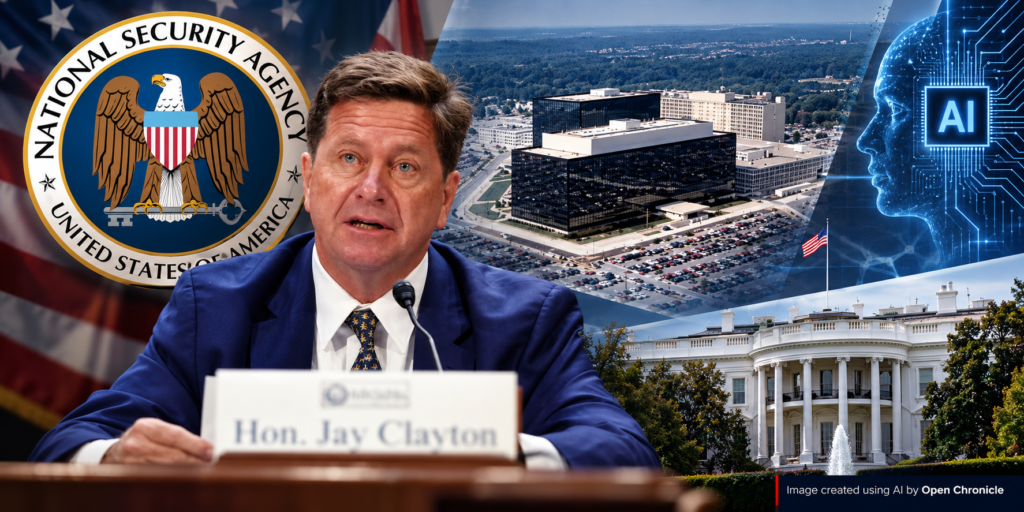
President Donald Trump has selected Director of National Intelligence Jay Clayton to lead a new White House initiative examining the risks and opportunities created by artificial intelligence, with the task force expected to deliver its recommendations within 120 days.
By Open Chronicle with agencies
WASHINGTON. President Donald Trump has named Director of National Intelligence Jay Clayton to lead a new White House task force focused on artificial intelligence, as the administration seeks to maintain American leadership in advanced AI while assessing emerging national security and technological risks.
Clayton told The Wall Street Journal that he will lead a newly established team charged with producing a report within 120 days examining the opportunities and potential dangers associated with rapidly advancing artificial intelligence systems.
The initiative reflects the growing importance of AI within American economic, security and geopolitical strategy, particularly as technological competition between the United States and China intensifies.
A New White House AI Initiative
According to Clayton, Trump ordered the creation of what the administration is calling the “Super Intelligence Force.”
Its mandate will extend beyond examining the economic possibilities created by artificial intelligence.
The task force will assess potential AI related risks, review existing federal systems used to report breaches, intrusions and other incidents, and recommend measures that could strengthen the government’s response using its existing authorities.
The administration’s stated objective is to protect American interests while ensuring that the United States remains at the forefront of advanced artificial intelligence development.
Intelligence Community Takes a Central Role
Clayton’s appointment places the US intelligence leadership at the centre of the new initiative.
That positioning highlights the extent to which artificial intelligence is increasingly being viewed not simply as a commercial technology but as a national security issue.
Advanced AI systems could affect intelligence gathering, cybersecurity, military operations, critical infrastructure and the ability of governments to identify and respond to emerging threats.
The task force’s examination of breaches and intrusions also places cybersecurity among the issues expected to receive significant attention during its review.
Senior Administration Officials Join the Task Force
The initiative will bring together senior figures from across the Trump administration.
According to the Journal report cited in the supplied material, Emil Michael, Scott Kupor and Federal Trade Commission Chairman Andrew Ferguson will serve as deputy leaders.
The broader group will include Vice President JD Vance, Defense Secretary Pete Hegseth, Treasury Secretary Scott Bessent and White House Chief of Staff Susie Wiles.
The composition of the task force suggests that its work will cross several areas of federal policy, including national security, defense, economic policy, competition and technology regulation.
120 Days to Assess the Risks and Opportunities
The task force has been given 120 days to complete its report.
During that period, it is expected to examine both the potential benefits of increasingly powerful AI systems and the vulnerabilities associated with their rapid development.
The review will also consider whether existing federal mechanisms for identifying and reporting AI related incidents are adequate.
Rather than creating an entirely new regulatory structure immediately, the group has been asked to recommend ways the federal government can strengthen its response within authorities that already exist.
That approach is consistent with Trump’s broader preference for limiting regulatory barriers around artificial intelligence development.
AI Safety Debate Intensifies
The initiative comes as debate over artificial intelligence safety continues to grow in Washington.
Researchers have warned about potential risks associated with the rapid development and deployment of increasingly capable AI systems.
Lawmakers from both major US political parties have also called for additional measures to address concerns surrounding the technology.
The policy challenge for Washington is increasingly centred on how to manage those risks without slowing technological development in a field considered strategically important to the United States.
Trump Favors a Lighter Regulatory Approach
Trump has generally favored reducing regulatory constraints on artificial intelligence.
His administration has argued that excessive oversight could weaken American competitiveness and make it more difficult for US companies to maintain leadership in the global AI industry.
That position places economic and geopolitical competition alongside questions of technological safety.
The administration is particularly concerned about competition with China, which is also investing heavily in artificial intelligence and other advanced technologies.
For Washington, maintaining leadership in AI is increasingly being treated as an element of national power.
AI Becomes a National Security Priority
The establishment of the new task force illustrates how quickly artificial intelligence has moved from a primarily technological and commercial issue into the centre of national security policymaking.
AI now intersects with defense, intelligence, cybersecurity, financial systems, industrial competitiveness and geopolitical strategy.
By placing the Director of National Intelligence in charge of the initiative and involving senior officials from across the administration, the White House is signalling that the implications of increasingly powerful artificial intelligence systems extend across the federal government.
The task force’s report, expected within four months, could provide an important indication of how the Trump administration intends to balance two objectives that increasingly define American AI policy: protecting the country against emerging technological risks while preserving the speed of innovation necessary to maintain US leadership in the global artificial intelligence race.