
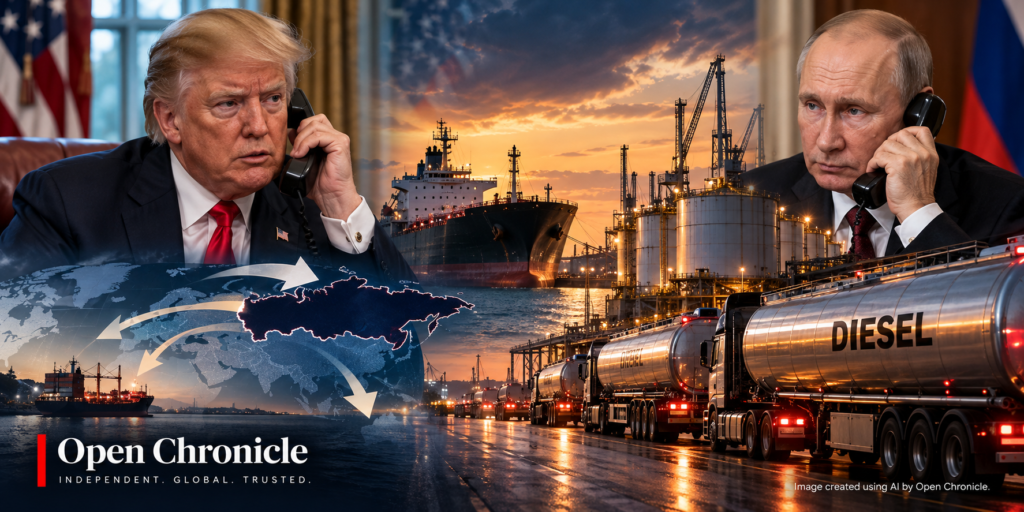
US President Donald Trump says Moscow will release more than 4.8 million tonnes of diesel onto international markets in an effort to ease soaring fuel prices ahead of November’s midterm elections, despite Washington’s continuing sanctions over the war in Ukraine.
By Open Chronicle with agencies
WASHINGTON, October 9, 2026 — US President Donald Trump said on Friday that he had reached an agreement with Russian President Vladimir Putin to increase Russian diesel supplies to global markets, marking a significant change in Washington’s approach to Moscow as rising fuel costs put pressure on the American economy.
Trump announced the agreement following a telephone conversation with Putin, saying Russia would immediately make more than 300,000 tonnes of diesel available, followed by another 500,000 tonnes in November and 1 million tonnes shortly afterwards.
A further 3 million tonnes would be supplied within what Trump described as a short period, bringing the total announced volume to more than 4.8 million tonnes.
The president presented the agreement as an effort to reduce fuel prices, which have risen sharply amid the war in Iran and disruption to international energy markets.
“Lower prices for Americans, especially our Great Farmers, Ranchers, and Truckers, is my Greatest Priority,” Trump wrote on social media.
The announcement comes less than four weeks before the November 3 midterm elections, when Republicans will seek to retain control of Congress amid growing concerns over the cost of living.
Treasury Moves to Allow Russian Diesel Exports
Shortly after Trump’s announcement, the US Treasury Department reportedly issued a temporary authorization allowing Russian diesel to enter international markets.
The move comes despite sanctions imposed on Moscow following its full-scale invasion of Ukraine in February 2022.
The United States banned imports of Russian oil and certain other energy products in 2022, while Washington and its allies introduced successive rounds of financial and trade restrictions intended to limit Russia’s ability to finance the war.
Trump signed additional sanctions legislation last month targeting Russian officials, banks, energy transactions and vessels associated with Moscow’s oil trade.
The legislation also provides for tariffs of up to 100 percent on major importers of Russian oil and natural gas, subject to certain exceptions.
The new diesel arrangement raises questions about how the administration intends to implement those restrictions while facilitating additional Russian energy exports.
The White House did not immediately explain whether American companies would purchase the diesel directly or whether the fuel would be sold to buyers elsewhere in the world.
Officials also did not clarify who would finance the transactions, which companies would handle the shipments or when the first deliveries would reach international markets.
The full terms of the reported Treasury authorization were not available in the information supplied for this report.
Diesel Prices Put Pressure on the US Economy
The agreement comes as American consumers and businesses face exceptionally high fuel costs.
According to figures attributed to AAA, the national average price of diesel stood at $6.23 per gallon on Friday, down from a reported record of $6.52 on September 22.
Although prices have eased from that peak, diesel remains a major expense for trucking companies, agricultural producers and other industries dependent on fuel-intensive operations.
Higher transport costs can also contribute to rising prices for food and consumer goods, adding to inflationary pressures already affecting American households.
The war in Iran has further unsettled energy markets, raising concerns about the security of oil production and shipping routes in the Middle East.
Trump has made reducing energy costs a central economic priority as the midterm elections approach.
However, it remains unclear whether the Russian diesel agreement will produce a measurable decline in American retail prices before voters go to the polls.
The administration has not specified whether the 500,000 tonnes expected in November will become available before Election Day.
Moscow Welcomes the Agreement
Russian presidential envoy Kirill Dmitriev welcomed the announcement, sharing the Treasury Department’s reported decision on X.
“Russia-US cooperation on diesel and energy will benefit the world,” Dmitriev wrote.
Moscow has continued exporting oil and petroleum products despite Western sanctions, increasingly relying on alternative markets and trading arrangements.
The new agreement could provide Russia with additional opportunities to sell refined fuel at a time when its energy sector remains under international pressure.
It could also complicate Washington’s efforts to discourage other countries from purchasing Russian energy.
The financial benefits to Moscow remain uncertain because the agreement’s prices, buyers and payment arrangements have not been disclosed.
There was no indication in Trump’s announcement that Russia had made concessions concerning the war in Ukraine in exchange for the diesel arrangement.
Questions Over Sanctions and the War in Ukraine
The decision represents a notable departure from the policy pursued by successive US administrations since Russia invaded Ukraine.
Washington has sought to restrict Moscow’s access to international financial markets and reduce the revenues available to support its military campaign.
Energy exports have been a particular focus because oil and gas remain important sources of income for the Russian state.
Trump’s agreement with Putin introduces a potential conflict between those sanctions objectives and the administration’s efforts to contain domestic fuel prices.
The president did not address that tension in his announcement, nor did he explain whether the agreement had been discussed with Ukraine or European allies.
The reported arrangement also comes amid continuing diplomatic efforts to find a settlement to the war, although no connection between those negotiations and the diesel deal has been established.
Midterm Elections Add Political Urgency
The timing of the announcement places it firmly within the final weeks of the US congressional election campaign.
Fuel prices have become a politically sensitive issue as Republicans face criticism over inflation and the economic consequences of the conflict in Iran.
Trump has repeatedly argued that his administration can bring down energy costs, particularly for industries that rely heavily on diesel.
The agreement with Putin gives the White House a new measure to present to voters, but its practical effects remain uncertain.
Additional Russian diesel could increase international supply and ease pressure on wholesale markets. The extent of any price reduction, however, will depend on actual deliveries, demand, shipping costs and continuing disruption in the Middle East.
For now, the agreement is an announced commitment rather than a confirmed series of completed shipments.
Its significance extends beyond fuel prices.
By seeking Russian energy supplies while maintaining sanctions against Moscow, the Trump administration has opened a new debate over the balance between domestic economic priorities and the United States’ policy toward the war in Ukraine.
Whether the deal delivers lower prices or leads to further changes in Washington’s relationship with Russia will become clearer as the administration releases additional details and the first shipments are arranged.