
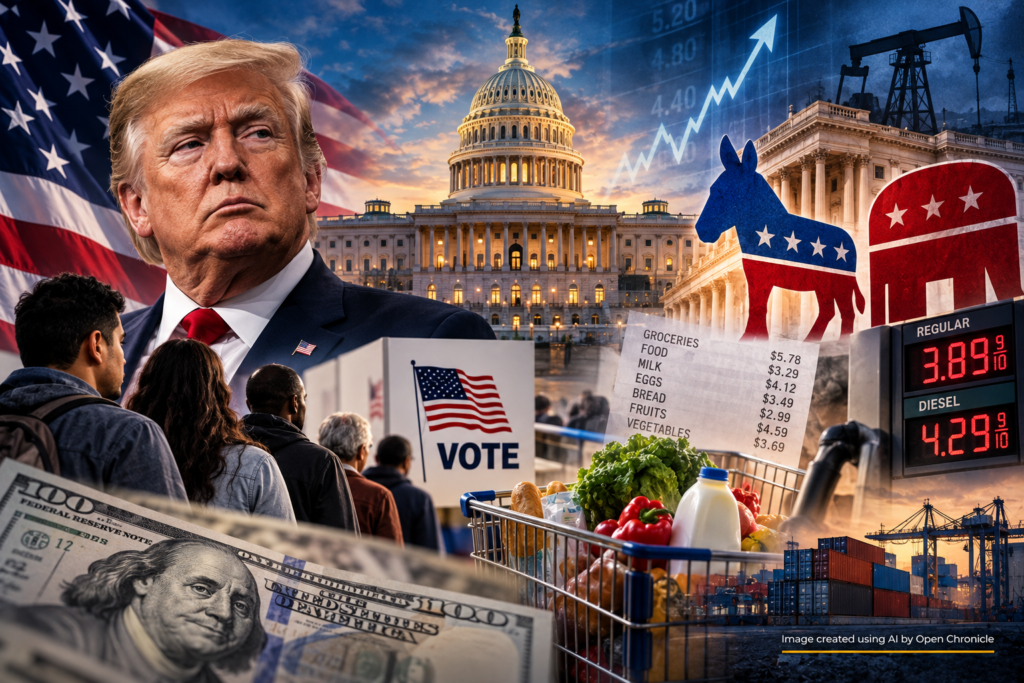
A new CBS News Battleground Tracker survey suggests Democrats retain an advantage in the race for control of the House of Representatives, with inflation, household expenses and dissatisfaction over President Donald Trump’s economic policies shaping voter preferences ahead of the November midterm elections.
By Open Chronicle with agencies
WASHINGTON, October 12, 2026 — Democrats continue to hold an advantage in the battle for control of the United States House of Representatives as concerns over rising prices, the cost of living and the economic consequences of the war with Iran weigh on Republican prospects, according to findings from the CBS News Battleground Tracker.
The survey suggests that Americans increasingly judge the performance of the economy through the prices they encounter in everyday life, rather than traditional indicators such as economic growth, employment figures or stock market performance.
For President Donald Trump and the Republican Party, the findings point to a potentially significant political vulnerability ahead of the November congressional elections.
Although the administration has emphasised broader economic performance, many voters remain dissatisfied with the cost of groceries, fuel and other essential goods.
The survey also indicates that Democrats may benefit from stronger enthusiasm among their supporters, while some Republicans express uncertainty about whether they will vote.
However, the eventual balance of power in Congress will depend on turnout, local candidates and competitive districts rather than national polling preferences alone.
For American Voters, the Economy Means Prices
The CBS News survey identifies household prices as the dominant measure Americans use when evaluating economic conditions.
While economists frequently assess the economy through gross domestic product, employment, investment, financial markets and borrowing costs, voters appear more focused on the immediate financial pressures affecting their families.
Food prices, grocery bills, gasoline costs and other routine expenses have become central to political perceptions.
The pattern has persisted since the COVID-19 pandemic, when inflation and disruptions to global supply chains substantially altered household budgets.
According to the survey, most voters believe Trump’s policies are contributing to higher food and grocery prices.
Many also believe the conflict involving Iran has pushed gasoline prices upward, connecting foreign policy decisions directly to their financial circumstances.
The findings suggest that positive economic indicators may offer limited political benefits if households continue to feel that essential goods are becoming less affordable.
For Democrats, the issue provides a central campaign argument.
The party continues to attract voters who describe rising prices as difficult to manage or a serious financial hardship.
Republicans, meanwhile, face the challenge of persuading voters that the administration is taking sufficient action to reduce everyday costs.
Republican Turnout Could Be Weakened by Inflation Concerns
One of the survey’s most consequential findings concerns potential voter participation.
Republican respondents are less likely than Democrats to say they will definitely vote in the midterm elections.
The difference appears connected, at least in part, to dissatisfaction with the administration’s handling of inflation.
Republicans give Trump substantially lower marks for managing rising prices than they do for immigration policy or his overall presidential performance.
The survey identifies a group of potentially reluctant Republican voters whose dissatisfaction with economic conditions could reduce their willingness to participate.
Republicans who believe the administration has not devoted sufficient attention to lowering prices are less likely to express definite intentions to vote.
A similar pattern emerges among Republicans who believe their congressional candidates are not discussing the cost of living enough.
The survey also finds that Republicans who consider Trump’s second term less successful than his first are almost 20 percentage points less likely to say they will definitely vote.
That difference could prove important in closely contested congressional districts, where relatively small changes in turnout can determine the outcome.
However, stated voting intentions do not necessarily translate into actual participation.
Campaign mobilisation, political developments and voter enthusiasm during the final weeks of the election could still change the picture.
Voters Hold Trump More Responsible Than Biden for Current Economy
The survey also examines how Americans assign responsibility for present economic conditions.
Economic dissatisfaction has persisted through multiple administrations, particularly since the pandemic and the inflationary pressures that followed.
Nevertheless, voters now place considerably more responsibility for the current economy on the Trump administration than on former President Joe Biden.
The findings indicate that the passage of time has shifted political accountability toward the incumbent president.
For Republicans, this creates a challenge in arguing that economic difficulties are primarily inherited from the previous administration.
For Democrats, it provides an opportunity to frame the election as a referendum on Trump’s economic management.
The political significance is particularly strong because voters are evaluating the administration not only on economic statistics but also on their personal experiences.
A household facing higher grocery or fuel costs may judge the economy negatively even when other indicators suggest growth or resilience.
Hispanic Voters Could Shape the Congressional Majority
Hispanic voters are emerging as another potentially decisive factor in the House elections.
The CBS News survey suggests that Republican support among Hispanic likely voters is lower than the share Trump received from Hispanic voters in the 2024 presidential election.
That shift could affect several competitive congressional districts, particularly those where recent redistricting has altered electoral boundaries.
Republicans made gains among Hispanic voters in 2024, but maintaining those gains may be essential to preserving their position in closely contested districts.
Economic concerns remain central to Hispanic voters, with inflation and household expenses ranking among their most important issues.
However, immigration enforcement and deportation policies also play a significant role.
According to the survey, most Hispanic voters believe the administration is deporting more people than they expected.
Compared with voters overall, Hispanic respondents are more likely to believe Trump is placing excessive emphasis on deportations.
The survey also finds concerns about fairness in Immigration and Customs Enforcement operations.
Hispanic voters are more likely to perceive that people from their communities face disproportionate immigration enforcement searches compared with individuals from other racial or ethnic backgrounds.
These perceptions could influence both party preferences and turnout.
For Republicans, the challenge is to retain Hispanic voters attracted by the party’s economic and political messaging in 2024.
For Democrats, the opportunity lies in rebuilding support among voters who have become dissatisfied with the administration’s approach to immigration and affordability.
Opposition to Trump Is Motivating More Voters Than Support for Him
The survey indicates that opposition to Trump is playing a substantial role in shaping the congressional campaign.
More voters say their House vote is motivated by opposition to the president than by support for him.
That finding suggests that the midterms are becoming a test of Trump’s leadership, even though the president himself is not on the ballot.
Some Republican candidates have responded by emphasising differences with the White House on selected issues.
The survey suggests that such positioning may have political appeal.
Most Republican voters say they prefer congressional candidates who generally agree with Trump but do not necessarily support every administration decision.
That preference provides room for candidates to distance themselves from particular policies while maintaining their broader Republican identity.
Tariffs are one area where opposition to the administration’s approach may resonate with voters.
The survey indicates that candidates opposing new tariffs can find greater support, all other factors being equal.
Trade policy has become closely connected to concerns about consumer prices, with voters increasingly attentive to the potential costs of import restrictions.
At the same time, some cultural issues continue to favour Republicans.
The survey finds that more voters prefer candidates who support restricting participation in school and competitive sports to teams corresponding to transgender athletes’ sex assigned at birth.
Those voters are predominantly supporting Republican candidates.
The findings illustrate how different policy issues can pull voters toward different parties, complicating campaign strategies built around a single national message.
Democrats Benefit From Cost-of-Living Focus but Face Their Own Challenges
Democratic candidates are perceived as discussing the cost of living more frequently than Republican candidates.
However, the survey suggests that neither party is widely viewed as devoting substantial attention to the issue.
That creates an opening for candidates who can present specific proposals addressing household expenses.
The findings also indicate that voters are not necessarily seeking strict ideological loyalty from congressional candidates.
Just as many Republicans prefer candidates who do not always agree with Trump, Democratic voters show a preference for candidates willing to depart from the national party’s position on some issues.
This reflects a broader political environment in which neither major party enjoys particularly favourable public perceptions.
Candidates who demonstrate independence may therefore be better positioned to appeal to voters dissatisfied with national politics.
The survey also examines the influence of democratic socialist organisations.
An endorsement from self-identified democratic socialists produces mixed reactions among Democratic voters and appears to offer limited appeal beyond the party’s existing supporters.
For Democratic campaigns, the findings suggest that affordability, local priorities and candidate independence may be more effective electoral messages than ideological identification alone.
Younger Voter Turnout Remains a Major Democratic Challenge
Although Democrats appear to hold an advantage in current House projections, the party still faces uncertainty over turnout.
Younger voters are particularly important to Democratic electoral prospects.
Historically, older Americans participate in elections at higher rates than younger voters, a pattern reflected in both survey responses and public voting records.
The CBS News findings indicate that older voters remain more likely to express definite intentions to cast a ballot.
For Democrats, this means that favourable political sentiment among younger Americans may not be sufficient unless it translates into actual participation.
The party’s ability to mobilise younger voters could determine the outcome in competitive districts.
Student outreach, voter registration efforts, early voting campaigns and digital mobilisation may all become important components of the election strategy.
Republicans, meanwhile, may seek to compensate for weaker enthusiasm among some supporters by focusing on established voters with stronger participation records.
The balance between enthusiasm and actual turnout remains one of the largest uncertainties in the congressional race.
Iran War Adds Pressure Through Rising Fuel Prices
The conflict involving Iran has become another issue influencing voter preferences.
Although Americans generally place greater importance on domestic economic conditions than on the war itself, the survey suggests that the two issues are closely connected.
Most voters believe the conflict has contributed to higher gasoline prices.
Those voters are more likely to support Democratic candidates for the House.
The findings also indicate that many Americans would prefer congressional candidates who support bringing the war to an end.
That preference extends beyond Democratic voters.
Approximately one-third of Republicans share the view that candidates should advocate ending the conflict.
Some Republican congressional candidates have already called for a conclusion to the war, reflecting concern about its political and economic consequences.
The survey also finds that more voters believe the conflict would be more likely to end if Democrats gained control of Congress than if Republicans retained their majority.
These perceptions could influence voting decisions even among Americans who do not identify foreign policy as their primary concern.
Higher fuel prices affect transportation, food distribution, manufacturing and household spending, allowing developments abroad to influence domestic economic confidence.
For the Trump administration, the challenge is to persuade voters that its foreign policy decisions are compatible with efforts to reduce living costs.
Artificial Intelligence Emerges as an Economic Election Issue
Artificial intelligence is also becoming part of the midterm campaign, particularly because of concerns about employment and the future of the economy.
The CBS News survey indicates that many Americans believe AI is more likely to create problems than solve them.
That scepticism extends across political affiliations and age groups.
Voters also tend to believe that AI will eliminate more jobs than it creates.
These concerns have implications for candidates discussing technology regulation, labour markets and economic security.
The survey finds a general preference for candidates who support restrictions on the use and development of artificial intelligence.
Voters favouring stronger restrictions are disproportionately supporting Democratic candidates.
The issue is not limited to software or automation.
Data centres, which require substantial electricity, water and infrastructure investment, are also becoming politically sensitive.
Communities may welcome technology investment while simultaneously expressing concern about energy costs, environmental effects and pressure on local resources.
The findings suggest that AI is increasingly being evaluated through its potential consequences for employment, affordability and community infrastructure.
For candidates, technology policy may therefore become another aspect of the broader debate over economic security.
A House Election Shaped by Affordability and Political Trust
The CBS News Battleground Tracker presents a political environment in which Democrats retain an advantage but cannot assume that national dissatisfaction will automatically translate into congressional victories.
The findings suggest that several forces are working in their favour.
Economic frustration remains widespread, voters increasingly hold the Trump administration responsible for current conditions, and some Republicans are expressing weaker intentions to vote.
Democrats also appear to be benefiting from concerns about immigration enforcement, the economic effects of the Iran war and the potential consequences of artificial intelligence.
However, the party faces challenges of its own.
Younger voters may not participate at the rates required to convert favourable preferences into electoral victories, while candidate quality and district-level conditions remain important.
Republicans retain advantages on certain cultural issues and may be able to improve their position by focusing more directly on affordability.
The survey also suggests that voters in both parties value a degree of independence from national political leadership.
That could benefit candidates who demonstrate responsiveness to local concerns rather than relying entirely on partisan loyalty.
Control of Congress Remains Uncertain
The November midterm elections will determine whether Republicans maintain control of the House of Representatives or Democrats gain the majority.
The CBS News Battleground Tracker indicates that Democrats currently hold an advantage, but the result remains dependent on the distribution of votes across individual congressional districts.
A national lead does not necessarily guarantee a House majority.
Redistricting, regional voting patterns, candidate strength and turnout can all affect the number of seats each party wins.
The survey’s central message is that economic perceptions remain the defining issue of the campaign.
For millions of Americans, the economy is measured less by national statistics than by the cost of filling a shopping basket, paying household bills or purchasing gasoline.
Those everyday experiences are shaping assessments of the Trump administration and influencing voters’ willingness to participate in the election.
As November approaches, both parties face a similar challenge: convincing Americans that their candidates understand the financial pressures affecting households and can offer credible solutions.
For now, the CBS News findings suggest that Democrats are benefiting more from those concerns, while Republicans must work to rebuild confidence among voters dissatisfied with the administration’s economic performance.
The ultimate outcome will depend on whether those attitudes persist and, crucially, which voters turn out on Election Day.