
Why does a country with 120 parliamentary seats often need several political parties to form a government? Inside Israel’s electoral system, where voters choose party lists, parliamentary arithmetic shapes political power, and coalition negotiations determine who governs.
By Open Chronicle Explained
1. What Is the Knesset?
The Knesset is Israel’s national parliament and the central institution of its parliamentary democracy. It has 120 members, known as MKs, who make laws, scrutinize the government, approve budgets and participate in parliamentary committees.
Unlike countries with two legislative chambers, Israel has a unicameral parliament. There is no separate upper house or senate.
The number 120 has remained a defining feature of the institution since Israel’s establishment. Its name and size reflect the historical tradition of the Great Assembly, an ancient Jewish deliberative institution.
But the Knesset is more than a legislature. It is also the arena in which governments are created, sustained and potentially brought down.
That distinction is essential: Israelis elect a parliament, not a prime minister directly.
2. How Do Israelis Actually Vote?
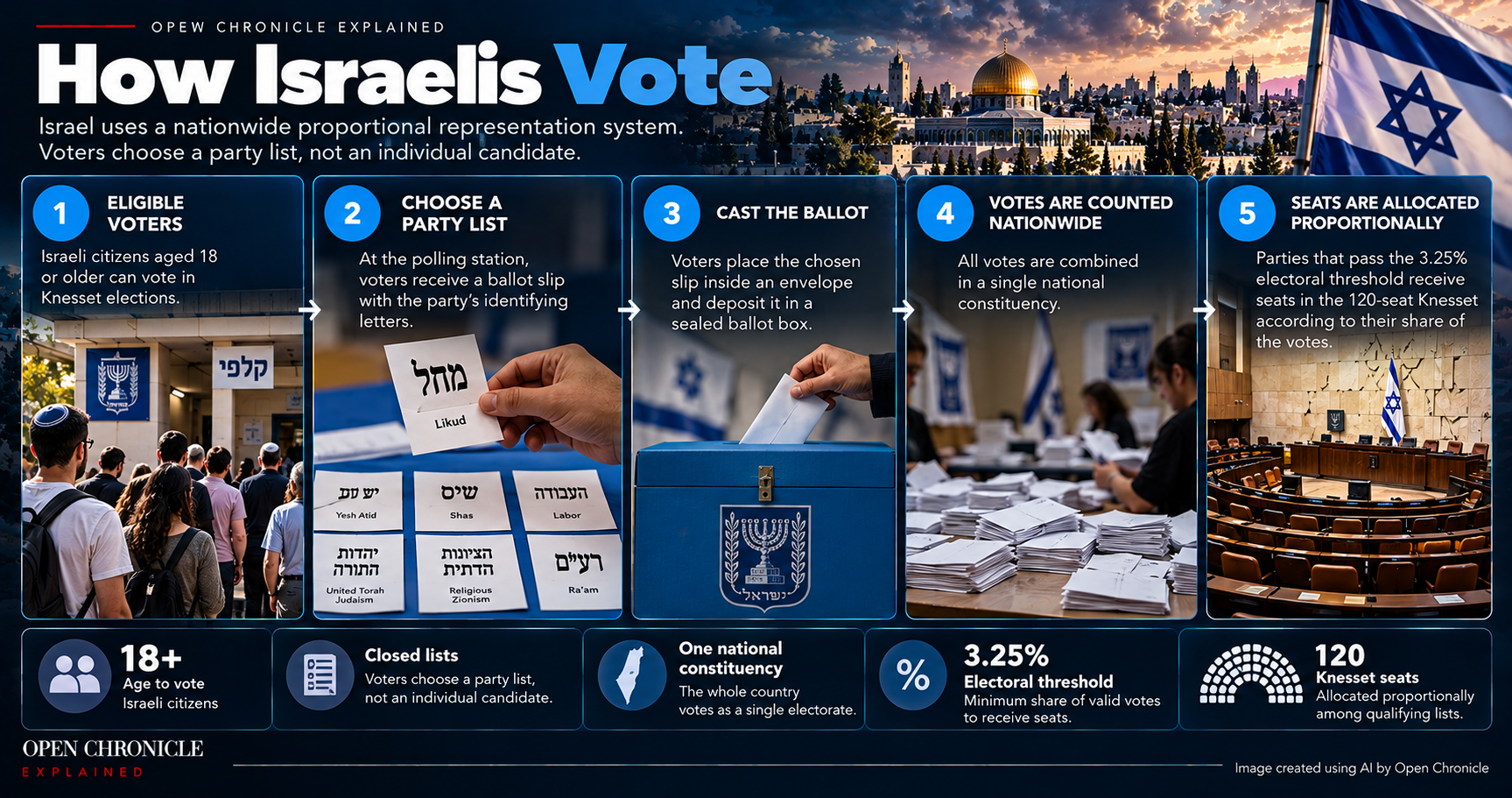
Israel uses a system of nationwide proportional representation.
The country is treated as one electoral constituency for Knesset elections. Rather than electing a local representative for a particular district, voters choose a national list of candidates presented by a political party or electoral alliance.
At a polling station, voters select a paper slip bearing the identifying letters of their chosen list, place it inside an envelope and deposit it in a ballot box.
The system is based on closed lists. Voters cannot rearrange the order of candidates or select an individual candidate from within the list.
If a list receives enough votes to win ten seats, the first ten candidates on that list ordinarily enter the Knesset.
This makes the selection and ordering of candidates by political parties an important part of the electoral process.
3. Who Can Vote?
Israeli citizens aged 18 or older are eligible to vote in Knesset elections, subject to applicable legal requirements. Israeli citizens belonging to Jewish, Arab and other communities participate under the same national electoral system.
Citizenship matters: permanent residence alone does not confer the right to vote for the Knesset. This distinction is particularly relevant when discussing East Jerusalem and the occupied Palestinian territories.
Israeli citizens living in West Bank settlements can vote in Israeli parliamentary elections. Palestinians in the West Bank who do not hold Israeli citizenship do not vote for the Knesset. Palestinian permanent residents of East Jerusalem who are not Israeli citizens likewise cannot vote in Knesset elections, although municipal voting rights differ.
These differences are central to understanding the population represented by Israel’s parliamentary system, as well as wider debates over political rights and territorial governance.
4. What Does Proportional Representation Mean?
In a proportional system, parties receive parliamentary seats broadly according to their share of the qualifying vote.
Imagine that a party receives approximately 25% of the votes counted toward seat allocation. It might expect roughly 30 of the Knesset’s 120 seats, although the final distribution depends on electoral rules and the results of other lists.
This is different from a winner-takes-all constituency system, where a candidate can win a district without receiving an absolute majority.
Proportional representation gives multiple political movements opportunities to enter parliament. It can accommodate differences of ideology, religion, identity and public policy.
However, it also makes it less common for one party to secure an outright parliamentary majority.
The consequence is a system in which governing usually requires cooperation between several parties.
5. Why Is the Electoral Threshold So Important?
Israel does not distribute parliamentary seats to every party that receives votes.
A list must obtain at least 3.25% of valid votes to qualify for seat allocation.
This is known as the electoral threshold.
A party receiving 3.24% would receive no seats, even if hundreds of thousands of citizens supported it. A party passing the threshold would participate in the national allocation of the 120 seats.
Votes cast for lists below the threshold do not count toward the distribution of seats among qualifying lists.
That can produce an important political effect: two groups of parties receiving similar overall public support can obtain different parliamentary representation if more votes for one group go to lists that fail to qualify.
The threshold therefore influences not only the outcome of an election but also the decisions parties make before voting begins. Smaller parties may form joint lists to reduce the risk of exclusion.
6. How Are Votes Converted Into 120 Seats?
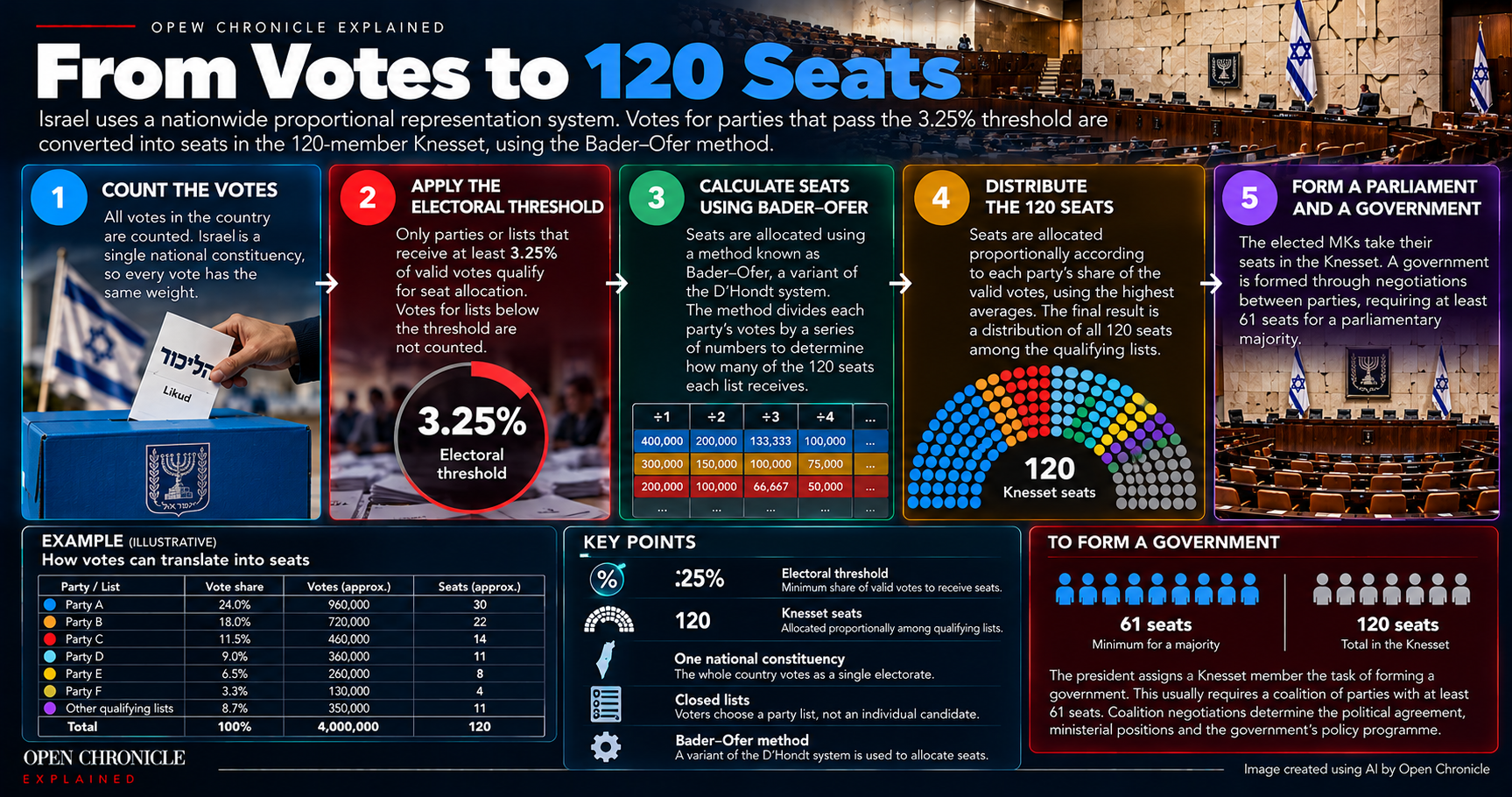
The calculation is more sophisticated than simply multiplying every party’s national vote percentage by 120.
Israel uses a method commonly called Bader–Ofer, related to the D’Hondt system used in other proportional electoral arrangements.
The process begins by identifying all lists that have crossed the electoral threshold. Votes for those that did not qualify are excluded from the seat-allocation calculation.
A preliminary allocation is made according to each qualifying list’s share of the relevant votes. Remaining seats are then distributed through the Bader–Ofer calculation, which compares the average votes per seat for eligible lists or paired lists.
Two qualifying lists may also have signed a surplus-vote agreement before the election. This allows their votes to be considered together during the allocation of remaining seats, potentially helping one of them secure an additional seat.
A surplus-vote agreement is not the same as a coalition agreement. It concerns electoral arithmetic, not a commitment to govern together.
7. Why Does Israel Have So Many Political Parties?
Israel’s party system reflects several overlapping political and social divisions.
One concerns national security, the Israeli–Palestinian conflict, territorial policy and approaches to diplomacy.
Another concerns religion and the state, including the role of Jewish religious law, public institutions, military service and religious exemptions.
Economic debates also matter, including taxation, welfare, housing, public spending and the relationship between markets and state intervention.
Other political divisions concern constitutional arrangements, judicial authority, civil rights, minority representation and the powers of elected institutions.
These questions do not fit neatly onto a single left–right spectrum.
A party may favor market-oriented economic policies while supporting socially conservative religious positions. Another may emphasize national security while advocating different positions on judicial reform or public services.
This multidimensional political environment helps explain why Israeli coalition-building can involve parties that agree on some questions but disagree sharply on others.
8. What Are Israel’s Main Political Traditions?
Israeli politics includes several broad political traditions, although individual parties can change, merge, split or reposition themselves over time.
Nationalist and right-wing parties often emphasize security, national identity and varying positions on territorial control. Likud has long been a major force within this political tradition.
Centrist parties frequently emphasize governance, security, institutional reform and pragmatic policy positions. Yesh Atid is one example, while other centrist formations have changed across election cycles.
Left-wing and social-democratic traditions have historically included Labor and Meretz, whose political legacies have evolved through later party reorganizations and alliances.
Religious and ultra-Orthodox parties, including Shas and United Torah Judaism, focus on matters affecting their constituencies, such as religious education, welfare, community institutions and religion–state relations.
Religious-nationalist parties combine religious and nationalist positions, often with particular emphasis on territorial and settlement policy.
Arab political parties and alliances, including Ra’am and formations associated with Hadash and Ta’al, represent different political approaches and constituencies. They should not be treated as a single ideological bloc.
The specific parties competing, their leaders, candidate lists and electoral alliances must always be assessed for the particular election rather than assumed to be permanent.
9. What Happens on Election Night?
When polling stations close, votes are counted and preliminary results begin to emerge.
Early results may show how many seats each party is expected to receive. But these numbers do not themselves determine the next government.
A party could finish with more seats than any other party and still be unable to assemble sufficient parliamentary support.
Another party leader might have a clearer route to a governing arrangement through agreements with several other lists.
This is why election-night reporting in Israel often focuses on two separate questions:
Which party has won the most seats?
And, more importantly for government formation:
Which combination of parties can support a government?
These are not necessarily the same question.
10. Why Is the Number 61 So Important?
THE KNESSET · PARLIAMENTARY ARITHMETIC
120
Total parliamentary seats
61
Absolute majority of seats
An absolute majority of the 120-seat Knesset is 61 seats.
This is the benchmark most commonly used when discussing whether a coalition has a stable parliamentary majority.
Consider a hypothetical result:
| Party | Seats |
|---|---|
| Party A | 34 |
| Party B | 17 |
| Party C | 11 |
| Party D | 10 |
| Other parties | 48 |
| Total | 120 |
Party A is the largest party, but it has only 34 seats.
If it reaches an agreement with Party B and Party C, the three parties together hold 62 seats — an absolute majority.
Yet Party A and Party B alone would have only 51 seats.
This demonstrates why coalition negotiations can matter as much as the electoral result itself.
A government does not always require 61 affirmative votes at every parliamentary vote: formal confidence procedures and the possibility of abstentions or outside support introduce further distinctions. Nevertheless, a reliable majority of at least 61 members is the clearest basis for sustained parliamentary control.
11. Who Chooses the Prime Minister?
Israel’s president has an important constitutional role after parliamentary elections.
The president consults representatives of the parliamentary factions and then assigns a member of the Knesset the task of attempting to form a government.
The president does not simply have to choose the leader of the largest party. The relevant question is who appears capable of assembling a government that can obtain the Knesset’s confidence.
The first designated member ordinarily has 28 days to form a government. The president may grant extensions totaling up to 14 additional days.
If that attempt fails, the Basic Law provides procedures for another candidate and, under specified circumstances, an opportunity for Knesset members to propose a candidate. If the process ultimately fails, another election may follow.
The prime minister is therefore not elected separately by the public. The office emerges through the parliamentary process.
12. How Is a Coalition Government Negotiated?
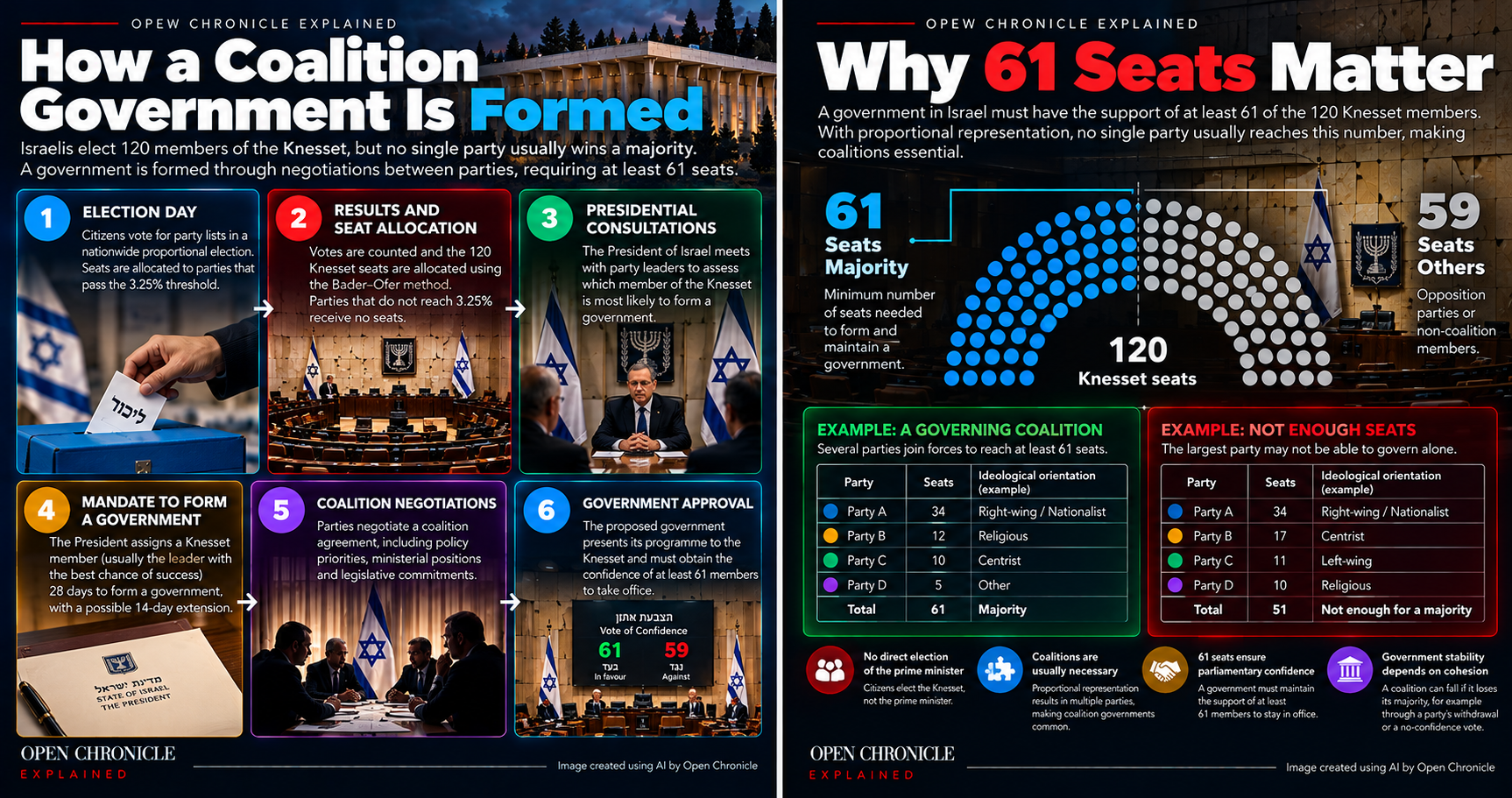
Coalition negotiations involve much more than adding seats together.
Parties discuss the political commitments that would allow them to participate in the same government or support it in parliament.
These discussions can include budgets, security policy, judicial legislation, religion–state arrangements, education, housing, infrastructure and other policy priorities.
They also concern the allocation of ministerial portfolios, the leadership of parliamentary committees and mechanisms for resolving disagreements.
A coalition agreement may establish shared policy objectives, legislative commitments and procedures for cooperation.
But the agreement does not erase the identities of the participating parties. Each retains its own parliamentary members, electoral constituency and political priorities.
That is why coalition agreements can create a government without eliminating the tensions that existed between its members.
13. What Is the Difference Between a Coalition and an Opposition?
The governing coalition consists of the parties supporting the government through the parliamentary arrangement on which it relies.
The opposition consists of parliamentary factions outside the governing arrangement, although opposition parties do not necessarily agree with one another.
Opposition members can question ministers, introduce legislation, participate in committees and scrutinize government decisions.
The distinction is not always equivalent to a single ideological divide. Two parties may both oppose the government for entirely different reasons.
Similarly, a party may support a particular government bill while opposing the government’s broader political program.
This flexibility is one of the defining features of multiparty parliamentary politics.
14. Can a Party Support a Government Without Joining It?
Yes. Parliamentary support and formal participation in government are not identical.
A party may decide not to accept ministerial positions but still support a government in a confidence vote, abstain to allow its formation, or back selected legislation.
This is sometimes described as outside support.
Such arrangements may permit a government to operate without all supporting parties becoming coalition members.
However, outside support can also make the government’s position more dependent on negotiations over individual votes.
A government that relies on abstentions or issue-by-issue cooperation may face different political challenges from one supported by a cohesive absolute majority.
15. Why Can Small Parties Have So Much Influence?
Imagine a coalition with 61 seats, including a small party holding five seats.
If that party withdraws its support, the coalition could be reduced to 56 seats.
The smaller party may therefore have considerable negotiating influence, despite representing a relatively limited share of the electorate.
Political scientists often describe this as bargaining leverage.
But influence depends on circumstances. A small party may have little leverage if alternative coalition partners are available or if its departure does not endanger the government’s ability to survive.
The essential point is that parliamentary influence depends not only on how many seats a party holds, but also on whether its seats are necessary to sustain a governing arrangement.
16. Why Do Israeli Governments Sometimes Collapse?
Coalition governments can experience disagreements over legislation, public spending, military policy, religious questions, leadership and political strategy.
A party may withdraw from the coalition. Individual members may refuse to support important bills. A dispute over the state budget may trigger a constitutional process leading to dissolution.
Israel also has a mechanism known as constructive no-confidence. Rather than merely voting against the existing government, the Knesset must support an alternative governing arrangement under the applicable legal procedure.
A government may also end through resignation or other circumstances provided for by law.
The departure of a coalition partner does not automatically mean the government immediately ceases to exist. Legal procedures, parliamentary arithmetic and possible alternative arrangements determine what happens next.
17. Why Have Elections Sometimes Been Repeated So Frequently?
Between 2019 and 2022, Israel held five Knesset elections.
That period illustrated the difference between producing an election result and forming a durable governing arrangement.
Repeated elections can occur when parliamentary factions cannot assemble a government, when an existing coalition loses its ability to govern, or when the Knesset is dissolved under the relevant procedures.
The consequences can include prolonged negotiations, caretaker governments, uncertainty over budgets and repeated electoral campaigning.
Yet frequent elections do not automatically mean that the state itself has collapsed or that democratic institutions have ceased functioning.
An important distinction must be maintained between government instability — the difficulty of sustaining a particular cabinet — and state instability, which concerns the functioning and legitimacy of the wider institutional system.
18. What Is the Difference Between the President and the Prime Minister?
Israel has both a president and a prime minister, but their responsibilities are different.
The president is the head of state and performs constitutional and representative duties, including the role in government formation.
The prime minister is the head of government and leads the executive branch.
The cabinet directs government policy and administration, subject to the country’s legal and parliamentary framework.
The Knesset, meanwhile, is the elected legislature that provides parliamentary oversight and the confidence on which a government depends.
Understanding these distinctions helps explain why the president can play an important role after an election without being the political leader who governs the country.
19. Why Do Religious and Secular Questions Matter So Much?
The relationship between religion and the state is a longstanding feature of Israeli politics.
Disputes can concern religious education, public transportation on the Sabbath, marriage and divorce arrangements, conversion, public funding and military service.
These issues affect the interests and identities of different communities.
Ultra-Orthodox parties may prioritize the preservation of religious institutions and arrangements affecting their communities. Secular and other parties may advocate different approaches to public services, civic equality or the distribution of obligations.
Religious-nationalist movements have their own political priorities, which should not be conflated with those of ultra-Orthodox parties.
Because these differences can influence coalition negotiations, religion–state questions may become central to the formation or survival of governments.
20. How Does the Israeli–Palestinian Conflict Shape Party Politics?
Questions concerning the Israeli–Palestinian conflict have influenced Israeli political alignments for decades.
Parties differ over territorial policy, settlement activity, Palestinian statehood, security arrangements, negotiations and the role of international actors.
These differences intersect with views about military strategy, national identity, civil rights and the country’s long-term political future.
However, it would be misleading to reduce every Israeli party to a single position on the conflict.
Economic priorities, religion–state relations, leadership, judicial institutions and political alliances also influence electoral behavior.
Moreover, the positions of parties and voters can change in response to major events.
An accurate understanding of Israeli elections therefore requires examining both long-term ideological traditions and the immediate circumstances of each electoral cycle.
21. How Does the Knesset Oversee the Government?
The Knesset is not merely the institution that helps create a government.
It also scrutinizes the executive through debates, parliamentary questions, committees and legislative procedures.
Parliamentary committees examine proposed laws, public expenditure and the activities of government institutions.
The state budget is especially important because it connects political commitments with the resources available to implement them.
Coalition discipline often matters during parliamentary votes. Parties participating in government generally seek to coordinate their positions to avoid defeats that could weaken the cabinet.
Opposition parties, meanwhile, can challenge government policy, demand explanations and use parliamentary procedures to bring issues into public debate.
22. Why Is Israel’s Electoral System Both Representative and Complicated?
Proportional representation can allow a wider range of political identities and policy preferences to obtain parliamentary representation than systems based exclusively on single-member constituencies.
This can be especially significant in a society with multiple religious, ethnic, ideological and socioeconomic divisions.
At the same time, a fragmented parliament may require negotiations among parties with conflicting priorities.
Coalition bargaining can produce compromises that accommodate different constituencies. It can also create difficulties when agreement is required across many policy areas.
Neither result is automatic.
The political consequences depend on the electoral rules, the number of parliamentary factions, their willingness to cooperate and the wider institutional environment.
The central trade-off is between representing political diversity and assembling a government capable of sustained collective action.
23. How Should We Read Israel’s October 2026 Election?
The election scheduled for October 27, 2026 provides a contemporary example of how Israel’s parliamentary system works.
The most useful questions are not limited to which party finishes first.
Readers should examine how many lists cross the 3.25% threshold, how the 120 seats are distributed, which parliamentary combinations are mathematically possible and which parties are willing to cooperate.
It is equally important to distinguish campaign statements from signed coalition agreements, preliminary results from certified results, and a proposed coalition from a government that has actually obtained parliamentary confidence.
The outcome cannot be determined by electoral arithmetic alone. Coalition formation is a political and constitutional process that takes place after the votes have been counted.
For that reason, this explainer describes the system rather than forecasting the result of the election.
24. What? How? Why?
What? — What do Israelis elect?
Israeli voters elect the 120 members of the Knesset through a nationwide proportional representation system using closed party lists.
How? — How does an election produce a government?
Lists that cross the electoral threshold receive seats. The president consults parliamentary factions and assigns a Knesset member the task of forming a government. Coalition negotiations may follow, and the proposed government must obtain parliamentary confidence.
Why? — Why do coalitions matter so much?
Because a single party rarely controls an absolute majority of parliamentary seats, governing commonly requires agreements among several parties. The resulting coalition determines how parliamentary representation is translated into executive power.
Conclusion — The Mathematics of Political Power
Israel’s electoral system begins with a straightforward democratic act: a citizen chooses a party list.
What follows is considerably more complex.
Votes must be converted into seats. Parties must decide whether they can cooperate. The president must initiate the government-formation process. Political leaders must negotiate policies and responsibilities. And the proposed government must secure the Knesset’s confidence.
The system illustrates a broader principle of parliamentary democracy: winning votes, winning seats and winning the ability to govern are related but distinct achievements.
To understand Israeli politics, therefore, it is not enough to ask who received the most votes.
The more revealing question is how electoral representation becomes a functioning government.
That is the central logic of Israel’s parliamentary democracy — and the reason 120 seats can produce such complex political outcomes.
Sources and Further Reading
Official parliamentary documentation, electoral research and constitutional references supporting this explanation of Israel’s electoral system and coalition governments.
The Knesset — Electoral System and Seat Allocation
Official explanation of the national electoral system, electoral threshold, party lists and Bader–Ofer method.
Israel Democracy Institute — How Votes Become Knesset Seats
Detailed research explainer published in March 2026, including worked examples of electoral calculations.
The Knesset — Forming a Government
Official account of presidential consultations, government-formation deadlines and parliamentary confidence.
Basic Law: The Government
Israel’s constitutional framework governing the executive, the appointment of a government and parliamentary accountability.
This article explains the Israeli electoral system and its constitutional procedures as of October 13, 2026. Party names are included as examples of political traditions, not as a definitive list of candidates or alliances in the forthcoming election. The article does not forecast electoral results or endorse any party.
Understanding the systems behind the headlines.
Explore Open Chronicle Explained →