
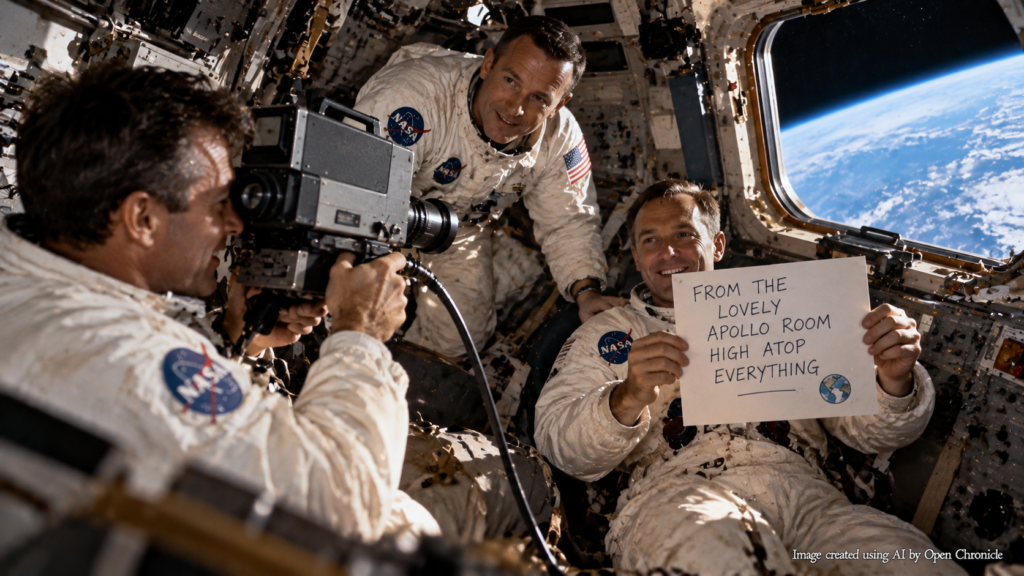
How three American astronauts, flying aboard the first crewed Apollo mission, turned a spacecraft into a television studio and helped restore confidence in NASA’s journey to the Moon.
By Open Chronicle History Desk
On October 14, 1968, millions of people were given an extraordinary opportunity.
They could watch astronauts speaking to them from a spacecraft orbiting Earth.
The broadcast came from Apollo 7, NASA’s first crewed mission in the Apollo program.
The astronauts were Walter M. Schirra Jr., Donn F. Eisele and R. Walter Cunningham.
Their spacecraft had launched three days earlier, on October 11, from Cape Kennedy in Florida.
Now, travelling hundreds of kilometers above the planet, they were demonstrating that the new Apollo spacecraft could support human life and operate in orbit.
The television transmission was brief.
Its images were imperfect.
The equipment was primitive by modern standards.
Yet the moment was historically significant.
It brought the public directly into the spacecraft at a time when NASA was attempting to recover from one of the greatest tragedies in its history.
On January 27, 1967, a fire during a ground test had killed Apollo 1 astronauts Gus Grissom, Ed White and Roger Chaffee.
The disaster had exposed serious weaknesses in the spacecraft’s design and safety procedures.
The Apollo program had been forced to stop, investigate and rebuild.
Apollo 7 was the first opportunity to demonstrate that the redesigned spacecraft was ready to carry astronauts safely.
Its success was essential.
Without a reliable command and service module, there could be no journey around the Moon, no lunar landing and no fulfillment of President John F. Kennedy’s goal of landing an American on the Moon before the decade ended.
The television broadcast was therefore more than a technological curiosity.
It was a public demonstration of progress.
The astronauts appeared on screens across Earth, joking with viewers and showing the interior of their spacecraft.
Their transmission became one of the memorable images of the early space age.
But the larger achievement of Apollo 7 was not television.
It was proving that NASA could once again send astronauts into space and bring them safely home.
1. The Space Race in 1968
By 1968, the United States and the Soviet Union had spent more than a decade competing for achievements in space.
The Soviet Union had taken several early leads.
In 1957, it launched Sputnik 1, the first artificial satellite.
In 1961, Yuri Gagarin became the first human to orbit Earth.
The United States responded with the Mercury and Gemini programs.
American astronauts learned to maneuver spacecraft, perform spacewalks and remain in orbit for extended periods.
But the ultimate American objective was the Moon.
President Kennedy had committed the United States to a crewed lunar landing before the end of the 1960s.
The Apollo program was designed to make that possible.
2. Kennedy’s Challenge
On May 25, 1961, Kennedy addressed Congress and called for a national effort to land a man on the Moon and return him safely to Earth before the decade ended.
The goal was extraordinarily ambitious.
NASA needed new rockets, spacecraft, navigation systems and life-support equipment.
Engineers had to solve problems that had never been confronted on such a scale.
The program required cooperation among government agencies, universities, contractors and thousands of specialists.
Apollo became one of the largest technological projects of the twentieth century.
Its success was not guaranteed.
3. The Tragedy of Apollo 1
On January 27, 1967, astronauts Gus Grissom, Ed White and Roger Chaffee were inside their Apollo command module during a ground test.
A fire broke out in the cabin.
The spacecraft’s pressurized oxygen environment allowed flames to spread rapidly.
The hatch could not be opened quickly enough.
All three astronauts died.
The disaster shocked NASA and the American public.
Investigations identified serious design and procedural problems.
The command module required extensive modifications.
The tragedy delayed the program.
It also forced NASA to reconsider how safety was managed.
4. Rebuilding the Apollo Spacecraft
Following the fire, NASA and its contractors redesigned important elements of the command module.
The spacecraft received improvements to wiring, materials and fire protection.
The hatch system was changed to allow faster emergency escape.
Ground-test procedures were revised.
The cabin atmosphere used during launch preparations was reconsidered.
The redesign was not a minor adjustment.
It represented a major effort to make the spacecraft safer and more reliable.
Before astronauts could travel toward the Moon, the new command module had to be tested in Earth orbit.
5. Apollo 7: The First Crewed Apollo Mission
Apollo 7 was designed to test the command and service module in space.
The mission would not travel to the Moon.
Instead, it would remain in Earth orbit for nearly eleven days.
The astronauts would evaluate propulsion, navigation, electrical systems, life support and communications.
They would also test the spacecraft’s ability to perform maneuvers required for later lunar missions.
The mission carried enormous responsibility.
A serious failure could delay the entire Apollo schedule.
A successful flight would clear the way for more ambitious operations.
6. The Apollo 7 Crew
The mission commander was Walter M. Schirra Jr., a veteran of the Mercury and Gemini programs.
Schirra had flown aboard Sigma 7 in 1962 and commanded Gemini 6A in 1965.
Apollo 7 would be his third spaceflight.
Donn F. Eisele served as command module pilot.
R. Walter Cunningham served as lunar module pilot, although Apollo 7 did not carry a lunar module.
Both Eisele and Cunningham were making their first spaceflights.
Together, the three astronauts were responsible for evaluating a spacecraft that would become central to the lunar landing program.
7. October 11, 1968: Launch
Apollo 7 launched on October 11, 1968, from Launch Complex 34 at Cape Kennedy.
The spacecraft was carried into orbit by a Saturn IB rocket.
Unlike the much larger Saturn V, the Saturn IB was intended for missions in Earth orbit.
The launch was successful.
The spacecraft entered orbit.
The crew began the complex process of testing the command and service module.
For NASA, the moment marked the return of American astronauts to space after the Apollo 1 tragedy.
8. The Saturn IB Rocket
The Saturn IB was an essential part of Apollo’s development.
It provided the power needed to launch the Apollo command and service module into Earth orbit.
The rocket consisted of multiple stages.
Its engines generated the thrust required to overcome Earth’s gravity.
Although smaller than the Saturn V, it represented a major engineering achievement.
Apollo 7 would be the Saturn IB’s only crewed Apollo flight.
Later lunar missions would rely on the larger Saturn V.
9. The Command and Service Module
Apollo 7 used the redesigned Block II command module.
The command module housed the astronauts.
It contained the flight controls, life-support systems and equipment needed for reentry.
The service module carried propulsion and other essential systems.
Together, they formed the core spacecraft that would later carry astronauts toward the Moon.
Apollo 7 was intended to prove that these systems could operate reliably for an extended period.
10. Life Inside Apollo 7
The spacecraft was cramped.
Three astronauts lived and worked inside a small cabin filled with equipment.
There was little privacy.
Every movement had to be planned around the spacecraft’s limited space.
The crew followed a demanding schedule.
They conducted tests, monitored instruments, communicated with mission control and documented the spacecraft’s performance.
Living in orbit required adaptation.
The astronauts experienced weightlessness.
Ordinary activities such as eating, sleeping and moving around became unfamiliar.
11. The First Days in Orbit
During the first days, the astronauts evaluated spacecraft systems and performed maneuvers.
One important test involved separating the command and service module from the rocket’s upper stage.
The crew then maneuvered the spacecraft in relation to the stage.
These operations helped demonstrate capabilities that would later be essential during lunar missions.
The astronauts also tested the service propulsion system.
The spacecraft performed successfully.
Mission controllers received encouraging results.
12. The Service Propulsion System
The service propulsion system was one of the most important components of the Apollo spacecraft.
Its engine would be required for major maneuvers during lunar missions.
It would help place spacecraft into lunar orbit and later send them back toward Earth.
Failure of this engine could be catastrophic.
Apollo 7 tested the engine repeatedly.
The successful firings demonstrated that the propulsion system could operate as required.
This was a major contribution to NASA’s confidence in the spacecraft.
13. Communications with Earth
Reliable communications were essential for the Apollo program.
Astronauts needed to exchange information with mission control.
Engineers needed to monitor spacecraft performance.
The mission depended on a network of ground stations and tracking facilities.
Apollo 7 tested communication systems under operational conditions.
Voice transmissions were routine.
Telemetry provided information about spacecraft systems.
Television added a new public dimension to the mission.
14. The Idea of Television from Space
NASA had already used television technology in spaceflight.
Uncrewed spacecraft had transmitted images of Earth and other celestial bodies.
The Soviet space program had also transmitted television images involving crewed spacecraft before Apollo 7.
Apollo 7’s broadcasts were therefore not the first television images ever transmitted from space.
Their significance lay in being the first live television broadcasts from an American crewed spacecraft.
They allowed viewers to see astronauts working and speaking from orbit.
The transmissions brought spaceflight into ordinary homes.
15. October 14, 1968: The First Broadcast
On October 14, Apollo 7 transmitted its first live television broadcast.
The crew used a small camera inside the command module.
The astronauts appeared before the lens.
They showed viewers parts of the spacecraft.
They also displayed humorous messages.
One sign read:
“From the lovely Apollo room high atop everything.”
The broadcast combined technological demonstration with entertainment.
It offered a rare glimpse of everyday life in orbit.
16. A Television Studio in Orbit
The Apollo 7 cabin was hardly designed as a conventional television studio.
There were no large cameras.
No lighting rigs.
No production crew.
The astronauts had to position the camera carefully.
The spacecraft’s limited interior created challenges.
Nevertheless, the broadcasts succeeded.
Viewers could see the crew in weightlessness.
The transmissions made the distant spacecraft feel unexpectedly close.
17. The Public Watches
Television had become one of the dominant forms of mass communication during the 1960s.
Millions of Americans followed major events through broadcasts.
The space program was particularly suited to television.
Rocket launches offered dramatic images.
Astronauts became public figures.
The Apollo 7 broadcasts provided something different.
Instead of watching a launch from Earth, audiences could see astronauts inside the spacecraft itself.
The result helped make space exploration more immediate and personal.
18. The Wally, Walt and Donn Show
The crew’s television broadcasts became informally known as the “Wally, Walt and Donn Show.”
The name reflected the astronauts’ first names.
The transmissions featured informal conversation and humor.
The astronauts displayed handwritten signs and interacted with viewers.
The broadcasts were a departure from the highly controlled image often associated with spaceflight.
They showed astronauts as individuals rather than distant technological symbols.
The crew eventually received a special Emmy Award in recognition of the broadcasts.
19. Why the Broadcast Was Delayed
The first television transmission had originally been planned earlier in the mission.
But the crew and mission control disagreed about scheduling.
The astronauts were dealing with a demanding workload and discomfort.
Commander Schirra was particularly concerned about completing essential spacecraft tests.
The television broadcast was postponed.
This episode reflected tensions that would emerge during the flight.
Apollo 7 was successful technically, but relations between the crew and ground controllers were not always smooth.
20. Illness in Space
During the mission, Schirra developed symptoms of a head cold.
The other astronauts also experienced respiratory discomfort.
In weightlessness, congestion can be particularly unpleasant.
Fluid distribution differs from that on Earth.
The astronauts experienced difficulties associated with blocked nasal passages.
Their discomfort affected morale.
It also contributed to disagreements with mission control.
21. The Human Side of Spaceflight
Apollo 7 demonstrated that astronauts were not simply components of a technological system.
They were human beings working under physical and psychological stress.
The spacecraft was crowded.
The schedule was demanding.
The crew was uncomfortable.
Communication with mission control sometimes became tense.
These difficulties were important lessons.
Long-duration spaceflight required attention not only to machinery but also to the health and wellbeing of crews.
22. Disagreements with Mission Control
Schirra and the crew sometimes challenged instructions from mission control.
The disagreements concerned scheduling, operational priorities and the astronauts’ physical condition.
One particularly contentious issue involved the use of helmets during reentry.
The crew feared that congestion could cause discomfort or injury during pressure changes.
Mission controllers preferred established procedures.
The astronauts ultimately reentered without wearing their helmets.
The episode became one of the best-known examples of crew-ground tension during Apollo.
23. A Mission That Had to Succeed
Despite these disagreements, Apollo 7’s technical performance was highly successful.
The spacecraft operated reliably.
Its major systems performed as expected.
The propulsion system passed important tests.
The crew completed the essential objectives.
NASA gained confidence that the redesigned command and service module was ready for more demanding missions.
This was the mission’s most important achievement.
24. The Apollo 7 Television Transmissions
Apollo 7 conducted seven television broadcasts during its mission.
The transmissions provided views of the astronauts and the spacecraft interior.
They demonstrated the feasibility of live television from an American crewed spacecraft.
They also helped NASA develop techniques for later broadcasts.
Television would become an important part of the Apollo program.
The most famous example would come during Apollo 11 in July 1969.
25. The Road to Apollo 8
Apollo 7’s success had immediate consequences.
NASA was preparing Apollo 8.
The next mission would be far more ambitious.
Instead of remaining in Earth orbit, Apollo 8 would travel to the Moon.
The crew would orbit the Moon and return to Earth.
Such a mission required confidence in the command and service module.
Apollo 7 supplied that confidence.
Its results helped make Apollo 8 possible.
26. The Decision to Orbit the Moon
NASA’s decision to send Apollo 8 around the Moon was shaped by technical progress, scheduling challenges and the broader space race.
The lunar module was not yet ready for a crewed mission.
But the command and service module had demonstrated its capabilities.
Apollo 8 offered an opportunity to test navigation, communications and propulsion beyond Earth orbit.
It also allowed NASA to advance toward Kennedy’s deadline.
The decision was bold.
Apollo 7 had helped provide the technical foundation for it.
27. December 1968: Apollo 8
On December 21, 1968, Apollo 8 launched aboard a Saturn V rocket.
The crew consisted of Frank Borman, James Lovell and William Anders.
They became the first humans to travel to the vicinity of the Moon.
On Christmas Eve, they entered lunar orbit.
Their mission produced the famous Earthrise photograph.
It also included a television broadcast from lunar orbit.
Apollo 8 represented a major step toward the lunar landing.
28. Television and the Moon
Apollo 7 demonstrated that live television from an American spacecraft was practical.
Apollo 8 extended the experience to lunar orbit.
Apollo 11 would take it further.
On July 20, 1969, Neil Armstrong and Buzz Aldrin landed on the Moon.
Armstrong’s first steps were televised to audiences around the world.
The ability to share such moments helped transform the Moon landing into a global historical event.
Apollo 7 was part of the technological and cultural path that led there.
29. The Role of Television in the Space Age
Television changed the relationship between the public and space exploration.
Before the space age, most people encountered exploration through written accounts, photographs and newsreels.
Live broadcasts introduced a new experience.
Audiences could witness events as they happened.
The Apollo program became one of the defining television narratives of the twentieth century.
The astronauts were not only explorers.
They were participants in a global media event.
30. Apollo 7 and NASA’s Public Image
The Apollo 1 tragedy had damaged confidence in NASA.
The agency needed to demonstrate that it had learned from the disaster.
Apollo 7 provided evidence of technical recovery.
The television broadcasts reinforced the message.
They showed astronauts alive, working and communicating from orbit.
The public could see the redesigned spacecraft functioning.
The broadcasts did not eliminate the risks of spaceflight.
But they helped restore a sense of progress.
31. The End of the Mission
Apollo 7 remained in space for almost eleven days.
The crew completed 163 orbits of Earth.
The mission lasted approximately 10 days and 20 hours.
On October 22, 1968, the spacecraft returned to Earth.
The command module splashed down in the Atlantic Ocean.
Recovery forces retrieved the astronauts.
The mission had achieved its principal objectives.
NASA now possessed a proven crewed Apollo command and service module.
32. The Crew’s Return
The astronauts returned to public recognition.
Apollo 7 was widely regarded as a technical success.
But the tensions between the crew and mission control affected how NASA viewed the flight.
Schirra had already announced his intention to retire from NASA.
Eisele and Cunningham did not fly in space again.
Their contributions nevertheless remained important.
They had completed the first crewed Apollo mission.
Their work helped establish the reliability of the spacecraft used in later lunar flights.
33. Lessons for Future Missions
Apollo 7 provided NASA with valuable operational experience.
Engineers studied the spacecraft’s performance.
Flight controllers reviewed procedures.
Medical specialists examined the crew’s health issues.
Mission planners considered the problems created by demanding schedules.
The experience influenced later missions.
Space exploration required continual learning.
Apollo 7 demonstrated that success could include both excellent technical results and difficult human experiences.
34. The Apollo Program Accelerates
After Apollo 7, the Apollo program moved rapidly.
Apollo 8 orbited the Moon in December 1968.
Apollo 9 tested the lunar module in Earth orbit in March 1969.
Apollo 10 rehearsed key lunar landing procedures near the Moon in May.
Apollo 11 achieved the first crewed lunar landing in July.
The pace was extraordinary.
Within nine months of Apollo 7’s return, humans were walking on the lunar surface.
35. The Engineers Behind the Mission
Apollo 7’s success depended on far more than its three astronauts.
Thousands of engineers, technicians, scientists and support personnel contributed.
They designed the spacecraft.
Tested its components.
Operated tracking stations.
Managed communications.
Prepared the launch vehicle.
Monitored the flight.
The Apollo program was a collective achievement.
The astronauts became its public representatives, but the work required an enormous technical organization.
36. The Legacy of Apollo 1
Apollo 7 cannot be understood without Apollo 1.
The deaths of Grissom, White and Chaffee forced NASA to confront serious design failures.
The resulting changes improved the command module.
Apollo 7 tested those improvements in flight.
The mission therefore represented both technological progress and the consequences of tragedy.
Its success was built on lessons learned at terrible cost.
37. Apollo 7 in the History of Broadcasting
The mission occupies an important place in broadcasting history.
Its live transmissions showed that television could operate from an American crewed spacecraft.
The broadcasts combined scientific achievement with public communication.
They helped establish a format that later space missions would use extensively.
The spacecraft became a temporary television studio.
The astronauts became presenters.
And the audience extended across an entire nation.
38. The Limits of the Images
Apollo 7’s television pictures were modest by modern standards.
The camera equipment had limited resolution.
Transmission conditions affected image quality.
The cabin was small and difficult to film.
Yet the technological achievement was considerable.
The broadcasts required coordination among spacecraft systems, communications networks and ground facilities.
The simplicity of the images should not obscure the complexity of the technology behind them.
39. The View from Orbit
For viewers in 1968, the broadcasts offered a new perspective.
The astronauts were not speaking from a studio in Houston.
They were orbiting Earth.
Their words and images crossed enormous distances through a technological network.
The broadcast made the boundary between Earth and space feel less absolute.
It suggested that human activity beyond the atmosphere was becoming an operational reality.
The future of exploration appeared closer.
40. Why October 14 Matters
October 14, 1968 marks the first live television broadcast from an American crewed spacecraft.
The event demonstrated the growing sophistication of space communications.
It helped connect the public with the Apollo program.
It also occurred during a mission of exceptional technical importance.
Apollo 7 proved that the redesigned command and service module could support astronauts safely in orbit.
That achievement helped make the next steps toward the Moon possible.
The broadcast was memorable.
The mission’s success was indispensable.
October 14, 1968: The Day Space Entered the Living Room
Imagine an ordinary American living room in October 1968.
The television is switched on.
The picture is imperfect.
The image flickers.
Then three astronauts appear.
They are not standing on a stage.
They are not sitting in a television studio.
They are travelling around Earth inside a spacecraft.
They smile.
They speak.
They show the camera their surroundings.
The broadcast lasts only a few minutes.
But it represents a remarkable change.
For the first time, Americans can watch a live television transmission from their own astronauts in orbit.
The Apollo program is no longer only a story told through rocket launches and official announcements.
It is becoming something people can witness directly.
Behind the broadcast lies a much larger achievement.
A spacecraft redesigned after a fatal tragedy is functioning successfully.
Its systems are being tested.
Its crew is alive.
NASA is preparing for the Moon.
Two months later, Apollo 8 will orbit the Moon.
Nine months later, Apollo 11 will land there.
On October 14, 1968, Apollo 7 brought live television into the American space program and helped demonstrate that the journey to the Moon was becoming possible.
Historical Sources and Further Reading
Explore the official NASA records, mission
documentation and historical studies
behind Apollo 7, the first crewed Apollo
flight and its pioneering live television
broadcasts from Earth orbit.
About Apollo 7:
The First Crewed Apollo Space Mission
NASA’s official account of the Apollo 7
mission, covering the crew, launch,
spacecraft systems, operational tests,
live television broadcasts and
successful return to Earth.
Read the NASA Mission History →
50 Years Ago:
Live from the Apollo Room
A detailed NASA historical article
documenting the first Apollo 7
television broadcast, the ground
stations involved, the astronauts’
messages and the importance of
the transmissions.
Explore the Broadcast History →
Apollo Television:
Technical History
A technical study of the Apollo
television systems, including
the slow-scan camera used on Apollo 7,
its transmission format, ground
conversion equipment and the
development of television
broadcasting during the Apollo era.
Apollo by the Numbers:
A Statistical Reference
NASA’s detailed statistical
reference for the Apollo program,
including Apollo 7 mission timing,
flight operations, television
transmission events and
orbital mission data.
October 14, 1968, marks the first
live television broadcast from an
American crewed spacecraft.
Apollo 7 launched on October 11
and returned on October 22 after
completing 163 Earth orbits.
The first television transmission
lasted approximately seven minutes.
Apollo 7 was not the first spacecraft
to transmit television images from
space. Earlier American uncrewed
missions and Soviet space activities
had already demonstrated aspects
of space-based television technology.
Its distinction lies specifically
in the first live television broadcast
from a United States crewed spacecraft.
The mission’s central achievement
was the successful qualification
of the redesigned Apollo command
and service module for crewed
operations. Its results helped
enable Apollo 8’s lunar orbital
mission in December 1968 and
the subsequent Apollo lunar
landing program.