
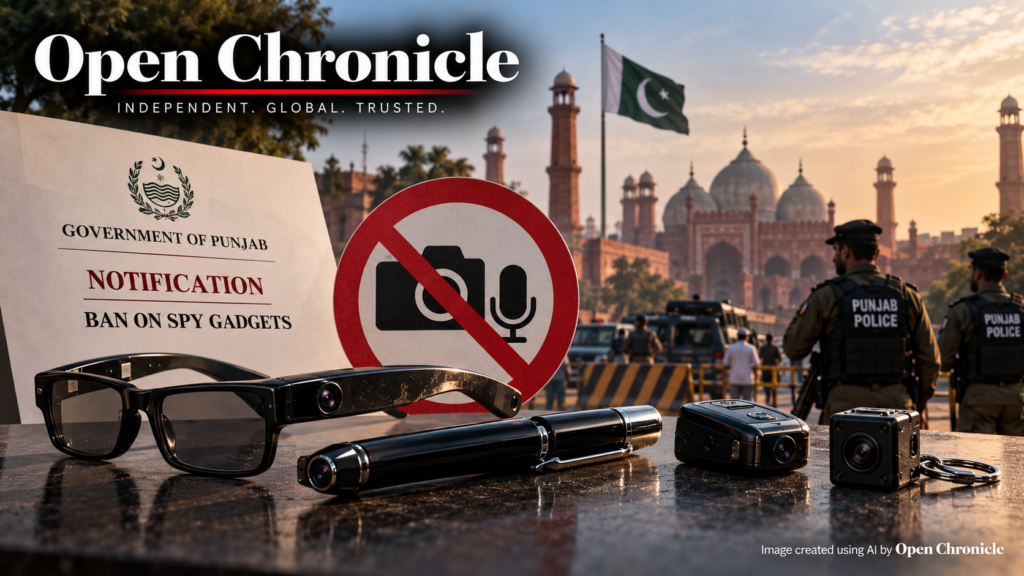
Authorities in Pakistan’s most populous province have introduced a temporary ban on the use, sale and online trading of covert recording devices, including camera-equipped glasses, pens and keychains, citing threats to personal privacy and the protection of women and children.
By Open Chronicle News Desk with Agencies
LAHORE, PAKISTAN — October 21, 2026
The government of Pakistan’s Punjab province has imposed a 30-day ban on covert surveillance gadgets capable of secretly recording photographs, videos and audio, as authorities seek to address growing concerns about personal privacy, the misuse of recording technology and the security of sensitive locations.
According to an official notification described in local reporting, the restriction covers the use, sale and online trading of devices specifically designed for concealed recording.
Among the products affected are glasses fitted with hidden cameras, camera pens and keychains containing miniature recording equipment.
The provincial government has also prohibited the commercial sale of these devices through physical shops and online platforms during the restriction period.
Authorities say the measure is intended to protect citizens from unauthorised surveillance, prevent the misuse of sensitive information and safeguard the dignity and privacy of women and children.
The notification provides exemptions for conventional electronic devices, including mobile phones, laptops and tablets, as well as terminal equipment approved by the Pakistan Telecommunication Authority (PTA).
A 30-Day Restriction on Covert Recording Devices
The Punjab government’s decision introduces a temporary restriction targeting equipment designed to record individuals or locations without their knowledge.
The notification establishes a 30-day period during which the specified devices cannot legally be used, sold or traded within the scope of the provincial order.
Unlike ordinary consumer electronics, covert recording gadgets are frequently designed to resemble everyday objects, making their surveillance functions difficult to detect.
Such devices may incorporate miniature cameras, microphones or digital storage systems inside accessories that appear harmless.
The government’s restrictions specifically identify several categories of concealed recording equipment.
These include camera-equipped spectacles, pens fitted with hidden recording technology and keychains containing covert cameras or audio-recording devices.
The notification also extends to other gadgets designed for similar secret surveillance purposes.
By covering both physical and online sales, the government is seeking to restrict the availability of these products through multiple commercial channels.
However, the information provided does not specify the penalties applicable to violations, the enforcement procedures or whether the restriction may be extended beyond the initial 30 days.
Government Cites Threats to Personal Privacy
A central justification for the ban is the potential misuse of hidden recording equipment to invade personal privacy.
According to the notification, covert surveillance devices can expose individuals to unauthorised photography, video recording and audio monitoring.
Unlike visible cameras or conventional mobile phones, concealed devices can allow recording to take place without the subject being aware that surveillance is occurring.
This raises particular concerns in private environments, workplaces, educational institutions and other locations where individuals may reasonably expect privacy.
The provincial government argues that restricting such equipment can reduce opportunities for the collection and misuse of personal information.
The measure also reflects concerns about the possible circulation of secretly recorded material.
Images, video and audio obtained without consent can potentially be used for harassment, intimidation, blackmail or other forms of abuse.
Although the notification identifies privacy risks as a central concern, the supplied information does not provide specific statistics on incidents involving these devices in Punjab.
The ban should therefore be understood as a preventive regulatory measure rather than evidence of a particular documented increase in covert recording offences.
Protecting Women and Children a Key Priority
The Punjab government has identified the protection of women and children as an important objective of the restriction.
Authorities say hidden recording equipment can threaten personal dignity and expose vulnerable individuals to intrusive surveillance.
The concern is especially relevant where recordings are made without consent and subsequently distributed or used to intimidate those involved.
The increasing availability of miniature recording technology has made it possible to conceal cameras and microphones inside ordinary-looking accessories.
While such technology may have legitimate applications in certain professional or security contexts, its misuse can create serious privacy risks.
The provincial government’s notification emphasises that preventing unauthorised surveillance is necessary to protect individuals from exploitation.
The restriction is intended to reduce access to devices that can be used to secretly capture personal images, conversations or activities.
However, the announcement does not indicate whether the government plans additional measures addressing the distribution of unlawfully recorded material or the investigation of privacy-related complaints.
Sensitive Installations Also Covered by Security Concerns
Beyond individual privacy, the Punjab government has cited the security of sensitive installations as another reason for introducing the ban.
Covert recording equipment can potentially be used to capture images, video or audio in locations where surveillance or unauthorised information collection presents security concerns.
The notification identifies the protection of sensitive information and installations as part of the government’s justification.
The measure therefore combines personal privacy objectives with broader security considerations.
Concealed recording devices may create difficulties for security personnel because their appearance can disguise their intended function.
Accessories such as pens, glasses and keychains are common everyday objects, making devices containing hidden cameras less immediately recognisable than conventional recording equipment.
The provincial government has not identified specific security incidents that directly prompted the restriction.
Nor does the supplied notification describe any particular threat involving a government facility or other protected installation.
Shops and Online Platforms Face Sales Restrictions
The ban is not limited to individuals using covert recording equipment.
It also covers businesses and online sellers offering the affected products.
Physical retailers are prohibited from selling the specified surveillance gadgets during the restriction period.
Online trading platforms and sellers are likewise included in the order.
This broader approach is intended to reduce the commercial availability of covert recording devices while the temporary measure remains in force.
The inclusion of online trading is significant because small surveillance gadgets can be marketed and distributed through digital marketplaces without requiring specialist retail premises.
By extending the prohibition to commercial transactions, the authorities are attempting to address both the possession-related use of such technology and its availability to potential buyers.
However, the supplied information does not clarify whether the government has established a dedicated monitoring mechanism for online marketplaces.
It also does not specify whether existing owners are required to surrender affected equipment or whether the restriction applies exclusively to its use and commercial distribution.
Those details would require clarification from the complete official notification.
Mobile Phones, Laptops and Tablets Remain Exempt
The provincial government has explicitly excluded several categories of conventional electronic equipment from the ban.
These exemptions include mobile phones, laptops and tablets.
Terminal equipment approved by the Pakistan Telecommunication Authority is also exempt.
The distinction is important because many ordinary electronic devices contain cameras and microphones capable of recording photographs, videos and audio.
However, the Punjab government’s restriction is directed at equipment designed specifically for covert surveillance.
Conventional smartphones and computers generally have broader communication, computing and multimedia functions.
The exemptions indicate that the authorities are not introducing a general prohibition on recording technology.
Instead, the measure focuses on gadgets whose concealed recording capabilities create particular privacy or security concerns.
The supplied information does not explain how authorities will classify products that combine ordinary consumer functions with concealed surveillance features.
Such distinctions may become important during enforcement.
The Role of the Pakistan Telecommunication Authority
The notification’s reference to Pakistan Telecommunication Authority-approved terminal equipment highlights the distinction between regulated communications devices and specialised covert recording gadgets.
The PTA is Pakistan’s telecommunications regulator, responsible for overseeing aspects of the country’s telecommunications sector and regulating relevant communications equipment.
Its approval processes provide a regulatory framework for certain categories of terminal devices.
Under the Punjab notification, equipment covered by the specified PTA approval exemption is not subject to the temporary ban.
However, the exemption should not be interpreted as a general authorisation to record individuals without consent.
The legality of recording activities can depend on the circumstances, the information collected and applicable laws.
The notification, as described in the supplied report, addresses a specific category of covert recording equipment rather than establishing comprehensive rules for all photography, video recording or audio surveillance.
A Broader Debate Over Surveillance Technology
The Punjab government’s decision comes amid wider concerns about the accessibility of miniature recording devices and the challenges of protecting privacy in an increasingly digital environment.
Technological advances have made cameras, microphones and storage components smaller and easier to incorporate into everyday objects.
These developments have expanded the range of available recording products.
They have also complicated efforts to distinguish legitimate technological applications from intrusive or unlawful surveillance.
For regulators, the challenge is to prevent misuse without unnecessarily restricting ordinary electronic devices or lawful activities.
Temporary restrictions can provide authorities with a mechanism for responding to identified concerns, but their effectiveness depends on clear rules and consistent enforcement.
The Punjab notification does not establish whether the government intends to develop permanent regulations governing covert recording equipment.
It also does not indicate whether similar measures are being considered elsewhere in Pakistan.
What Remains Unclear About the Ban?
Although the government has established the scope and duration of the restriction, several questions remain unanswered in the supplied information.
The precise commencement and expiry dates of the 30-day period have not been independently established.
The available account also does not specify which provincial department or enforcement authority will oversee implementation.
Details concerning penalties, inspections, confiscation procedures and possible exceptions for authorised professional activities have not been provided.
It is also unclear whether the government intends to review the measure before its expiry or extend it if privacy and security concerns persist.
These questions are relevant to retailers, online sellers, existing equipment owners and individuals who may use recording technology for legitimate purposes.
Further clarification from the provincial government would help establish how the restriction will operate in practice.
The Big Picture: Punjab Moves to Limit Covert Surveillance
Punjab’s temporary ban illustrates the growing regulatory challenges associated with surveillance technology that can be concealed inside everyday objects.
The government’s stated objective is to protect personal privacy, safeguard women and children and reduce risks involving sensitive information and installations.
By restricting the use and sale of hidden cameras and recording gadgets, the authorities are attempting to limit access to technology that can facilitate unauthorised surveillance.
At the same time, exemptions for smartphones, laptops, tablets and PTA-approved terminal equipment demonstrate an effort to distinguish specialised spying devices from conventional consumer electronics.
The measure’s effectiveness will depend on how clearly the authorities define prohibited equipment and how consistently the restrictions are enforced.
For now, Punjab has introduced a 30-day prohibition that places covert recording gadgets under temporary restrictions while leaving ordinary communication and computing devices outside the ban.
Whether the measure becomes the basis for longer-term regulation remains to be seen.
Sources and Further Reading
The following references provide institutional and legal background for the Punjab government’s reported restriction.
Government of Punjab — Official Portal
Provincial government information, announcements and public administration resources.
Home Department, Government of Punjab
Provincial department responsible for matters relating to public order, internal security and administrative notifications.
Pakistan Telecommunication Authority — Official Website
Information concerning telecommunications regulation, equipment approvals and regulatory responsibilities in Pakistan.
Pakistan Ministry of Law and Justice
Official institutional resources relating to Pakistan’s legal framework and legislation.
Digital Rights Foundation — Pakistan
Civil society organisation working on digital rights, online safety and privacy issues in Pakistan.
Editorial Note
This article is an original Open Chronicle news synthesis based on supplied reporting concerning a 30-day restriction on covert recording devices announced by the government of Punjab, Pakistan.
The reported prohibition on the use, sale and online trading of hidden recording equipment, together with the exemptions for conventional electronic devices, is based on the notification as described in the supplied information. Open Chronicle has not independently examined the complete official notification or verified its publication date, legal provisions and enforcement arrangements.
The article does not assume that the restriction applies to ordinary mobile phones, tablets or laptops, which are explicitly described as exempt. It also does not infer penalties, confiscation procedures or permanent regulatory changes that have not been established.
The institutional and civil society references provide background on the relevant authorities and privacy issues. They should not be interpreted as independent confirmation of the specific 30-day order.