
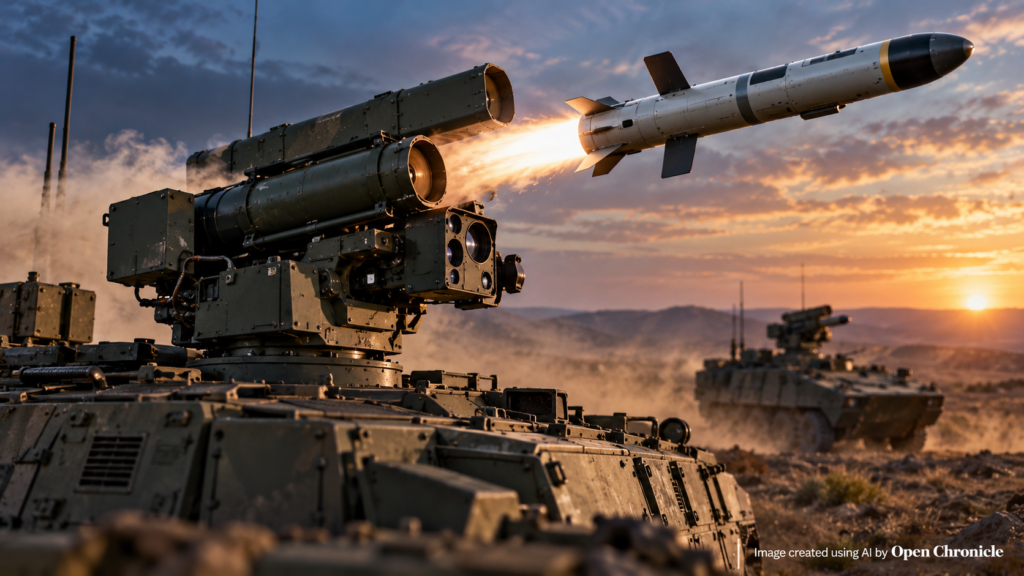
The new field-reconfigurable system is designed to allow military vehicles equipped with TOW missile launchers to integrate Spike LR2 missiles while retaining existing weapons compatibility, offering a flexible approach to ground combat modernisation.
By Open Chronicle News Desk with Agencies
UNITED STATES — October 21, 2026
Leonardo DRS has announced the development of a new Multi-Purpose Missile Launcher (MPML), a modular weapon system designed to expand the anti-armour capabilities of existing and future ground combat platforms.
The system is intended to provide military operators with greater flexibility in missile selection while reducing the need for extensive modifications to vehicles already equipped with Tube-launched, Optically tracked, Wire-guided (TOW) missile systems.
According to the company, the MPML will enable compatible platforms to employ Spike LR2 missiles while retaining the ability to operate TOW weapons, creating a pathway for modernising anti-armour capabilities without replacing established launch infrastructure.
The announcement reflects a broader trend in military technology towards modular weapon systems, open architectures and greater interoperability between existing platforms and newer precision-guided munitions.
A New Approach to Anti-Armour Modernisation
Modern ground forces increasingly face the challenge of integrating new weapons into military vehicles that may remain operational for decades.
Platforms such as the Bradley Fighting Vehicle and the Stryker family of armoured vehicles have undergone successive upgrades to extend their operational relevance.
However, incorporating new missile technologies can require substantial changes to launch systems, vehicle electronics and fire-control equipment.
Leonardo DRS says its MPML has been developed to address these challenges through a field-reconfigurable design.
Rather than requiring operators to replace an entire missile-launching arrangement, the new system is intended to function as a direct upgrade for compatible platforms already equipped with TOW launchers.
This approach could allow armed forces to introduce additional missile capabilities while preserving investments in existing equipment.
The company describes the MPML as a solution for both established ground combat vehicles and future military platforms.
Combining TOW and Spike LR2 Compatibility
The central feature of the MPML is its ability to support two different anti-armour missile families within a common launcher architecture.
The TOW missile system has served as a major anti-tank weapon for decades and remains in use across numerous military forces.
The Spike LR2, developed by Israel’s Rafael Advanced Defense Systems, represents a newer generation of precision-guided anti-armour technology.
Leonardo DRS says its new launcher has been designed to support the integration of Spike LR2 missiles while maintaining compatibility with existing TOW weapons.
The system incorporates three principal elements:
- A new lightweight launcher derived from TOW-based technology.
- Adapters designed to accommodate Spike LR2 missiles.
- A common missile control unit supporting the integrated launcher architecture.
Together, these components are intended to provide a flexible platform for operators seeking to employ different compatible missile types.
The company says the reconfigurable arrangement is designed to facilitate transitions between supported weapons without requiring major changes to the vehicle’s launcher installation.
The announcement does not establish that every existing TOW-equipped vehicle can immediately employ Spike LR2 missiles without additional qualification or integration work.
Designed for Bradley and Stryker Platforms
Leonardo DRS identifies the Bradley and Stryker among the ground combat platforms that could benefit from the MPML architecture.
The Bradley Fighting Vehicle has long been a central component of US Army mechanised formations, combining infantry transport capabilities with cannon and anti-armour weapons.
The Stryker family provides a range of wheeled armoured vehicles used for infantry transport, reconnaissance and other military missions.
Both vehicle families have been subject to modernisation programmes intended to maintain their effectiveness against evolving threats.
A launcher capable of supporting multiple missile families could provide additional options for future upgrades.
For military procurement authorities, retaining compatibility with existing systems may also offer advantages in terms of fleet management, training and the gradual introduction of new weapons.
However, the operational and financial benefits would depend on the specific vehicle configuration, integration requirements and procurement decisions.
Leonardo DRS has not specified which Bradley or Stryker variants would receive the system first.
Open Architecture Could Support Future Loitering Munitions
Beyond its immediate compatibility with TOW and Spike LR2 missiles, the MPML incorporates an open-systems architecture intended to support future weapons integration.
According to Leonardo DRS, this design could allow the launcher to accommodate compatible loitering munitions as the system evolves.
Loitering munitions are weapons capable of remaining airborne while searching for or awaiting an opportunity to engage a target.
Their increasing use in contemporary conflicts has encouraged defence manufacturers to explore systems that combine conventional guided missiles with newer unmanned precision-strike capabilities.
The MPML’s architecture is intended to provide a foundation for such future integration.
However, the company has not identified a specific loitering munition that has completed integration with the launcher.
Nor has it announced a timetable for introducing that additional capability.
The reference to loitering munitions should therefore be understood as a potential future development rather than a confirmed operational feature.
Leonardo DRS Emphasises Flexibility for Military Operators
Aaron Hankins, senior vice president and general manager of Leonardo DRS Land Systems, said the new launcher was designed to provide armed forces with a practical modernisation option.
“MPML gives warfighters a practical path to introduce new anti-armour capability while preserving the flexibility of the systems they already operate,” Hankins said.
“The launcher’s reconfigurable design supports the evolving needs of legacy and future ground combat platforms and the missions they perform.”
The company’s emphasis on reconfigurability reflects the growing importance of adapting existing military equipment to new operational requirements.
Ground combat vehicles are expensive to develop, acquire and maintain.
As a result, defence organisations frequently seek incremental upgrades that can extend the usefulness of existing platforms while introducing more capable sensors, weapons and electronic systems.
A modular launcher could support that approach by reducing dependence on a single missile family.
Nevertheless, the actual degree of operational flexibility will depend on successful integration, testing and qualification.
Why Anti-Armour Flexibility Matters
Anti-armour warfare has become increasingly complex as military forces introduce improved vehicle protection systems, advanced sensors and new precision-guided weapons.
Traditional anti-tank guided missiles remain important, but armed forces are also seeking greater flexibility in how they engage different battlefield threats.
The ability to integrate multiple missile families may allow operators to select weapons according to mission requirements, available stocks and the capabilities supported by their platforms.
It may also help defence organisations avoid becoming entirely dependent on one weapons configuration.
For military planners, such flexibility can be particularly valuable when modernising fleets that contain vehicles developed during different periods.
The MPML announcement also illustrates the importance of interoperability in defence procurement.
Open-system designs can make it easier to introduce new technologies over time, although compatibility must still be demonstrated through engineering work and testing.
What Is Known About the New Launcher?
Leonardo DRS has outlined the MPML’s intended design and capabilities, but several important details remain undisclosed.
The announcement does not provide a confirmed procurement contract, production quantity or delivery schedule.
It also does not establish whether the system has completed all necessary qualification tests for operational deployment.
No detailed information has been provided about its cost, weight, performance characteristics or the full range of vehicles that may ultimately support it.
Similarly, although the company identifies compatibility with TOW and Spike LR2 as a central objective, the announcement does not describe the complete testing status of each missile configuration.
These details will be important in determining how quickly the system could move from a newly announced capability to operational service.
For now, the MPML should be regarded as a manufacturer-announced modernisation solution whose wider adoption remains subject to future decisions.
The Big Picture: Modernising Existing Vehicles for Future Combat
The announcement of Leonardo DRS’s Multi-Purpose Missile Launcher highlights an important direction in the evolution of land warfare technology.
Rather than relying exclusively on new combat vehicles, defence manufacturers are developing modular systems that can introduce additional capabilities into established platforms.
For military forces operating large fleets of armoured vehicles, this approach offers the prospect of gradual modernisation without replacing every major component.
The MPML’s proposed compatibility with TOW and Spike LR2 missiles illustrates how existing launch systems could be adapted to support newer precision-guided weapons.
Its open architecture also points towards possible future integration of loitering munitions, reflecting the growing convergence between conventional anti-armour weapons and unmanned strike technologies.
However, the ultimate significance of the system will depend on its technical validation, operational performance and adoption by military customers.
For Leonardo DRS, the MPML represents an effort to make anti-armour modernisation more adaptable, allowing established combat platforms to evolve alongside the weapons they carry.
Whether that approach translates into widespread operational deployment will become clearer as additional technical, testing and procurement information emerges.
Sources and Further Reading
The following references provide background on the manufacturer, the missile systems and the combat platforms mentioned in the announcement.
Leonardo DRS — Official Corporate Website
Company information, defence technologies and land systems portfolio.
Rafael Advanced Defense Systems — Official Website
Manufacturer information concerning the Spike family of precision-guided missiles.
RTX — Official Website
Corporate information and resources relating to the TOW missile family.
US Army — Official Website
Institutional information about US Army ground combat vehicles, including Bradley and Stryker platforms.
Defence Connect — Defence Industry News
Defence industry reporting, including the supplied announcement concerning Leonardo DRS’s new launcher.
Editorial Note
This article is an original Open Chronicle news synthesis based on information supplied concerning Leonardo DRS’s announcement of the Multi-Purpose Missile Launcher.
The system’s stated compatibility with TOW and Spike LR2 missiles, field-reconfigurable design, open-systems architecture and intended application to Bradley and Stryker platforms are based on the manufacturer’s description. These claims have not been independently validated through operational testing information.
No procurement contract, production schedule, operational deployment date or confirmed integration of specific loitering munitions has been established by the supplied material. The article distinguishes announced capabilities from potential future applications.
The institutional links above provide manufacturer and technical background; they are not presented as independent confirmation that the MPML has entered operational service.