
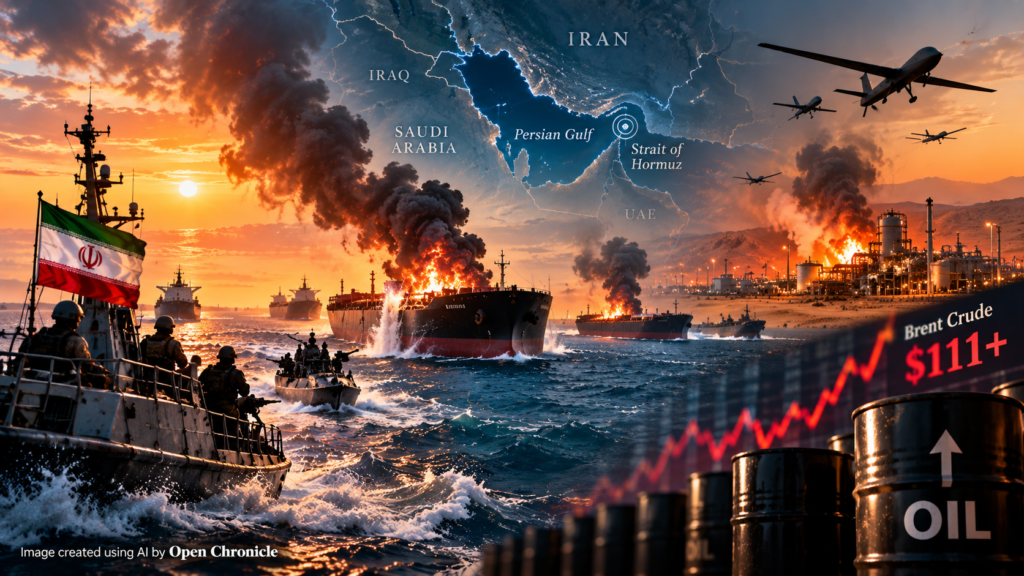
Iran’s Revolutionary Guards say four oil tankers were struck by Iranian forces and three other vessels hit mines near the Strait of Hormuz. Meanwhile, Houthi attacks on Saudi energy infrastructure have intensified concerns over regional oil supplies, prompting Washington to reduce its diplomatic presence in Saudi Arabia.
By Open Chronicle News Desk with Agencies
TEHRAN / RIYADH — October 22, 2026
Iran’s Islamic Revolutionary Guard Corps (IRGC) Navy claimed on Thursday that seven commercial vessels, including oil tankers, had been struck by Iranian forces or naval mines in the Persian Gulf over the previous 24 hours, raising fears of a broader maritime security crisis in one of the world’s most strategically important energy corridors.
The Iranian military organisation said its forces had tracked and attacked four tankers involved in oil transfers in the northern Persian Gulf, while three additional vessels had reportedly struck mines west of the Strait of Hormuz.
The claims have not been independently verified, and the IRGC did not provide sufficient information in the account available to establish the identity, flag states, ownership or extent of damage to the vessels.
The announcement was accompanied by a warning to the United States that further military provocations could trigger a wider Iranian response against American bases across the region.
The latest escalation comes as Yemen’s Iran-aligned Houthi movement intensifies attacks against Saudi Arabian infrastructure, including facilities near the strategically important Shaybah oilfield.
The combined developments have unsettled energy markets, pushing Brent crude futures above $111 per barrel during Asian trading on Thursday.
Iranian Revolutionary Guards Claim Four Tankers Attacked
According to the IRGC Navy, Iranian forces monitored four oil tankers conducting transfer operations in the northern Persian Gulf before striking them.
The organisation separately claimed that three other vessels encountered naval mines in waters west of the Strait of Hormuz.
The statement did not establish whether any of the seven vessels had sunk, whether crew members had been injured or whether oil had been released into the sea.
Nor was it immediately clear whether the reported incidents had been independently documented by international maritime security organisations.
The absence of independently confirmed details is significant because the Persian Gulf is a major international shipping route used by commercial tankers carrying crude oil, petroleum products and liquefied natural gas.
Any sustained campaign against commercial shipping could have consequences extending far beyond the immediate conflict.
The IRGC’s announcement also raises questions about the potential use of naval mines in waters used by international merchant vessels.
Unlike direct attacks against identified targets, mines can continue to threaten shipping after their deployment, potentially complicating navigation and requiring extensive clearance operations.
Tehran Warns Washington of Wider Military Response
Alongside its maritime claims, the IRGC Navy issued a warning directed at the United States.
The Iranian force said continued American provocations could lead to an expanded response targeting US military installations in the region.
The warning comes amid heightened tensions involving Iran, American forces and regional governments.
The United States maintains military facilities and personnel across the Gulf, where its security partnerships support regional defence, maritime operations and international navigation.
Any direct escalation involving those installations could broaden the confrontation beyond attacks on commercial shipping and energy infrastructure.
The IRGC statement should be understood as an Iranian military warning rather than evidence that additional attacks against American bases have already occurred.
For regional governments, the central concern is whether the confrontation can remain geographically contained or develops into a wider conflict affecting multiple countries.
Houthi Drone Attacks Threaten Saudi Energy Infrastructure
The Iranian announcement coincided with renewed attacks by Yemen’s Houthi movement against Saudi Arabian infrastructure.
The Houthis have expanded their operations as fighting continues in Yemen, where a Saudi-led coalition is attempting to regain territory in the country’s southwest.
The conflict has particular strategic importance because southwestern Yemen borders the Red Sea and lies close to the Bab el-Mandeb Strait, a critical passage connecting the Red Sea with the Gulf of Aden.
The Houthis say their attacks against Saudi targets are a response to the coalition’s military offensive.
Their operations have increasingly raised concerns about the security of Saudi energy facilities and transport infrastructure.
Among the latest incidents was an attack involving drones near the Shaybah oilfield, one of Saudi Arabia’s major oil-producing assets.
Two Killed Near Shaybah Oilfield
On Wednesday, October 21, two people were reportedly killed and two others injured by debris from intercepted drones near a processing facility associated with the Shaybah oilfield.
The incident highlighted the danger posed by aerial attacks even when incoming drones are intercepted before reaching their intended targets.
Falling debris can cause casualties and damage infrastructure beyond the immediate point of interception.
Despite the incident, operations at Shaybah and its associated processing facilities were reported to be unaffected.
That distinction is important because the attack did not, according to the available information, result in a confirmed interruption of production at the field.
Nevertheless, the proximity of the incident to a major energy installation has intensified concerns about the vulnerability of Saudi oil infrastructure.
Shaybah is located in Saudi Arabia’s Eastern Province, within the Rub’ al Khali desert, and plays an important role in the kingdom’s oil production system.
A successful attack causing prolonged disruption at a major Saudi production or processing facility could have substantial consequences for international energy markets.
The latest incident has therefore attracted attention not only because of the casualties but also because of the potential economic implications of further strikes.
Brent Crude Rises Above $111 a Barrel
Oil prices climbed by more than 2% during Asian trading on Thursday as investors reacted to the escalating attacks.
Brent crude futures rose above $111 per barrel, reflecting renewed concerns about the security of oil production facilities and tanker movements.
The price increase followed the Houthi attacks on Saudi targets and reports of maritime incidents in the Persian Gulf.
The market reaction illustrates the sensitivity of international oil prices to developments affecting major producers and shipping corridors.
Saudi Arabia has reportedly restored much of its oil export activity through routes involving the Strait of Hormuz and the Red Sea.
However, the latest attacks have revived concerns about the reliability of those routes.
Oil markets respond not only to confirmed interruptions in production but also to the possibility that future attacks could restrict supply.
The risk of damage to processing facilities, delays to tanker movements and higher shipping insurance costs can influence prices even when physical oil deliveries continue.
For oil-importing economies, sustained price increases could place additional pressure on transport costs, industrial activity and inflation.
Strait of Hormuz Remains a Critical Global Energy Route
The Strait of Hormuz, situated between Iran and Oman, is one of the world’s most important maritime chokepoints.
It connects the Persian Gulf with the Gulf of Oman and the wider Indian Ocean.
The waterway is essential for energy exports from several Gulf producers, including Saudi Arabia, Iraq, Kuwait, Qatar and the United Arab Emirates.
A major interruption to shipping through the strait could affect international oil and gas supplies.
The reported use of naval mines west of the strait is therefore particularly concerning.
Even a limited number of confirmed mine incidents could cause commercial operators to reconsider routes, delay departures or seek additional security guarantees.
The consequences would depend on the scale and location of the threat, the availability of alternative export infrastructure and the response of regional and international maritime forces.
At present, the Iranian claims concerning the seven vessels remain unverified in the information available.
Nevertheless, the reports add to an already volatile security environment.
United States Orders Diplomatic Personnel to Leave Saudi Arabia
The deterioration in regional security has also prompted a diplomatic response from Washington.
The United States has ordered non-essential government personnel, diplomats and eligible family members to leave Saudi Arabia.
The measure follows the expansion of Houthi attacks against Saudi infrastructure and mounting concerns about potential threats to American personnel.
Such departures are generally intended to reduce the exposure of diplomatic staff and their families during periods of heightened security risk.
They do not necessarily mean that an embassy or diplomatic mission is closing.
The decision nevertheless represents a significant indication of Washington’s assessment of the current security environment.
Saudi Arabia is a major American security partner, and developments affecting its territory have direct implications for US regional policy.
The departure order also comes against the backdrop of Iranian warnings concerning American military bases.
Together, the developments underline the growing complexity of the regional confrontation.
Yemen’s Conflict Adds a Second Maritime Flashpoint
The latest escalation is unfolding across two strategically important maritime areas.
In the Persian Gulf, the principal concern is the security of tanker movements and energy exports through the Strait of Hormuz.
Further south, the conflict in Yemen threatens the security of shipping around the Bab el-Mandeb Strait.
Bab el-Mandeb connects the Red Sea to the Gulf of Aden and forms part of the maritime route linking Asia and Europe through the Suez Canal.
Instability affecting both waterways could complicate international shipping operations.
For commercial operators, the risks include direct attacks, possible mining, higher insurance premiums, vessel diversions and delays.
For governments, the challenge is to protect freedom of navigation while avoiding military steps that could trigger additional escalation.
The Houthi movement’s stated justification for its attacks is linked to the Saudi-led coalition’s offensive in southwestern Yemen.
The situation demonstrates how fighting on land can produce wider consequences for maritime security and international trade.
Growing Risk to Saudi Oil Production
The attack near Shaybah has intensified concern about the possibility of future strikes directly affecting Saudi oil output.
The kingdom’s production and processing infrastructure is central to global petroleum markets.
Although the latest reported incident did not interrupt Shaybah’s operations, it has demonstrated the potential exposure of energy facilities to drone attacks.
Repeated attacks could force operators to increase protective measures and review emergency procedures.
The risk extends beyond production sites to pipelines, processing plants, export terminals and other infrastructure required to deliver oil to international customers.
The possibility of a major facility being damaged remains a risk rather than an established outcome of the latest incidents.
Nevertheless, that risk is contributing to market uncertainty.
The Big Picture: Two Maritime Chokepoints, One Growing Energy Crisis
The developments in the Persian Gulf and Saudi Arabia reveal the increasingly interconnected nature of the Middle East’s security and energy challenges.
Iran’s Revolutionary Guards claim that seven commercial vessels have been affected by military strikes or naval mines, while warning that American military installations could face a broader response.
At the same time, Houthi attacks against Saudi Arabia are bringing the threat of disruption closer to major energy installations.
The immediate economic consequence has been renewed upward pressure on oil prices, with Brent crude moving above $111 per barrel.
Three risks now stand out.
First, commercial shipping in the Persian Gulf faces growing uncertainty. If the reported vessel attacks and mine incidents are confirmed, they could lead to additional security restrictions and higher maritime operating costs.
Second, Saudi energy infrastructure is facing renewed threats. The attack near Shaybah did not interrupt operations, but it has increased concern about the consequences of future strikes.
Third, the confrontation could expand geographically. Iranian warnings directed at US bases and continuing Houthi operations raise the possibility of a broader regional escalation.
The coming days will be important in establishing whether the reported maritime incidents represent isolated attacks or the beginning of a sustained campaign against commercial shipping.
For international markets, the central question is whether oil production and export routes can continue operating without major interruption.
For regional governments and their international partners, the challenge is to prevent attacks on shipping and energy infrastructure from developing into a wider military confrontation.
With oil prices rising, maritime security deteriorating and diplomatic personnel being withdrawn, the latest escalation demonstrates how quickly instability in the Persian Gulf and Yemen can become a global economic concern.
Sources and Further Reading
The following references were provided as the basis for this article.
Iran’s IRGC Navy Says Seven Vessels Hit, Warns US of Wider Response
Reporting on statements by Iran’s Islamic Revolutionary Guard Corps Navy concerning four allegedly attacked oil tankers, three vessels reportedly struck by naval mines and warnings directed at the United States.
Oil Tops $110 as Houthi Drone Strike Near Saudi Shaybah Field Rattles Markets
Coverage of casualties following the October 21 drone incident near the Shaybah oilfield, the operational status of the Saudi energy facilities and the reaction of international oil markets.
Oil Prices Surge Above $111 as Houthis Strike Saudi Targets
Analysis of rising crude oil prices and the risks posed by attacks on Saudi Arabian energy infrastructure to global petroleum supplies and market stability.
US Diplomatic Personnel Ordered to Leave Saudi Arabia
Reporting on security measures adopted by the United States, including the departure of non-essential diplomatic personnel and eligible family members amid growing regional tensions.
Editorial Note
This article is an original Open Chronicle news synthesis based on the supplied reporting concerning Iranian maritime operations, Houthi attacks against Saudi Arabia and developments in international energy markets.
The reported attacks on seven vessels are claims attributed to Iran’s Islamic Revolutionary Guard Corps and should not be interpreted as independently confirmed incidents.
Casualty figures, the operational status of energy facilities and oil-price movements reflect the information available in the supplied reporting as of October 22, 2026.
The referenced news pages could not be independently retrieved during preparation of this edition. The article therefore distinguishes attributed military claims from reported developments and includes analytical context that should not be mistaken for independently established facts.