
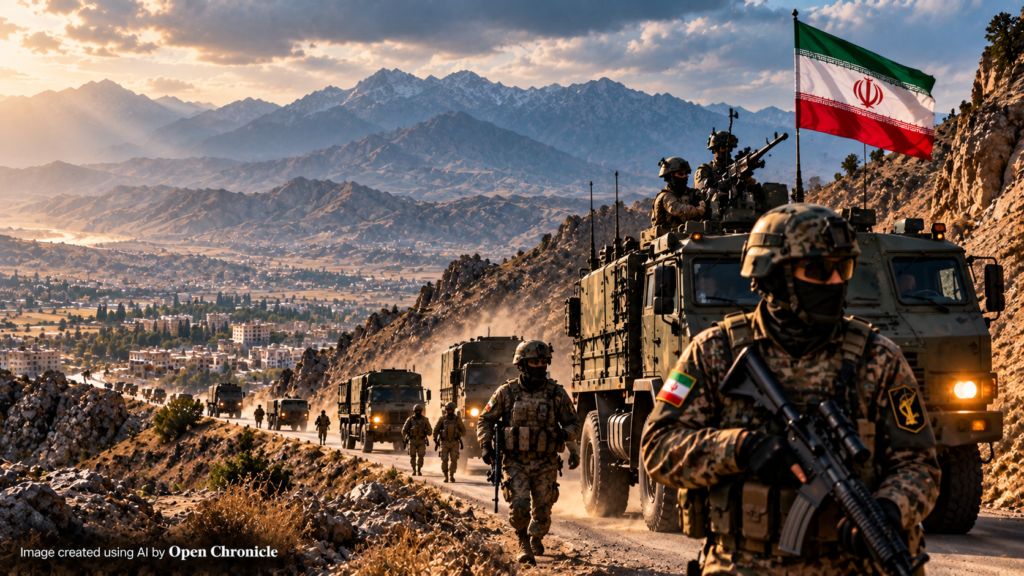
Human rights monitors report the arrival of IRGC military convoys, special forces and artillery units in several Kurdish cities and mountainous border areas. Local sources also describe reconnaissance deployments and alleged artillery and drone strikes around Shaho and Marivan.
By Open Chronicle News Desk with Agencies
SANANDAJ, IRAN — October 22, 2026
Iran’s Islamic Revolutionary Guard Corps (IRGC) has reportedly deployed substantial numbers of troops, military vehicles and heavy weapons across several areas of Kurdistan Province, according to information obtained by the Kurdistan Human Rights Network (KHRN).
The reported deployments involve Sanandaj, Kamyaran, Sarvabad, Marivan and Baneh, with military convoys said to have arrived from other Iranian provinces over recent weeks.
Local sources cited by the human rights organisation describe the movement of special forces, reconnaissance personnel and artillery-equipped units into strategically important mountainous areas.
The reports also indicate that IRGC personnel have established ambush positions near villages in the Shaho mountains and deployed artillery near the Surin mountains along the border.
The scale, operational purpose and precise command arrangements of the deployments have not been independently verified.
Nevertheless, the reported movements suggest an increased military presence in parts of western Iran where mountainous terrain and proximity to international borders have long shaped security operations.
Military Reinforcements Reported Across Five Cities
According to the Kurdistan Human Rights Network, the IRGC has transferred military personnel and equipment from other provinces into several locations throughout Kurdistan Province.
The organisation said it received information from sources in Sanandaj, Kamyaran, Sarvabad, Marivan and Baneh.
The reported reinforcements include military convoys carrying medium and heavy weapons, as well as personnel assigned to specialised operations.
Sanandaj, the provincial capital, appears to be an important destination for some of the transferred forces.
Other deployments have reportedly concentrated on mountainous areas outside urban centres, including locations near villages and along the province’s western border.
The available information does not establish the total number of troops deployed across the province or whether the movements form part of a single coordinated military operation.
No official explanation from the IRGC was included in the information supplied by the human rights network.
Special Forces Reportedly Establish Positions in Shaho Mountains
One of the most significant reported deployments concerns Kamyaran County, where local sources describe the arrival of hundreds of IRGC special forces.
An informed source in Kamyaran told the KHRN that the troops were believed to belong to the IRGC’s Saberin Unit, a formation associated with specialised military operations.
According to the source, the personnel arrived in military convoys and established positions around villages on the slopes of the Shaho mountains.
The source described the deployment as involving hundreds of personnel and reported the establishment of ambush positions in the surrounding terrain.
The Shaho mountain range forms part of the rugged landscape of western Iran, where steep slopes, valleys and remote settlements can complicate military movement and observation.
The reported establishment of ambush positions suggests preparations for operations in mountainous terrain, although the intended targets and objectives have not been identified.
The identification of the personnel as members of the Saberin Unit remains an assessment attributed to the local source rather than an independently confirmed military designation.
Reconnaissance Personnel Transferred to Sanandaj
Separate accounts from sources in Sanandaj, Sarvabad and Marivan indicate that IRGC reconnaissance personnel have also been moved into Kurdistan Province.
According to these reports, the personnel were transferred from the Hamzeh Seyyed al-Shohada Headquarters in Orumiyeh, in neighbouring West Azerbaijan Province.
Their reported destination was the IRGC’s Beyt ol-Moghaddas base in Sanandaj.
The movement would represent the transfer of personnel between two significant IRGC military installations in western Iran.
Reconnaissance units typically support military operations by gathering information about terrain, movements and potential targets.
However, the specific responsibilities assigned to the transferred personnel have not been publicly established in the information available.
The KHRN sources also linked the personnel to recent military activity in the Shaho and Marivan areas.
Artillery Bombardments and Drone Attacks Alleged
According to several sources cited by the human rights network, the transferred reconnaissance personnel participated in artillery bombardments and drone attacks in the mountainous areas of Shaho and Marivan during the previous week.
The accounts suggest that the reported troop movements have coincided with active military operations in parts of Kurdistan Province.
However, the available information does not identify the precise locations struck, the intended targets or the types of drones reportedly used.
It also provides no independently confirmed casualty figures or assessment of damage.
The allegations therefore remain attributed to the KHRN’s local sources.
If corroborated, the combination of artillery fire, drone operations and reconnaissance deployments would indicate the use of several military capabilities in the affected areas.
The presence of villages near reported military positions also raises questions about possible risks to civilians, although the supplied accounts do not establish that civilian settlements were attacked or damaged.
Artillery Convoy Reported Near Baneh Border Area
A further military deployment was reported in Baneh County, near Iran’s western border.
An informed source in Baneh told the Kurdistan Human Rights Network that an IRGC convoy equipped with artillery had moved into the area surrounding the Surin mountains.
The deployment reportedly took place along the border, adding another location to the series of military movements described across Kurdistan Province.
The Surin mountains form part of the region’s mountainous border landscape.
Artillery deployments in such terrain can support military operations over considerable distances, depending on the equipment involved.
However, the report does not identify the specific artillery systems transported to the area or establish whether the weapons have been used.
The purpose of the convoy and the duration of its deployment also remain unclear.
Western Iran’s Strategic Border Geography
Kurdistan Province occupies a strategically important position in western Iran, bordering Iraq and lying close to areas of long-standing regional security sensitivity.
Its mountainous geography presents both logistical challenges and opportunities for military forces operating in remote terrain.
Roads, mountain passes and valleys can influence the movement of personnel and equipment, while elevated positions may offer advantages for observation and surveillance.
The reported deployments around Shaho, Marivan and Baneh are therefore notable for their geographic concentration.
The transfer of reconnaissance personnel from West Azerbaijan Province also suggests military activity extending beyond a single provincial command area.
However, the information currently available does not establish whether the reinforcements are intended for border security, counterinsurgency operations, deterrence or another military objective.
Any assessment of the IRGC’s operational intentions remains provisional without further evidence or an official explanation.
Human Rights Monitoring and Independent Verification
The Kurdistan Human Rights Network documents developments affecting Kurdish communities and reports on security and human rights conditions in the region.
Its latest account is based on information provided by local sources in several cities.
Such reporting can offer insight into developments in areas where independent journalists and international observers may face restrictions.
At the same time, information obtained through confidential local sources can be difficult to corroborate independently.
The reports concerning troop numbers, unit identities, weapons deployments and military operations should therefore be distinguished from independently established facts.
In particular, the identification of Saberin personnel, the alleged participation of reconnaissance units in artillery and drone operations, and the deployment of artillery near Baneh require further verification.
The available information does not include an official IRGC response.
The Big Picture: Increased Military Activity in Iranian Kurdistan
The reported deployment of IRGC troops and heavy weapons across Kurdistan Province points to a potentially significant increase in military activity in western Iran.
According to the Kurdistan Human Rights Network, reinforcements have arrived in several cities and mountainous areas, including locations near the Iraqi border.
The accounts describe three notable developments: the reported arrival of special forces around the Shaho mountains, the transfer of reconnaissance personnel to Sanandaj and the deployment of artillery-equipped convoys near Baneh.
Sources have also alleged that IRGC personnel participated in recent artillery bombardments and drone attacks in the Shaho and Marivan areas.
The full scale and purpose of these movements remain uncertain.
Further information will be necessary to determine whether the deployments represent temporary security operations, a sustained military reinforcement or preparations for additional activity.
For communities in the affected areas, the immediate concern is the presence of armed units and heavy weapons near villages and mountainous settlements.
For observers of Iranian security developments, the reported movements raise broader questions about military priorities and operational activity along the country’s western frontier.
The central development is the reported expansion of the IRGC’s military presence across several parts of Kurdistan Province, with local sources describing special forces, reconnaissance personnel, artillery and recent drone operations. The claims remain subject to independent verification.
Sources and Further Reading
Kurdistan Human Rights Network (KHRN)
Primary reporting based on information provided by local sources in Sanandaj, Kamyaran, Sarvabad, Marivan and Baneh concerning the reported deployment of Islamic Revolutionary Guard Corps personnel, military convoys, specialised units and heavy weapons across Kurdistan Province.
Editorial Note
This article is an original Open Chronicle news synthesis based on information attributed to the Kurdistan Human Rights Network.
The reported IRGC deployments, identification of specialised military personnel, establishment of ambush positions and allegations of artillery and drone operations are presented as claims from local sources rather than independently verified findings.
The source material does not provide confirmed casualty figures, the total number of deployed personnel or an official explanation from Iranian military authorities. Geographic and military context has been included to explain the significance of the reported developments without assigning unverified motives to the operations.