
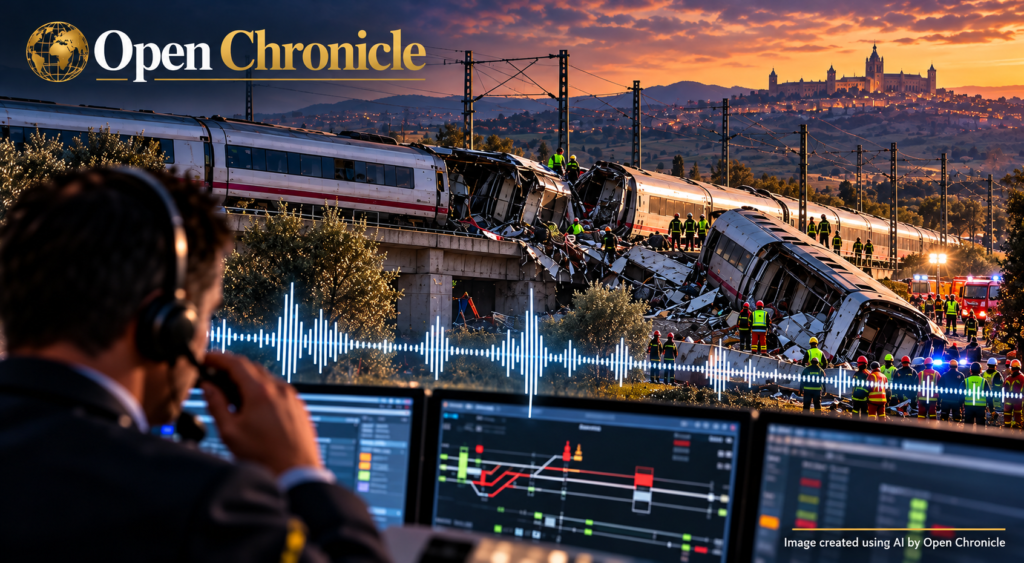
Three recordings reportedly reveal confusion between train drivers and a traffic controller before the deadly collision near Urda, Toledo, with instructions to resume normal speed now at the centre of questions over railway safety procedures.
By Open Chronicle with agencies
MADRID, October 29, 2026 — Audio recordings of communications between train drivers and a railway traffic controller have raised new questions about the circumstances surrounding Wednesday’s deadly collision between two high-speed trains near Urda, in Spain’s Toledo province.
According to information attributed to Spanish newspaper El País, three recordings suggest that both trains received instructions to resume their journeys at normal speed despite an earlier technical problem that had brought one of the services to a halt.
The latest information supplied for this report places the death toll at 68, a substantial increase from the 30 fatalities reported earlier. That updated figure has not been independently confirmed.
The recordings reportedly capture approximately five minutes of communications and suggest that crucial safety procedures may not have been followed before the collision.
However, the precise sequence of events, the responsibilities of the railway personnel involved and the technical cause of the disaster remain matters requiring official investigation.
Audio Recordings Reveal Confusion Before Collision
According to El País, the first communications began at approximately 8:36 a.m. local time on Wednesday, October 28.
The exchanges involved the driver of an AVE high-speed train and a railway traffic controller.
At that stage, the AVE service was reportedly stopped approximately 25 kilometres from an Iryo train that had experienced a technical problem.
The Iryo driver had previously informed railway authorities that the train was stationary because of the malfunction and could not resume its journey.
The situation required coordination between the two services and the traffic-control system to ensure that movements along the railway line remained safe.
However, the reported recordings suggest that the subsequent instructions did not adequately account for the continuing difficulties affecting the Iryo train.
The conversations, described by El País as confused, have become central to questions about how the collision could have occurred.
Controller Reportedly Ordered AVE Train to Resume Normal Speed
One of the most significant details concerns an instruction allegedly given to the AVE driver.
According to the newspaper’s account, the traffic controller instructed the stationary AVE train to continue its journey at normal speed.
The supplied report states that the applicable safety procedure instead required the train to proceed at 40 kilometres per hour.
That distinction could prove important to investigators.
Speed restrictions are used in railway operations to reduce risks when normal traffic conditions are disrupted, including situations involving technical faults or uncertainty about the position of another train.
The instruction to resume normal speed therefore raises questions about whether the controller had an accurate understanding of the situation ahead.
It also raises questions about the information available to the AVE driver when the instruction was received.
The recordings alone, as described in the supplied material, do not establish whether the controller’s instruction was the direct cause of the collision.
Investigators will need to examine the complete communications, signalling records, train-control systems and operational procedures before reaching that conclusion.
Iryo Train Reportedly Unable to Restart
The Iryo service was also reportedly instructed to resume its journey at normal speed.
However, approximately seven minutes later, its driver contacted railway control again to report that the train could not restart.
The second communication indicated that the technical problem had not been resolved.
According to the account attributed to El País, the AVE train was not warned to brake while sufficient time may still have remained to prevent the collision.
That reported failure is among the most serious issues raised by the recordings.
The sequence suggests a possible breakdown in communication between the railway traffic controller and the two trains.
However, the information supplied does not establish exactly when the AVE train began moving, how fast it was travelling before impact or what warnings were available through its onboard safety systems.
Those details will be essential to reconstructing the accident.
Safety System Failure Becomes Central to Investigation
The recordings have also drawn attention to a reported failure of the LZB train-control system, which is used to supervise train movements and enforce operating restrictions.
According to reporting by Spanish public broadcaster RTVE and news agency EFE, the system stopped functioning at approximately 8:30 a.m., causing several trains on the Madrid–Seville high-speed line to halt.
Six minutes later, the AVE driver received instructions from the Adif control centre at Madrid’s Atocha station to disconnect and reconnect the system before resuming normal operation.
The significance of the instruction lies in the distinction between normal operation and the more restrictive procedures required when automatic train protection is unavailable.
Spanish reporting indicates that the AVE should have been operating under a precautionary procedure known as marcha a la vista, which required a maximum speed of 40 kilometres per hour under the conditions described.
Instead, the driver was reportedly authorised to proceed at normal speed.
The recordings have prompted questions about why the precautionary restriction was not applied and whether the control centre correctly assessed the position of the stationary Iryo service.
Investigators must also determine why the failure of the LZB system did not result in an effective alternative means of preventing the collision.
The Final Minutes Before Impact
The emerging timeline provides a clearer picture of the events leading up to the accident.
According to information released by Spanish authorities and the recordings reported by national media, the LZB system failed at approximately 8:30 a.m.
At 8:36 a.m., the AVE train received permission to resume its journey.
Around 8:41 a.m., the Iryo driver informed the control centre that the train remained stopped near the entrance to Urda station.
The driver was instructed to attempt to restore the system and continue the journey.
A later communication confirmed that the Iryo train was still unable to move.
The AVE continued along the same railway line and struck the stationary Iryo train at approximately 8:53 a.m., according to the timetable provided by Spain’s Ministry of Transport.
Some reports have cited a different collision time, making the precise chronology an important issue for investigators.
The approximately 17-minute interval between the AVE’s authorisation to move and the reported impact is likely to receive particular scrutiny.
Investigators will need to establish whether the control centre had sufficient information and time to issue a warning or emergency instruction.
Transport Minister Describes Decision as Inexplicable
Spain’s Transport Minister, Óscar Puente, has publicly questioned the decision to authorise the AVE to resume normal operation while another train remained stationary ahead.
He described the instruction from the control centre as inexplicable and clearly mistaken, according to Spanish media reports.
Puente also indicated that the control centre had time to identify the danger before the collision.
The minister’s remarks place particular emphasis on operational decision-making following the failure of the train-control system.
However, his assessment does not replace the conclusions of an independent technical or judicial investigation.
The investigation must establish how the instructions were issued, what information was available to the personnel involved and whether the relevant railway regulations were breached.
The responsibilities of individual employees and institutions cannot be definitively established solely from the published audio excerpts.
Death Toll Reaches 68 as Spain Mourns
The collision has become one of Spain’s deadliest railway disasters in recent years.
Authorities in Castilla-La Mancha reported at least 68 fatalities, with many other passengers injured.
Emergency personnel worked among the wreckage after several carriages derailed, including vehicles that fell down an embankment.
The crash has also renewed public concern about the safety of Spain’s high-speed railway network.
It follows the January 2026 accident near Adamuz, in Córdoba province, which killed 46 people.
Although both disasters occurred on the Madrid–Andalusia railway corridor, there is no established evidence that they shared the same technical or operational cause.
The latest investigation will need to examine the specific circumstances of the Urda collision before any broader conclusions can be drawn.
Questions Facing Spain’s Railway Authorities
The publication of the recordings has brought several issues to the centre of the investigation.
One concerns the handling of the LZB system failure and the procedures applied when normal train protection became unavailable.
Another concerns communication between the control centre and the drivers, particularly after the Iryo service reported that it remained unable to move.
Investigators will also need to establish whether the AVE’s speed complied with the applicable emergency operating rules and whether the control centre could have intervened before impact.
A further question is whether the information available to railway personnel was sufficient to identify that both trains were on the same track and that one remained stationary.
These issues will require examination of the complete recordings, electronic logs, signalling data and operational documentation.
Investigation Continues
The newly reported recordings represent an important development in understanding the circumstances of the disaster.
They indicate that the AVE driver received permission to resume normal operation after a train-control system failure, while the Iryo service remained unable to continue its journey.
They also raise serious questions about the effectiveness of communication and the application of precautionary railway procedures.
Nevertheless, the recordings are only part of the evidence.
A definitive account will require investigators to reconstruct the movements of both trains, determine the operational status of the safety systems and establish the decisions taken at the control centre.
For the families of the victims, the immediate priority remains obtaining reliable answers about how the collision occurred.
For Spain’s railway authorities, the challenge is to establish whether failures in operating procedures, communication or safety systems allowed a dangerous situation to develop into a catastrophe.
The central question is why the AVE was authorised to resume normal speed while another train remained stopped ahead on the same railway line — and why no effective intervention prevented the collision.
Editorial Note
This article is based on information supplied concerning the October 28, 2026, high-speed train collision near Urda, Toledo, supplemented by reporting from Spanish news organisations and statements attributed to railway and government authorities. The audio recordings described in the article have been reported by multiple media outlets, but their publication does not constitute a completed technical investigation. The reported death toll of at least 68 reflects figures released by regional authorities on October 28 and may be revised. Allegations of operational error and breaches of safety procedures remain subject to official investigation. No individual or institution should be considered legally responsible solely on the basis of the published recordings.
Sources and Further Reading
01 — EFE
October 28, 2026. Reporting on the communications between Adif’s control centre and the AVE driver.
02 — RTVE
October 28, 2026. Examination of the three audio recordings and the reported LZB system failure.
03 — El País
October 28, 2026. Coverage of the collision, government statements and the developing investigation.
04 — Cadena SER
October 28, 2026. Reporting on the audio recordings and the precautionary speed restrictions.
05 — Castilla-La Mancha Regional Authorities
Casualty figures and emergency response information.