
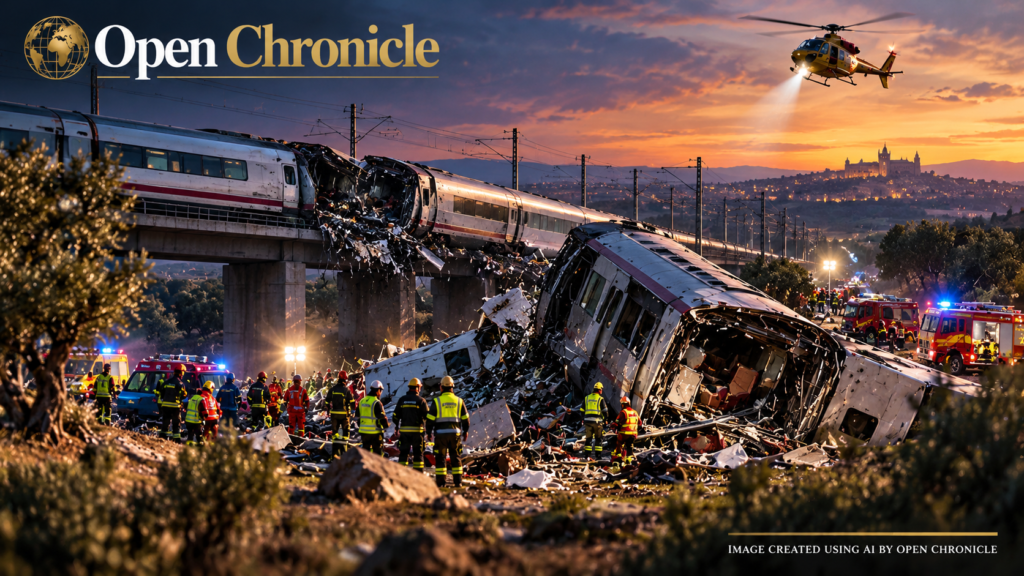
The collision on the Madrid–Andalusia rail corridor leaves extensive wreckage and raises renewed questions about railway safety, nine months after another deadly accident on the same line.
By Open Chronicle with agencies
MADRID, October 28, 2026 — At least 30 people were killed when two high-speed trains collided in central Spain on Wednesday, according to regional authorities, in the second major fatal accident in less than a year on the railway corridor connecting Madrid with the southern region of Andalusia.
The government of Castilla-La Mancha confirmed that the death toll had risen from an initial figure of 10 to 30, warning that the number could increase as emergency operations continued.
Images broadcast by regional television showed extensive damage at the accident site, including a derailed train with at least one carriage remaining on an elevated section of railway track.
Twisted metal, broken panels and other debris were scattered across an embankment beneath the line, illustrating the force of the collision.
The disaster has renewed attention on the safety of Spain’s high-speed railway network, particularly following a previous collision involving trains operated by the same companies on the same corridor in January.
Death Toll Rises as Scale of Disaster Emerges
The full scale of Wednesday’s collision became clearer as regional authorities released updated casualty figures.
Initial reports indicated that at least 10 people had died. However, the Castilla-La Mancha regional government subsequently raised the confirmed toll to 30.
Authorities warned that the number of fatalities could increase.
The supplied reports did not establish a definitive number of injured passengers or provide a complete account of how many people were travelling aboard the two trains.
The accident occurred on one of Spain’s principal high-speed railway corridors, connecting the capital with Andalusia, a region that includes major cities such as Córdoba, Seville and Málaga.
The collision left substantial wreckage around the railway infrastructure.
Television footage showed damaged rolling stock and debris extending down an embankment, while at least one carriage remained on an elevated section of track.
The images suggested that the impact had caused extensive structural damage to parts of the trains.
The exact sequence of events leading to the collision had not been established in the initial reports.
Passenger Describes a Massive Impact
One passenger travelling in the rear carriage of one of the trains described the moment of the collision as a sudden and terrifying experience.
Miguel, who was travelling with several colleagues, told Spanish radio station COPE that he heard an exceptionally loud noise before realising that another train had been involved.
“We heard a massive roar, a truly enormous thud that went on for 10 seconds, as if the train were about to derail,” he said.
“Through the right-hand window, we could see a wrecked train — I imagine it must have been the other one.”
His account provides an indication of the force of the impact and the confusion experienced by passengers in the immediate aftermath.
The description of a prolonged, violent noise suggests that passengers had little opportunity to understand what was happening as the collision unfolded.
The witness testimony does not, however, establish the cause of the accident or the sequence in which the trains collided and derailed.
Those questions will require a technical investigation.
Television Images Show Extensive Wreckage
Footage broadcast by Castilla-La Mancha Television revealed the severity of the damage.
At least one carriage could be seen remaining on an elevated section of the railway line, while wreckage was scattered beneath the tracks.
The images showed twisted metal and broken exterior panels, with debris spread across the surrounding embankment.
The visual evidence illustrates the destructive consequences of a collision involving high-speed railway vehicles.
However, the footage alone does not establish the speed of either train at the moment of impact or identify the mechanical, operational or infrastructure factors that may have contributed.
Those details will be essential to understanding how the accident occurred.
Investigators will need to reconstruct the movements of both trains and examine the condition of the railway infrastructure and the relevant operating systems.
Second Deadly Collision on the Same Line in Nine Months
Wednesday’s disaster comes nine months after another major accident involving high-speed trains on the Madrid–Andalusia corridor.
In January, 46 people were killed when a train derailed and collided with an oncoming service near Adamuz, in the province of Córdoba.
That accident involved trains belonging to the same operators identified in reports of Wednesday’s collision.
The January disaster prompted a national debate about railway maintenance, infrastructure investment and the safety of Spain’s expanding high-speed rail network.
The latest collision is likely to renew those discussions.
Although the two accidents occurred on the same broad corridor, there is no basis in the supplied information to conclude that they shared a common cause.
Each incident requires its own investigation, supported by technical evidence.
Nevertheless, the occurrence of two fatal collisions within nine months raises questions that transport authorities will be expected to address.
These include the condition of railway infrastructure, inspection procedures, maintenance planning and the effectiveness of systems designed to prevent serious accidents.
Railway Maintenance Returns to the National Debate
Spain operates one of Europe’s most extensive high-speed railway networks, connecting Madrid with major cities across the country.
The network has become an important component of national transport infrastructure, supporting business travel, tourism and connections between regional economic centres.
High-speed rail depends on multiple layers of safety, including track maintenance, signalling, train-control systems, rolling-stock inspections and operational procedures.
A failure in one area does not necessarily explain a collision, and investigators must examine the available evidence before identifying contributing factors.
Following January’s fatal accident near Adamuz, public debate focused on whether investment in railway maintenance had kept pace with the demands placed on the network.
Wednesday’s collision is expected to bring those concerns back into focus.
Any assessment of the system’s safety will need to distinguish between established technical findings and broader political arguments over infrastructure funding.
The latest disaster makes the outcome of a transparent and comprehensive investigation particularly important.
Investigators Face Questions About the Cause
The cause of Wednesday’s collision remains undetermined in the information available.
A technical investigation would ordinarily examine the operating conditions of both trains, the state of the railway infrastructure and the sequence of events immediately before impact.
Particular attention may be given to signalling records, train movements, communication between railway personnel and any available onboard recording systems.
Investigators may also assess the condition of the track and relevant components of the trains.
The aim will be to establish whether the collision resulted from a technical malfunction, an operational problem, infrastructure damage or a combination of circumstances.
At this stage, attributing responsibility to a particular company, institution or individual would be premature.
The findings will be important not only for determining the cause of the accident but also for identifying measures that could reduce the risk of similar incidents.
A New Tragedy for Spain’s Rail Network
The collision represents another devastating episode for Spain’s railway system.
For passengers and their families, the immediate consequences are the loss of life, injuries and uncertainty surrounding those affected.
For the railway sector, the accident presents an urgent need to establish what happened and whether existing safety arrangements require changes.
The proximity of the latest disaster to January’s fatal collision adds to the public significance of the investigation.
The two incidents have occurred within less than a year on a corridor that plays an important role in Spain’s national transport network.
While their causes cannot be assumed to be connected, the recurrence of a major fatal accident will intensify scrutiny of railway safety and maintenance.
What Happens Next?
The immediate priorities are the completion of emergency operations, identification of victims and confirmation of the final casualty figures.
Authorities will also need to assess the damage to the railway infrastructure and determine when the affected section can safely return to operation.
The technical investigation will seek to establish the sequence of events and identify the factors that contributed to the collision.
Its conclusions may influence future railway maintenance policies, inspection procedures and safety regulations.
For now, the confirmed information remains limited.
At least 30 people have died, according to the Castilla-La Mancha regional government, and the death toll may rise.
The cause of the collision has not been established.
Nine months after another tragedy on the same railway corridor, Spain faces renewed questions about the safety of its high-speed rail system — questions that can only be answered through a detailed examination of the evidence.
Editorial Note
This article is based on information supplied concerning the October 28, 2026, collision between two high-speed trains on Spain’s Madrid–Andalusia railway corridor. The reported death toll of at least 30 is attributed to the Castilla-La Mancha regional government, while descriptions of the wreckage and passenger testimony are attributed to Castilla-La Mancha Television and COPE radio. The account of the January collision near Adamuz is included as historical context. The cause of Wednesday’s accident has not been established in the supplied material, and no connection between the causes of the two accidents should be assumed. Casualty figures and other details may change as official information becomes available.