
OPEN CHRONICLE | INTERNATIONAL RELATIONS | 10 NOVEMBER 2026
Myanmar’s military-backed government is courting American investment in minerals essential to modern technology. But the deposits lie at the intersection of civil war, Chinese industrial dominance and an environmental crisis. Washington’s renewed diplomatic engagement raises a difficult question: can critical mineral security be pursued without reinforcing the forces destabilising Myanmar?
By Open Chronicle International Affairs Desk
Analysis | Power and Global Change
A new front in the struggle for critical minerals
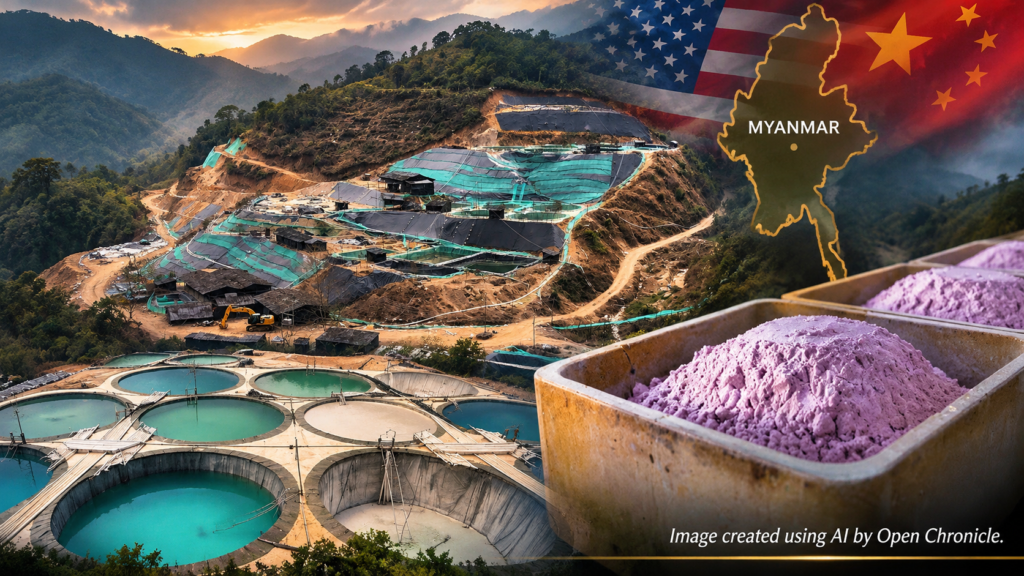
In the mountains of northern Myanmar, a largely overlooked struggle over some of the world’s most strategically important minerals is becoming entangled with the rivalry between the United States and China.
The prize is not oil, natural gas or gold.
It is a group of elements known as rare earths, essential to technologies ranging from electric vehicles and wind turbines to advanced industrial equipment and military systems.
On 10 November 2026, Reuters reported that Myanmar’s military-backed government was urging Washington to accelerate diplomatic engagement and investment in the country’s rare earth sector.
The appeal followed the publication of a United States State Department strategy outlining ambitions to expand American commercial influence in Myanmar, including potential access to critical mineral deposits.
A Washington lobbying firm, DCI Group, acting on behalf of Myanmar’s information ministry, argued that the country’s mineral resources should become a central element of renewed relations with the United States.
The proposal appears straightforward: Myanmar possesses strategically important resources, while Washington wants to reduce its dependence on Chinese supply chains.
But the reality is far more complicated.
The most important mining districts are situated in territory affected by Myanmar’s civil war. Major deposits in Kachin State are controlled by the Kachin Independence Army, an ethnic armed organisation fighting the country’s military.
Meanwhile, China occupies a dominant position in the processing and manufacturing stages that transform raw minerals into technologically valuable products.
The central issue is therefore not simply who can obtain Myanmar’s rare earths.
It is who controls the territory, who processes the minerals, who receives the revenues and whether a new international competition for resources could deepen an already devastating conflict.
The story reveals how the global race for technological independence can become inseparable from local struggles over sovereignty, security and survival.
Why rare earths have become a strategic priority
Rare earths are a group of 17 chemical elements with properties that make them important for advanced manufacturing.
Despite their name, many are not exceptionally rare in the Earth’s crust. The difficulty lies in locating economically viable deposits, extracting them and separating individual elements into materials suitable for industrial use.
Among the most strategically important are neodymium, praseodymium, dysprosium and terbium.
These elements are used in high-performance permanent magnets, particularly those required in certain electric motors, wind turbines and advanced industrial systems.
Dysprosium and terbium can improve the performance of magnets under demanding temperature conditions.
This makes them especially valuable in applications where efficiency, reliability and compact design are important.
Their significance extends beyond civilian manufacturing.
Rare earth materials also have applications in aerospace, defence electronics and other strategically sensitive technologies.
For governments seeking greater industrial independence, reliable access has become a national security concern.
The International Energy Agency’s Global Critical Minerals Outlook 2026, published in July, identifies supply chain concentration as a major vulnerability.
China remains particularly influential in rare earth separation, refining and downstream manufacturing.
The distinction between mining and processing is crucial.
A country can possess significant deposits without having the industrial capacity to turn them into finished magnets.
And a company may obtain raw materials from several countries while remaining dependent on a single processing centre.
This is one reason Myanmar matters.
Its deposits provide important raw materials to a global manufacturing system whose most valuable processing capabilities remain heavily concentrated in China.
Myanmar’s position in China’s industrial supply chain
Myanmar has become one of the world’s major sources of heavy rare earth elements.
Much of its production crosses the border into China, where the minerals enter processing facilities and industrial supply chains.
China’s advantage is not limited to its domestic geological resources.
It has developed extensive capabilities in separation, refining, metal production, alloy manufacturing and magnet production.
This industrial infrastructure gives Beijing influence over multiple stages of the value chain.
According to Reuters, China produces approximately 90 percent of the world’s rare earth magnets.
That concentration is strategically significant because the finished magnets, rather than the raw mineral deposits alone, are what manufacturers ultimately need.
A disruption in mining supplies can affect processors.
But an interruption in refining or magnet production can also affect manufacturers even when alternative mineral deposits are available.
The International Energy Agency warned in its 2026 outlook that new mining projects outside dominant producing countries are not being matched by sufficient investment in processing and downstream manufacturing.
For the United States, this creates a difficult problem.
Obtaining access to additional mineral resources is only one part of supply chain diversification.
The country must also develop or secure the industrial capacity to process those resources.
Myanmar could potentially contribute to a more diversified supply network.
But mineral access alone would not eliminate dependence on Chinese technology, infrastructure or manufacturing expertise.
Washington’s diplomatic shift
The latest developments represent a notable change in the American approach to Myanmar.
Following the military coup of February 2021, Washington imposed sanctions on military leaders and associated entities, froze certain Myanmar assets and sought to isolate the military authorities diplomatically.
The coup had overthrown the elected civilian government and triggered widespread resistance.
The subsequent conflict evolved into a complex civil war involving the military, ethnic armed organisations and resistance movements.
For several years, American policy focused heavily on sanctions, political pressure and support for a return to democratic governance.
In 2026, however, Washington reopened direct contacts with Myanmar’s military-backed leadership.
Reuters reported that American officials held discussions in September and subsequently met Myanmar representatives in Tokyo in October.
The renewed engagement has involved several American priorities, including the fight against online scam operations, the treatment of American citizens, the operating environment for businesses and prospects for a political settlement.
Critical minerals have become another important consideration.
A State Department strategy document, approved in August and published in October according to Reuters, explicitly linked diplomatic engagement and possible peace initiatives with opportunities for access to Myanmar’s mineral resources.
The document reportedly envisaged efforts to facilitate dialogue among competing political and armed actors.
It also established commercial objectives, including securing at least three significant agreements involving American companies, each valued above $5 million.
These are policy objectives, not completed investment agreements.
There is no verified evidence in the reporting reviewed that American companies have already secured operational control of Myanmar’s principal rare earth mines through this initiative.
The distinction matters.
Diplomatic discussions and investment ambitions do not automatically translate into access to territory, production facilities or export routes.
The problem Washington cannot negotiate away
Myanmar’s mineral geography does not align neatly with the authority claimed by its central government.
Many important deposits are located in Kachin State, close to the Chinese border.
The region has experienced decades of conflict involving the Kachin Independence Army and Myanmar’s armed forces.
The Kachin Independence Army is not simply an opposition movement operating from distant territory.
It is an established ethnic armed organisation with territorial influence, military capabilities and political objectives centred on autonomy and the future structure of Myanmar.
Control of important rare earth mining areas shifted during the conflict, particularly as ethnic armed forces challenged positions previously held by military-aligned groups.
This creates an immediate obstacle to the investment strategy promoted by Myanmar’s military-backed authorities.
A government may invite foreign companies to invest in national resources without possessing effective control over the land where those resources are located.
It may also lack the capacity to guarantee security, infrastructure access or enforceable agreements.
For investors, these are not secondary considerations.
They determine whether mining projects can operate, whether contracts can be implemented and whether revenues can be transferred without violating sanctions or other legal restrictions.
For Washington, the challenge is even more complicated.
Any effort to gain access to deposits may require engagement with multiple actors whose political interests conflict.
An agreement with the military-backed government would not necessarily secure access to mines controlled by the Kachin Independence Army.
And negotiations with armed organisations would raise separate questions about legitimacy, local governance and the distribution of future revenues.
This is where the language of mineral security encounters the political realities of civil war.
China has advantages that extend beyond ownership
Beijing’s position in Myanmar is often described simply as dominance.
That description captures the scale of China’s economic influence but risks overlooking the complexity of its relationships with actors inside the country.
China maintains important interests in border security, trade, infrastructure and access to natural resources.
Its commercial networks have developed over many years, giving Chinese companies and intermediaries established connections to Myanmar’s mineral economy.
Beijing also possesses processing facilities capable of absorbing heavy rare earth supplies from the border region.
These relationships are difficult for a new investor to reproduce quickly.
China’s influence does not mean that every armed group in northern Myanmar acts under Beijing’s direct control.
Local organisations pursue their own political, territorial and economic interests.
Their relationships with China can involve cooperation, dependence, negotiation and disagreement.
Nevertheless, Chinese authorities and businesses possess geographical and industrial advantages that American companies would struggle to match.
Transport distances are shorter.
Commercial networks already exist.
Processing capacity is established.
And Chinese companies have accumulated technical experience in the sector.
The November lobbying campaign acknowledged these realities.
Myanmar’s representatives argued that American engagement would need to move beyond limited commercial targets if Washington hoped to compete effectively.
But larger investments would not, by themselves, resolve the underlying political and security obstacles.
The United States would still need reliable partners, legal clarity, secure logistics and processing capacity.
China’s position has been built across an entire industrial ecosystem.
Replacing or diversifying that ecosystem would require sustained investment far beyond the purchase of mineral rights.
The hidden environmental cost of strategic minerals
The geopolitical debate over rare earths frequently concentrates on governments, companies and industrial supply chains.
For communities living near mining operations, the most immediate concerns are often different.
They include contaminated water, damaged farmland, deforestation, hazardous working conditions and the loss of livelihoods.
Heavy rare earth extraction in parts of Myanmar has expanded rapidly since the 2021 coup.
A 2024 investigation by Global Witness documented extensive mining activity in Kachin State and reported serious environmental and social consequences.
The organisation found that Chinese imports of heavy rare earth oxides from Myanmar had risen from approximately 19,500 tonnes in 2021 to 41,700 tonnes in 2023.
Those figures describe a historical period, not production volumes for 2026.
Satellite imagery and community testimony indicated the expansion of mining sites, while environmental testing identified highly acidic water and elevated concentrations of arsenic in affected streams.
The extraction methods used in some mining areas involve chemical leaching, a process intended to separate rare earth elements from mineral-bearing material.
Without adequate controls, chemical residues and contaminated runoff can enter surrounding soil and waterways.
A 2025 investigation by Myanmar Witness, part of the Centre for Information Resilience, documented the expansion of mining activity around Pang War and neighbouring areas in Kachin State.
Its satellite-based research indicated substantial growth in the geographical footprint of mining operations between 2018 and 2024.
The consequences are not confined to Myanmar.
Mining-related pollution has become a transboundary concern, particularly for communities along rivers flowing into northern Thailand.
In 2026, United Nations human rights experts raised concerns about reported contamination associated with mining activities in Myanmar and their effects on downstream populations.
The available evidence points to serious environmental risks, although individual pollution incidents and their precise sources require careful investigation.
This introduces another dimension to the American investment debate.
If Washington wishes to build more secure and responsible supply chains, the question cannot be limited to whether mineral supplies become less dependent on China.
It must also consider whether extraction takes place under credible environmental standards, transparent ownership arrangements and enforceable protections for workers and local communities.
Otherwise, diversifying the international supply chain could reproduce some of the same problems under a different commercial structure.
When mineral revenues become part of the conflict
Natural resources can contribute to economic development.
But in territories where political authority is fragmented and armed groups control access to land, mineral revenues can also become a source of conflict financing.
Myanmar illustrates this problem.
Different armed organisations and military-aligned groups have exercised influence over mining areas, transport routes and commercial transactions.
Control of mineral production can provide revenue through taxation, licensing arrangements, fees or other forms of economic extraction.
A February 2026 report from the Office of the United Nations High Commissioner for Human Rights described links between extractive activities and armed conflict in Myanmar.
It identified concerns about mining revenues supporting armed actors and documented serious environmental and civilian protection risks.
These findings do not establish that every mining operation finances the same organisation or that all mineral transactions are unlawful.
The relationships vary across territories and operators.
Nevertheless, they demonstrate why the political economy of extraction matters.
A foreign investment agreement that increases mineral production without addressing governance could strengthen actors who already control territory and revenue flows.
Conversely, an arrangement that excludes local communities and armed stakeholders could provoke additional disputes over ownership, autonomy and political representation.
The central question is therefore not merely how to extract rare earths.
It is how decisions about extraction, taxation, environmental regulation and revenue distribution would be made in a country without a comprehensive political settlement.
Can mineral diplomacy contribute to peace?
The American strategy introduces a potentially significant idea: economic interests could become part of negotiations intended to reduce conflict.
In principle, resource revenues might support reconstruction, infrastructure and local development if they were governed through legitimate and transparent institutions.
Negotiations over territorial administration and fiscal federalism could also address longstanding disputes between Myanmar’s central authorities and ethnic communities.
However, such outcomes cannot be assumed.
Economic incentives can encourage cooperation when parties believe that a negotiated settlement offers greater benefits than continued fighting.
But they can also intensify competition when resources are valuable and the rules governing their ownership remain contested.
Myanmar’s conflict is not primarily a dispute over rare earths.
It involves the consequences of the 2021 coup, demands for democracy, ethnic autonomy, military power and competing visions of the country’s political future.
Any diplomatic initiative that treats mineral access as the principal objective risks misunderstanding those deeper causes.
The State Department’s strategy, as described in Reuters reporting, envisages progress towards a durable peace agreement by 2030.
That is a stated objective rather than a forecast that such an agreement will be achieved.
Whether mineral diplomacy can support a settlement depends on the participation of relevant stakeholders, the credibility of political commitments and the protection of communities affected by the conflict.
A lasting agreement would need to address far more than commercial investment.
It would require difficult decisions about political authority, territorial boundaries, accountability and the distribution of economic resources.
The human rights dilemma facing Washington
Renewed engagement with Myanmar’s military-backed authorities presents a sensitive diplomatic problem for the United States.
The military’s seizure of power in 2021 was followed by widespread repression and armed conflict.
United Nations reporting has documented grave human rights violations, attacks affecting civilians and large-scale displacement.
Washington’s previous sanctions policy was designed partly to pressure military leaders and restrict their access to international financial resources.
A shift towards commercial engagement therefore raises questions about consistency.
Can the United States pursue critical mineral security while maintaining meaningful pressure over human rights abuses?
Could investment arrangements provide economic or political benefits to military-linked interests?
Would companies be able to establish transparent supply chains in territories where armed organisations exercise substantial authority?
And how would affected communities participate in decisions concerning their land and resources?
These questions do not necessarily rule out all diplomatic engagement.
Governments routinely maintain contact with authorities whose conduct they oppose, particularly when negotiations concern humanitarian access, conflict resolution or security threats.
Diplomatic contact is also distinct from formal recognition, sanctions relief or approval of a government’s actions.
But the purpose and consequences of engagement matter.
A policy intended to improve supply chain security could face criticism if its commercial benefits came at the expense of accountability or civilian protection.
For Washington, the challenge is to demonstrate that strategic interests and human rights commitments are not being treated as entirely separate concerns.
Why the United States cannot simply replace China
The appeal of Myanmar’s rare earth deposits is understandable.
For American policymakers, a new source of heavy rare earths could appear to offer an opportunity to weaken China’s influence over strategically important materials.
But the global supply chain is not a simple competition between mines.
It is a sequence of specialised industrial activities.
Minerals must be extracted, concentrated, separated, refined and transformed into usable materials.
Some must then be converted into metals, alloys and permanent magnets.
Each stage requires capital, expertise, equipment and reliable access to energy and infrastructure.
The International Energy Agency’s 2026 assessment indicates that diversification efforts remain uneven.
Mining projects are advancing in several countries, but refining and downstream manufacturing capacity have not expanded at the same pace.
This means that obtaining minerals from Myanmar would not necessarily make American manufacturers independent of China.
If those minerals continued to be processed in Chinese facilities, a significant part of the strategic dependence would remain.
Alternative processing arrangements would need to be developed.
That would take time and require substantial investment.
Myanmar’s internal conditions introduce additional complications.
Investors would face political uncertainty, infrastructure limitations, sanctions compliance obligations, environmental liabilities and the risks associated with operating in conflict-affected areas.
There is also a commercial question.
A mining project must remain economically viable, not merely strategically attractive.
Government support may reduce certain financial risks, but it cannot automatically resolve problems of territorial control or political legitimacy.
The United States could therefore pursue Myanmar as one element of a wider diversification strategy.
It would be much harder to transform the country into a straightforward substitute for China’s established rare earth industry.
The wider lesson for international relations
Myanmar’s rare earth story illustrates a broader transformation in global politics.
Natural resources have always influenced relations between states.
Oil, gas, coal, iron ore and other commodities have shaped industrial development, military power and diplomatic relationships.
The difference today is the growing strategic importance of materials used in advanced technologies.
Critical minerals sit at the intersection of industrial policy, national security, environmental protection and international trade.
Their supply chains connect countries with very different political systems and levels of economic development.
They also expose contradictions in the global energy transition.
Technologies intended to reduce greenhouse gas emissions may depend on mineral extraction that causes serious environmental damage when poorly regulated.
Governments seeking strategic autonomy may become more involved in politically unstable regions.
And efforts to reduce dependence on one major power can create new dependencies elsewhere.
Myanmar demonstrates that mineral security cannot be measured exclusively by the quantity of resources available.
It also depends on the political and institutional conditions under which those resources are produced.
A supply chain may be geographically diversified but remain vulnerable to conflict.
It may be commercially efficient but environmentally destructive.
It may serve national security objectives while creating difficult diplomatic and human rights questions.
Understanding these tensions is essential to understanding the emerging international order.
Three possible futures for Myanmar’s rare earth sector
The current developments suggest several possible trajectories, none of which should be treated as inevitable.
Continued Chinese industrial dominance
Myanmar’s heavy rare earths could remain primarily integrated into Chinese processing and manufacturing networks.
Established commercial relationships, proximity and industrial capacity would continue to favour China, even if Washington expands diplomatic contacts.
Limited American commercial engagement
The United States could secure selected investment or commercial arrangements without gaining substantial influence over the principal mining districts.
Such agreements might serve broader diplomatic and economic objectives while leaving the structure of rare earth supply chains largely unchanged.
A more comprehensive political and economic settlement
A future negotiated arrangement involving Myanmar’s central authorities, ethnic stakeholders and local communities could create opportunities for more transparent resource governance.
Under suitable conditions, mineral revenues might contribute to reconstruction and development.
However, this would depend on political agreements, credible oversight and meaningful civilian protections that are not presently guaranteed.
These scenarios are analytical possibilities, not predictions.
The available evidence does not establish which path Myanmar will follow.
A strategic prize with no simple winner
Myanmar’s rare earth deposits have become part of a larger international competition over technology, industrial independence and strategic influence.
For the United States, the country’s mineral resources represent a possible opportunity to diversify critical supply chains.
For China, Myanmar remains an important source of raw materials feeding an extensive processing and manufacturing system.
For Myanmar’s military-backed authorities, American interest offers a potential means of expanding diplomatic and economic engagement.
For armed organisations controlling important mining areas, the resources are intertwined with questions of territory, political autonomy and revenue.
And for local communities, the consequences of extraction can be immediate and deeply personal.
These interests overlap, but they are not identical.
That is why Myanmar cannot be understood simply as another battlefield in the competition between Washington and Beijing.
Its future will be shaped by domestic political struggles as well as external strategic ambitions.
The most important question is not which major power can secure the largest share of the country’s rare earth resources.
It is whether the pursuit of those resources can be reconciled with political stability, environmental responsibility and the rights of the people living above them.
Without those conditions, the international race for critical minerals risks creating new vulnerabilities even as governments attempt to eliminate old ones.
Sources and Further Reading
Investigative reporting, international institutional research and independent environmental assessments informing this analysis of Myanmar’s rare earth industry and its geopolitical significance.
Myanmar Lobbies US to Invest in Its Rare Earths Sector, Dominated by China
Primary investigation by Panu Wongcha-um and Devjyot Ghoshal examining Myanmar’s investment campaign, American diplomatic engagement and China’s established influence over rare earth supply chains.
US Strategy Links Myanmar Peace Talks to Rare Earth Access
Reporting by Simon Lewis on the US State Department’s integrated country strategy, including proposed peace initiatives, investment targets, sanctions questions and possible access to mineral deposits.
Global Critical Minerals Outlook 2026
Official analysis of global critical mineral markets, processing concentration, supply chain vulnerabilities, investment trends and the strategic importance of rare earth elements.
Fuelling the Future, Poisoning the Present: Myanmar’s Rare Earth Boom
Investigation using trade data, satellite imagery, environmental evidence and community testimony to examine the expansion of heavy rare earth mining and its consequences in Kachin State.
Myanmar: Annual Update on the Human Rights Situation in 2025
Official OHCHR assessment documenting the human rights situation, conflict-related concerns, environmental damage and risks associated with mining activities and armed actors.
Mining, Conflict, and Environmental Action in Myanmar’s Borderlands
Policy research exploring the relationship between resource extraction, armed conflict, local governance and cross-border environmental risks affecting Myanmar and neighbouring countries.
This article draws on Reuters reporting published on 2 and 10 November 2026, official international research and independent investigations into Myanmar’s mining industry. The American investment objectives discussed here are policy proposals and diplomatic ambitions, not evidence of completed mining agreements. Historical trade and environmental figures are identified by their original reporting periods and should not be interpreted as current 2026 production totals. The analysis distinguishes documented events from possible geopolitical outcomes. Environmental and human rights allegations are attributed to the institutions and investigations reporting them. Open Chronicle has not independently inspected mining facilities or verified confidential diplomatic discussions.
Explore International Relations
Discover more reporting and analysis on diplomacy, international security, global governance and the changing balance of power.
Return to International Relations →