
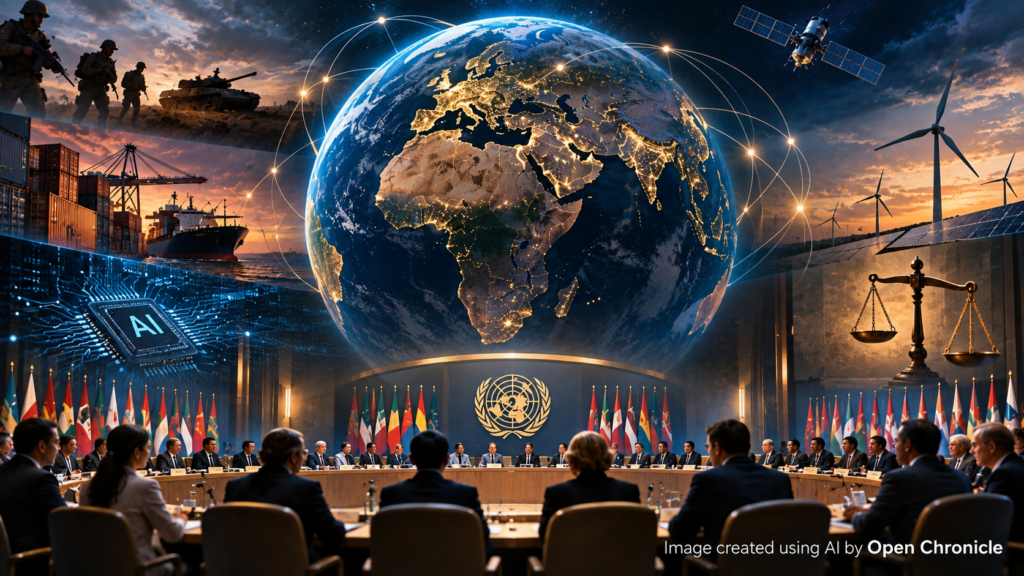
From military alliances and economic sanctions to artificial intelligence, global trade and climate diplomacy, international relations now extend far beyond meetings between presidents. Understanding them means understanding how power is exercised, contested and negotiated in an increasingly interconnected world.
By Open Chronicle International Affairs Desk
A world connected, but increasingly divided
International relations have always involved questions of power, territory, security and cooperation. In 2026, however, those questions reach into almost every aspect of modern life.
A military confrontation thousands of kilometres away can disrupt energy supplies. A decision by a major central bank can affect borrowing costs in another continent. Export restrictions on advanced semiconductors can reshape technological development, while a cyberattack against critical infrastructure can produce consequences that cross national borders within seconds.
At the same time, international institutions face growing pressure to respond to armed conflicts, economic competition, migration, climate change and the accelerating development of artificial intelligence.
The result is a world characterised by a fundamental contradiction.
Countries depend on one another for trade, technology, finance, energy and security, yet governments increasingly seek to reduce strategic vulnerabilities and preserve their freedom of action.
This tension is one of the defining features of international relations in 2026.
To understand today’s world, it is therefore necessary to look beyond diplomatic statements and military confrontations.
International relations concern the rules, institutions, interests and interactions that determine how the international system operates.
They also concern what happens when those rules are challenged.
What exactly are international relations?
International relations can be understood in two related ways.
First, they describe the interactions between countries and other actors operating across national borders.
Second, they constitute an academic discipline that studies those interactions, seeking to explain why states cooperate, compete, negotiate or enter into conflict.
The field includes diplomacy, international law, war and peace, trade, economic development, human rights, environmental governance and global security.
Traditionally, states have occupied the central position in international relations.
Governments negotiate treaties, establish diplomatic missions, maintain armed forces, regulate borders and participate in international organisations.
But states are no longer the only influential actors.
Multinational corporations control important technologies and supply chains. International organisations coordinate responses to shared problems. Humanitarian agencies operate across borders. Civil society organisations influence public debate, while financial institutions and digital platforms can shape the economic and informational environment in which governments make decisions.
International relations today therefore involve a complex network of state and non-state actors.
Their influence is not equal, and they do not possess the same legal authority.
Nevertheless, understanding international politics requires examining how these actors interact.
The international system: sovereignty without a world government
One of the central characteristics of international relations is the absence of a single global government with authority comparable to that exercised by a state within its territory.
Countries possess sovereignty, meaning that they exercise authority over their internal affairs and participate in international relations as legally independent entities.
The United Nations Charter establishes sovereign equality as a foundational principle of the international order.
It also prohibits the threat or use of force against the territorial integrity or political independence of states, subject to the exceptions recognised under the Charter.
However, the international system does not possess a universal enforcement mechanism equivalent to a national police force or judiciary.
International law depends on treaties, customary rules, institutions, national implementation and the willingness or obligation of states to comply.
This creates an enduring tension between legal principles and political power.
A country may invoke international law to defend its position, while another may dispute the interpretation or challenge the authority of an institution.
Powerful states can also possess greater resources to resist diplomatic or economic pressure.
As a result, international relations are shaped by both formal rules and the practical distribution of power.
The existence of international law does not eliminate geopolitical competition.
It provides a framework within which that competition is conducted, constrained and contested.
The major powers shaping the world in 2026
The contemporary international system is influenced by several major centres of power.
The United States remains a central military, financial and technological actor, supported by an extensive network of alliances and partnerships.
China combines industrial scale, global commercial influence and growing technological and military capabilities.
Russia remains a major nuclear power and an important security actor, particularly in Europe and Eurasia.
The European Union exercises substantial economic and regulatory influence, although its foreign and security policies must accommodate the interests of its member states.
India has become increasingly important because of its population, economic development, technological ambitions and diplomatic relationships.
Other countries, including Japan, Brazil, Türkiye, Saudi Arabia, Indonesia and South Africa, influence regional and global developments through different combinations of economic, military, diplomatic and institutional power.
The distribution of power is therefore more complex than a simple division between two rival blocs.
Some countries maintain close security relationships with the United States while pursuing extensive commercial ties with China.
Others cooperate with several major powers without formally aligning themselves with one geopolitical camp.
This behaviour is often described as strategic autonomy, hedging or multi-alignment, depending on the circumstances.
The distinctions matter.
A country seeking strategic autonomy may wish to preserve independent decision-making.
A government pursuing hedging may develop relationships with competing powers to reduce the risks of dependence.
Multi-alignment can involve cooperation with different partners on different issues.
These approaches illustrate how contemporary international relations often resist rigid classifications.
Why the United States and China matter so much
Competition between Washington and Beijing has become one of the most important structural forces in international politics.
Their relationship affects international trade, technology, security arrangements and the future of global institutions.
The two countries are deeply connected economically, yet they disagree over significant strategic questions.
These include Taiwan, military activity in the Indo-Pacific, access to advanced technologies, industrial subsidies and the governance of critical supply chains.
Semiconductors are a particularly revealing example.
Advanced chips are essential for artificial intelligence, telecommunications, military systems and modern industrial production.
Restrictions on their export can therefore serve both economic and national security objectives.
Such measures also affect companies and countries that are not directly involved in the political dispute.
The competition extends to batteries, electric vehicles, rare earth processing, telecommunications infrastructure and emerging technologies.
However, describing the relationship exclusively as a new Cold War risks overlooking important differences from the twentieth century.
The American and Chinese economies remain connected through trade, investment and production networks.
Many other countries also resist being forced into a binary choice.
The central challenge is managing strategic competition without allowing economic interdependence to become a source of uncontrolled escalation.
Europe and the return of territorial security
European security has undergone a profound transformation since Russia’s full-scale invasion of Ukraine in February 2022.
The war challenged assumptions about territorial stability, military deterrence and the effectiveness of diplomatic arrangements on the continent.
It also reinforced the importance of NATO as a collective defence alliance.
European governments have faced renewed questions about defence expenditure, industrial production, military readiness and long-term security guarantees.
The European Union has simultaneously sought to strengthen its capacity to respond to geopolitical and economic risks.
The relationship between NATO and the European Union illustrates the distinction between different forms of international cooperation.
NATO is primarily a political and military alliance organised around collective defence.
The European Union is a broader political and economic union whose activities include trade, regulation, development assistance and foreign policy coordination.
Their responsibilities overlap in certain areas, but their structures and legal foundations differ.
Europe’s contemporary security debate is therefore not simply about military spending.
It also concerns energy independence, industrial resilience, technological capabilities and the relationship between national sovereignty and collective action.
These questions will continue to shape international relations beyond the immediate outcome of any particular conflict.
The Middle East and the limits of diplomatic influence
The Middle East demonstrates how regional rivalries can produce global consequences.
Security relationships, energy markets, territorial disputes, religious and political divisions, and the involvement of external powers create an exceptionally complex diplomatic environment.
Conflicts involving Israel and the Palestinians, tensions concerning Iran and the security of maritime routes have consequences far beyond the region.
Instability can affect energy prices, commercial shipping, humanitarian operations and the diplomatic priorities of major powers.
The region also reveals the limits of military and diplomatic influence.
A country may possess significant military capabilities without being able to secure a durable political settlement.
Likewise, diplomatic agreements may reduce tensions without resolving the underlying causes of conflict.
International relations therefore require distinguishing between immediate crisis management and long-term political solutions.
A ceasefire, for example, can reduce violence without necessarily addressing territorial disputes, security guarantees or political representation.
Durable peace depends on political arrangements that the relevant parties can sustain.
The challenge is particularly acute when governments, armed groups, regional powers and international organisations pursue different objectives.
The Global South is not a single geopolitical bloc
The expression Global South is frequently used in international political debate.
It generally refers to countries across Africa, Asia, Latin America and parts of Oceania that share certain historical experiences or development challenges.
However, it does not describe a unified political alliance.
Countries grouped under the term possess different economic structures, political systems, security interests and diplomatic priorities.
India, Brazil, South Africa, Indonesia and numerous other states may agree on the need for greater representation in international institutions while disagreeing on trade, security or regional conflicts.
The term can therefore be useful when discussing inequalities in the international system, but misleading when treated as evidence of a common foreign policy.
One important development is the growing willingness of middle powers to pursue independent diplomatic strategies.
Rather than automatically following the preferences of Washington, Beijing, Brussels or Moscow, governments may negotiate with several partners.
This can increase their diplomatic leverage.
It can also complicate efforts by major powers to organise international coalitions.
The result is an international system in which influence depends increasingly on negotiation across overlapping partnerships.
The international economy has become a geopolitical battlefield
Economic relations are no longer treated exclusively as questions of efficiency and commercial opportunity.
Governments increasingly examine trade and investment through the lens of national security.
Access to energy, food, critical minerals, semiconductor manufacturing and transport infrastructure can determine a country’s ability to respond to international crises.
This has encouraged policies described as economic security, friend-shoring, supply-chain diversification and de-risking.
These concepts are related but not identical.
Economic security concerns the protection of strategically important economic capabilities.
Friend-shoring involves shifting production or sourcing towards politically trusted partners.
De-risking seeks to reduce exposure to particular vulnerabilities without necessarily ending economic relationships.
The World Trade Organization’s October 2026 outlook illustrates the complexity of this environment.
Despite disruptions associated with conflict in the Middle East, the WTO projected merchandise trade volume growth of 3.9 percent in 2026 and 4.1 percent in 2027, supported partly by resilient supply chains and demand for goods associated with artificial intelligence.
These figures demonstrate that geopolitical tensions do not automatically produce a collapse in international trade.
Economic relationships can adapt, even while their underlying risks increase.
The International Monetary Fund’s October 2026 World Economic Outlook projected global economic growth of 3.1 percent in 2026 and 3.4 percent in 2027.
The IMF also warned that renewed trade tensions, conflict escalation and financial vulnerabilities could undermine the outlook.
For international relations, the lesson is that economic interdependence can create both cooperation and vulnerability.
A shared supply chain may encourage countries to maintain stable relations.
But dependence on a strategically important supplier can also become a source of political pressure.
Technology, artificial intelligence and digital sovereignty
Technology is now a central component of international power.
Artificial intelligence, advanced computing, satellite communications, cybersecurity and telecommunications infrastructure influence economic productivity and military capabilities.
Governments increasingly compete to develop domestic technological capacity and reduce dependence on foreign suppliers.
Artificial intelligence raises particularly complex international questions.
Countries disagree over how rapidly AI should be developed, what restrictions should apply to advanced systems and which institutions should establish common standards.
Technological competition also extends to access to computing infrastructure, electricity, specialist talent and high-performance semiconductors.
The ability to develop advanced AI systems depends on industrial and financial resources that are unevenly distributed.
This creates potential inequalities between countries that control major technological platforms and those that primarily consume their services.
Cybersecurity introduces another dimension.
Cyber operations can target infrastructure, government institutions, businesses and communications systems without requiring conventional military deployment.
Attribution can be difficult, and states may disagree about what constitutes an internationally unlawful cyber operation or an armed attack.
These developments complicate traditional distinctions between peace and conflict.
International relations increasingly involve competition that occurs below the threshold of open warfare.
Climate change is also international politics
Climate change demonstrates why international relations cannot be understood solely through military and economic competition.
Greenhouse gas emissions cross borders through their effects on the global climate.
No country can fully protect itself through domestic action alone.
Effective responses therefore depend on international cooperation, even when governments disagree about responsibilities, financing and economic development.
This challenge is especially visible during the week of 9 November 2026.
The United Nations Climate Change Conference, COP31, opened in Antalya, Türkiye, on 9 November and is scheduled to continue until 20 November.
Türkiye is hosting the conference and holding its presidency, while Australia is chairing the formal negotiations under an agreed division of responsibilities.
The arrangement itself provides an example of international diplomacy.
Two countries with competing hosting ambitions reached a compromise that distributed institutional responsibilities rather than allowing disagreement to prevent the conference from taking place.
COP31 also highlights disputes over climate finance.
Developing countries argue that those with greater historical responsibility for emissions and stronger financial resources should contribute more to adaptation and climate-related losses.
Wealthier countries face competing fiscal pressures and disagreements over the scale and structure of financial commitments.
These debates are not simply environmental.
They involve economic development, international justice, sovereignty and the distribution of responsibility.
Climate diplomacy is therefore a form of international relations in which scientific evidence, political interests and economic resources must be negotiated simultaneously.
The United Nations: indispensable but constrained
The United Nations remains the principal universal forum for diplomatic dialogue between sovereign states.
Its General Assembly allows all member states to debate international questions and adopt resolutions.
The Security Council possesses particular responsibilities for international peace and security.
Its five permanent members, China, France, Russia, the United Kingdom and the United States, possess veto powers over substantive decisions.
This arrangement reflects the political settlement that emerged after the Second World War.
It also creates recurring difficulties when major powers disagree.
A veto can prevent the adoption of a resolution even when it has substantial support among other Council members.
Critics argue that this structure limits the organisation’s ability to respond effectively to conflicts involving powerful states or their close partners.
Defenders of the system emphasise that the Security Council was designed to incorporate the interests of major powers into a common institutional framework.
The debate reflects a fundamental dilemma.
International organisations must work with the political realities of their member states while seeking to uphold principles that apply beyond individual national interests.
The United Nations cannot independently eliminate those tensions.
But its institutions remain important venues for negotiation, humanitarian coordination, peacekeeping and international legal processes.
Why the first week of November 2026 matters
Recent developments offer practical examples of how the international system operates.
DIPLOMATIC DEVELOPMENTS | 3 TO 10 NOVEMBER 2026
5 November | Diplomacy during armed conflict
The UN Security Council adopted a presidential statement concerning the role of diplomacy during active hostilities. The initiative illustrates the continuing effort to preserve negotiation channels even while fighting continues.
ydsftksff8.execute-api.us-east-1.amazonaws.com+1
9 November | Ukraine at the Security Council
The Council convened a briefing on the maintenance of peace and security in Ukraine, demonstrating how military conflict remains a central subject of multilateral diplomacy.
Security Council
9 November | COP31 opens in Antalya
Climate negotiations began with governments facing difficult questions about emissions reductions, adaptation and financial responsibilities.
United Nations+1
10 November | South Sudan on the diplomatic agenda
The Security Council scheduled discussions on South Sudan, highlighting the role of peace operations, regional security and international engagement beyond conflicts dominating global headlines.
securitycouncilreport.org
These developments concern different regions and policy areas.
Yet they share a common feature: governments are attempting to manage problems that cannot be resolved by unilateral action alone.
The examples also reveal the limits of international institutions.
Holding a meeting does not guarantee agreement.
Adopting a statement does not ensure implementation.
And opening a climate conference does not establish that its participants will reach a satisfactory settlement.
Diplomacy is a process through which interests are negotiated, not a guarantee that those interests will converge.
How international relations affect ordinary people
The consequences of international relations are often most visible far from diplomatic meeting rooms.
Consider the price of fuel.
A conflict affecting an important energy-producing region or shipping route can increase transport and production costs in countries that are not involved in the fighting.
Those costs can influence food prices, household budgets and inflation.
Trade policy offers another example.
Tariffs or export restrictions can alter the prices and availability of consumer goods, industrial components and technological equipment.
Migration policy can affect families, labour markets, education and access to humanitarian protection.
International agreements may influence environmental standards, product safety, digital privacy and the regulation of multinational companies.
Security alliances can shape national defence budgets and public investment priorities.
These connections demonstrate why international relations are not exclusively the concern of diplomats, political leaders or military specialists.
They are part of the institutional environment in which societies function.
Understanding them helps citizens assess political decisions that may otherwise appear distant or abstract.
Five questions for understanding any international crisis
A useful way to analyse international developments is to ask five questions.
First, who are the actors involved?
These may include governments, international organisations, companies, armed groups or civil society organisations.
Second, what interests are at stake?
The answers may concern security, territory, economic resources, political legitimacy or domestic stability.
Third, what forms of power are being used?
Power may involve military capabilities, economic pressure, diplomatic influence, technological control or the ability to shape public narratives.
Fourth, what rules and institutions apply?
International law, treaties, regional agreements and organisational procedures can influence the available choices.
Finally, what outcomes are realistically possible?
A negotiated settlement, temporary compromise, prolonged confrontation or institutional deadlock may all be plausible.
These questions do not automatically produce a definitive interpretation.
But they help distinguish evidence from rhetoric and identify the interests shaping political decisions.
What comes next for international relations?
The international system is unlikely to become either completely fragmented or fully cooperative.
Economic and technological interdependence will continue to connect countries, even as governments seek greater control over strategic resources.
Military deterrence will remain important, particularly among nuclear-armed powers.
Regional organisations and middle powers will continue to influence international negotiations.
Climate change will generate demands for cooperation across political divisions.
Artificial intelligence and other emerging technologies will introduce new questions about security, regulation and the distribution of economic power.
At the same time, international institutions will face pressure to demonstrate that they can respond effectively to crises.
Their legitimacy will depend partly on whether countries regard their rules and decisions as sufficiently representative, consistent and effective.
The challenge is not merely to preserve the institutions established after 1945.
It is to determine how they can function in a world whose political, economic and technological conditions have changed substantially.
International relations are ultimately about managing coexistence
International relations are often presented as a struggle between powerful states.
Competition is undeniably central to the subject.
But it is not the entire story.
Countries also cooperate because they share interests, recognise common dangers and understand that some problems cannot be addressed independently.
Diplomacy provides a mechanism for negotiating differences.
International law establishes principles and obligations.
Institutions create opportunities for coordination.
Economic exchange connects societies, while technological and environmental challenges generate new forms of interdependence.
In 2026, the defining feature of international relations may be the simultaneous growth of competition and cooperation.
Governments seek greater independence while remaining dependent on global systems.
They defend sovereignty while negotiating international commitments.
They prepare for conflict while maintaining diplomatic channels.
Understanding international relations today means recognising these contradictions rather than reducing world politics to a contest between allies and adversaries.
The central question is not whether countries will compete.
They will.
It is whether competition can be managed through rules, negotiation and institutions before its consequences become more destructive than the interests it was intended to protect.
That question lies at the heart of international relations in the twenty-first century.
Sources and Further Reading
Official international sources documenting global economic trends, international security and climate diplomacy in 2026.
United Nations Climate Change | COP31
Official information on the climate conference taking place in Antalya, Türkiye, from 9 to 20 November 2026, including international cooperation and negotiations.
World Economic Outlook, October 2026
Resilience Under Strain, Urgent Choices. The IMF’s assessment of global growth, inflation, geopolitical risks, technological investment and international economic vulnerabilities.
Global Trade Outlook and Statistics
October 2026 update examining global merchandise trade, the effects of geopolitical disruption and the growing influence of artificial intelligence on international commerce.
Security Council Meeting on Ukraine
9 November 2026. Official meeting information concerning the maintenance of international peace and security in Ukraine.
Security Council Report | November 2026
Independent analysis of the Security Council’s November agenda, including conflict diplomacy, peace operations, Ukraine, South Sudan and institutional negotiations.
This explainer combines established concepts from international relations with developments documented through 10 November 2026. Economic projections are forecasts rather than confirmed outcomes. The November diplomatic examples are based on institutional records and published agendas; scheduled discussions should not be interpreted as evidence of agreements or completed decisions. Interpretations concerning multipolarity, strategic autonomy, economic security and the future international order are analytical assessments rather than universally accepted conclusions. Open Chronicle distinguishes documented developments from broader geopolitical interpretation.
Explore International Relations
Discover more reporting and analysis on diplomacy, international security, global governance and the changing balance of power.
Return to International Relations →