
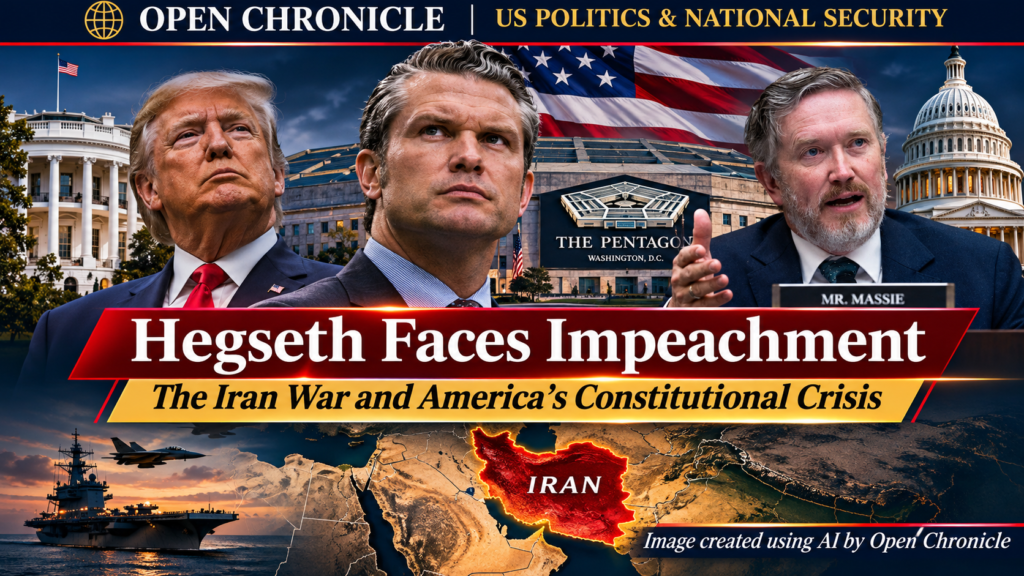
Republican Congressman Thomas Massie has introduced eight articles of impeachment against Defense Secretary Pete Hegseth, accusing him of violating congressional war powers, disregarding civilian protections and abusing his authority. With Democrats having won control of both chambers in the 2026 midterm elections, the confrontation raises fundamental questions about presidential military power, constitutional accountability and the future of the Pentagon’s leadership.
By Open Chronicle News Desk
November 9, 2026 | Washington, D.C.
The political consequences of the United States’ war against Iran reached the Pentagon’s highest civilian office on Monday when Republican Congressman Thomas Massie formally renewed an effort to impeach Defense Secretary Pete Hegseth.
Massie, a Kentucky Republican who has repeatedly challenged President Donald Trump’s military policies, introduced eight articles of impeachment accusing Hegseth of serious violations of constitutional and statutory limits on executive authority.
The allegations extend beyond the Iran conflict, encompassing American military operations in Yemen and Venezuela, lethal strikes against suspected drug trafficking vessels, the protection of civilians during military operations and alleged retaliation against a United States senator.
The resolution also arrives at a moment of extraordinary political change in Washington.
Following the November 3 midterm elections, Democrats have secured control of the House of Representatives and Senate for the next Congress, which will take office in January 2027.
Republicans nevertheless retain control of both chambers until the current congressional term expires.
That distinction makes the immediate impeachment effort especially significant. Massie is attempting to compel action before the transfer of power, while Democratic leaders are preparing for a period of more extensive congressional oversight.
The resolution could reach the House floor within two legislative days, although Republican leaders retain procedural options to refer, table or otherwise dispose of the measure.
President Trump has defended Hegseth and criticised Massie’s initiative. Hegseth has rejected the allegations and characterised the effort as politically motivated.
The central dispute is whether a defence secretary can be held constitutionally accountable for implementing military operations that members of Congress contend were never lawfully authorised.
The accusations remain contested. Introducing articles of impeachment does not establish that Hegseth committed unlawful acts, and no conviction or removal has occurred.
1. A Republican challenges the Pentagon from within Trump’s own party
The impeachment initiative is unusual not simply because it targets a serving defence secretary, but because it originates with a member of the president’s own party.
Massie has established himself as a Republican willing to break with Trump over constitutional powers, federal spending and foreign military intervention.
His latest action reflects a disagreement over the legal foundations of American military policy.
In announcing the resolution, Massie argued that Hegseth had continued military hostilities against Iran for more than 90 days without the necessary congressional authorisation.
He also accused the defence secretary of disregarding congressional restrictions, participating in unlawful military operations and using the powers of his office against political critics.
The congressman initially introduced impeachment articles in September.
The House subsequently recessed without holding the anticipated vote.
On November 9, Massie reintroduced the resolution under procedures intended to require the House to address it within two legislative days.
That mechanism creates a parliamentary deadline, but it does not guarantee that the House will vote directly to approve or reject every allegation.
Republican leaders may instead seek to table the resolution or refer it to a committee.
Massie’s immediate objective is therefore both substantive and procedural: to place the accusations before the House and require lawmakers to take a recorded position on how the matter should proceed.
2. The eight articles of impeachment
The resolution contains eight distinct articles alleging abuses of authority and violations of constitutional or legal obligations.
Three focus directly on the war against Iran.
The remaining five concern civilian casualties, maritime military strikes, freedom of expression and operations in Venezuela and Yemen.
OPEN CHRONICLE | THE EIGHT CHARGES EXPLAINED
What Massie alleges against Pete Hegseth
| I | Initiating or conducting war against Iran without the legal authorisation required under the War Powers Resolution. |
| II | Continuing hostilities after Congress allegedly directed the withdrawal of American forces. |
| III | Continuing military operations beyond statutory time limits without congressional authorisation. |
| IV | Failing to comply with laws intended to minimise civilian casualties. |
| V | Overseeing allegedly unlawful lethal strikes against suspected drug trafficking vessels. |
| VI | Allegedly retaliating against Senator Mark Kelly for constitutionally protected speech. |
| VII | Allegedly directing the unlawful seizure of Nicolás Maduro and Cilia Flores in Venezuela. |
| VIII | Conducting military operations in Yemen without appropriate congressional authorisation and reporting. |
Source: Representative Thomas Massie’s official summary of the impeachment resolution, November 9, 2026. All eight articles contain allegations, not established findings of guilt.
The scope of the resolution is important.
Massie is not merely asking Congress to evaluate one military decision.
He is alleging a broader pattern in which the defence secretary has exercised or implemented executive power without sufficient regard for statutory restrictions and constitutional checks.
Whether those allegations satisfy the constitutional standard for impeachment is a question for Congress, not one resolved by the filing itself.
3. The Iran war and the constitutional limits of presidential power
The first three articles concern the legal authority under which the United States has conducted military operations against Iran.
The conflict began on February 28, 2026, when American and Israeli forces launched strikes against Iranian targets.
The Trump administration presented the operation as necessary to address threats posed by Iran, including concerns about its military capabilities and nuclear ambitions.
Critics questioned whether the president possessed sufficient legal authority to begin and sustain the campaign without explicit approval from Congress.
Under the United States Constitution, Congress possesses the power to declare war.
The president, meanwhile, serves as commander in chief of the armed forces.
These constitutional provisions have generated disputes throughout American history over the scope of presidential authority to initiate hostilities.
The War Powers Resolution of 1973 was enacted to establish a framework for congressional involvement in military operations.
Among other provisions, it requires reporting to Congress in specified circumstances and sets a general 60 day limit for certain hostilities conducted without congressional authorisation, followed by a possible 30 day withdrawal period.
Massie’s resolution argues that the administration exceeded those limits during the Iran conflict.
It also alleges that military operations continued despite congressional action directing the removal of American forces.
The administration disputes the underlying characterisation of its military actions.
The resulting disagreement is not simply about whether the war was strategically justified.
It concerns whether the executive branch complied with the legal procedures governing the use of military force.
A determination that a military operation lacked statutory authorisation would not, by itself, establish every element of personal wrongdoing alleged against the defence secretary.
Questions of presidential authority, congressional action, statutory interpretation and individual responsibility must be considered separately.
4. The significance of the congressional withdrawal dispute
One of the more consequential allegations concerns a congressional resolution directing the withdrawal of American forces from hostilities involving Iran.
Massie contends that both chambers acted to require the termination of unauthorised operations.
His second impeachment article alleges that Hegseth continued military action despite that instruction.
This creates a dispute over the legal effect of congressional action and the obligations imposed on the executive branch.
The War Powers Resolution includes mechanisms through which Congress may seek to require the withdrawal of forces.
However, the legal status and enforceability of particular legislative measures can depend on constitutional requirements, including the distinction between concurrent resolutions and legislation presented to the president.
That distinction is important because Congress cannot necessarily create a legally binding command merely by adopting a resolution that has not satisfied the constitutional requirements applicable to legislation.
Massie’s allegation therefore requires careful examination of the relevant congressional text, the procedures used to adopt it and the legal authority claimed by the administration.
The broader constitutional question remains substantial even where the legal effect of a particular resolution is contested.
If Congress opposes a continuing military operation, what practical mechanisms does it possess to constrain the executive branch?
And how should responsibility be allocated between a president who directs military policy and a secretary of defence who oversees its implementation?
These questions have implications extending beyond the current conflict.
5. Civilian casualties and the Iranian school strike
The fourth article raises a separate issue: the legal and humanitarian obligations of military commanders and civilian officials during armed conflict.
Massie’s resolution cites an American strike that hit an elementary school in Minab, Iran, during the opening phase of the war.
The incident has become a focus of controversy over civilian protection, military targeting procedures and accountability.
The congressman alleges that Hegseth failed to uphold legal requirements intended to minimise civilian harm.
International humanitarian law requires parties to armed conflict to distinguish between military objectives and civilians, observe proportionality requirements and take feasible precautions to reduce civilian casualties.
However, determining whether a particular strike violated those obligations requires a detailed assessment of the target, intelligence available at the time, weapons employed, anticipated civilian harm and decisions made by responsible officials.
A civilian casualty incident does not automatically establish that a war crime occurred.
Equally, the existence of a military operation does not remove the obligation to investigate credible allegations of unlawful civilian harm.
For Congress, the relevant questions include what information the Pentagon possessed, what targeting safeguards were used and whether any failures were identified or concealed.
The impeachment resolution makes serious allegations, but those allegations require independent examination of the underlying evidence.
6. Allegations of extrajudicial killings at sea
The fifth impeachment article concerns American military strikes against vessels suspected of involvement in drug trafficking.
The operations, conducted in maritime areas including the Caribbean and eastern Pacific, have generated disputes over the circumstances in which military force may lawfully be used against suspected criminal activity.
Massie’s resolution alleges that Hegseth oversaw a campaign that resulted in at least 243 deaths.
The figure appears in the congressman’s accusations and should be treated as a reported allegation rather than an independently established casualty total.
The resolution also raises questions concerning attacks on survivors, obligations to rescue people in distress and the legal basis for treating suspected traffickers as military targets.
The distinction between military operations and law enforcement is central to this dispute.
Ordinary criminal activity, even when organised across international borders, does not automatically make suspected participants lawful military targets.
The legal analysis depends on the applicable framework, including whether an armed conflict exists, whether individuals have a legally recognised combatant or targetable status and whether the use of lethal force is necessary and proportionate.
Supporters of aggressive maritime operations argue that transnational criminal networks can present serious national security threats.
Critics maintain that the use of military weapons against suspected traffickers raises profound concerns about due process, civilian protection and executive authority.
The impeachment article places those questions directly before Congress.
It does not, however, establish the individual circumstances of every reported strike or prove that all deaths were unlawful.
7. The Mark Kelly controversy and freedom of expression
The sixth article concerns Senator Mark Kelly, a Democrat from Arizona and a former naval aviator.
Massie alleges that Hegseth used the authority of the Department of Defense to intimidate or retaliate against Kelly for speech concerning unlawful military orders.
The controversy touches on the relationship between civilian political debate, military discipline and constitutional protections.
American service members have obligations to obey lawful orders, but the legal framework does not require obedience to manifestly unlawful commands.
Disagreements can arise over how public officials discuss those obligations, particularly when military operations are politically contentious.
Members of Congress also possess constitutional protections connected to their legislative responsibilities.
The question raised by the impeachment article is whether the defence secretary used official powers to punish protected political expression.
Such an allegation requires examination of the precise statements, any official action taken against Kelly, the legal basis invoked and evidence concerning the purpose of that action.
The existence of a political dispute between Kelly and Hegseth does not itself establish unconstitutional retaliation.
But the accusation raises a broader institutional concern: whether executive agencies can use administrative or disciplinary authority in ways that interfere with legitimate congressional scrutiny.
8. Venezuela and the limits of American intervention
The seventh article concerns Operation Absolute Resolve, the American operation involving the seizure of Nicolás Maduro and Cilia Flores in Venezuela.
Massie alleges that Hegseth directed the operation without sufficient constitutional or legal authority.
The article characterises the seizure as an unlawful act against a foreign leader.
That characterisation is contested and should be attributed to the impeachment resolution rather than presented as a settled legal conclusion.
The operation raises several distinct questions.
One concerns the authority of the American executive branch to conduct military or coercive operations in another sovereign state.
Another concerns the relationship between criminal law enforcement, national security operations and the international legal principles governing state sovereignty.
A further question involves the role of Congress in authorising or supervising such operations.
Even where a foreign official faces criminal allegations, the existence of those allegations does not automatically settle the legality of a particular method of apprehension.
For the impeachment process, the relevant issue is whether Hegseth’s role in the operation involved conduct sufficiently serious to justify constitutional sanctions.
Congress would need to evaluate both the underlying legal framework and the evidence concerning his personal responsibility.
9. Yemen and another dispute over congressional authorisation
The eighth article concerns Operation Rough Rider, an American military campaign in Yemen.
Massie alleges that Hegseth authorised or conducted operations without the necessary congressional approval or a qualifying imminent threat.
The resolution also raises questions about compliance with reporting obligations under the War Powers Resolution.
American military operations in Yemen have historically involved concerns about attacks on international shipping, regional armed groups and the security of strategically important maritime routes.
Such security concerns can provide the policy rationale for military action.
They do not, however, eliminate the need to identify an applicable legal basis.
The dispute resembles the controversy over Iran in one important respect.
Both involve the extent to which a president may order military operations without a specific congressional authorisation.
The Yemen article therefore reinforces the central theme of Massie’s resolution: the constitutional distribution of war powers between Congress and the executive branch.
10. Trump’s response: Defending Hegseth and confronting Massie
President Trump has responded by defending his defence secretary and criticising the Republican congressman responsible for the impeachment effort.
Hegseth has also rejected the accusations.
He argues that the Iran campaign was necessary to confront threats to American national security, including Iran’s nuclear ambitions.
The administration maintains that its military operations have served legitimate security objectives.
Secretary of State Marco Rubio has publicly praised Hegseth’s performance.
House Speaker Mike Johnson, meanwhile, has expressed opposition to advancing an impeachment vote while American forces remain engaged in overseas hostilities.
These responses reveal different dimensions of the political dispute.
For Trump, the controversy concerns the defence of his administration’s military strategy and a senior member of his cabinet.
For Hegseth, it involves both the legality of his decisions and his continued authority to lead the Pentagon.
For Republican congressional leaders, the immediate challenge is managing a divisive vote during the final weeks of their majority.
Massie’s position is that the constitutional issues require congressional action regardless of whether lawmakers support the underlying military campaign.
The dispute is therefore taking place simultaneously on legal, institutional and partisan political grounds.
11. Democrats prepare for a new era of congressional oversight
The November 3 midterm elections have fundamentally changed the political setting in which the impeachment controversy is unfolding.
Democrats have secured control of both chambers of Congress for the legislative term beginning in January 2027.
The results represent a substantial shift from the Republican majorities under which Trump began his second presidential term.
The new congressional balance could affect the administration’s ability to advance legislation, confirm certain appointments and resist parliamentary investigations.
Control of the House is particularly important for oversight.
Committee chairs can schedule hearings, request documents, examine government conduct and pursue investigations into executive agencies.
Democratic lawmakers have already indicated support for the impeachment effort against Hegseth.
House Democratic leader Hakeem Jeffries and Senate Democratic leader Chuck Schumer have backed the initiative, according to Associated Press reporting.
However, the immediate proceedings remain under the authority of the outgoing Republican controlled Congress.
This creates two distinct political phases.
The first concerns whether the current House takes action on Massie’s resolution.
The second concerns what the incoming Democratic majorities may choose to investigate after January.
Those processes should not be conflated.
A vote in November would occur under different parliamentary conditions from an investigation or impeachment proceeding initiated in the new Congress.
12. What impeachment actually means
The American impeachment process is frequently misunderstood.
Impeachment is not equivalent to criminal prosecution, nor does it automatically remove an official from office.
Under the Constitution, the House of Representatives possesses the power to impeach federal civil officers.
The Senate has the authority to try impeachments.
A majority vote in the House is generally sufficient to approve an article of impeachment.
A conviction in the Senate requires the concurrence of two thirds of the senators present.
If the Senate convicts, the official is removed from office. The Senate may also consider disqualification from future federal office.
These constitutional procedures are distinct from criminal investigations or prosecutions.
A person may be impeached without being criminally charged.
Likewise, an impeachment allegation does not establish that a criminal offence occurred.
OPEN CHRONICLE | CONSTITUTIONAL PROCESS
How the impeachment process works
Introduction of articles
A member of the House submits allegations of impeachable misconduct.
House consideration
Lawmakers may debate, refer, table or vote on the articles under applicable House procedures.
House impeachment vote
Approval by a simple majority constitutes impeachment.
Senate proceedings
The Senate considers the charges through its constitutional impeachment procedures.
Conviction or acquittal
Conviction requires two thirds of senators present. Without conviction, impeachment does not remove the official.
Introducing a resolution is not the same as impeaching an official. Impeachment by the House is not the same as conviction by the Senate.
The distinction is crucial to the current case.
Hegseth faces a formal impeachment initiative, but the House has not been shown to have approved the charges as of the reporting reviewed on November 9.
His legal and political position could change as the congressional process develops.
13. A rare constitutional confrontation involving a cabinet secretary
Impeachment proceedings against cabinet officials are relatively uncommon in American history.
Two notable precedents provide historical context.
In 1876, Secretary of War William Belknap was impeached by the House after allegations involving corruption.
Belknap resigned before the House voted, but the Senate nevertheless proceeded with a trial. He was ultimately acquitted.
More recently, in 2024, Homeland Security Secretary Alejandro Mayorkas was impeached by the Republican controlled House over allegations concerning his handling of immigration and border policy.
The Senate dismissed the articles without conducting a full evidentiary trial.
These cases illustrate both the constitutional availability of impeachment against cabinet officials and the political difficulties associated with obtaining a Senate conviction.
The Hegseth controversy differs in subject matter.
It concerns the use of military force, constitutional war powers and the conduct of the Department of Defense during armed conflicts.
That gives the dispute a direct connection to the most consequential national security decisions a government can make.
It also raises the question of whether impeachment is an appropriate mechanism for addressing alleged violations of war powers statutes.
Some constitutional scholars regard impeachment as an essential instrument for addressing serious executive misconduct.
Others caution against treating disagreements over contested legal interpretations or policy decisions as automatically impeachable offences.
The Constitution does not provide a comprehensive list of every act that qualifies as a high crime or misdemeanor.
Congress must therefore assess the gravity of the alleged conduct, the evidence and the constitutional responsibilities of the officeholder.
14. The wider implications for the Iran war
The impeachment effort does not occur in isolation from the military and economic consequences of the Iran conflict.
The war has affected American foreign policy, regional security and international energy markets.
Continuing military operations, attacks involving facilities used by American forces and disruption to shipping have contributed to the political debate.
Higher energy prices and concerns about the cost of living also formed part of the environment surrounding the midterm elections.
However, the extent to which the Iran war independently determined the election results cannot be established solely from the outcome.
Voters may have been influenced by several overlapping issues, including inflation, domestic policy, economic confidence and the administration’s overall performance.
For the Pentagon, the impeachment initiative creates a separate institutional challenge.
A defence secretary must maintain the confidence of the president while managing military operations and responding to congressional oversight.
Public disputes over legality can complicate those relationships.
They may also increase demands for disclosure of military planning, targeting procedures and legal advice.
Some of that information may be classified or operationally sensitive.
Congressional investigations would therefore have to balance accountability with legitimate national security considerations.
The central constitutional principle remains that military operations are not exempt from civilian oversight merely because they involve sensitive or dangerous circumstances.
15. Five questions Congress must confront
OPEN CHRONICLE | INVESTIGATION WATCH
1. What legal authority supported the Iran campaign?
Congress may seek the administration’s legal justification for initiating and continuing hostilities, including its interpretation of presidential powers and the War Powers Resolution.
2. What did Hegseth know about civilian casualty risks?
Investigators could examine targeting procedures, intelligence assessments, precautions and internal reviews concerning incidents involving civilian harm.
3. Were maritime strikes conducted under a lawful framework?
Lawmakers may examine the evidence used to identify suspected traffickers, rules governing lethal force and obligations toward survivors.
4. Did the Pentagon use official authority to retaliate against critics?
Relevant evidence would include official correspondence, disciplinary actions and the legal basis for any measures directed at Senator Mark Kelly.
5. What changes when Democrats assume congressional control?
New committee leadership could expand oversight, seek additional records and consider further proceedings concerning military operations and executive authority.
These are Open Chronicle editorial questions for future investigation, not findings of misconduct.
16. Three possible political and constitutional outcomes
OPEN CHRONICLE | EDITORIAL SCENARIOS
Scenario 1: The House blocks the impeachment effort
Republican leaders secure sufficient support to table the resolution, refer it to committee or defeat the articles.
Hegseth remains in office, but the underlying allegations continue to attract political scrutiny.
The incoming Congress may decide whether to revisit the issues after January.
Scenario 2: The House approves impeachment articles
A coalition of Democrats and Republicans votes to impeach Hegseth.
The matter proceeds to the Senate, where conviction would require a two thirds majority of senators present.
The administration faces a formal constitutional confrontation over the defence secretary’s conduct.
Scenario 3: The dispute becomes a broader congressional investigation
The immediate resolution does not produce a conviction or removal, but the new congressional majorities launch investigations into the Iran war and other Pentagon operations.
Hearings, document requests and legal scrutiny could extend beyond Hegseth to examine the administration’s military decision making.
The resulting findings might influence future legislation, oversight procedures or political decisions concerning Pentagon leadership.
These scenarios are independent Open Chronicle editorial assessments, not confirmed developments or predictions.
17. The next 48 hours and the next Congress
The immediate parliamentary timetable is unusually compressed.
Massie’s use of privileged procedures places pressure on House leaders to address the resolution within two legislative days.
That could bring a procedural or substantive vote by November 11.
The precise outcome will depend on the motions presented, the attendance of members and the positions adopted by lawmakers.
The incoming Congress represents a longer term development.
Democratic control of both chambers could create a different environment for investigations and oversight beginning in January 2027.
However, even under Democratic majorities, any attempt to remove Hegseth through impeachment would remain subject to the constitutional requirements of the Senate.
The political importance of the case therefore extends beyond whether the first vote succeeds.
It concerns how Congress chooses to exercise its constitutional responsibilities during a controversial military campaign.
Conclusion | A test of accountability in wartime
The impeachment initiative against Pete Hegseth brings together several of the most contested questions in American constitutional government.
How far can a president go in ordering military action without congressional approval?
What obligations does a defence secretary have when implementing disputed military orders?
How should civilian casualties and allegations of unlawful force be investigated?
And what mechanisms are available when Congress believes the executive branch has exceeded its authority?
Thomas Massie’s resolution offers one answer: the constitutional impeachment process.
President Trump and Hegseth reject the allegations and defend the administration’s military actions.
Congress must now determine how to respond.
The impending transfer of congressional power adds another dimension to the dispute.
Republicans retain control during the immediate proceedings, but Democrats will assume control in January following the midterm elections.
That transition could reshape the scope and intensity of scrutiny directed at the Pentagon.
For Hegseth, the immediate question is whether the House advances the charges.
For the administration, the broader issue is whether its legal justification for the Iran war and other military operations can withstand sustained congressional examination.
And for the American constitutional system, the case raises a question that extends beyond any individual officeholder.
When military operations become the subject of serious allegations of unlawful conduct, how effectively can Congress enforce the limits it is constitutionally empowered to uphold?
Open Chronicle will continue monitoring the House proceedings, the administration’s response and any subsequent congressional investigations. The allegations described in this report remain contested and should not be interpreted as established findings of unlawful conduct.