
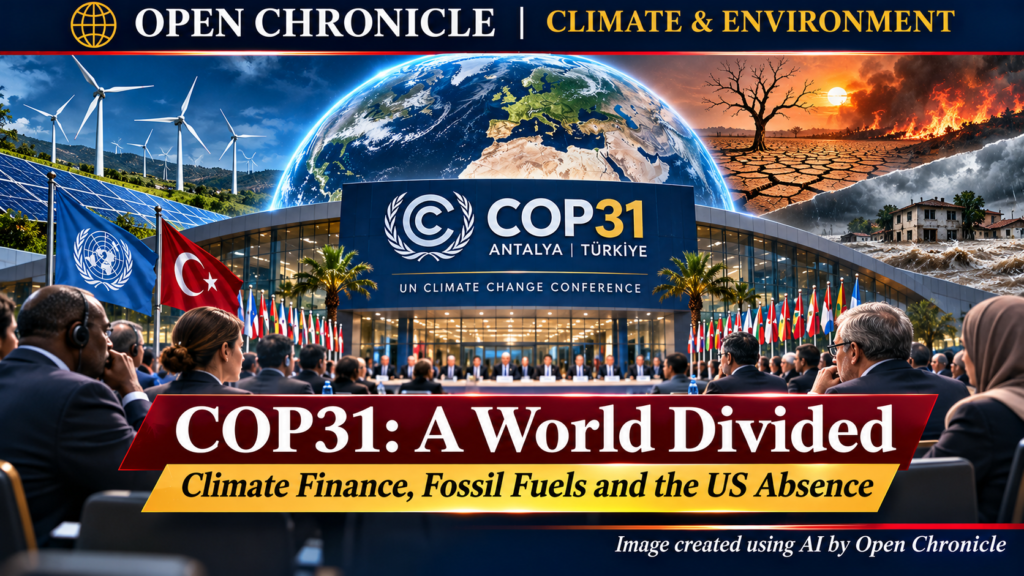
The United Nations climate summit has opened in Antalya with a difficult diplomatic confrontation over money, fossil fuels and the future of international cooperation. With Washington absent from government negotiations, developing nations demanding stronger financial commitments and Europe confronting its own political limitations, COP31 faces a defining test: can the world turn climate promises into measurable action?
By Open Chronicle News Desk
November 9, 2026 | Antalya, Türkiye
The world’s largest annual climate negotiations opened in Turkey on Monday under the shadow of deepening geopolitical divisions, financial disagreements and mounting pressure to deliver concrete results.
The 31st United Nations Climate Change Conference, known as COP31, brings together representatives of governments, international organisations, scientific institutions, businesses and civil society in the Mediterranean city of Antalya.
The conference, scheduled to run from November 9 to November 20, comes after another year marked by damaging extreme weather events and growing concerns about the world’s ability to meet its climate commitments.
But the diplomatic atmosphere was tense before the formal negotiations had properly begun.
Developing countries demanded greater attention to climate finance, while wealthier nations faced mounting domestic pressure over public spending and economic competitiveness.
The opening ceremony was delayed as negotiators struggled over the conference agenda, an early indication of the disagreements likely to shape the following two weeks.
Meanwhile, the United States, historically one of the world’s largest contributors to greenhouse gas emissions, has not sent a federal government delegation to the summit.
President Donald Trump’s administration has instead pursued an energy policy centred on domestic production and opposition to international climate restrictions.
The absence of Washington creates a significant challenge for other negotiating powers, particularly the European Union, China and developing countries seeking stronger financial support.
COP31 is therefore confronting a fundamental question: can international climate cooperation produce meaningful progress when some of the world’s most influential economies disagree over who should act, who should pay and how quickly fossil fuels should be replaced?
1. A difficult opening in Antalya
Antalya is hosting one of the largest international diplomatic gatherings of the year.
The conference is expected to attract tens of thousands of participants, including government negotiators, environmental organisations, industry representatives and observers.
Its programme covers greenhouse gas emissions, climate adaptation, financial assistance, technological cooperation and the economic transformation required to reduce dependence on fossil fuels.
Yet the opening exposed the difficulties facing the negotiating process.
Representatives of developing nations pushed for climate finance questions to receive greater prominence in the formal agenda.
Their argument is that countries with limited financial resources are being asked to confront a crisis to which they have historically contributed less than the world’s wealthiest industrial economies.
Wealthier countries, meanwhile, face competing demands on public budgets, including defence, infrastructure, healthcare and economic support.
The disagreement delayed the conference’s opening proceedings.
Such disputes are not unusual at United Nations climate negotiations, where decisions depend heavily on consensus.
However, they can consume valuable negotiating time before countries begin discussing the substance of a final agreement.
The early confrontation in Antalya suggests that financial responsibility will once again be among the summit’s most difficult questions.
2. Why the United States is absent
The absence of an official American government delegation is one of the most consequential features of COP31.
The Trump administration has rejected much of the international climate policy framework pursued by previous American governments.
Washington has withdrawn from the Paris Agreement under Trump’s renewed presidency and has prioritised domestic energy production, including fossil fuels.
A White House official defended the administration’s position on Monday, criticising international climate policies as economically damaging.
The decision not to send federal representatives means that the United States will not participate in the negotiations in the same way as countries maintaining active government delegations.
That absence matters for several reasons.
The United States is a major economy, an important energy producer and a leading source of climate technology and investment.
It also has considerable influence over international financial institutions and global trade.
American participation can therefore affect both the political credibility and practical implementation of international climate agreements.
However, the absence of the federal government does not mean that all American political institutions have abandoned the climate debate.
A congressional delegation is expected to attend COP31, demonstrating that climate policy remains contested within the United States.
American states, cities, businesses and research institutions also continue to pursue their own energy and emissions strategies.
Nevertheless, these actors cannot automatically substitute for federal commitments in international negotiations.
The result is an unusual situation in which American economic and technological influence remains substantial, but Washington’s official diplomatic engagement is sharply reduced.
3. Turkey and Australia share an unusual leadership arrangement
COP31 is being organised under an arrangement that divides responsibilities between Turkey and Australia.
Turkey holds the conference presidency and hosts the negotiations in Antalya.
Australia, represented by Climate Change and Energy Minister Chris Bowen, is leading the negotiating process.
The arrangement emerged after discussions over which country would host the summit.
It gives Ankara a prominent international platform while allowing Australia to play a central role in facilitating agreement among participating governments.
The division of responsibilities could become particularly important if negotiations encounter serious obstacles.
Turkey must manage the political visibility and organisation of the conference.
Australia must help navigate competing positions on emissions, finance, adaptation and other issues.
Both will be judged by whether the summit produces credible outcomes rather than merely another declaration of ambition.
The conference has been presented as an opportunity to shift from promises toward implementation.
That objective is broadly supported in principle.
The difficulty is reaching agreement on what implementation should require and how progress should be measured.
4. Climate finance: The central diplomatic confrontation
Climate finance is likely to be one of the defining issues of COP31.
Developing countries argue that the international climate response cannot succeed without substantial financial support.
They face costs associated with building renewable energy systems, protecting infrastructure, improving agricultural resilience and responding to increasingly destructive weather events.
Some countries also confront high borrowing costs, limited tax revenues and substantial public debt.
These constraints can make climate investment difficult even when governments recognise the urgency of taking action.
The principle of financial assistance is embedded in international climate agreements.
Developed countries have historically accepted responsibilities to support developing nations in addressing climate change.
However, disputes persist over the amount of money required, how funding should be delivered and which countries should contribute.
A central disagreement concerns the difference between grants and loans.
Grants can provide assistance without increasing a recipient country’s debt burden.
Loans may finance important projects but can create additional repayment obligations.
Developing countries also want funding that is predictable and accessible rather than dependent on complex approval procedures.
For wealthier governments, the challenge involves demonstrating that international climate spending can produce measurable results while remaining politically acceptable to domestic taxpayers.
The question is therefore not simply how much money is promised.
It is whether the money reaches the countries and communities that need it, on terms they can afford.
5. The problem of climate inequality
Climate change does not affect every country equally.
Some of the nations most exposed to rising temperatures, flooding, drought and sea level rise have contributed relatively little to cumulative global greenhouse gas emissions.
Many small island states face particularly serious threats from rising seas and coastal erosion.
African countries confront risks involving water availability, agriculture, infrastructure and extreme heat.
Parts of Asia and Latin America are also experiencing increasingly complex climate pressures.
The economic consequences can be severe.
A major flood can destroy roads, homes, electricity networks and agricultural production.
A prolonged drought can reduce food supplies, undermine rural livelihoods and increase pressure on public finances.
When disasters strike countries with limited fiscal capacity, recovery may require international assistance.
Developing nations argue that climate negotiations must recognise these unequal vulnerabilities.
Wealthier countries generally accept the importance of adaptation but disagree over the scale and structure of additional financial obligations.
The result is a persistent tension between historical responsibility, present economic capacity and future emissions growth.
For COP31, addressing that tension will be essential to building trust.
6. The fossil fuel dispute remains unresolved
One of the most politically sensitive questions is how quickly the world should reduce its dependence on coal, oil and natural gas.
At COP28 in Dubai in 2023, governments agreed on language calling for a transition away from fossil fuels in energy systems.
The agreement was considered an important diplomatic milestone.
However, countries have struggled to translate that commitment into a common timetable or enforceable implementation framework.
At COP30 in Brazil, the final agreement did not explicitly include a new commitment on fossil fuels after opposition from producing countries.
Brazil subsequently promoted a voluntary roadmap intended to help governments develop their own approaches.
The disagreement continues in Antalya.
Some countries want stronger commitments to reduce fossil fuel production and consumption.
Others argue that energy security, economic development and national circumstances require a more gradual transition.
Fossil fuel exporters are particularly concerned about the economic consequences of rapidly declining demand.
Developing economies may also argue that they need affordable and reliable energy to expand industrial production and improve living standards.
The challenge is finding an approach that reduces emissions without ignoring energy access, economic stability or the differing capabilities of national economies.
A central weakness of international climate diplomacy remains the distance between agreeing on a long term direction and agreeing on the policies needed to reach it.
7. Turkey’s electrification proposal: 35% by 2035
One of the most prominent initiatives associated with COP31 is a proposal to increase the proportion of global final energy demand supplied by electricity.
Turkey is encouraging countries to support a voluntary objective that would raise electricity’s share of energy consumption from approximately 20% to 35% by 2035.
The proposal reflects the growing importance of electrification in the transition toward lower emissions.
Electric vehicles can reduce dependence on petrol and diesel.
Electric heat pumps can replace some conventional heating systems.
Industrial electrification can reduce the need to burn fossil fuels directly in manufacturing processes.
However, electrification alone does not guarantee lower greenhouse gas emissions.
The environmental benefits depend partly on how electricity is generated.
If increased demand is met primarily through coal or gas, emissions reductions may be smaller than those achieved through renewable or other low carbon electricity sources.
This distinction has already generated diplomatic friction.
The European Union has emphasised the importance of clean electrification, seeking to ensure that expanded electricity consumption supports the wider transition away from fossil fuels.
Other countries may prefer a more technologically neutral approach that accommodates their existing energy systems.
The disagreement illustrates a recurring problem in climate negotiations.
Governments can agree on an attractive headline target while interpreting the practical meaning of that target differently.
The proposed global electrification target
Current
2035 target
Illustrative comparison of the approximate current share and the proposed 2035 objective. Not a forecast.
The proposed increase is 15 percentage points. The target is voluntary and does not, by itself, establish how the additional electricity would be generated.
8. Europe arrives with reduced ambitions
The European Union has historically presented itself as one of the principal defenders of international climate cooperation.
Its policies include emissions reduction targets, renewable energy development, industrial decarbonisation and mechanisms intended to encourage cleaner production.
However, European governments are confronting increasingly difficult domestic political conditions.
High energy costs, industrial competitiveness concerns, public spending pressures and resistance to certain environmental regulations have complicated the implementation of climate policies.
Several governments are also increasing defence expenditure in response to geopolitical instability.
These pressures have influenced the European negotiating position at COP31.
European officials are approaching the summit with more limited expectations than in some previous years.
Rather than pursuing an extensive package of new commitments, the EU is concentrating on implementing existing agreements and supporting practical measures.
This includes electrification, methane emissions reduction and the development of cleaner energy systems.
Europe also faces pressure from developing countries to contribute more climate finance.
European governments maintain that they already provide substantial international support, but their willingness to accept additional financial obligations remains constrained.
The resulting position is politically delicate.
Europe wants to preserve its international climate leadership while avoiding commitments that may prove difficult to defend or implement domestically.
The credibility of that leadership will depend increasingly on whether existing promises translate into measurable progress.
9. China, India and the changing balance of climate diplomacy
The absence of the American federal government places additional attention on other major economies.
China is central to the global energy transition because of its enormous manufacturing capacity, extensive renewable energy industry and continuing reliance on fossil fuels.
Chinese companies are major suppliers of solar panels, batteries, electric vehicles and other technologies essential to electrification.
At the same time, China’s industrial scale and energy requirements make its emissions trajectory internationally significant.
Beijing’s position therefore matters both for climate diplomacy and for the global market in clean technologies.
India faces a different combination of challenges.
Its expanding economy requires major investments in electricity generation, infrastructure and industrial development.
Indian policymakers have consistently emphasised development needs, energy access and the principle that wealthy countries should contribute more to financing climate action.
Other emerging economies, including Brazil, South Africa and Indonesia, also have substantial interests in the outcome.
They are seeking to balance economic development with emissions reduction, environmental protection and access to investment.
COP31 will test whether these different priorities can be reconciled.
The negotiations may also reveal how the balance of influence in international climate diplomacy is changing as countries outside the traditional Western powers become increasingly important to clean energy supply chains and investment.
10. Brazil’s role after COP30
Brazil enters COP31 with an important diplomatic legacy.
The country hosted COP30 in Belém in 2025, placing particular emphasis on forests, climate justice and the relationship between environmental protection and development.
The Amazon rainforest remains central to global discussions about biodiversity, carbon storage and land use.
Brazil has also promoted efforts to develop a voluntary roadmap for moving away from fossil fuels.
That initiative seeks to maintain political momentum following the difficulties of reaching stronger commitments at COP30.
President Luiz Inácio Lula da Silva is expected to participate in the leaders’ summit in Antalya.
His involvement could strengthen the voice of countries arguing that environmental protection must be accompanied by greater financial support and more equitable economic opportunities.
Brazil’s position also illustrates the complexity of the climate debate.
The country has major renewable energy resources and significant environmental responsibilities, but it is also an oil producer.
Like many economies, Brazil must navigate the tension between energy revenues, development priorities and climate commitments.
11. Climate adaptation is becoming impossible to ignore
Much of the international climate debate has traditionally focused on mitigation, meaning the reduction of greenhouse gas emissions.
Mitigation remains essential to limiting future warming.
However, governments are increasingly confronting the immediate consequences of climate change.
Adaptation refers to measures that help societies prepare for and respond to climate impacts.
These may include stronger flood defences, improved water management, drought resistant agriculture, more resilient electricity networks and better early warning systems.
For many vulnerable countries, adaptation is an immediate economic and humanitarian necessity.
A government facing repeated floods cannot wait for global emissions to decline before strengthening its infrastructure.
A farming community confronting prolonged drought needs practical assistance with water availability and agricultural resilience.
Yet adaptation projects often struggle to attract private investment because they may not generate direct commercial returns.
This increases the importance of public finance, development banks and international assistance.
The question for COP31 is whether governments can create more reliable mechanisms for delivering that support.
Without effective adaptation, the human and economic costs of climate change are likely to increase even if global emissions begin to fall.
12. Loss and damage: Who pays when adaptation is not enough?
Adaptation cannot prevent every climate related loss.
Some disasters destroy infrastructure, displace communities or damage ecosystems despite preventive measures.
This has given rise to the international debate over loss and damage.
The concept refers to climate impacts that cannot be avoided through emissions reduction or adaptation alone.
Developing countries have long argued that vulnerable populations should not bear these costs without international assistance.
The establishment of dedicated funding arrangements represented an important diplomatic development.
However, questions remain about the scale of available resources, eligibility, access and long term financing.
Countries experiencing severe climate impacts want mechanisms that can deliver support quickly and predictably.
Potential contributors are concerned about financial commitments, governance and how responsibility should be allocated.
COP31 provides another opportunity to assess whether existing arrangements are capable of meeting growing needs.
The challenge is especially urgent for small island states and countries facing repeated climate disasters.
For them, loss and damage is not an abstract negotiating concept.
It can concern the survival of communities, the preservation of livelihoods and the ability of governments to recover after catastrophic events.
13. The economic consequences extend beyond climate policy
Climate negotiations increasingly intersect with trade, industrial strategy and technological competition.
The global energy transition requires enormous investment in electricity networks, manufacturing facilities, energy storage and new infrastructure.
Countries are competing to attract those investments.
They also want to develop domestic industries capable of supplying the technologies required.
This competition creates opportunities but also tensions.
Governments may support local manufacturers through subsidies, public procurement or trade measures.
Such policies can accelerate industrial development but may also produce disputes over market access and fair competition.
Critical minerals represent another strategic concern.
Battery manufacturing, electricity transmission and many clean technologies depend on materials whose extraction and processing are concentrated in particular countries.
Supply chain security has therefore become part of the climate debate.
For developing countries, the central question is whether the transition will create domestic employment and industrial opportunities or simply reinforce dependence on imported technologies.
For wealthier economies, the challenge is balancing decarbonisation with industrial competitiveness and energy affordability.
COP31 cannot resolve every economic dispute.
But its decisions may influence the direction of investment and international cooperation for years to come.
14. The world leaders’ summit: November 11 and 12
The first major political test will arrive when heads of state and government gather in Antalya on November 11 and 12.
The summit, convened under the leadership of Turkish President Recep Tayyip Erdoğan, is organised around the theme of a sustainable, resilient and equitable future.
United Nations Secretary General António Guterres is scheduled to address the gathering.
The programme includes discussions on clean energy, electrification, industrial investment, access to finance and urban resilience.
These meetings will give political leaders an opportunity to signal priorities and attempt to resolve disagreements that technical negotiators cannot settle independently.
However, speeches and declarations will not necessarily translate into binding commitments.
The more significant test will be whether political interventions help negotiators reach agreement on difficult issues before the conference concludes on November 20.
15. Five questions that will determine whether COP31 succeeds
Five Questions That Will Determine Whether COP31 Succeeds
Can Countries Reach a Credible Climate Finance Agreement?
The central issue is whether developing countries receive sufficiently clear commitments concerning financial support, accessibility and implementation.
Will Governments Make Progress on Fossil Fuels?
Negotiators must determine whether they can move beyond broad statements toward practical measures consistent with previous commitments.
Can Electrification Become a Meaningful Global Initiative?
The proposed 2035 target will require clarity about clean electricity generation, infrastructure investment and participation.
Will Adaptation and Loss and Damage Receive Stronger Support?
Vulnerable countries are seeking resources that can help protect communities and recover from increasingly destructive climate impacts.
Can International Cooperation Survive Major Geopolitical Divisions?
With the American federal government absent, other countries must determine whether they can maintain momentum and produce an agreement with practical significance.
These questions reflect Open Chronicle editorial analysis of the summit’s principal challenges.
COP31 | CLIMATE DIPLOMACY | ANTALYA 2026
OPEN CHRONICLE | CLIMATE & ENVIRONMENT
16. Three possible outcomes for COP31
Three Possible Outcomes for COP31
Examining how the negotiations in Antalya could shape the future of international climate cooperation.
A Meaningful Implementation Agreement
Governments reach a compromise on climate finance, strengthen support for adaptation and agree on practical steps toward cleaner energy systems.
The summit produces measurable commitments and mechanisms for monitoring progress.
Such an outcome would reinforce confidence in international climate cooperation despite geopolitical disagreements.
A Limited Compromise Preserves the Process
Negotiators reach an agreement that maintains existing commitments but delivers few major advances.
Climate finance disputes remain partially unresolved, and progress on fossil fuels depends largely on voluntary national initiatives.
The conference avoids a diplomatic breakdown but leaves substantial work for future summits.
Deep Divisions Prevent Substantial Progress
Disagreements over financial responsibilities, energy policy and implementation weaken the final outcome.
Countries leave Antalya without a convincing response to the gap between climate ambitions and current policies.
Such an outcome could intensify criticism of the international negotiating process and encourage greater reliance on regional or bilateral initiatives.
These scenarios are Open Chronicle editorial assessments, not confirmed developments or predictions.
COP31 | ANTALYA 2026 | CLIMATE DIPLOMACY
OPEN CHRONICLE | CLIMATE & ENVIRONMENT
17. Why COP31 matters beyond Antalya
For many people, international climate conferences can appear distant from everyday concerns.
The negotiations involve technical language, complex financial arrangements and lengthy diplomatic procedures.
Yet their consequences can affect electricity prices, infrastructure investment, employment, food production and public spending.
Decisions about clean energy investment can influence industrial development and future energy costs.
Adaptation finance can help communities protect homes, businesses and public infrastructure.
International cooperation can accelerate access to technologies that might otherwise remain unaffordable.
Conversely, a failure to coordinate climate action can increase the difficulty and expense of responding to future environmental damage.
The challenge is translating international commitments into policies that governments can implement and citizens can evaluate.
That is why COP31’s emphasis on implementation matters.
The credibility of climate diplomacy increasingly depends on demonstrating results beyond the conference venue.
Conclusion | The climate crisis will not wait for diplomatic consensus
COP31 has opened at a moment when the international climate system faces serious political and economic pressures.
The absence of the American federal government weakens the participation of a major global power.
Disagreements over climate finance continue to divide wealthier and developing nations.
The transition away from fossil fuels remains politically contentious, while the costs of adapting to climate impacts are becoming increasingly difficult to ignore.
Turkey and Australia now face the challenge of guiding negotiations through these competing interests.
The summit’s success will not be determined simply by the number of participating countries or the strength of its final declarations.
It will depend on whether governments agree on practical measures, credible financial arrangements and mechanisms capable of turning promises into action.
For vulnerable communities already confronting destructive weather, the consequences of delay are not theoretical.
For businesses and governments planning the future of energy systems, the uncertainty affects investment decisions today.
And for international diplomacy, COP31 represents another test of whether collective action remains possible in an increasingly divided world.
The defining question in Antalya is not whether governments recognise climate change as a global challenge. It is whether they are prepared to accept the economic and political responsibilities required to address it.
Open Chronicle will continue following the COP31 negotiations, including the November 11 and 12 leaders’ summit, climate finance discussions and the final agreement expected by November 20.
Sources and Further Reading
1. UN Climate Change | COP31 Official Conference Documentation
Official conference schedule, negotiating agenda, climate finance documentation and institutional information for COP31, held in Antalya from November 9 to 20, 2026.
2. Agence France-Presse | COP31 Opens with Early Fight Over Climate Finance
November 9, 2026. Reporting on the opening disagreements over climate finance, the absence of US federal officials, Turkey’s electrification initiative and continuing divisions over fossil fuels.
3. Financial Times | Europe’s Reduced Ambitions for COP31
November 9, 2026. Analysis of the European Union’s negotiating priorities, domestic economic pressures, climate finance disagreements and efforts to implement existing commitments.
4. UN Climate Change | Antalya Leaders’ Summit
Official programme for the November 11 and 12 leaders’ summit, including discussions on clean energy, electrification, climate finance, industrial development and urban resilience.
Editorial Note
This article reflects information available on November 9, 2026, the opening day of COP31. Negotiations remain ongoing, and the positions of participating governments may change before the conference concludes.
Proposed electrification targets and other voluntary initiatives should not be interpreted as binding international agreements unless formally adopted under the applicable framework.
The policy assessments, questions and scenarios presented in this article represent independent Open Chronicle editorial analysis, not confirmed outcomes or predictions.