
OPEN CHRONICLE MAGAZINE
SHADOW PROTOCOLS
INTELLIGENCE & ESPIONAGE
Behind the Rescue: Intelligence, Deception and Special Operations Inside Iran
The April recovery of a downed American aviator brought the CIA and military rescue forces into a publicly acknowledged partnership. What was disclosed explains the mission’s central challenge, while leaving much of its execution concealed.
By Open Chronicle | 11 November 2026
Before a rescue force can recover someone behind enemy lines, it must answer a difficult question: where is the person, and how certain is that information? Aircraft and commandos cannot resolve uncertainty simply by arriving in strength.
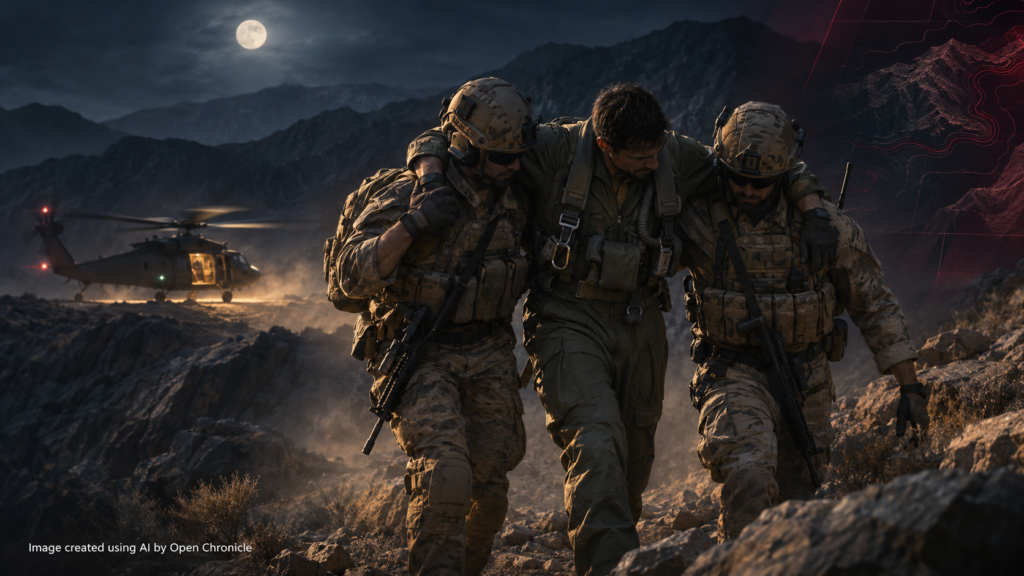
The American recovery of two F-15E crew members from Iran in early April 2026 offers an unusually public account of how intelligence and military action can meet. One airman was recovered before the other. The longer search for the injured weapons systems officer became the focus of a mission whose disclosed elements included location work, dissimulation and special operations.
This is a retrospective examination of that mission, rather than a report of a new November operation. Its significance lies in the relationship between agencies and forces, and in the difference between a successful recovery and a complete public explanation of how it happened.
01. Two recoveries, different challenges
In a release published on 5 April, U.S. Central Command announced that both service members had been recovered in separate missions after their aircraft was shot down.
At the White House briefing the following day, General Dan Caine described positive communication with the second crew member, confirmation that he was injured and evading enemy forces, and assistance from interagency partners in identifying his location.
The distinction between the two recoveries matters. An account that compresses them into a single extraction loses the central feature of the second effort: the need to find and recover someone while an opposing search continued.
The basic outcome is publicly acknowledged by the U.S. military. The detailed chronology and operational picture remain dependent on statements and reporting, rather than an independently available mission record.
02. The CIA’s acknowledged role
CIA Director John Ratcliffe stated publicly on 6 April that the agency used human and technical resources to locate the aviator and ran a deception campaign intended to confuse Iranian searchers. He said the agency confirmed on Saturday morning that the airman was alive and concealed in a mountain crevice.
Ratcliffe described that confirmation being passed to national leadership before the recovery moved to execution. His remarks establish an acknowledged CIA contribution, without disclosing the sources or technologies used.
That boundary is important. A statement about human resources does not identify a particular agent inside an Iranian organisation. A reference to technical capabilities does not establish which sensor, platform or communications method produced the decisive information.
The story is substantial without filling those gaps. The director publicly placed the agency inside the effort to locate and protect a missing service member, rather than leaving its involvement entirely to anonymous reporting.
03. Deception as support for recovery
Reuters reporting published on 5 April described a more specific account from a senior administration official: information was circulated suggesting that the missing airman had already been found and was being moved out of Iran.
That account gives a proposed purpose to the deception: altering what opposing searchers believed while the actual recovery remained unresolved. It does not show which Iranian units received the information or independently measure how much it changed their behaviour.
The analytical lesson is that deception can serve a rescue by creating uncertainty for an adversary while friendly forces work to reduce their own. Its value depends on effects, however, not merely on the existence of a plan.
THE TWO INFORMATION PROBLEMS
A recovery effort seeks reliable information about the person it must retrieve. A supporting deception effort seeks to make the opposing search less reliable. Those are related objectives, but success in one does not automatically prove success in the other.
04. What is known about the special forces
CNN’s 5 April reconstruction, attributed to U.S. officials, identified Delta Force and SEAL Team Six among the forces involved. It also described CIA support and aircraft providing protection for the recovery.
The unit names belong to that attributed reporting. They should not be treated as a publicly released task organisation or as proof of which team carried out each part of the extraction.
A mission can depend on aircrews, intelligence personnel, medical support and command arrangements as well as the personnel who reach the survivor. Focusing only on the best known unit names risks confusing recognition with explanation.
The central relationship is between actionable information and a force capable of using it. The public sources illuminate that relationship more clearly than they illuminate the complete order of battle.
05. The contested account of aircraft losses
Reuters reported an American official’s explanation that at least one aircraft used in the recovery had malfunctioned and was destroyed by U.S. forces. Iranian authorities claimed several American aircraft had been destroyed during the operation. Reuters verified that footage of burned aircraft wreckage was from the area.
Location of wreckage does not, by itself, establish the cause of every loss. The respective claims require more than a photograph to resolve questions of damage, abandonment and deliberate destruction.
This is also why a recovered airman does not imply an operation without costs or complications. The outcome and the performance of every component are separate matters.
06. Cooperation without a complete public blueprint
The acknowledged sequence presents intelligence as part of execution: locating a survivor, confirming identity and informing a decision to send a recovery force. That is different from treating an agency as a distant supplier of background analysis.
It also leaves questions about authority. An agency’s contribution to location work does not mean it commanded military personnel. Public praise for coordination cannot substitute for a disclosed command structure.
A fuller assessment would require operational records showing what information was available at each decision point, how confidence was evaluated and how plans changed. Those records were not part of the material reviewed for this article.
07. Beyond the triumphant account
American officials presented the mission as a demonstration of resolve and institutional capability. That public message is part of the event’s aftermath, but it should not determine the analytical conclusion.
A successful recovery can demonstrate an ability to solve an exceptionally difficult personnel problem without establishing broader control of the battlefield or the success of a war. Nor does it resolve the separate legal and political questions surrounding the conflict.
For Shadow Protocols, the mission’s most revealing feature is the acknowledged combination of intelligence work, deception and military recovery. Its limits are equally instructive: some participants were named only through reporting, collection methods remain undisclosed and accounts of aircraft losses differ.
The strongest reconstruction preserves both features. Two service members were recovered according to the U.S. military. Understanding the partnership that made that possible requires distinguishing what officials acknowledged, what reporters learned from sources and what the public record still cannot show.
Sources and Further Reading
Official announcements establish the U.S. account of the outcome. Recorded public remarks document acknowledged roles. News reconstructions add operational claims whose sourcing is identified below.
1. U.S. Central Command | Recovery announcement
5 April 2026. Official announcement that the two F-15E crew members were recovered in separate missions.
2. Reuters Connect | Recorded remarks by Ratcliffe and Caine
6 April 2026. Video record and transcript excerpts of the CIA director and chairman of the Joint Chiefs discussing location, confirmation and deception. This is a record of official statements, not independent verification of their full content.
3. CNN, reproduced by KVIA | Inside the recovery mission
5 April 2026. Kevin Liptak’s reconstruction, including the identification of special operations units through official sources not named in the report.
4. Reuters, reproduced by Military Times | Rescue and competing aircraft accounts
5 April 2026. Reporting by Phil Stewart and Menna Alaa El-Din on the recovery, reported deception and differing accounts of aircraft losses.
Editorial Note
This is a retrospective documentary analysis of an April 2026 mission, prepared on 11 November 2026. It is not a report of a new rescue or a declassified operational history. Open Chronicle has not independently examined mission logs, classified collection, the full command structure or aircraft loss investigations. Public official remarks, anonymous source reporting and analysis are distinguished. Specific unit participation is attributed to CNN reporting. Neither the complete effectiveness of the deception nor the cause of every aircraft loss is independently established here. Descriptions of military success do not constitute an assessment of the legality or overall conduct of the conflict.