
OPEN CHRONICLE MAGAZINE
SHADOW PROTOCOLS
INTELLIGENCE & ESPIONAGE
From Intelligence to Capture: Mexico’s Naval Special Forces and the Hunt for R2
The arrest in Zapopan brings a Mexican intelligence service, an American law enforcement agency and military special operations into the same public account. Their roles must be distinguished.
By Open Chronicle | 11 November 2026
An arrest is the visible endpoint of work that is often much harder to reconstruct: identifying a person, locating them, evaluating information and deciding how to act. When several institutions contribute, the public announcement may reveal the partnership while leaving its internal workings undisclosed.
The capture of Rafael “N”, known as “R2”, in Zapopan on 8 November offers a recent example. Mexican authorities identify him as an alleged leader of “Los Rs”, a cell associated with the Jalisco New Generation Cartel, or CJNG. Public accounts connect his location to Mexican intelligence work and information supplied by the U.S. Drug Enforcement Administration.
For Shadow Protocols, the story is the relationship between those functions. It is a documented arrest operation with an intelligence component, rather than evidence of a newly exposed American clandestine mission inside Mexico.
01. The intervention in Zapopan
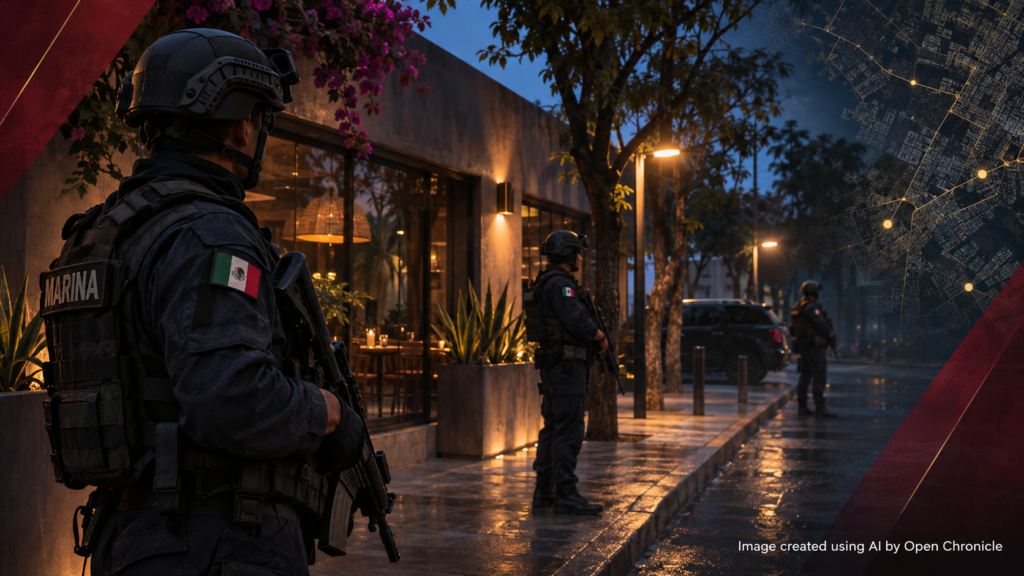
Mexico’s Security Cabinet published its account on 9 November. It describes naval personnel approaching a restaurant in Zapopan while supporting a Michoacán state prosecutor’s order to locate and present individuals. The statement says CNI intelligence work had helped locate organised crime figures there.
According to the authorities, naval personnel came under fire and returned it. Rafael “N” was wounded, treated and taken to hospital in custody. A naval member also suffered a gunshot wound, which the statement described as not life threatening.
The announcement reported 19 additional detainees. Their detention does not establish a common role or criminal guilt. The official statement said they were referred to the competent authorities for investigation and clarification of the facts.
This provides a basic sequence, attributed to the institutions involved. It does not disclose a complete reconstruction of the confrontation, independent witness evidence or the individual legal position of everyone detained.
02. The special operations component
Security Secretary Omar García Harfuch’s public account, reproduced by Mexican university broadcaster UDGTV, identifies the Navy’s Unidad Naval de Operaciones Especiales, UNOPES, as leading the operation with the security ministry, supported by Mexican Army special forces.
The same account credits the Centro Nacional de Inteligencia, CNI, and information shared by the DEA with locating the suspect. It describes its information as preliminary and subject to updates as investigations proceed.
The institutional distinction is useful. UNOPES is the special operations unit identified in the public narrative. CNI is the Mexican intelligence organisation credited with locating work. The DEA is the American law enforcement agency credited with sharing information.
None of those descriptions, by itself, reveals who held each tactical responsibility, how the information was collected or how the final operational decision was reached.
03. What the DEA contribution does and does not establish
Reuters reported the arrest as an operation aided by DEA intelligence. It also reported that the DEA said the suspect was wanted in the United States on federal drug trafficking and firearms charges.
Sharing information can be consequential without implying physical participation. The reviewed public material does not establish that American agents entered the restaurant, commanded the Mexican units or exercised authority over the intervention.
It would therefore be misleading to convert the acknowledged information partnership into a claim of a U.S. special forces raid. The agency identified here is the DEA; the public account supplies no basis for adding a CIA role.
KEEPING THE ROLES DISTINCT
Information sharing, operational command and physical intervention are different contributions. Evidence of the first does not automatically establish the other two.
04. Why locating a suspect is only one part of the mission
The analytical lesson is that intelligence and execution solve different problems. A report may narrow a location without establishing identity beyond doubt. A credible location may still leave unanswered questions about other people present, legal authority and the risks of intervention.
The public account does not allow an outside reader to assess all those decisions in Zapopan. It nevertheless shows why the distinction matters: the announcement describes both information work and an armed encounter. The existence of the former does not explain every event in the latter.
A fuller reconstruction would require the relevant orders, the evidentiary basis for identifying the suspect and a review of the confrontation. Filling those gaps with imagined surveillance methods or a dramatic operational narrative would obscure what is actually known.
05. The judicial objective
El Economista reports that the suspect had an outstanding aggravated homicide warrant issued in Apatzingán, Michoacán, and a warrant for extradition purposes to the United States. It describes UNOPES leadership, Army special forces support and the intelligence partnership in its account of the capture.
A warrant for extradition purposes is not a completed extradition. Nor does capture establish guilt for the alleged offences. Those distinctions remain important even when officials describe a detainee as a major source of regional violence.
The judicial outcome must be assessed separately from the operational outcome. Establishing custody is one result; sustaining charges and determining responsibility require further legal process.
06. Measuring more than a successful capture
The arrest supplies evidence of an intervention, not proof that a criminal organisation has been dismantled or that violence and extortion will decline. Such conclusions would require subsequent evidence about the cell’s activity, finances and ability to replace personnel.
This is a broader analytical limitation of reporting centred on prominent arrests. The event is immediate and visible. The organisational consequences may take longer to establish and may not follow a simple pattern.
For an intelligence partnership, another question concerns what can be made public without exposing sources. Authorities may acknowledge an agency’s contribution while withholding its substance. That leaves an important boundary between recognition of cooperation and independent verification of its precise impact.
07. A partnership visible in outline
The Zapopan case places Mexican special operations and intelligence work alongside an acknowledged contribution from an American agency. That outline is enough to support a serious examination of cooperation. It is not enough to reconstruct every stage of the mission.
The strongest account keeps the operational and evidentiary questions connected: what information was available, who had authority to act, how the intervention unfolded and what the legal process establishes afterward.
The capture is the beginning of that public assessment. Understanding the partnership requires following the case beyond the announcement, without mistaking institutional credit for a complete operational record.
Sources and Further Reading
The official statement provides the authorities’ account of the intervention. Other reports reproduce public institutional statements; their agreement does not independently verify every operational detail.
1. Mexico’s Security Cabinet | Official arrest announcement
9 November 2026. Primary account of the restaurant intervention, CNI contribution, injuries and initial detention total.
2. UDGTV | Public statement by the security secretary
8 November 2026. Reproduces Omar García Harfuch’s statement identifying UNOPES, Army special forces support, CNI work and DEA information sharing.
3. Reuters | Operation aided by DEA intelligence
9 November 2026. Reports the Mexican operation and the DEA’s statement about U.S. charges.
4. El Economista | R2 arrested in Jalisco
9 November 2026. Additional reporting on participating Mexican units and the reported warrants.
Editorial Note
This article analyses public material reviewed on 11 November 2026. Accounts of the confrontation and institutional roles are attributed to authorities and reporting, rather than independently reconstructed by Open Chronicle. The complete judicial file, operational records and individual detainees’ responses were not examined. Initial detention figures are identified as such. All suspects are presumed innocent. DEA information sharing is not presented as evidence of American participation on the ground, American command, CIA involvement or a completed extradition. No reduction in cartel activity is inferred from the capture alone.