
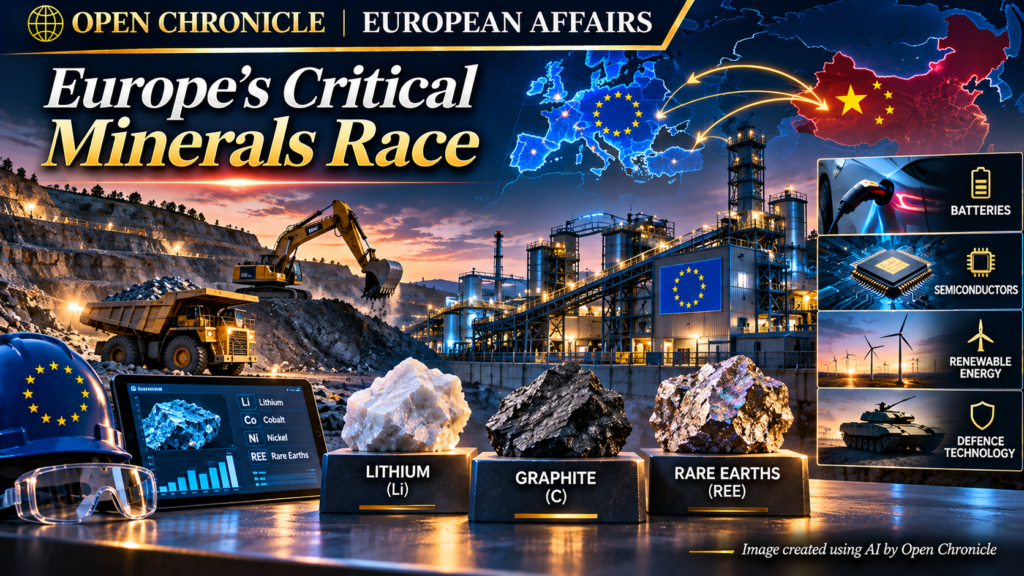
OPEN CHRONICLE | EUROPEAN AFFAIRS | INDUSTRY & GEOPOLITICS
Brussels has approved another 46 strategic raw materials projects, bringing its programme to 106 initiatives worldwide. But turning mines, refineries and recycling facilities into a resilient European supply chain will require financing, public acceptance and years of industrial development.
By Open Chronicle News Desk
November 11, 2026 | Special Report
Introduction | Europe’s industrial future begins underground
Europe’s ambitions for electric vehicles, renewable energy, advanced semiconductors and modern defense systems depend on materials that rarely appear in political speeches but determine whether factories can operate.
Lithium, cobalt, graphite, rare earth elements, tungsten, gallium and germanium are essential components of the technologies shaping the twenty-first century.
They are also at the center of an increasingly important geopolitical contest.
For decades, European industry has relied on international supply chains in which extraction, refining and manufacturing are often concentrated outside the European Union.
China occupies a particularly influential position in several of these markets, especially in the processing of rare earth elements and the production of materials used in batteries, electronics and permanent magnets.
That concentration has become a strategic vulnerability.
Trade restrictions, diplomatic tensions or disruptions affecting a limited number of suppliers can have consequences far beyond the mining industry.
They can influence the cost of manufacturing electric vehicles, the availability of industrial equipment and the production of technologies considered essential to European economic security.
The European Union is now attempting to change that equation.
On October 9, 2026, the European Commission selected 46 additional strategic projects under the Critical Raw Materials Act, extending its efforts to develop extraction, processing and recycling capacity.
The decision represents another step toward the EU’s 2030 industrial objectives.
But it also raises a difficult question.
Can Europe build enough of its own industrial capacity to reduce strategic dependence without creating new environmental, financial and political problems?
The answer will depend less on the number of projects announced than on how many can reach commercial operation.
1. A new generation of European strategic projects
The Commission’s October decision selected 46 new projects located across 16 EU member states.
They were chosen from 102 applications submitted during the latest selection process.
The countries involved are Belgium, Bulgaria, Estonia, Finland, France, Germany, Greece, Italy, Lithuania, the Netherlands, Poland, Portugal, Romania, Slovakia, Spain and Sweden.
The projects cover different stages of the supply chain, from mineral extraction to refining and the recovery of valuable materials from waste.
The Commission’s published breakdown identifies eight extraction projects, eleven processing projects, nineteen recycling projects and eight integrated projects.
These initiatives follow 47 projects selected within the EU in March 2025 and 13 projects in third countries and overseas territories selected in June 2025.
Together, the three groups account for 106 designated strategic projects.
The designation is significant, but its meaning requires care.
Strategic status does not mean that a mine has opened, a refinery is operating or a recycling facility has reached full production.
Instead, it identifies a project considered important to European supply security and potentially eligible for administrative and financing support.
The central challenge is converting those designations into operating industrial facilities.
2. The numbers behind Europe’s mineral ambitions
Europe’s Industrial Targets
Four benchmarks guide the European Union’s efforts to strengthen domestic capacity, expand recycling and diversify strategic raw material supply chains by 2030.
Extraction
EU annual consumption
Processing
EU annual consumption
Recycling
EU annual consumption
Maximum Dependency
From any single third country
What These Benchmarks Mean
The first three benchmarks concern the European Union’s capacity to extract, process and recycle strategic raw materials relative to its annual consumption. The fourth benchmark addresses supply concentration. The EU aims to avoid relying on any single third country for more than 65% of its annual consumption of a strategic raw material at a relevant processing stage.
These are EU-level, non-binding capacity and diversification benchmarks for 2030, not evidence that the targets have already been achieved. The bars illustrate the numerical benchmarks, not measured progress
toward their implementation.
European Commission and Council of the European Union. Critical Raw Materials Act, Regulation (EU) 2024/1252. The percentages are statutory EU policy benchmarks for 2030.
The Critical Raw Materials Act, which entered into force in May 2024, established four principal benchmarks.
By 2030, the EU aims to have extraction capacity equivalent to at least 10% of its annual consumption of strategic raw materials, where geological reserves permit.
It also aims to develop processing capacity equivalent to at least 40% of annual consumption and recycling capacity equivalent to at least 25%.
A fourth benchmark seeks to prevent dependence on a single third country for more than 65% of the EU’s annual consumption of any strategic raw material at a relevant processing stage.
These objectives are intended to guide industrial development and diversification.
They are not binding production quotas imposed individually on every company.
Nor does reaching an EU-wide benchmark guarantee that every material will have a secure supply chain.
Different minerals present different geological, technological and commercial challenges.
3. Why China’s position matters
China’s influence in critical mineral supply chains extends beyond the location of mines.
One of the most important distinctions is between extracting a mineral and transforming it into a material that manufacturers can use.
Rare earth elements illustrate the problem.
Mining rare earth-bearing ore is only one stage in a complex industrial process.
The material must be separated, purified and converted into products suitable for applications such as permanent magnets.
These magnets are used in electric motors, wind turbines, industrial machinery and certain defense technologies.
China has developed extensive industrial capabilities across several stages of this value chain.
The European Commission has warned that concentrated global production and processing create dependencies that can be used as instruments of geopolitical pressure.
Chinese export controls introduced since 2023 have covered materials including gallium, germanium, graphite and certain rare earth products.
The measures have increased concern among European manufacturers about access, delivery schedules and the possibility of future restrictions.
However, the issue should not be reduced to a simple confrontation between Europe and China.
European companies also benefit from international trade, established industrial relationships and access to competitive global suppliers.
The EU’s stated objective is diversification rather than complete economic separation.
That distinction matters because replacing every imported material with domestic production would be technically difficult, economically costly and, in some cases, environmentally undesirable.
The more realistic objective is to reduce excessive concentration and create alternative sources of supply.
4. Mining is only the beginning
Europe possesses mineral resources, but geological availability does not automatically translate into industrial production.
A commercially viable mining project requires exploration, technical studies, financing, environmental assessment, infrastructure and regulatory approval.
Even after those stages are completed, construction and commissioning can take considerable time.
The same applies to processing facilities.
A refinery must secure appropriate feedstock, establish reliable industrial processes and find customers for its products.
A recycling operation needs access to sufficient quantities of recoverable material and technology capable of extracting it economically.
This is why the Commission’s strategy covers the entire supply chain.
The October 2026 project selection includes initiatives involving extraction, processing, recycling and integrated operations.
The Commission has indicated that projects selected in 2025 are making progress through environmental assessments and construction permitting.
Nevertheless, administrative progress should not be confused with commercial production.
A project with a construction permit may still require substantial investment before producing its first material.
For Europe’s industrial strategy, the critical indicators will be actual output, operating costs, technical reliability and the ability to secure long-term customers.
5. Recycling: Europe’s alternative to opening more mines
Recycling occupies an increasingly important place in the European strategy.
Used batteries, electronic equipment, industrial machinery and manufacturing waste can contain materials that are difficult or expensive to obtain through primary extraction.
Recovering these materials could reduce the need for imports while retaining economic value within Europe.
The Commission’s latest selection gives considerable weight to recycling, with nineteen of the 46 new projects classified in that category.
This reflects an important industrial opportunity.
Europe already generates substantial quantities of electronic and industrial waste.
Developing the capacity to recover strategic materials could transform part of that waste into a domestic resource.
But recycling is not an immediate substitute for mining.
The quantity of material available depends on how many products reach the end of their useful lives.
New technologies also require new supplies before sufficient quantities of discarded products exist for large-scale recovery.
The economics of recycling depend on collection systems, material composition, processing efficiency and market prices.
Consequently, recycling is likely to complement rather than eliminate the need for primary production.
The strongest European supply chains may combine domestic extraction, imported raw materials, regional processing and recycling.
6. Portugal and the geography of Europe’s mineral strategy
Portugal is among the sixteen member states included in the Commission’s October 2026 selection.
Its participation places the country within a wider European effort to diversify sources of strategic raw materials.
For Portugal, as for other participating countries, potential benefits include industrial investment, specialized employment, infrastructure development and participation in European manufacturing supply chains.
However, the economic outcome will depend on the individual projects and the extent to which they create lasting local value.
A mineral deposit does not automatically generate a diversified industrial economy.
If raw materials are extracted but most subsequent processing takes place elsewhere, a significant share of the economic value may leave the producing region.
Conversely, developing processing and recycling capabilities can create additional industrial activity.
The question for Portugal is therefore not simply whether it can supply strategic minerals.
It is whether mineral development can support broader industrial capabilities while meeting environmental requirements and addressing the concerns of affected communities.
The same challenge applies to projects elsewhere in Europe.
7. The environmental contradiction at the heart of the transition
Critical minerals are essential to technologies intended to reduce greenhouse gas emissions.
Yet producing those materials can create environmental pressures of its own.
Mining may affect landscapes, water resources, biodiversity and nearby communities.
Processing can require substantial quantities of energy and chemicals.
Waste management and site rehabilitation may remain important long after extraction has ended.
This creates a political dilemma.
Europe wants to expand clean energy technologies while maintaining environmental protections and public confidence in industrial development.
Accelerating approval procedures may help reduce uncertainty for investors.
But speed alone cannot establish whether a project is environmentally sustainable.
The Critical Raw Materials Act includes requirements intended to support responsible production and sustainable supply chains.
Strategic projects must satisfy criteria relating to feasibility and sustainability, among other conditions.
Nevertheless, project designation does not eliminate the need for applicable environmental assessments and permits.
The legitimacy of Europe’s mineral strategy will depend partly on whether local communities believe that decisions are transparent, environmental risks are addressed and economic benefits are fairly distributed.
A strategy designed to strengthen European resilience could encounter significant resistance if those concerns are neglected.
8. The financing challenge: strategic status is not a blank cheque
One of the greatest obstacles to developing European mineral supply chains is financing.
Mining and processing projects frequently require substantial investment before generating revenue.
Investors must assess geological uncertainty, construction costs, energy prices, regulatory requirements and future demand.
They must also consider competition from established international producers.
A new European facility may face higher operating costs than an existing plant in a country with cheaper energy, established infrastructure or economies of scale.
The Critical Raw Materials Act seeks to improve investment conditions by facilitating administrative procedures and access to financing opportunities.
Strategic status can help projects attract attention from public institutions, financial organizations and potential industrial customers.
However, it does not guarantee financing or commercial success.
A project may be strategically desirable while remaining economically difficult.
This distinction becomes especially important when public resources are involved.
Governments must determine whether supporting a project creates sufficient long-term economic and security benefits to justify the financial risks.
They must also avoid creating facilities that depend indefinitely on subsidies without developing competitive operations.
9. Germany calls for European strategic stockpiles
The debate over critical minerals has also moved beyond investment in future production.
On November 5, German Chancellor Friedrich Merz called for European-level stockpiles of critical raw materials to reduce dependence on concentrated global supply chains.
Speaking at an economic conference in Berlin, Merz emphasized the importance of these materials for batteries, electric motors, semiconductors and other strategic technologies.
He also advocated greater diversification, recycling and circular economic activity.
The remarks reflect concern that developing new mines and processing facilities may take longer than Europe’s immediate security requirements allow.
Strategic stockpiles could provide a temporary buffer against supply interruptions.
But they would introduce additional questions.
Which materials should be stored?
Who would finance the purchases?
How large should the reserves be?
And under what circumstances should stored materials be released?
Stockpiling can improve resilience, but it cannot permanently compensate for insufficient production or excessive dependence on particular suppliers.
It is therefore best understood as one possible element of a broader strategy rather than a complete solution.
10. The defense dimension
Critical raw materials are not only an economic issue.
They are increasingly relevant to European defense planning.
Modern military systems depend on sophisticated electronics, specialized metals, advanced sensors and high-performance components.
Certain rare earth elements are used in permanent magnets, while tungsten and other materials have applications in demanding industrial and defense environments.
Disruptions affecting these supply chains could complicate manufacturing and maintenance.
The EU’s strategic raw materials framework explicitly recognizes the importance of these materials for defense and aerospace.
This does not mean that every designated project will supply military manufacturers.
Many will serve civilian industries, including automotive production, renewable energy and electronics.
But the same industrial capabilities can support several sectors.
A more diversified European materials supply chain could therefore improve both civilian industrial resilience and the availability of inputs for defense manufacturing.
The strategic benefit depends on whether projects produce materials in forms that European manufacturers can actually use.
11. International partnerships remain indispensable
Europe’s mineral strategy is sometimes described as an effort to achieve self-sufficiency.
That description is incomplete.
The EU’s own framework recognizes that domestic extraction cannot meet every requirement.
Geological resources are unevenly distributed, and certain materials may be more economical or environmentally appropriate to obtain from international partners.
The European Commission has established strategic partnerships on raw materials with countries including Canada, Chile, Norway and Ukraine.
These arrangements are intended to support cooperation, investment and more diversified supply chains.
The objective is not necessarily to replace one dominant supplier with another.
It is to develop a broader network of reliable partners and reduce the consequences of disruptions affecting any single source.
However, diversification must extend beyond the country where a mineral is extracted.
If ore is mined in one country but must be shipped to another dominant supplier for processing, the supply chain may remain vulnerable.
European policymakers therefore need to examine the complete industrial pathway.
Extraction, refining, component manufacturing and transportation can each create dependencies.
12. The difference between announced capacity and industrial independence
The Commission’s latest project selection represents measurable progress in implementing the Critical Raw Materials Act.
Yet the number of projects is not a sufficient measure of success.
A more meaningful assessment would examine whether the EU is developing operating capacity across the materials and industrial stages where dependence is most concentrated.
Several questions will be particularly important over the coming years.
Will designated projects secure financing and complete permitting?
Will they begin production within their expected schedules?
Can European refineries compete with established international suppliers?
Will recycling facilities obtain enough suitable material to operate efficiently?
And will manufacturers sign the long-term purchasing agreements needed to support investment?
These questions distinguish industrial planning from industrial capability.
The Commission has indicated that the combined EU projects selected in 2025 and 2026 could meet the 2030 extraction benchmarks for several materials, including lithium, nickel, rare earth elements, magnesium and tungsten.
That is a projection based on anticipated capacity, not confirmation that those targets have already been achieved.
It also does not establish that Europe will possess sufficient processing and manufacturing capacity for every downstream application.
The difference is fundamental.
A continent can possess mineral resources and still depend heavily on foreign industrial infrastructure.
13. What European industry should watch next
The next phase of the strategy will be judged by implementation rather than announcements.
Three developments deserve particular attention.
First, progress toward construction and commercial production. Project status should be evaluated through permits, financing decisions, construction milestones and actual output.
Second, investment in processing and recycling. These activities will determine whether Europe captures more value from extracted and recovered materials.
Third, the evolution of international trade restrictions. New export controls or changes in global supply conditions could alter the economics and urgency of European projects.
The Commission has indicated that further applications for strategic project status are expected as the programme continues.
But future designations will only strengthen the European economy if they lead to commercially viable, environmentally responsible and technically reliable operations.
Conclusion | Europe’s strategic autonomy will be built in factories, not declarations
The European Union has identified a vulnerability that affects its industrial, technological and geopolitical future.
The materials required for electric vehicles, renewable energy, semiconductors and defense equipment are embedded in international supply chains that Europe does not fully control.
The Critical Raw Materials Act represents an attempt to reduce that vulnerability.
The selection of 46 additional projects in October 2026 demonstrates that the strategy is moving from legislation toward industrial implementation.
Yet the most difficult work remains.
Europe must attract investment, complete environmental assessments, construct facilities, develop processing technologies and establish reliable commercial relationships.
It must also balance industrial security with environmental protection and the interests of communities affected by mineral development.
Reducing dependence on China does not require abandoning international trade.
It requires ensuring that European industries have credible alternatives when global supply chains become unreliable.
The decisive question is no longer whether Europe recognizes the importance of critical raw materials.
It is whether the continent can turn its strategic ambitions into functioning industrial capacity before the next major disruption exposes the cost of waiting.
Open Chronicle will continue examining the implementation of Europe’s critical raw materials strategy, including project financing, industrial development, environmental challenges and the evolution of international supply dependencies.
Sources and Further Reading
Official European Commission decisions, European Union legislation, institutional analysis and independent reporting on Europe’s critical raw materials strategy.
Commission Selects 46 New Strategic Projects
October 9, 2026. Official announcement concerning 46 new strategic projects in 16 EU member states, selected to strengthen European supply chains and diversify access to critical raw materials.
Selected Strategic Projects Under the CRMA
Official register of the strategic projects selected under the Critical Raw Materials Act, including projects inside and outside the EU. The Commission identifies 106 designated projects across its selection rounds.
European Critical Raw Materials Act
Regulation (EU) 2024/1252. Legal framework establishing strategic raw materials benchmarks, supply security measures and criteria for strategic projects.
The Critical Raw Materials Act Explained
Institutional explanation of the EU’s 2030 benchmarks, supply diversification, strategic project designation and measures to strengthen European industrial resilience.
Critical Raw Materials: Securing Sustainable Supply
Official overview of the European strategy to expand extraction, processing and recycling, alongside international partnerships intended to diversify strategic supply chains.
Implementing the EU’s Critical Raw Materials Act
Parliamentary analysis of the legislation, its 34 critical raw materials, 17 strategic materials, industrial objectives and implementation challenges.
Europe Must Stockpile Critical Raw Materials, Merz Says
November 5, 2026. Reporting on German Chancellor Friedrich Merz’s call for European strategic stockpiles and greater diversification of mineral supplies.
This report is based on European Union legislation, European Commission project documentation and independent reporting available as of November 11, 2026. Strategic project designation does not establish that a facility is operational or that projected production capacity has been achieved. The EU’s 2030 benchmarks are policy objectives rather than confirmed current production levels.