
OPEN CHRONICLE | U.S. NEWS DESK | DEFENSE & INTELLIGENCE
SPECIAL INVESTIGATION | NOVEMBER 11, 2026
By Open Chronicle News Desk
Three men have been indicted in the United States over an alleged campaign of nearly 20 terrorist attacks and attempted attacks across Europe and America. At the center of the latest charges is an extraordinary accusation: a suspected plot against RAF Fairford, a British airbase hosting American bombers, was allegedly coordinated in part by a man already imprisoned in New York.
A terrorist plot, an American airbase and instructions from a prison cell
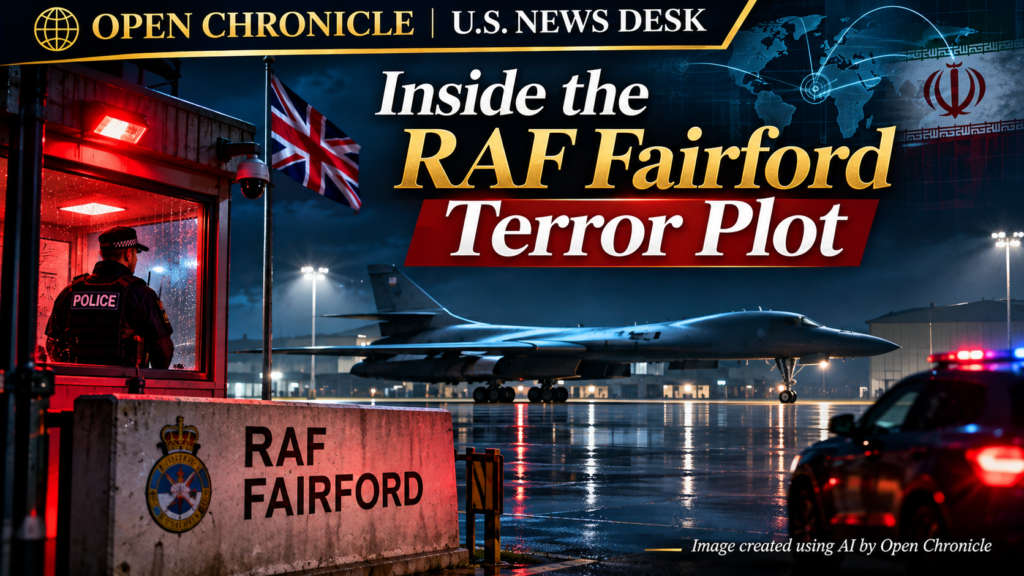
A British military airbase housing American personnel and strategic bombers became the target of an alleged terrorist conspiracy involving operatives associated with Iranian-backed organizations, according to an indictment unveiled by the U.S. Department of Justice on November 10, 2026.
The investigation centers on RAF Fairford, a Royal Air Force installation in Gloucestershire that has played an important role in American military operations.
Federal prosecutors allege that three men participated in a wider network responsible for planning or supporting nearly 20 terrorist attacks and attempted attacks across Europe and the United States.
The allegations involve attacks against Jewish communities, Israeli-linked targets and American military interests.
But one detail makes the case particularly striking.
According to prosecutors, a central figure in the alleged network continued attempting to coordinate activities even after being arrested and imprisoned in New York.
Investigators say he used telephone conversations with relatives in Iraq to pass coded messages to associates operating outside the United States.
The indictment describes a transnational network involving individuals in Iran, Iraq, Britain and the United States.
It also raises difficult questions about the ability of suspected extremist networks to operate across borders, exploit intermediaries and maintain communications after key members have been detained.
The charges are serious, but they remain allegations.
No conviction has been established against the three defendants in relation to the newly announced charges. Iran has denied involvement in the RAF Fairford incident, and the prosecution’s account has not yet been tested through a completed trial.
1. The three men at the center of the investigation
The eight-count superseding indictment identifies three defendants.
The accused | U.S. federal indictment
| Mohammad Baqer Saad Dawood al-Saadi | 32, Iranian and Iraqi national. Already in U.S. custody. |
| Mohsen Mohajeri | 48, Iranian national. Reportedly in Iran during the Fairford incident. |
| Mohammad Ali al-Hassani | 35, Iraqi national. Alleged organizer of the Fairford operation. |
Identities and ages as published by the U.S. Department of Justice on November 10, 2026.
Prosecutors accuse the men of supporting an Iran-aligned network involving Kata’ib Hizballah, an Iraqi armed organization, and Iran’s Islamic Revolutionary Guard Corps.
Both organizations are designated foreign terrorist organizations under U.S. law.
The indictment alleges that the defendants coordinated or supported a series of violent operations, including attacks targeting Jewish communities in Europe and the United States.
The latest charges place particular emphasis on the attempted operation against RAF Fairford in September 2026.
According to the Justice Department, al-Hassani and Mohajeri were in Iran during the period of the alleged Fairford plot.
Al-Saadi, meanwhile, was already in federal custody in New York.
The prosecution claims that imprisonment did not end his involvement.
Instead, investigators allege that he continued to communicate through family members and intermediaries.
That allegation is central to understanding the broader case.
2. RAF Fairford: why the alleged target mattered
RAF Fairford is not an ordinary military installation.
Located in Gloucestershire, approximately 160 kilometers west of London, the base has long supported American air operations.
It has hosted U.S. strategic bombers, including aircraft capable of conducting long-range missions.
Its importance extends beyond Britain.
The installation forms part of the wider infrastructure supporting American military operations in Europe and beyond.
During periods of international tension, access to forward operating facilities allows the United States to position aircraft closer to potential theaters of operation.
In 2026, RAF Fairford was particularly sensitive because American bombers had been operating from the installation during the conflict involving Iran.
The alleged targeting of the base therefore carried significance beyond the possibility of physical damage.
An attack could have threatened American military personnel, aircraft and infrastructure on British territory.
It could also have created a major diplomatic and security crisis between Washington, London and Tehran.
The strategic importance of the base helps explain why the investigation attracted the attention of American federal prosecutors and British counterterrorism authorities.
It does not, however, establish that the alleged plot was directed by the Iranian government.
That question requires evidence beyond the defendants’ reported affiliations and the prosecution’s allegations.
3. The September incident: how the alleged operation unfolded
The indictment describes a sequence of preparatory activities during August and September 2026.
Prosecutors allege that al-Hassani arranged for associates in Britain to conduct reconnaissance near RAF Fairford.
They also claim that individuals acting under his direction acquired vehicles and materials associated with preparations for a possible attack.
Some vehicles were allegedly disguised to resemble ordinary commercial service vans.
The prosecution says that three vans were directed toward the military installation on September 26.
At least two reportedly encountered a security roadblock and were prevented from continuing along their intended route.
British authorities subsequently recovered three vehicles and arrested their occupants.
The investigation linked the incident to a suspected attempt to attack the base.
No successful bombing of RAF Fairford has been established.
The distinction is important because the indictment describes an alleged attempted operation rather than a completed attack on the installation.
Independent reporting indicates that the incident prompted significant security precautions, including the withdrawal of American B-1 bombers from the base.
The circumstances illustrate how a suspected threat can affect military operations even when an attack does not succeed.
4. The prison connection: how prosecutors say the network continued operating
One of the most consequential allegations concerns al-Saadi’s communications while in custody.
According to the Justice Department, he made telephone calls to relatives in Iraq while awaiting trial in New York.
Prosecutors allege that some conversations contained coded references to individuals and activities associated with the wider network.
They say he used family members to communicate indirectly with associates outside prison.
In one reported exchange shortly before the Fairford incident, investigators allege that he discussed providing financial support to an individual associated with the operation.
The prosecution interprets these conversations as evidence of continued coordination.
The allegations raise a wider security issue.
Detaining a suspected organizer can interrupt a network’s activities, but it does not necessarily eliminate every communication channel or relationship.
Organizations operating across several countries may rely on intermediaries, personal relationships and informal networks.
However, the interpretation of coded communications is a matter for the courts.
The defendants and their lawyers must have the opportunity to challenge the prosecution’s evidence, including the context and meaning of recorded conversations.
The existence of telephone calls does not, by itself, establish that the participants were coordinating terrorism.
The government’s case depends on demonstrating the relevant criminal intent and conduct through admissible evidence.
5. A campaign allegedly extending beyond the military base
The Fairford incident forms part of a larger prosecution.
The Justice Department alleges that the defendants supported a campaign involving nearly 20 terrorist attacks and attempted attacks in Europe and the United States.
Some of the alleged operations targeted Jewish institutions and communities.
Independent reporting has linked the wider investigation to incidents involving arson, assaults and other acts of violence.
These allegations indicate that the prosecution is examining more than a single military target.
Investigators are attempting to establish whether several incidents were connected through shared organizers, financing or operational support.
If the prosecution succeeds, the case could provide evidence of a network operating across multiple countries and targeting different categories of people and institutions.
But the legal distinction remains essential.
The indictment’s description of a broader campaign is the prosecution’s theory of the case.
Individual incidents, defendants’ roles and alleged organizational connections must be evaluated separately.
A criminal indictment does not establish that every attack attributed to a network was carried out by the same individuals.
6. Iran, Kata’ib Hizballah and the IRGC: what the allegations establish
The alleged organizational connections are among the most politically sensitive aspects of the case.
Kata’ib Hizballah is an Iraqi armed organization with longstanding links to Iran.
The Islamic Revolutionary Guard Corps is a central component of Iran’s military and security establishment.
Both have been designated foreign terrorist organizations by the United States.
The Justice Department alleges that the defendants acted in support of these organizations.
This is a significant accusation because it connects the alleged Fairford plot to the wider confrontation involving Iran and the United States.
However, several questions must be kept separate.
The first is whether the defendants committed the alleged criminal acts.
The second is whether they were acting in support of particular organizations.
The third is whether Iranian state authorities directly ordered, financed or controlled the operation.
Those are not identical propositions.
Iran has denied involvement in the RAF Fairford incident.
The indictment identifies an alleged Iran-aligned network, but a finding of direct state responsibility would require its own evidentiary basis.
Responsible reporting must avoid treating every accusation against an Iran-linked individual as proof that the Iranian government ordered a specific attack.
7. The British investigation and the American prosecution
The case involves two national legal systems.
The suspected operation took place in Britain, where local police and counterterrorism authorities investigated the vehicles and individuals associated with the September incident.
The broader indictment was issued in the United States.
American prosecutors are pursuing charges connected to alleged support for designated terrorist organizations and attacks involving international targets.
British authorities have also taken action against individuals suspected of involvement in the Fairford incident.
According to reporting available on November 11, two individuals were subsequently charged under Britain’s National Security Act following the initial arrests.
The British proceedings and the American prosecution should not be confused.
They involve different legal jurisdictions, potentially different defendants and distinct statutory offenses.
Their findings must be evaluated independently.
The cross-border dimension nevertheless illustrates the importance of cooperation between law enforcement and intelligence authorities.
Evidence relevant to a suspected international conspiracy may be distributed across several countries.
Investigators must therefore work within different legal frameworks while preserving the requirements of due process.
8. The charges and potential penalties
The superseding indictment contains eight counts.
They include allegations concerning material support for designated terrorist organizations, conspiracy, financing terrorism and attempted terrorist offenses.
Some charges carry maximum penalties of 20 years in prison.
Others carry maximum penalties of life imprisonment.
The potential penalties depend on the specific counts and defendants involved.
They are statutory limits, not sentences already imposed.
Only a court can determine guilt and any resulting punishment.
The Prosecution in Numbers
Key figures from the U.S. federal indictment concerning the alleged international terrorist network and the RAF Fairford incident.
2026
The figures above describe allegations contained in a U.S. federal indictment. They do not establish that the defendants committed the alleged offenses. Criminal charges are not convictions, and the
defendants are presumed innocent unless proven guilty in court.
Source: U.S. Department of Justice, November 10, 2026. These figures describe the prosecution’s allegations, not proven criminal conduct.
9. Why American bombers were withdrawn
The alleged Fairford plot had consequences for American military operations.
Independent reporting indicates that the United States withdrew B-1 bombers from RAF Fairford after the September incident.
The move illustrates the potential operational impact of a credible security threat.
Military commanders must consider the safety of personnel, the vulnerability of aircraft on the ground and the possibility of further incidents.
Precautionary redeployments can be made even before investigators determine whether a particular threat would have succeeded.
Such decisions do not necessarily demonstrate that an attack was imminent or that security at the installation had been compromised.
They may instead reflect efforts to reduce exposure while authorities assess the situation.
The case also highlights the challenge of protecting military infrastructure situated within civilian communities.
RAF Fairford is a strategic installation, but it is also surrounded by roads, businesses and residential areas.
Military security must therefore operate alongside ordinary civilian activity.
That creates a complex environment for both protection and investigation.
10. The wider threat to Jewish communities
The indictment’s allegations involving Jewish communities deserve particular attention.
According to prosecutors, the alleged network was associated with attacks and attempted attacks against Jewish institutions and individuals.
These allegations fit within a broader international concern about threats against religious communities.
Violence targeting people because of their Jewish identity is antisemitic.
Such acts can generate fear far beyond the immediate victims and damage the security of entire communities.
The investigation raises questions about whether geographically separated incidents were coordinated or supported by common organizers.
It also highlights the importance of protecting places of worship, schools, community organizations and other civilian institutions.
The prosecution will need to demonstrate the alleged connections through evidence.
Until then, the relationship between individual incidents and the defendants remains subject to judicial determination.
11. A security challenge spanning four countries
The alleged conspiracy illustrates how international investigations can involve several different geographic centers.
The prosecution is based in New York.
The attempted operation was allegedly directed toward a British military installation.
Some defendants were reportedly in Iran.
The alleged prison communications involved relatives in Iraq.
This geographic distribution complicates the investigation.
Different countries have different laws governing surveillance, evidence collection, detention and extradition.
Investigators may need to establish who communicated with whom, how money moved and whether separate incidents were part of a coordinated operation.
They must also distinguish criminal conduct from lawful communication and association.
That task becomes especially difficult when prosecutors allege the use of coded language or indirect intermediaries.
The outcome will depend not simply on the seriousness of the accusations but on the strength of the evidence presented in court.
12. What remains unproven
The available reporting establishes that American prosecutors have filed serious terrorism-related charges.
It also establishes that British authorities investigated a suspicious incident involving vehicles near RAF Fairford in September.
But several important matters remain unresolved.
There has been no completed trial establishing the guilt of the three defendants on the newly announced charges.
The full extent of any alleged operational support from Iranian state institutions has not been judicially determined.
The prosecution’s interpretation of prison communications has not been tested through a completed trial.
Nor should the number of attacks cited in the indictment be treated as a count of offenses conclusively attributed to the defendants.
These limitations do not diminish the seriousness of the allegations.
They define what can responsibly be stated at this stage.
13. Why this case matters beyond RAF Fairford
The significance of the case extends beyond a single airbase.
If the allegations are substantiated, they would demonstrate the ability of an international network to maintain relationships across borders and attempt to threaten military and civilian targets in several countries.
The case would also raise questions about communications by detained suspects, the security of foreign military installations and the effectiveness of international counterterrorism cooperation.
For the United States and Britain, the investigation is another reminder that overseas military operations can generate security concerns far from the immediate battlefield.
For European governments, the allegations concerning Jewish communities underline the continuing importance of protecting civilian targets.
For the courts, the challenge is to determine individual criminal responsibility without allowing geopolitical tensions to substitute for evidence.
These are separate but interconnected responsibilities.
Conclusion | A plot disrupted, a prosecution still to be tested
The alleged operation against RAF Fairford is one of the most striking international terrorism cases announced by American authorities in recent months.
Three men face charges involving an alleged network that prosecutors say supported nearly 20 attacks and attempted attacks across Europe and the United States.
The central accusation is extraordinary: one defendant allegedly continued coordinating activity from an American prison while associates abroad prepared a possible attack against a British military installation hosting U.S. forces.
The September incident resulted in arrests and significant military security precautions.
Yet the final legal conclusions remain unwritten.
The defendants are presumed innocent unless proven guilty beyond a reasonable doubt.
The question now is whether prosecutors can demonstrate the connections, communications and criminal intent described in the indictment.
For Washington and London, the case highlights the importance of international cooperation in protecting military personnel and civilian communities.
For the wider world, it illustrates how security threats can cross borders, involve multiple jurisdictions and create consequences far beyond their immediate targets.
Open Chronicle will continue to monitor the federal prosecution, British proceedings and official developments concerning the alleged RAF Fairford plot.
Sources and Further Reading
Official U.S. Department of Justice statements and independent international reporting provide the documentary basis for this investigation into the alleged RAF Fairford terrorist plot.
Three Iranian-Backed Operatives Indicted
November 10, 2026. Official announcement identifying the three defendants, eight federal counts, alleged organizational connections and the suspected September operation targeting RAF Fairford.
Southern District of New York: Superseding Indictment
November 10, 2026. Detailed prosecution announcement explaining the alleged network, prison communications and events preceding the Fairford incident. The page includes the superseding indictment as an attachment.
U.S. Charges Three Men Over Alleged Terror Plots
November 10, 2026. Independent reporting examining the allegations, the suspects’ custody status, the alleged attacks against Jewish communities and the impact of the Fairford incident on U.S. military operations.
U.S. Charges Three Over British Airbase Plot
November 10, 2026. Coverage of the investigation into the RAF Fairford incident, the September security response and the subsequent withdrawal of American bombers.
Three Men Charged in RAF Fairford Investigation
November 11, 2026. British reporting on the indictment, the individuals accused and the alleged international coordination behind the attempted operation.
International Investigation Into Fairford Plot
November 11, 2026. Additional independent coverage of the charges, British arrests, the military security response and Iran’s denial of involvement.
This article distinguishes documented legal proceedings from allegations contained in the U.S. federal indictment. The defendants are presumed innocent unless proven guilty beyond a reasonable doubt. Alleged links to Iranian organizations do not independently establish direct responsibility by the Iranian government. Information reflects reporting available November 11, 2026.