
OPEN CHRONICLE | GLOBAL NEWS DESK | RUSSIA & SECURITY
An explosion in a southern district of St. Petersburg has killed a Russian serviceman reportedly holding the rank of colonel. The attack adds to a series of killings targeting military personnel inside Russia, raising questions about domestic security, the consequences of the war in Ukraine and the dangers of attributing responsibility before investigators establish the facts.
By Open Chronicle News Desk
November 12, 2026 | Special Report
Introduction | Another deadly explosion far from the battlefield
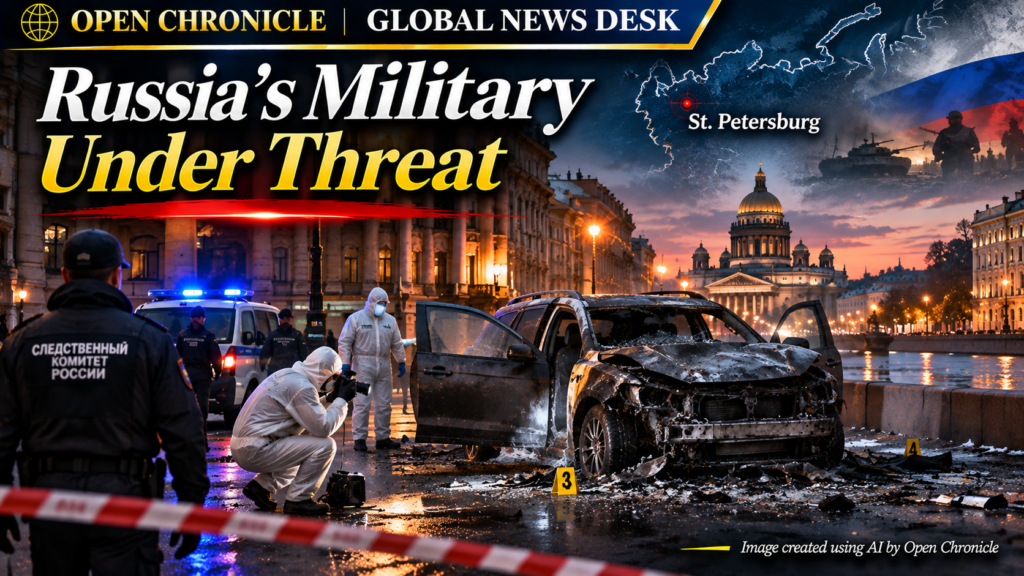
A Russian military serviceman was killed on Thursday morning when his vehicle exploded in a residential area on the southern outskirts of St. Petersburg, in the latest incident involving military personnel targeted far from the front lines of the war in Ukraine.
Russia’s Investigative Committee confirmed that a member of the armed forces had died in a vehicle explosion in the city’s Pushkinsky District and announced the opening of a murder investigation.
Local media reported that the victim was a colonel in the Russian armed forces, potentially connected to an air and air defense formation. However, Russian authorities had not publicly identified the serviceman or officially confirmed his rank at the time of reporting.
The explosion occurred in the Shushary area, near Kolpinskoye Highway, shortly after 7 a.m. local time.
Photographs and video from the scene showed a severely damaged vehicle, debris scattered across the roadway and investigators examining the area under police protection.
The killing follows several similar incidents involving Russian military figures since the beginning of Moscow’s full-scale invasion of Ukraine in February 2022.
Although Russian authorities have previously accused Ukraine of involvement in attacks against senior military officers, no responsibility for Thursday’s explosion had been independently established.
Ukraine had not immediately commented on the incident.
The bombing raises difficult questions about the security of military personnel inside Russia, the effectiveness of protective measures and the possibility that the war’s consequences are increasingly being felt in Russian urban areas.
1. What happened in St. Petersburg?
The explosion took place on the morning of November 12 in Shushary, a district south of central St. Petersburg.
According to Russia’s Investigative Committee, the vehicle was being driven by a member of the Russian armed forces when it exploded.
The serviceman died at the scene.
Investigators opened a criminal case concerning his killing and began examining the circumstances of the blast.
Military police secured the area while forensic specialists inspected the damaged vehicle and surrounding debris.
Footage from the scene showed a dark SUV with extensive damage. A nearby passenger bus also appeared to have sustained damage, although the extent and cause of that damage were not immediately clear.
Local Russian media, including Fontanka, reported that an explosive device had been attached beneath the vehicle and detonated as the serviceman drove away from a residential courtyard.
Those details had not all been independently confirmed by investigators.
The distinction is important.
The death of a serviceman and the opening of a murder investigation are officially confirmed.
The reported method of detonation, the victim’s precise military position and the identity of those responsible remain matters requiring further verification.
2. Was the victim a senior Russian military officer?
Several Russian news outlets identified the dead serviceman as a colonel.
Some reports suggested that he served as chief navigator within Russia’s 6th Air and Air Defense Army.
That formation is associated with the Russian military’s air and air defense structure in the country’s northwestern region.
However, the Investigative Committee’s initial public statement did not identify the victim.
Reuters reported that it could not independently verify the claim concerning his rank.
The distinction between a confirmed military death and an unverified identification is particularly important in a case with potential national security implications.
If the reported rank and position are confirmed, the killing would involve an officer with responsibilities extending beyond those of an ordinary serviceman.
Nevertheless, the available evidence does not establish that the victim’s professional duties were the reason he was targeted.
Nor does it demonstrate that the attack was connected to a particular Russian military operation.
Those questions remain open.
Until investigators disclose additional evidence, conclusions about the victim’s operational importance should be treated cautiously.
3. A second deadly bombing in the same area
The location of Thursday’s explosion has attracted particular attention because a similar incident occurred nearby earlier this year.
On August 27, another Russian serviceman was killed in a vehicle explosion in the same general district.
Russian media reported that the earlier victim was a lieutenant colonel connected to military aviation.
His wife survived but was seriously injured, according to local reporting.
The proximity of the two incidents has raised questions about whether they share a common operational pattern.
Both reportedly involved explosive devices placed on vehicles.
Both occurred in the southern part of St. Petersburg.
And both involved members of the Russian armed forces.
However, these similarities do not establish that the same individuals or organization were responsible.
Investigators would need to examine forensic evidence, communications, movements and other relevant information before drawing such a conclusion.
The repetition is nevertheless significant from a security perspective.
It suggests that personnel connected to the armed forces may face risks in locations previously regarded as relatively removed from the battlefield.
It also creates pressure on Russian security agencies to explain how such attacks could occur within the same urban area over a period of several months.
4. A series of attacks on Russian military figures
Thursday’s bombing belongs to a broader pattern of attacks against Russian military personnel and individuals associated with Moscow’s war effort.
Several prominent cases have occurred since 2024.
Attacks on Russian Military Personnel
A chronological overview of five reported fatal
explosions involving Russian military personnel, from Moscow to St. Petersburg.
Lieutenant General Igor Kirillov
Head of Russia’s radiological, chemical and biological defense forces, Kirillov was killed by an explosive device concealed in a scooter near his residence. A Ukrainian security source
claimed responsibility.
Lieutenant General Yaroslav Moskalik
Moskalik was killed in a car bombing in Balashikha, east of Moscow.
Lieutenant General Fanil Sarvarov
A senior officer responsible for operational training within Russia’s General Staff, Sarvarov was killed in a vehicle explosion.
Fatal Vehicle Explosion
A Russian serviceman died in a vehicle explosion in the southern suburbs of St. Petersburg. A woman accompanying him survived.
Shushary Vehicle Explosion
Another Russian serviceman was killed when his vehicle exploded in Shushary. His identity and the perpetrators had not been officially established at the time of reporting.
These incidents occurred at different times and locations. Their inclusion in the same chronology does not establish common perpetrators, coordinated operations or a shared chain of command. Responsibility
must be assessed separately for each case.
SOURCES & METHODOLOGY
Selected incidents reported by Reuters, Euronews and independent Russian media. Information reflects reporting available through November 12, 2026. The chronology is selective and does not constitute an exhaustive record of attacks against Russian military personnel.
The incidents vary in circumstances, location and reported targets.
Some have been associated with explicit Ukrainian claims of responsibility.
Others remain unresolved or contested.
Russia has accused Ukraine of carrying out assassinations connected to the war, while Ukrainian sources have claimed involvement in some cases and denied it in others.
It would therefore be misleading to describe every explosion as part of a single confirmed campaign.
Nevertheless, the repeated deaths of military personnel inside Russia have become a significant domestic security concern.
5. Why the attacks matter beyond the immediate victims
Targeted attacks against military personnel can have effects that extend beyond the loss of an individual officer.
The first is psychological.
A military organization depends on the ability of its personnel to perform their duties with confidence in basic security arrangements.
When officers are killed near their homes or during routine travel, the perception of personal vulnerability can increase.
The second effect concerns institutional confidence.
Repeated attacks can generate questions about the ability of security agencies to identify threats, investigate suspicious activity and protect personnel considered at risk.
The third is political.
The Russian government has presented the war in Ukraine as a matter of national security.
Incidents involving military personnel in Russian cities can complicate official efforts to demonstrate that the country’s domestic security environment remains under control.
The fourth concerns public safety.
Explosions in residential areas create risks for civilians, regardless of the intended target.
Thursday’s incident occurred on a public roadway, near ordinary urban infrastructure.
That environment illustrates the danger of using explosives in populated locations.
Even when an attack appears directed at a specific individual, its consequences can extend to bystanders and surrounding property.
These concerns apply regardless of who ultimately proves responsible.
6. The intelligence question: Who could be responsible?
The most politically sensitive question concerns responsibility for the explosion.
Russia has previously accused Ukrainian intelligence services of organizing attacks against military figures inside Russian territory.
Ukrainian security sources have acknowledged involvement in certain past operations, including the killing of Igor Kirillov in December 2024.
However, previous involvement in other incidents cannot establish responsibility for the St. Petersburg bombing.
Investigators must consider the evidence specific to this case.
Possible explanations may include an operation connected to the war, a domestic criminal act or another motive that has not yet emerged.
At present, there is insufficient verified information to identify the perpetrators.
This uncertainty matters because premature attribution can influence public opinion and political decisions.
Claims made by governments, anonymous security sources or military commentators should be evaluated according to the evidence supporting them.
The existence of a plausible motive does not establish guilt.
Nor does the reported use of an explosive device reveal the nationality or organizational affiliation of those responsible.
A credible investigation will require evidence capable of connecting the attack to identifiable individuals.
Until such evidence becomes public, attribution remains unresolved.
7. The security challenge facing Russian authorities
The latest killing presents Russia’s security institutions with a difficult challenge.
Protecting every member of the armed forces at all times would be practically impossible.
However, the deaths of officers in residential neighborhoods can prompt questions about whether particular individuals face identifiable threats and whether appropriate precautions are being taken.
Russian military and domestic security institutions operate within a complex structure that includes the armed forces, military police, the Federal Security Service and investigative authorities.
Their responsibilities differ, and public reporting does not establish which institutions had specific protective duties concerning Thursday’s victim.
The central issue is therefore not simply whether the attack could have been prevented.
It is whether investigators can establish what happened, identify those responsible and determine whether the incident reveals a broader security problem.
The August and November explosions in the same general area are particularly relevant to that assessment.
Their similarities may justify closer investigative scrutiny.
They do not, by themselves, prove a common network or failure by a particular agency.
8. Could the attacks affect Russia’s military command structure?
The death of a military officer can have operational consequences, especially when the individual holds specialized responsibilities.
Senior officers may possess institutional knowledge, technical expertise and experience coordinating complex military activities.
Replacing those capabilities can take time.
However, the significance of any individual loss depends on the person’s actual position, responsibilities and role within the organization.
In Thursday’s case, the victim’s reported position within an air and air defense formation had not been officially confirmed.
It would therefore be premature to claim that the explosion has disrupted Russian air operations or command arrangements.
The broader pattern nevertheless raises questions about how military institutions maintain continuity when personnel are killed outside conventional combat operations.
Modern armed forces generally rely on distributed command structures, replacement procedures and institutional processes designed to preserve operational effectiveness.
An individual killing may create disruption without fundamentally changing an organization’s military capabilities.
The strategic effect should not be exaggerated.
9. The wider war continues to shape Russia’s domestic security
The St. Petersburg explosion occurred against the background of Russia’s continuing war against Ukraine.
The conflict has involved conventional military operations, long-range strikes, intelligence activity, cyber operations and competing political narratives.
As the war has continued, security concerns have extended beyond the immediate battlefield.
Russia has experienced attacks and suspected sabotage incidents involving military infrastructure and personnel.
Ukraine has also endured extensive Russian strikes against civilian infrastructure, including energy facilities, as the conflict approaches another winter.
The two countries’ experiences are not identical, and individual incidents require separate assessment.
Nevertheless, the continuation of the war creates an environment in which military security, intelligence activity and domestic political pressures are increasingly interconnected.
The latest explosion demonstrates how a single incident far from the front line can become part of the wider confrontation.
It may also complicate diplomatic efforts.
The bombing occurred as American representatives were pursuing discussions with Moscow concerning the war.
There is no verified evidence connecting the St. Petersburg explosion to those negotiations.
But incidents of this nature can contribute to an atmosphere of mistrust during an already difficult diplomatic process.
10. The legal and humanitarian dimensions
The deliberate killing of an individual through an explosive attack raises serious legal questions.
Under domestic law, Russian authorities are investigating the incident as murder.
Any possible connection to an armed conflict would require additional factual and legal analysis.
International humanitarian law distinguishes between civilians and combatants and regulates the conduct of hostilities.
Whether a particular individual may lawfully be targeted depends on the applicable legal framework, their status, the circumstances of the operation and other relevant requirements.
Military rank alone does not settle every legal question.
Nor does the existence of an armed conflict automatically make any attack anywhere lawful.
The use of explosives in populated areas also raises concerns about risks to civilians.
A responsible assessment must consider the specific circumstances rather than assuming that the reported military status of the victim determines the legality of the attack.
At present, too little is publicly known to reach a definitive conclusion concerning the international legal characterization of Thursday’s incident.
11. What investigators need to establish
Several unanswered questions will determine the significance of the St. Petersburg bombing.
The first concerns the identity of the victim.
Official confirmation of his rank and position would help establish whether he held responsibilities of particular military importance.
The second concerns the cause of the explosion.
Local reporting describes an explosive device attached to the vehicle, but the full forensic findings have not been made public.
The third concerns the perpetrators.
No individual or organization has been independently identified as responsible.
The fourth concerns the relationship, if any, with the August bombing in the same area.
Investigators would need evidence of shared participants, planning or other connections.
The fifth concerns the possibility of further arrests or official disclosures.
Statements made during an investigation should still be assessed critically, particularly where politically sensitive allegations are involved.
Finally, authorities must establish whether any civilians were injured.
Some local reports described a wounded relative, but initial accounts differed concerning the circumstances.
These questions should guide subsequent coverage rather than assumptions about a predetermined explanation.
12. A security problem with political consequences
The Russian government faces a broader challenge in responding to incidents of this nature.
An effective response requires a credible investigation and the protection of public safety.
But there is also a political dimension.
High-profile killings can generate demands for stronger security measures and more aggressive counterintelligence activity.
Such responses may be presented as necessary to protect military personnel and prevent further attacks.
However, expanding security powers also raises questions about oversight, proportionality and civil liberties.
The political environment surrounding the war makes these issues particularly sensitive.
Public information may be limited, and competing narratives can emerge before investigators establish the facts.
For independent observers, the priority should be maintaining a clear distinction between official findings, media reporting and political allegations.
The credibility of any subsequent attribution will depend on the evidence disclosed.
Conclusion | A killing that exposes unanswered questions
The November 12 explosion in St. Petersburg is another reminder that the security consequences of Russia’s war against Ukraine extend beyond the battlefield.
A Russian serviceman is dead.
A murder investigation has been opened.
Local media report that the victim was a colonel, potentially serving within an air and air defense formation.
Yet his identity, the precise circumstances of the explosion and the perpetrators have not been independently established.
The attack follows a series of killings involving Russian military personnel, including another fatal explosion in the same part of St. Petersburg in August.
Those incidents raise legitimate questions about the security of military officers and the capacity of Russian institutions to prevent further attacks.
They also illustrate the danger of treating allegations as established facts.
Russia has accused Ukraine of responsibility for previous assassinations, and Ukrainian sources have acknowledged some earlier operations.
But the evidence concerning Thursday’s bombing must stand on its own.
The central question is no longer simply whether senior Russian military personnel face risks away from the front line. It is whether the authorities can establish who is responsible for the latest killing and prevent further violence in populated areas.
Open Chronicle will continue monitoring the investigation, official identification of the victim and any verified developments concerning responsibility for the explosion.
Sources and Further Reading
International reporting and independent Russian coverage of the November 12 vehicle explosion in St. Petersburg, the official murder investigation and previous attacks against Russian military personnel.
Car Bomb Kills Russian Serviceman Near St. Petersburg
Reporting on the Investigative Committee’s confirmation, forensic examination of the scene and the absence of verified attribution.
Russian Officer Killed in St. Petersburg Car Blast
Coverage of the explosion, Russian media claims concerning the victim’s military position and earlier attacks against officers.
Russian Colonel Reportedly Killed in Vehicle Explosion
Independent Russian reporting on the incident in Shushary, local witness accounts and the ongoing investigation.
St. Petersburg Car Blast Kills Russian Aerospace Forces Officer
Reporting on the possible military affiliation of the victim and similarities with the August explosion in the same area.
Russian Colonel Killed in St. Petersburg Explosion
Independent reporting based on local sources, including details of the explosion and the previous August incident.
Another Russian Officer Killed in St. Petersburg Car Blast
Regional security reporting on the November bombing and the earlier attack involving a military officer.
This article was prepared on November 12, 2026. Russian authorities confirmed the death of a military serviceman and opened a murder investigation. Reports identifying the victim as a colonel or linking him to a specific military formation have not been independently verified. Responsibility for the explosion has not been established. Comparisons with previous incidents are presented as context, not evidence of common perpetrators.