
GUITARWORLDX | BEYOND THE STRINGS | FEATURE 002
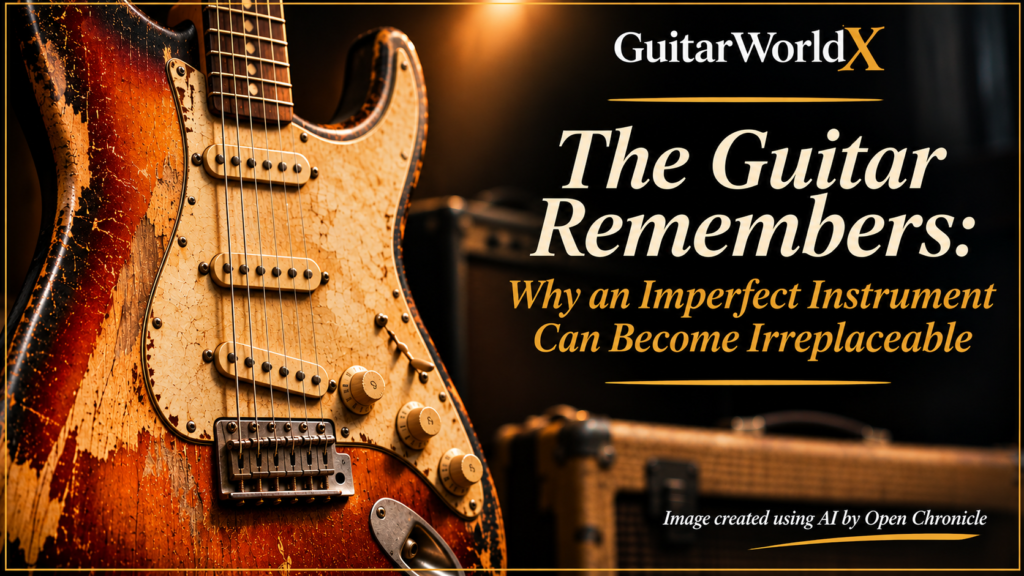
Scratches, worn frets, faded finishes and decades of music. Why some of the world’s most beloved guitars are valuable for reasons that have little to do with perfection.
By GuitarWorldX Editorial Staff | November 2026
Every Scratch Has a Story
Imagine two guitars.
The first is brand new. Its finish is flawless, its hardware shines, and its fretboard has never experienced the pressure of a musician’s hands.
The second is decades old.
Its finish has faded. The neck bears the marks of countless performances. The pickguard is scratched, the metal components have lost their original brilliance, and several parts may have been replaced.
Which is the better guitar?
From a purely technical perspective, the answer depends on condition, construction, setup and the needs of the player.
But from a musician’s perspective, the question becomes far more complicated.
Because the second guitar possesses something that cannot be manufactured in a factory.
A history.
1. The Myth of the Perfect Guitar
The modern guitar industry is built partly around the pursuit of perfection.
Manufacturers invest heavily in precision machining, improved hardware, sophisticated electronics and increasingly consistent quality control.
These developments have made excellent instruments more accessible than at almost any previous point in guitar history.
Yet many musicians remain fascinated by instruments that are visibly imperfect.
A worn neck can feel familiar. A particular pickup combination may produce a sound the owner has spent years learning to control. A repaired instrument may retain the feel of countless rehearsals and performances.
The attraction is not always rational.
And that is precisely what makes it interesting.
A guitar is simultaneously a mechanical object and an emotional companion.
2. Willie Nelson and Trigger: An Instrument That Refused to Disappear
Few guitars illustrate this relationship more vividly than Trigger, Willie Nelson’s famous Martin N20 classical guitar.
Acquired in 1969, Trigger became one of the most recognisable instruments in American music.
Its soundboard developed an enormous worn opening near the bridge, created through years of playing with a pick on an instrument without a conventional pickguard.
Its appearance would be alarming to someone evaluating an ordinary secondhand guitar.
Yet Trigger became inseparable from Nelson’s musical identity.
The guitar has undergone maintenance and repairs over the years, allowing it to remain playable despite its extraordinary wear.
Its importance is not explained by pristine condition.
It is explained by continuity.
Trigger accompanied Nelson through decades of recordings, concerts and personal history.
Replacing it with an immaculate example of the same model would not recreate that relationship.
3. Rory Gallagher: The Stratocaster That Became a Portrait
Rory Gallagher’s heavily worn 1961 Fender Stratocaster became almost as famous as the Irish guitarist himself.
The instrument’s extensively damaged sunburst finish gave it a distinctive appearance.
But the guitar was not simply a visual trademark.
It was Gallagher’s principal working instrument, an extension of the forceful blues and rock style that defined his performances.
Its wear developed through prolonged use rather than as a decorative design choice.
Today, manufacturers produce guitars with deliberately aged finishes, often described as relic treatments.
These instruments can offer a particular appearance and tactile feel.
But there is an important distinction between simulated wear and the accumulated history of an instrument that has accompanied a musician for decades.
The difference is not necessarily audible.
It is biographical.
4. Brian May and the Red Special: The Guitar That Could Not Be Bought
Brian May’s Red Special offers another perspective.
Built with his father, Harold May, during the early 1960s, the guitar emerged from ingenuity, experimentation and limited resources.
Its unconventional construction and electronics helped shape the sound that would become associated with Queen.
Unlike a mass produced instrument chosen from a showroom, the Red Special was designed around the specific ideas and requirements of its creator.
It became a lifelong musical partner.
The story challenges the assumption that a legendary sound must begin with an expensive instrument.
Sometimes originality comes from building something that does not yet exist.
5. Does an Old Guitar Actually Sound Better?
This is where romanticism must meet reality.
A vintage guitar is not automatically superior to a modern instrument.
Age can influence materials and components, but the audible results depend on many factors, including construction, maintenance, pickups, strings, electronics, amplification and playing technique.
Wood can change as it experiences environmental conditions. Hardware can wear. Electrical components may drift from their original specifications.
Some changes may be desirable. Others can make an instrument less reliable.
Claims that every old guitar improves with age are therefore too simplistic.
For solid body electric guitars in particular, the relationship between material ageing and amplified tone is more complex than popular mythology often suggests.
A well constructed modern guitar can perform exceptionally well.
The real distinction may be less about measurable superiority and more about familiarity.
A musician who has played the same guitar for twenty years knows its response.
They know how hard to attack the strings.
They know which notes sustain beautifully, where the instrument feels resistant and how its controls respond.
That knowledge becomes part of the performance.
6. The Guitar as Personal Memory
Consider the first guitar someone buys with their own money.
Perhaps it is inexpensive.
Perhaps its pickups are noisy, its tuning stability is imperfect and its finish is nothing special.
But it may also be the instrument on which that person learned their first complete song.
It may have accompanied their first band, their first concert or their first attempt at composing music.
Years later, they may own instruments that are objectively better.
Yet selling that original guitar can feel strangely difficult.
The instrument has become a physical connection to an earlier version of themselves.
This is not unique to musicians.
People form emotional attachments to objects associated with important experiences.
But guitars are particularly powerful because their owners interact with them physically and creatively.
They are not merely possessions.
They participate in the making of memories.
7. When Restoration Erases History
The restoration of an old guitar presents an interesting dilemma.
Should every scratch be repaired?
Should worn hardware be replaced?
Should a faded finish be refinished?
There is no universal answer.
A professional restoration may be essential to preserve an instrument’s structural integrity and playability.
But excessive cosmetic restoration can remove features that contribute to its historical character and, in some cases, reduce its value to collectors.
The most thoughtful approach distinguishes between preserving functionality and eliminating evidence of use.
A guitar should not have to become unplayable in order to remain authentic.
Equally, it does not need to look new in order to be beautiful.
8. What Makes a Guitar Irreplaceable?
The answer is not necessarily rarity, price or technical excellence.
It may be the relationship between the musician and the instrument.
A particular guitar can become the physical reference point around which a musician develops an entire style.
The player adapts to the guitar.
The guitar is adjusted to the player.
Over time, that relationship becomes increasingly individual.
Perhaps this is why certain instruments seem almost inseparable from their owners.
Trigger without Willie Nelson would still be a remarkable guitar.
The Red Special without Brian May would still be an extraordinary piece of craftsmanship.
But their cultural meaning comes from the music created with them.
A guitar becomes truly irreplaceable when its history and the musician’s history can no longer be separated.
Sources and Further Reading
Historical and technical references exploring guitar craftsmanship, iconic instruments and the relationship between musicians and their guitars.
C. F. Martin & Co. | Guitar History and Construction
Official resources from one of the world’s most established acoustic guitar manufacturers, providing historical background on instrument construction, craftsmanship and the evolution of acoustic guitar design.
Brian May Guitars | The Red Special
Official Brian May Guitars resources dedicated to the legendary Red Special, the instrument originally constructed by Brian May and his father, Harold May. The guitar represents an extraordinary example of individual craftsmanship and the development of a distinctive musical identity.
Fender | Guitar Heritage and Instrument Design
Official Fender resources documenting the history, development and design of electric guitars, including the instruments that helped define modern popular music and the relationship between guitar innovation and artistic expression.
Historical examples are used to explore the relationship between musicians and instruments. Observations about ageing, tone and emotional attachment should not be interpreted as proof that vintage instruments are inherently superior. GuitarWorldX approaches these subjects through historical context, technical understanding and independent editorial interpretation.
GuitarWorldX
Lessons, gear, techniques, artists, guitar legends and the stories shaping the world of guitar.
Return to GuitarWorldX ›