
OPEN CHRONICLE | WARFARE JOURNAL | NOVEMBER 19, 2026
Repeated Ukrainian strikes have severely damaged the strategic crossing linking Russia to occupied Crimea, disrupting transport and exposing a critical military supply route just as Vladimir Putin meets Donald Trump and Xi Jinping in China.
By Open Chronicle Warfare Journal
The Crimean Bridge has come under attack for the third time in a week, forcing Russian authorities to suspend traffic across one of Moscow’s most strategically and politically important infrastructure projects.
The latest strike, reported overnight before Thursday, November 19, prompted an immediate response from Russian authorities in occupied Crimea. Officials confirmed the temporary suspension of railway services and said engineers were assessing the damage.
The attack followed two earlier Ukrainian operations against the crossing, including a major combined drone and missile strike that destroyed a central section of the road bridge.
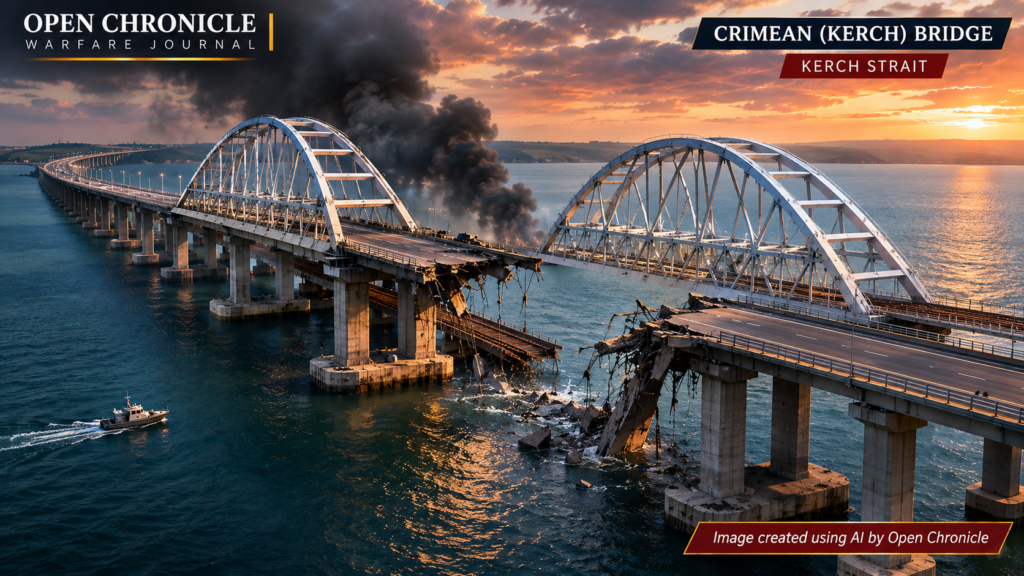
Reuters reported that verified images and videos showed the main road arch collapsing into the Kerch Strait, leaving a substantial gap in the structure.
The renewed attacks have created an increasingly difficult military and diplomatic situation for Moscow. Beyond disrupting transport, they have struck a highly visible symbol of Russian control over Crimea just as President Vladimir Putin participates in high level discussions with US President Donald Trump and Chinese President Xi Jinping in Shenzhen.
The bridge’s vulnerability has once again raised a fundamental question about the war: Can Russia maintain secure logistics across occupied Crimea while Ukraine expands its long range strike capabilities?
1. The latest attack: Russian authorities suspend traffic
Sergey Aksyonov, the Russian appointed head of Crimea, confirmed that the crossing had been attacked again and that traffic had been temporarily halted while emergency and technical services assessed the situation.
Russia’s Transport Ministry subsequently reported that railway operations had been suspended following a nighttime drone attack.
The ministry said there were no casualties from the latest incident, although the full extent of the additional structural damage was not immediately established.
The distinction is important. The crossing had already suffered major damage earlier in the week, meaning that the operational consequences of the latest attack cannot be assessed independently of the previous strikes.
Russian officials have not provided a comprehensive public engineering assessment establishing which sections remain usable, what repairs are required or when normal transport capacity could be restored.
The latest incident therefore represents more than another temporary closure. It adds uncertainty to the condition and future operational reliability of an infrastructure corridor central to Russia’s military presence in Crimea.
2. Three attacks in one week: How the operation unfolded
CRIMEAN BRIDGE | NOVEMBER 2026
A Week of Escalating Strikes
November 16 | Initial strike
Ukrainian forces targeted the bridge, causing comparatively limited damage according to subsequent reporting. The incident tested Russian defensive responses and disrupted normal operations.
November 17 | Major structural destruction
A combined Ukrainian missile and drone operation caused a central road section to collapse. Verified imagery subsequently confirmed substantial destruction.
November 18 to 19 | Third attack
Another nighttime strike prompted Russian authorities to suspend traffic, including railway services, while engineers assessed additional damage.
Sequence reconstructed from Reuters, ABC News and Ukrainian reporting. The full damage assessment remains incomplete.
The progression of attacks is significant because it suggests a sustained effort to undermine the bridge’s functionality rather than a single isolated operation.
Ukrainian President Volodymyr Zelenskyy described the major strike earlier in the week as unprecedented and connected it to Russian attacks against Ukrainian bridges and other infrastructure.
Ukrainian reporting also described a coordinated operation involving several phases intended to weaken Russian defensive capabilities before the principal strike.
The precise operational sequence, including the contribution of individual weapons and the effectiveness of Russian air defences, has not been independently established in full.
3. Why the Crimean Bridge matters militarily
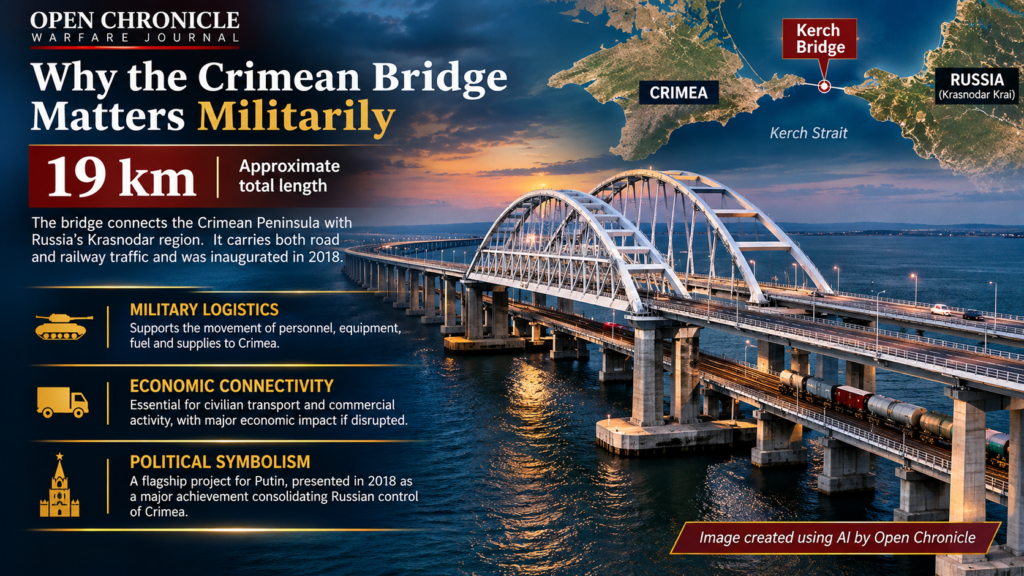
The bridge connects the Crimean Peninsula with Russia’s Krasnodar region. It carries both road and railway traffic and was inaugurated in 2018.
The Crimean Bridge, also known as the Kerch Bridge, has occupied a central position in Russia’s infrastructure and military strategy since its opening.
Constructed after Moscow’s 2014 annexation of Crimea, the crossing established a direct overland connection between Russia and the peninsula across the Kerch Strait.
Its importance extends across three dimensions.
Military logistics. The bridge supports the movement of personnel, equipment, fuel and supplies between Russia and Crimea. Although Russia has developed alternative routes through occupied southern Ukraine, the crossing remains an important transport corridor.
Economic connectivity. Civilian transport and commercial activity also depend on reliable access between Crimea and mainland Russia. Disruption can increase costs, delay deliveries and complicate regional economic activity.
Political symbolism. The bridge is closely associated with Putin’s efforts to consolidate Russian control over Crimea. Its inauguration in 2018 was presented as a major national infrastructure achievement.
For Ukraine, the crossing represents an important component of Russia’s military infrastructure in occupied territory.
For Moscow, repeated attacks demonstrate the difficulty of protecting a fixed and highly visible asset against evolving Ukrainian strike capabilities.
4. The consequences of destroying a central road section
The most consequential development of the week was the destruction of a central section of the roadway during the November 17 operation.
According to Reuters, verified visual material showed a major road arch collapsing into the water, leaving a large opening in the crossing.
This represents a substantially more serious outcome than surface damage or a temporary interruption caused by an air raid warning.
The destruction of a structural span can complicate restoration because engineers must assess the stability of adjacent sections, supporting elements and the remaining transport infrastructure.
However, the extent of damage to the road and railway components must be considered separately.
The railway section was reportedly able to resume limited service on one track following earlier damage, according to subsequent reporting, although additional repairs remained necessary.
A bridge can therefore be severely damaged without every part of the crossing becoming permanently unusable.
The strategic impact will depend on how much transport capacity remains available, the duration of repairs and Russia’s ability to redirect military and civilian movements through alternative corridors.
5. A wider campaign against Russian infrastructure
The bridge attacks coincided with reports of Ukrainian strikes elsewhere inside Russian territory.
In the Republic of Tatarstan, regional officials reported that oil storage tanks near Almetyevsk had been targeted overnight.
Russia’s Defence Ministry claimed that its forces intercepted at least 53 Ukrainian drones across several regions, including Belgorod, Voronezh, Kursk, Lipetsk, Oryol, Rostov, Ryazan, Smolensk, Tula and Tatarstan.
The figures were released by Russian authorities and have not been independently verified.
Ukraine’s air force, meanwhile, reported that Russia launched 98 drones overnight, including 61 jet powered aircraft, together with an unspecified number of antiship missiles.
According to Kyiv, Ukrainian defences intercepted or suppressed 69 drones, including 48 jet powered systems. Impacts were reported at 18 locations.
These figures illustrate the scale of aerial operations being conducted by both countries.
They also highlight an important development in the conflict: infrastructure far beyond the immediate front lines is increasingly exposed to long range attacks.
The expanding infrastructure war
Russia and Ukraine are pursuing campaigns designed to weaken each other’s capacity to sustain military operations.
For Russia, attacks against Ukrainian energy facilities, transport networks and urban infrastructure can disrupt economic activity and complicate military logistics.
For Ukraine, strikes against Russian oil facilities, transport corridors and military infrastructure seek to reduce Moscow’s operational flexibility and impose additional costs.
The growing reliance on drones, missiles and electronic warfare has expanded the geographical scope of the conflict.
Nevertheless, the operational effectiveness of individual strikes cannot be measured solely by the number of weapons launched or intercepted. Damage assessments, repair times and the ability to maintain essential functions are equally important.
6. The Shenzhen summit: Military pressure meets diplomacy
The timing of the latest Crimean Bridge attack is particularly significant.
On November 19, Putin is participating in diplomatic discussions in Shenzhen involving Trump and Xi, with the war in Ukraine among the principal subjects.
The summit has attracted international attention because it brings together the leaders of three major nuclear powers at a moment of considerable strategic uncertainty.
For Moscow, the gathering offers an opportunity to demonstrate continued international influence and present its position on the conflict.
For Washington, it provides a diplomatic channel through which to explore possible negotiations and broader security arrangements.
For Beijing, hosting the discussions reinforces China’s ambition to play a central role in international diplomacy.
Yet the attacks on the Crimean Bridge illustrate the limits of diplomatic symbolism.
While international leaders discuss potential agreements, military operations continue to change conditions on the ground.
Ukraine has repeatedly insisted that no settlement affecting its territory or sovereignty should be concluded without its participation.
The possibility of a diplomatic breakthrough therefore depends not simply on understandings between Washington, Moscow and Beijing, but also on whether any proposals address Ukraine’s security and political independence.
The timing of the bridge attack increases its political visibility. However, this alone does not establish that the operation was planned specifically to influence the summit.
7. Can Russia protect the Kerch Strait crossing?
The repeated attacks raise questions about Russia’s ability to defend strategically important fixed infrastructure.
Protecting a bridge of this size presents substantial challenges.
Defensive systems must address different threats, including aerial drones, missiles and potentially maritime systems. They must also operate across a large geographical area while protecting surrounding military and civilian infrastructure.
Ukraine’s evolving strike capabilities have complicated that task.
Even when an attack does not completely destroy its target, repeated interruptions can reduce the reliability of transport networks and force the defender to allocate additional resources to protection and repairs.
For Russia, the problem extends beyond the Crimean Bridge.
Oil facilities, airfields, military installations and logistical infrastructure across multiple regions have become potential targets.
The broader strategic question is whether Moscow can maintain the protection of these assets while continuing offensive operations in Ukraine.
8. Five strategic developments to watch
Five Strategic Developments to Watch
Following repeated attacks on the Crimean Bridge, five developments will help determine the operational consequences for Russian forces, the evolution of Ukraine’s long range strike campaign and the potential diplomatic implications.
The structural condition of the bridge
Whether further engineering assessments confirm additional damage to the railway, roadway or supporting structures.
Russian military logistics
Whether the disruption produces measurable delays in transport and supply operations supporting Russian forces in Crimea and southern Ukraine.
Ukraine’s long range strike campaign
Whether Kyiv continues targeting infrastructure deep inside Russian controlled territory.
Russia’s defensive response
Whether Moscow changes its air defence deployments or infrastructure protection measures following the repeated attacks.
The diplomatic consequences
Whether the military developments influence Russia’s negotiating position, Ukraine’s demands or discussions following the Shenzhen summit.
The strategic significance of the attacks will depend on the bridge’s remaining transport capacity, the duration of repair operations and the availability of alternative supply routes. Further developments may also influence military planning and diplomatic calculations, although the direct impact on negotiations remains uncertain.
The Big Picture | A Strategic Symbol Under Sustained Pressure
The Crimean Bridge has become one of the most recognisable symbols of the Russia Ukraine war.
Its importance lies not only in its physical role as a transport corridor, but also in the political meaning attached to its construction and continued operation.
The latest attacks demonstrate how military infrastructure can become a focal point for broader strategic competition.
For Ukraine, repeated strikes against the crossing offer a means of challenging Russia’s logistical arrangements and demonstrating the reach of Ukrainian military capabilities.
For Russia, protecting and restoring the bridge is both an operational necessity and a political priority.
The destruction of a major roadway section represents a significant development. Nevertheless, the ultimate military consequences will depend on the duration of the disruption, the availability of alternative transport routes and the effectiveness of repair operations.
The timing also exposes a central contradiction in the current international environment.
As Putin participates in discussions with Trump and Xi about international security and the future of the war, Ukraine continues to demonstrate that developments on the battlefield cannot be separated from the diplomatic process.
The Crimean Bridge is therefore more than a damaged crossing. It is a reminder that the outcome of the war will be shaped by military capabilities, economic endurance, political decisions and the terms of any eventual settlement.
Sources and Further Reading
The following references provide reporting and additional context for the developments discussed in this article.
Reuters
Ukraine strikes Crimean Bridge for third time in a week ahead of US China Russia summit
November 19, 2026. Damage verification, Russian transport restrictions and diplomatic context.
ABC News
Crimean bridge attacked for 3rd time in a week, officials say
November 19, 2026. Russian and Ukrainian official statements, drone operations and damage assessments.
Channel News Asia / Reuters
Ukraine strikes Crimean Bridge for third time
November 19, 2026. Structural damage, railway suspension and Russian statements.
The Kyiv Independent
Entire section of Crimean Bridge collapses after operation
November 17, 2026. Ukrainian accounts of the operation and the reported destruction of a structural section.
The Guardian
Crimea bridge attacked again
November 19, 2026. Historical context, bridge damage and the political significance of the attacks.
These sources combine international reporting, statements attributed to Russian and Ukrainian authorities, and analysis of the Crimean Bridge’s military and political significance. Claims concerning the extent of structural damage, intercepted drones and battlefield outcomes should be distinguished from independently verified findings.
This article was prepared by Open Chronicle using reporting published on November 17 and 19, 2026, statements attributed to Russian and Ukrainian authorities, and independent military and geopolitical analysis. Claims concerning drone interceptions, weapons employed, casualties and operational outcomes are attributed to their respective sources where independent confirmation is unavailable. The reported destruction of a central road section is supported by visual material verified by Reuters. Assessments concerning Russian military logistics, infrastructure vulnerability and the diplomatic significance of the Shenzhen summit represent editorial analysis rather than established operational conclusions.