
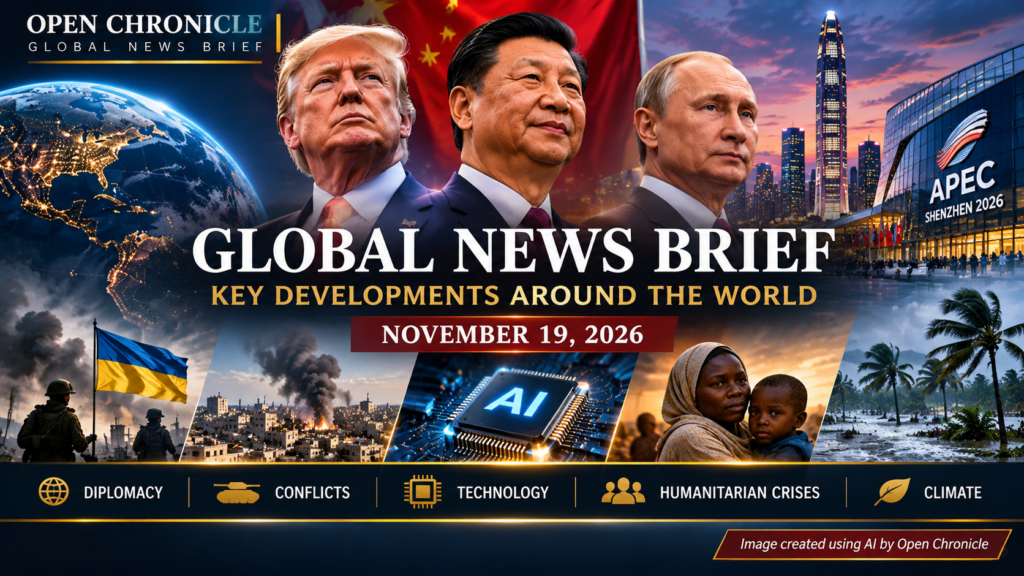
November 19, 2026 | Open Chronicle World News Desk
From the diplomatic summit in Shenzhen to the wars in Ukraine and the Middle East, renewed tensions on the Korean Peninsula, political developments across the Americas and humanitarian emergencies in Africa and the Pacific, today’s Global News Brief examines the events shaping the international landscape.
The November 19 edition is organised geographically, with developments grouped by subject within each region. The objective is to provide readers with a coherent picture of global affairs, connecting diplomatic decisions, armed conflicts, economic developments, technology, humanitarian crises and environmental threats.
The dominant international story is the gathering of Donald Trump, Xi Jinping and Vladimir Putin in China. Yet developments beyond Shenzhen are equally consequential. Fighting continues in Ukraine and Gaza, Saudi Arabia faces renewed missile threats, North Korea’s nuclear activities remain under scrutiny, and vulnerable communities confront displacement, drought and insecurity.
Editorial scope: This briefing draws on the news reports and headlines supplied for November 19, supplemented by external research. Developments that remain disputed, preliminary or dependent on official confirmation are identified accordingly.
ASIA PACIFIC
Diplomacy and Geopolitics
China | APEC opens as Trump, Xi and Putin prepare for unprecedented trilateral talks
Shenzhen has become the centre of international diplomacy as the Asia Pacific Economic Cooperation summit brings together leaders from across the region, with particular attention focused on the planned meeting between US President Donald Trump, Chinese President Xi Jinping and Russian President Vladimir Putin.
The three leaders are expected to discuss nuclear arms control, the wars involving Ukraine and Iran, strategic stability and the future of economic relations between major powers. Trump has already held separate discussions with Xi and Putin, setting the stage for the trilateral encounter.
The meeting comes at a sensitive moment. The expiration of the New START nuclear arms treaty has intensified questions about the future of strategic arms limitations, while China’s expanding nuclear capabilities have complicated Washington’s efforts to establish a broader negotiating framework.
For Beijing, hosting the summit provides an opportunity to present China as a central diplomatic actor. For Washington, the gathering offers a chance to pursue security negotiations while managing economic competition. Moscow is seeking to maintain its influence in discussions about European security and the international order.
The significance of the meeting will ultimately depend on whether the leaders establish a negotiating process or produce concrete commitments rather than diplomatic declarations.
China | Xi promotes regional economic integration and technological cooperation
Alongside the geopolitical discussions, Xi has called for stronger regional cooperation, fewer trade barriers and closer coordination on emerging technologies.
China has announced additional funding for APEC cooperation and initiatives covering digital technologies, cross border data flows, clean energy and smaller businesses.
These proposals reflect Beijing’s effort to strengthen its economic influence at a time when tariffs, export restrictions and competition over critical technologies are increasingly shaping international trade.
The central question is whether APEC can preserve its economic cooperation agenda while geopolitical rivalries dominate the summit.
Japan and Taiwan | Regional security concerns remain prominent
Japanese Prime Minister Sanae Takaichi has reaffirmed that Tokyo’s position on Taiwan has not changed, amid heightened diplomatic sensitivity surrounding the island.
Separately, reports of Russian military aircraft operating near Taiwan have drawn attention to the increasingly complex security environment in East Asia.
For Japan, the challenge is to preserve its security relationship with the United States while maintaining diplomatic channels with China and managing relations with Russia.
Korean Peninsula | Nuclear Security and Diplomacy
South Korea | President Lee calls for renewed dialogue with Pyongyang
South Korean President Lee Jae Myung has renewed his appeal for dialogue with North Korea, expressing hope that diplomatic engagement could eventually establish more durable peace on the Korean Peninsula.
His remarks come amid speculation that Trump could meet North Korean leader Kim Jong Un during his Asian visit.
No such meeting has been confirmed, however, and the possibility remains dependent on decisions by Washington and Pyongyang.
Seoul faces the challenge of supporting diplomacy without allowing direct negotiations between the United States and North Korea to marginalise South Korean security interests.
North Korea | IAEA warns of expanding uranium enrichment activities
The International Atomic Energy Agency has reported further developments at North Korea’s uranium enrichment facilities.
According to the agency’s latest assessment, an extension to the original enrichment facility at Yongbyon was externally completed by late October 2026, following construction activity observed since September.
The agency has also reported indications of continued reactor operations at Yongbyon.
These developments reinforce concerns that North Korea is expanding its capacity to produce nuclear material even as diplomatic discussions about possible negotiations continue.
The contrast between renewed diplomatic overtures and continuing nuclear development remains one of the region’s most important security challenges.
South and Southeast Asia
Bangladesh | Political confrontation intensifies as Muhammad Yunus’s ancestral home is attacked
Bangladesh is experiencing renewed political tensions following reports that the ancestral home of former interim leader Muhammad Yunus was set ablaze amid demonstrations associated with supporters of Sheikh Hasina’s Awami League.
Reports also describe disruptions in parts of the country as political groups seek to demonstrate their ability to mobilise supporters.
The developments illustrate the fragility of Bangladesh’s political transition and the persistence of deep divisions between rival political movements.
The immediate priorities are public security, accountability for political violence and the protection of democratic institutions.
Myanmar | International Court of Justice judgment brings Rohingya crisis back into focus
The Rohingya crisis has returned to the international agenda as the International Court of Justice is scheduled to deliver its judgment in the genocide case brought by The Gambia against Myanmar.
The proceedings concern allegations that Myanmar violated its obligations under the Genocide Convention.
The case has significant implications for international accountability, but legal proceedings alone cannot resolve the displacement, insecurity and uncertain future facing Rohingya communities.
Hundreds of thousands of Rohingya remain displaced, particularly in Bangladesh, while conditions inside Myanmar continue to complicate prospects for safe and voluntary return.
The judgment’s precise findings and legal consequences must be assessed from the Court’s official decision once delivered.
Indonesia | Legal reforms and industrial safety attract attention
Indonesia’s parliament has reportedly approved legislation concerning asset forfeiture, potentially strengthening the authorities’ ability to pursue proceeds associated with criminal activity.
Separately, an explosion at an oil refinery reportedly killed a worker, prompting an investigation into the circumstances.
Both developments highlight different governance challenges: improving institutional accountability and ensuring industrial safety in a major emerging economy.
Technology and Trade
China and the United States | Semiconductor restrictions remain a source of strategic tension
Competition over advanced artificial intelligence chips remains a major issue in relations between Washington and Beijing.
Trump has indicated that he briefly discussed the situation involving former Nvidia chief Jensen Huang with Xi. The wider dispute concerns American restrictions on advanced semiconductor exports and China’s efforts to develop domestic technological capabilities.
The consequences extend beyond the two countries. Southeast Asian economies seeking to build artificial intelligence infrastructure may face difficult choices involving access to chips, investment and competing regulatory systems.
Advanced computing is increasingly becoming both an economic asset and a national security priority.
EUROPE
War in Ukraine and European Security
Ukraine | Russian strikes on Odesa cause civilian casualties
Russian attacks on Ukraine continued as international leaders gathered in China for discussions about the future of the war.
Reports from Odesa indicate that at least four people were killed and 13 injured in a Russian strike. The figures remain subject to confirmation as emergency services assess the damage.
The attack illustrates the continuing human cost of the conflict and the distance between diplomatic negotiations and conditions on the ground.
Ukraine and Crimea | Renewed attacks target the Kerch Bridge
Ukrainian operations against Russian infrastructure in occupied Crimea have again focused attention on the Kerch Bridge.
Reports indicate that another attack disrupted railway traffic across the crossing, which connects Russia to the Crimean Peninsula.
The bridge has both logistical and symbolic importance. It supports transport between Russia and Crimea and represents one of Moscow’s most prominent infrastructure projects in the territory it annexed in 2014.
Claims about the extent of the damage and whether the bridge has become unusable require independent verification.
Ukraine | Kyiv insists that peace negotiations cannot exclude Ukrainian participation
President Volodymyr Zelenskyy has reiterated that decisions about Ukraine’s future cannot be made without Ukraine.
His comments come as Trump meets Putin and Xi, raising concerns in Kyiv and European capitals about the possibility of agreements negotiated by major powers without the direct participation of affected countries.
Trump has also indicated that he does not intend to conclude a settlement concerning Ukraine without Kyiv.
The central diplomatic challenge remains whether Washington, Moscow and Beijing can contribute to negotiations while respecting Ukraine’s sovereignty and the security interests of European governments.
European Union | Defence, Diplomacy and Regulation
European Union | Leaders confront the consequences of exclusion from Shenzhen talks
The gathering in China has renewed debate about Europe’s influence over decisions affecting its own security.
European governments remain major providers of financial and military support to Ukraine, yet the most prominent diplomatic discussions are taking place between Washington, Beijing and Moscow.
This has intensified calls for greater European strategic coordination, stronger defence capabilities and a more coherent negotiating position.
Germany and European partners | Ukraine assistance remains a political priority
European governments are examining how to preserve support for Ukraine despite political uncertainty, electoral changes and disagreements over the continent’s long term security architecture.
Discussions include defence financing, industrial capacity and mechanisms intended to maintain assistance across changing political circumstances.
The issue is not simply how much support Europe can provide, but whether it can sustain that support over several years.
European Union | Methane regulation and industrial competitiveness
EU governments are reportedly moving to extend implementation delays for important methane rules following pressure from the United States.
The development reflects a broader tension between environmental commitments, energy security and the competitiveness of European industry.
Methane reduction is an important component of climate policy, particularly in the energy sector, where emissions can occur during production, transportation and distribution.
Any regulatory delay raises questions about how the EU intends to reconcile economic pressures with its environmental targets.
European Commission | Reported cyberattack raises institutional security concerns
Reports of a cyberattack affecting the European Commission have highlighted the vulnerability of public institutions to digital disruption.
The available information does not establish the full extent of the incident, its technical cause or the identity of any responsible actor.
Nevertheless, the report underscores the importance of cybersecurity resilience as European governments face increasingly sophisticated threats to public infrastructure and administrative systems.
United Kingdom | Defence and Society
United Kingdom | Prince Harry discusses military service and the threat from Russia
Prince Harry has said he would consider returning to military service if circumstances required him to fight against Russia.
His comments have attracted attention amid continued debate about European defence preparedness and public support for Ukraine.
The remarks are a personal statement rather than an announcement of a new British military policy.
European Culture and Heritage
France | Van Gogh painting reportedly reaches $190.4 million
A painting attributed to Vincent van Gogh has reportedly sold for $190.4 million following controversy surrounding its ownership history during the Nazi era.
Beyond the reported record price, the sale highlights the importance of provenance research, restitution claims and the ethical responsibilities of the international art market.
The historical background of artworks remains an essential part of evaluating major cultural transactions.
MIDDLE EAST
Iran and Regional Security
Iran | Conflict remains central to international diplomacy
The war involving Iran is a major subject of discussions between the United States, China and Russia.
Trump and Xi have indicated a shared interest in preventing Iran from obtaining nuclear weapons and preserving energy shipments through the Strait of Hormuz.
However, agreement on broad objectives does not necessarily mean that the three powers share the same views about military operations, sanctions or the future political settlement.
Iran has also criticised regional governments over their relationship with US military operations, while reports of additional incidents in Gulf waters have raised concerns about maritime security.
Strait of Hormuz | Reports of tanker fires intensify energy concerns
Iranian reports that three oil tankers caught fire in the Strait of Hormuz have added to uncertainty surrounding one of the world’s most important energy corridors.
The circumstances of the reported fires, including their causes and the extent of the damage, have not been independently established in the information reviewed for this briefing.
Any sustained disruption to shipping through the strait could affect oil prices, insurance costs and global supply chains.
Gulf states | Regional military installations remain exposed
Reports of attacks or threats involving facilities in Kuwait and Bahrain underline the vulnerability of Gulf infrastructure during the wider confrontation involving Iran.
The presence of American military installations across the region creates additional risks of escalation.
Governments face the challenge of maintaining security cooperation while avoiding deeper involvement in regional hostilities.
Saudi Arabia and Yemen | Missile Threats
Saudi Arabia | Houthi missile attacks reach Riyadh
Saudi Arabia has reported renewed missile attacks attributed to Yemen’s Houthi movement.
The Saudi led coalition says it intercepted a ballistic missile and destroyed a launch platform used by the group.
Reports also indicate damage to a prominent building in Riyadh’s financial district following the latest attacks.
The incidents demonstrate the continuing threat posed by long range missiles and the difficulty of protecting urban and economic infrastructure against repeated launches.
Yemen | Conflict remains a regional security threat
Military operations involving the Houthis continue to affect the security environment across the Arabian Peninsula.
The latest incidents have renewed concerns about the potential for further retaliation and the consequences for civilians.
Yemen’s prolonged conflict also remains a humanitarian emergency, with regional escalation complicating prospects for a durable political settlement.
Israel and the Palestinian Territories
Gaza | Renewed Israeli military operations raise concerns over civilian protection
Reports indicate that Israeli forces have carried out additional operations in central Gaza, including the Nuseirat area.
Palestinian reports describe the destruction of residential buildings and renewed military activity amid allegations of ceasefire violations.
The precise circumstances of individual incidents and claims concerning operational coordination require further verification.
The developments reinforce concerns about civilian safety, displacement, humanitarian access and the durability of ceasefire arrangements.
Gaza | Arab League condemns attacks and threats to medical facilities
The Arab League has condemned Israeli military actions in Gaza, including reported attacks affecting medical facilities.
The protection of hospitals, medical personnel and civilians remains a central issue under international humanitarian law.
The humanitarian situation continues to demand sustained international attention, regardless of developments in broader diplomatic negotiations.
Lebanon and Iraq | Regional Instability
Lebanon | Hezbollah related security investigations and sanctions continue
Lebanese authorities have reportedly charged five Hezbollah members in connection with recruitment and the provision of weapons.
Separately, Washington has announced additional measures targeting alleged Hezbollah financing networks.
These developments highlight continuing tensions over armed organisations, state authority and the influence of regional powers in Lebanon.
Iraq | Border disruptions and armed group tensions threaten stability
Reports of border restrictions involving Iran and continuing tensions with armed groups have raised concerns about Iraq’s economic and security environment.
Iraq remains highly exposed to regional developments through trade, energy, political relationships and the activities of armed organisations.
Further instability could affect domestic commerce and complicate Baghdad’s efforts to strengthen state institutions.
NORTH AMERICA
United States | National Security and Intelligence
United States | Russian national accused of targeting Silicon Valley defence workers
US authorities have reportedly charged a Russian national with conducting intelligence related activities targeting employees of an American defence and technology company.
Reports identify the company as Palantir, which provides data analysis and software systems used in defence, intelligence and other sectors.
The allegations concern efforts to obtain information associated with sensitive technology and assistance to Ukraine.
The case illustrates the growing importance of private technology companies as potential intelligence targets.
The accusations remain allegations unless established through judicial proceedings.
United States | Artificial intelligence policy becomes a diplomatic issue
During his visit to China, Trump has criticised what he described as international or globalist regulation of artificial intelligence.
His remarks reflect Washington’s emphasis on technological competition, national autonomy and the economic importance of advanced computing.
The broader debate concerns how governments should regulate increasingly powerful AI systems without restricting innovation or creating incompatible international standards.
United States | Immigration policy returns to the Supreme Court
The Trump administration has reportedly made another request to the Supreme Court concerning protections for Venezuelan migrants.
The legal dispute reflects continuing tensions over executive immigration authority, humanitarian protections and the treatment of migrants already living in the United States.
The outcome could have consequences for affected families and for future decisions concerning temporary immigration programmes.
United States | Politics and Accountability
Washington | Congressional oversight intensifies after midterm elections
Democratic lawmakers are preparing further investigations involving the Trump administration, including questions concerning potential conflicts of interest and records associated with Jeffrey Epstein.
These initiatives reflect the changing political balance following the November midterm elections.
The significance of the investigations will depend on their legal authority, the evidence obtained and the findings eventually established.
Allegations under investigation should not be treated as proven misconduct.
United States | Elon Musk reflects on political campaign spending
Elon Musk has reportedly expressed regret about the scale of his political spending during the 2026 midterm elections.
His remarks have renewed debate about the role of wealthy individuals in electoral politics, campaign financing and the relationship between business leaders and political movements.
The broader issue concerns how financial influence affects democratic competition and public confidence in political institutions.
United States | Public Safety
Illinois | Federal terrorism charges follow alleged temple attack plot
US authorities have reportedly brought terrorism related charges against a man accused of planning an attack targeting a Hindu temple and members of South Asian communities.
The case has renewed concerns about threats directed at religious institutions and minority communities.
The defendant is entitled to the presumption of innocence, and the charges remain subject to judicial determination.
LATIN AMERICA AND THE CARIBBEAN
Venezuela | Defence and Diplomacy
Venezuela | Washington and Caracas agree to restore military ties
The United States and Venezuela have reportedly reached an agreement to reestablish military relations, according to US Defense Secretary Pete Hegseth during a visit to Caracas.
The announcement represents a potentially significant development in relations between the two governments.
Reported areas of cooperation include military communication, intelligence coordination and regional security.
The agreement could influence counter narcotics operations, migration related security concerns and the wider geopolitical environment in the Caribbean.
Its longer term significance will depend on the scope of implementation and the durability of political cooperation.
Haiti | Justice and Security
Haiti | Miami court convicts pastor over 2021 presidential assassination
A court in Miami has reportedly convicted a Haitian American pastor in connection with the 2021 assassination of Haitian President Jovenel Moïse.
The case forms part of the continuing judicial response to an assassination that plunged Haiti into deeper political instability.
Proceedings in the United States have examined alleged roles in the planning and organisation of the operation.
The conviction represents an important judicial development, although Haiti’s broader political and security crisis remains unresolved.
Haiti | International security assistance continues
Reports indicate that El Salvador has deployed approximately 2,500 military personnel to Haiti.
If confirmed, the deployment would represent a substantial international contribution to security operations in a country facing persistent armed violence.
The effectiveness of outside assistance will depend not only on military operations, but also on Haitian institutional capacity, political legitimacy and the protection of civilians.
Regional Economy and Strategic Infrastructure
Latin America | Competition over critical infrastructure grows
Chinese investment and participation in Latin American infrastructure projects continue to raise questions about strategic influence, national sovereignty and economic dependency.
Governments across the region face competing priorities: attracting investment, expanding transport and energy infrastructure, and preserving control over strategically important assets.
The challenge is to ensure that economic partnerships strengthen domestic development without creating excessive political or financial vulnerability.
AFRICA
Democratic Republic of the Congo | Public Health and Humanitarian Security
DR Congo | Ebola response faces wider humanitarian obstacles
Efforts to contain Ebola in the Democratic Republic of the Congo continue to face challenges associated with insecurity, displacement and weaknesses in public health infrastructure.
Humanitarian organisations warn that disease control cannot succeed through medical interventions alone.
Effective responses require community engagement, access to healthcare, reliable surveillance, safe transport and assistance to populations affected by violence.
The situation illustrates how armed conflict and humanitarian emergencies can undermine the response to infectious disease.
Sudan | Armed Conflict
Sudan | Reported defections add to uncertainty in civil war
Reports indicate that a commander associated with the Rapid Support Forces and accompanying personnel have defected to the Sudanese Armed Forces.
The reported development could affect local military dynamics, although its strategic significance remains unclear.
Sudan’s conflict continues to generate severe humanitarian consequences, including displacement, food insecurity and the destruction of essential infrastructure.
Individual battlefield developments do not alter the urgent need for civilian protection and humanitarian access.
Senegal | Migration and Maritime Safety
Senegal | Dozens missing after migrant boat reportedly sinks
Reports indicate that a boat carrying approximately 100 migrants sank off the coast of Senegal, leaving dozens of people missing.
The incident highlights the continuing dangers faced by people attempting maritime migration routes from West Africa.
Search and rescue operations, the identification of victims and the circumstances surrounding the sinking require further confirmation.
The wider crisis is linked to economic insecurity, limited legal migration opportunities and the activities of smuggling networks.
Libya | International Justice
Libya | ICC stresses cooperation on war crimes investigations
The International Criminal Court has renewed its emphasis on cooperation with Libyan authorities concerning investigations into alleged war crimes and other serious offences.
The issue remains important as Libya continues to confront institutional fragmentation and the legacy of years of conflict.
Accountability efforts depend on access to evidence, cooperation between authorities and the protection of witnesses and affected communities.
OCEANIA AND THE PACIFIC
Fiji | Climate and Water Security
Fiji | State of disaster declared amid severe drought
Fiji has declared a state of disaster as drought conditions associated with El Niño threaten water supplies.
The emergency highlights the vulnerability of Pacific island communities to prolonged dry periods, water shortages and pressure on agriculture.
For island states, water insecurity can rapidly become a broader public health and economic problem.
Emergency measures may provide short term relief, but long term resilience depends on infrastructure investment, water management and climate adaptation.
Pacific Islands | Climate Diplomacy
Vanuatu | Calls for reform of international climate negotiations
Vanuatu has called for changes to the international climate summit process, warning against weakening commitments and inadequate progress on adaptation.
Pacific island governments have repeatedly argued that international climate negotiations must give greater priority to countries facing severe environmental risks despite contributing relatively little to global emissions.
The debate surrounding COP31 centres on whether governments can translate climate pledges into reliable financing, adaptation measures and practical protection for vulnerable populations.
New Zealand | Labour Rights and Equality
New Zealand | Court ruling challenges government pay equity reforms
A New Zealand court has reportedly ruled that changes to the government’s pay equity framework violated women’s rights.
The decision raises questions about employment equality, legislative authority and the protection of workers against discriminatory outcomes.
Its broader significance will depend on the remedies ordered and the government’s response.
Australia | Natural World
Christmas Island | Annual red crab migration begins
Millions of red crabs have begun their annual migration toward the sea on Australia’s Christmas Island.
The event is one of the island’s most distinctive natural phenomena and illustrates the importance of protecting migration routes and sensitive habitats.
Although less urgent than the day’s geopolitical developments, the migration offers a reminder of the ecological processes that continue alongside global political crises.
GLOBAL DEVELOPMENTS
International Economy | Trade and Strategic Competition
Global trade | APEC exposes tensions between economic integration and national security
The Shenzhen summit has highlighted a fundamental contradiction in the international economy.
Governments continue to support trade, investment and technological cooperation, yet increasingly treat semiconductors, critical minerals, energy infrastructure and advanced manufacturing as matters of national security.
The United States, China and Russia approach these issues from different strategic positions, while smaller economies face growing pressure to adapt to competing economic systems.
The risk is that the international economy becomes more fragmented even as countries remain deeply dependent on global supply chains.
Energy Security | The Cost of Regional Wars
Global energy markets | Gulf instability threatens supply chains
Renewed military activity involving Iran, Yemen and the Gulf states has intensified concerns about the security of international energy supplies.
The Strait of Hormuz remains particularly important because of its role in transporting oil and liquefied natural gas.
Missile attacks, maritime incidents and the possibility of further escalation can influence markets even when physical supply disruptions remain limited.
The broader consequences extend to shipping insurance, industrial production, inflation and the economic security of energy importing countries.
Artificial Intelligence | Technology and Global Power
AI governance | Competition over chips, data and regulation accelerates
Artificial intelligence has become a central element of geopolitical competition.
Washington is focused on protecting advanced computing capabilities, Beijing is seeking greater technological independence, and other governments are attempting to develop domestic AI industries without becoming dependent on a single supplier.
The debate increasingly concerns not only who develops the most powerful systems, but also who controls the infrastructure, semiconductor supply chains and rules governing their deployment.
Climate and Humanitarian Security
Climate emergencies | Extreme weather and displacement reinforce global vulnerability
Drought in Fiji, cyclone related evacuations in India, displacement in Africa and continued migration emergencies demonstrate the interconnected nature of humanitarian risk.
In eastern India, reports indicate that nearly 72,000 people have been evacuated as Cyclone Akvan threatens coastal communities. The storm’s trajectory and final impact remain subject to meteorological updates.
The events illustrate why disaster preparedness, infrastructure resilience and humanitarian financing remain essential components of international security.
THE BIG PICTURE | A WORLD NEGOTIATING POWER WHILE CONFRONTING INSTABILITY
The international landscape on November 19, 2026, reveals several developments that extend beyond individual national crises.
The Big Picture
Beyond individual headlines, the developments of November 19, 2026, reveal five interconnected trends influencing global diplomacy, security, technology, humanitarian conditions and international governance.
Great power diplomacy is returning to the centre of international politics
The Shenzhen summit demonstrates the continuing importance of direct negotiations between major powers, but also raises questions about the participation of smaller countries whose interests may be affected.
Military conflicts remain resistant to diplomatic pressure
Continued fighting in Ukraine, Gaza and the wider Middle East shows that diplomatic engagement does not automatically translate into reduced violence.
Technology and economic security are becoming inseparable
Semiconductors, artificial intelligence, energy systems and critical infrastructure are increasingly central to geopolitical competition.
Humanitarian crises risk being overshadowed
Displacement, disease, food insecurity, migration deaths and climate emergencies continue to affect millions, often receiving less international attention than diplomatic summits.
International institutions face tests of credibility
Proceedings at the International Court of Justice, investigations into alleged war crimes and debates over climate commitments demonstrate the importance of institutions capable of applying rules beyond immediate political interests.
Together, these developments illustrate a world in which diplomatic engagement, military competition, technological transformation and humanitarian insecurity are increasingly interconnected. The effectiveness of international cooperation will depend not only on agreements between major powers, but also on the protection of vulnerable populations, respect for national sovereignty and the credibility of institutions responsible for upholding international rules.
The defining question is whether governments can transform diplomatic engagement into practical measures that reduce insecurity and strengthen international cooperation.
Shenzhen may produce new understandings among the world’s most powerful states. Yet the international system will ultimately be judged by developments far beyond the summit table, including the protection of civilians, the resolution of conflicts, the stability of economies and the ability of vulnerable communities to withstand future crises.
Open Chronicle World News Desk | November 19, 2026
Sources and Further Reading
The following sources were consulted to supplement the supplied news digest. They provide direct support for selected major developments, particularly the Shenzhen summit, North Korea’s nuclear programme and the Myanmar proceedings. The remaining shorter reports are based on the headlines supplied and require individual source verification before publication.
Associated Press
Nuclear arms and ending wars in Iran and Ukraine will top the agenda at Trump Xi Putin meeting.
November 19, 2026. Diplomatic agenda, nuclear arms control and bilateral discussions.
Reuters | Via Internazionale
Trump’s historic meeting with Xi, Putin headlines Asia trip.
November 19, 2026. Summit preparations, geopolitical priorities and economic tensions.
Yonhap News Agency
Trump, Xi, Putin set to hold historic trilateral summit; US North Korea meeting uncertain.
November 19, 2026. Korean Peninsula diplomacy and summit developments.
AnewZ / Reuters
Trump meets Xi at APEC ahead of Putin trilateral talks.
November 19, 2026. Xi’s economic initiatives and regional cooperation proposals.
International Atomic Energy Agency
Director General’s Introductory Statement to the Board of Governors.
November 2026. North Korean uranium enrichment and reactor activities.
European External Action Service
EU Statement on the Application of Safeguards in the DPRK.
November 18, 2026. European assessment of North Korea’s nuclear programme.
International Court of Justice
The Gambia v. Myanmar.
Official announcement of the November 19 judgment and the legal proceedings concerning the Genocide Convention.
United Nations Independent Investigative Mechanism for Myanmar
ICJ proceedings.
Background on the case and its procedural history.
These references identify reporting and institutional sources relevant to the November 19, 2026 briefing. The links above lead to the respective publishers or institutions rather than verified individual articles. Readers should consult the original publications for complete reporting, official statements and subsequent updates.
This Global News Brief was prepared by Open Chronicle using the international news digest supplied for November 19, 2026, supplemented by selected independently retrieved reporting, official institutional statements and editorial analysis. The briefing distinguishes confirmed developments from allegations, preliminary reports, scheduled diplomatic meetings and unverified operational claims. Some shorter reports have not been independently corroborated and should be checked against original reporting before publication. Analytical interpretations concerning geopolitical competition, regional security, economic fragmentation and international diplomacy represent Open Chronicle’s editorial assessment.