
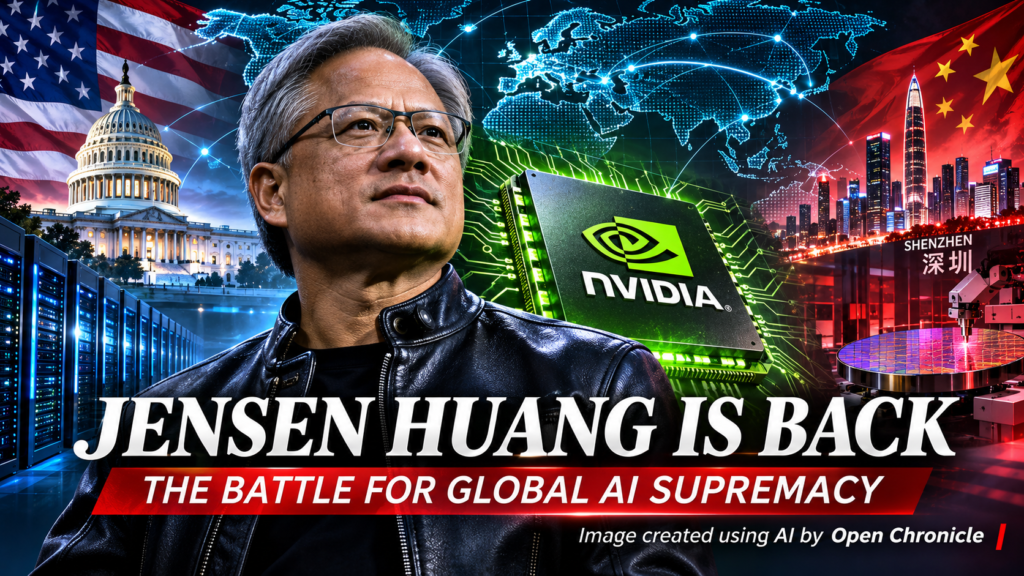
The dramatic return of Nvidia’s chief executive exposes a new geopolitical reality: the competition for artificial intelligence supremacy is no longer simply about faster processors. It is about controlling the technological infrastructure upon which the global economy will increasingly depend.
By Open Chronicle News Desk
November 23, 2026 | Technology, Geopolitics & International Security
Eleven days after stepping down as chief executive of Nvidia, Jensen Huang is back at the helm of one of the most strategically important corporations in the world.
His reinstatement on November 23 represents an extraordinary reversal by a board that had previously rejected the possibility of his return.
It also reveals something considerably more important than the rehabilitation of a Silicon Valley executive.
Artificial intelligence has become so central to American economic competitiveness, military modernization and international influence that the leadership of a private semiconductor company has evolved into a matter of national political concern.
With President Donald Trump publicly supporting Huang’s return, Nvidia once again finds itself at the intersection of corporate governance, national security and the technological rivalry between Washington and Beijing.
China, meanwhile, is pursuing its own semiconductor ecosystem, reducing its dependence on American suppliers and attempting to establish an alternative technological architecture.
The competition is increasingly about who will build, operate and influence the infrastructure of the intelligent economy.
An Extraordinary Corporate Comeback
Nvidia announced that its board of directors had unanimously approved Huang’s reinstatement as president, chief executive and board member, effective immediately.
The company said that consultations with senior American government officials had given the board confidence that his return did not present a national security risk. Colette Kress, who had temporarily assumed executive leadership, continues as chief financial officer.
Huang had resigned on November 12 following revelations concerning his personal relationships, including allegations involving a businesswoman suspected by American authorities of connections to Chinese intelligence.
Beijing has rejected the espionage allegations.
The reinstatement does not establish that every allegation has been resolved, nor does it bring the wider investigations concerning semiconductor exports to an end.
Nevertheless, the speed with which Nvidia reversed its position demonstrates the extraordinary commercial and strategic importance attached to Huang’s leadership.
Eleven days that shook Silicon Valley
November 12, 2026
Jensen Huang resigns as Nvidia chief executive.
November 17
Huang expresses willingness to return. Nvidia’s board chairman publicly rejects reinstatement.
November 18
Nvidia confirms that shipments of licensed Hopper processors to China have stopped.
November 20
President Trump publicly supports giving Huang another opportunity.
November 23
Nvidia’s board unanimously reinstates its cofounder.
December 3
Reported date for Huang’s appearance before the Senate Banking Committee.
Sources: Nvidia, Reuters, Associated Press and ABC News. Future congressional schedules remain subject to change.
A $950 Billion Vote of Confidence
Financial markets responded dramatically to Huang’s return.
Nvidia shares reportedly closed at $165.05 on Monday, rising 31.48% during the trading session and restoring approximately $952 billion in market capitalization.
The company’s overall valuation approached $4 trillion.
Nvidia | Market Reaction
Source: The Guardian, November 23, 2026. Market capitalization gains represent changes in equity valuation, not additional corporate revenue.
The extraordinary rally reflects investor confidence in Huang’s ability to guide Nvidia through its next phase of technological development.
But it also exposes a potentially dangerous institutional weakness.
When the departure and return of a single executive can trigger such enormous changes in market valuation, investors must consider whether the corporation has developed an excessive dependence on its founder.
For Washington, the implications extend considerably beyond Wall Street.
The United States has increasingly concentrated its artificial intelligence ambitions around a relatively small group of corporations whose decisions can influence everything from scientific research to military computing.
Why Donald Trump Wanted Huang Back
Trump’s intervention in the Nvidia leadership crisis illustrates the growing overlap between American industrial policy and corporate management.
According to Associated Press reporting, the president and senior administration officials encouraged Nvidia’s board to reconsider its decision.
The administration regarded Huang’s technological expertise and his role in maintaining American competitiveness as strategically significant.
Supporters of the intervention argue that preserving technological leadership during an intense period of international competition serves the national interest.
Critics, including lawmakers from both major American political parties, have raised questions about government interference in corporate governance and the handling of security concerns.
Both arguments deserve serious consideration.
A government has legitimate reasons to protect critical technologies. However, political support for an executive cannot replace independent investigations, effective compliance mechanisms or transparent corporate oversight.
The episode poses a fundamental question for the emerging AI economy.
Can a technology company become so strategically important that its leadership is effectively treated as a national security asset?
The H200 Dilemma: Selling Technology to a Strategic Competitor
One of the most controversial aspects of Huang’s leadership has been his approach to the Chinese market.
For years, Nvidia argued that excluding American semiconductor companies entirely from China could accelerate the development of competing Chinese technologies.
The underlying commercial logic was straightforward. As long as Chinese developers continued to depend on Nvidia hardware and software, the American technology ecosystem would retain considerable influence.
American national security officials, however, have long expressed concern that advanced computing technologies could support China’s military modernization, intelligence capabilities and development of sophisticated artificial intelligence models.
In January 2026, the US Bureau of Industry and Security introduced a revised licensing framework covering certain advanced processors, including Nvidia’s H200 and AMD’s MI325X.
The framework permitted individual export applications to be assessed against specific security requirements. It did not constitute unrestricted authorization to sell advanced processors to China.
The arrangement now faces renewed uncertainty.
On November 18, Reuters reported that Nvidia had discontinued shipments of licensed Hopper products to China, after recording approximately $2.4 billion in sales of those products during its latest reported quarter.
Whether the suspension will become permanent remains unclear.
The situation also reflects Beijing’s desire to reduce technological dependence on American companies.
Washington wants to control China’s access to advanced computing. Beijing wants to develop alternatives that make those restrictions increasingly irrelevant.
Nvidia is caught between these competing objectives.
From Hopper to Rubin: The Technology Behind the Geopolitical Battle
The debate over semiconductor exports cannot be understood without examining the rapid evolution of Nvidia’s processor architectures.
The H200 remains a powerful AI accelerator, despite belonging to an earlier generation. It is designed to support demanding computing workloads, including large language models.
However, Nvidia’s technological roadmap has already moved through Blackwell towards the Vera Rubin platform.
Nvidia Processor Architecture Evolution
HOPPER | BLACKWELL | RUBIN
Nvidia H200
An advanced accelerator with 141 GB of high bandwidth memory and memory bandwidth of 4.8 TB/s. Central to the recent Chinese export licensing controversy.
Nvidia Blackwell
A newer generation designed to improve AI training, inference and large computing clusters, with further developments introduced through Blackwell Ultra.
Nvidia Vera Rubin
A next generation computing platform combining advanced processors, memory, networking and system architecture to support increasingly demanding AI workloads.
Nvidia’s published technical comparison illustrates the scale of its architectural development.
Blackwell vs Rubin
Transistor count
Blackwell
208bn
Rubin
336bn
Published NVFP4 inference capability
Blackwell
10 PFLOPS
Rubin
50 PFLOPS
Source: Nvidia’s Vera Rubin technical documentation. Published theoretical figures depend on numerical precision, sparsity and execution conditions. They do not represent a universal comparison of application performance.
Percentage increases and performance ratios are calculated by Open Chronicle using the published figures presented above.
The significance of these developments extends beyond raw processing power.
Memory bandwidth, energy efficiency, communication between processors and software optimization are increasingly decisive in determining how economically an AI system can operate.
This explains why Nvidia is not merely selling individual chips. It is developing integrated computing environments that can become difficult and expensive for customers to replace.
The Real Prize: Controlling the Global AI Stack
Artificial intelligence is often discussed through the capabilities of chatbots, autonomous agents and increasingly sophisticated models.
Behind these applications lies a much larger industrial ecosystem.
Each layer depends on other technologies, infrastructure providers, specialized engineers and extensive financial investment.
The companies and countries that establish themselves across these layers will potentially exercise considerable influence over the direction of the global digital economy.
The Seven Layers of the AI Economy
GLOBAL AI STACK | TECHNOLOGICAL INTERDEPENDENCE
CONCEPTUAL FRAMEWORK
Conceptual illustration of the interdependent layers supporting the global artificial intelligence industry.
Nvidia’s competitive advantage is particularly important because it extends across several of these layers.
Its CUDA software ecosystem allows developers to build applications optimized for Nvidia processors. Its networking technologies connect vast computing clusters. Its partnerships with cloud providers make its infrastructure available to businesses and governments around the world.
The result is an ecosystem in which semiconductor performance and software adoption reinforce one another.
A competitor must therefore offer more than an affordable processor.
It must provide an alternative environment capable of attracting developers, researchers, cloud operators and enterprise customers.
China’s Strategy: Independence Through Industrial Scale
China’s technological ambitions cannot simply be dismissed as an attempt to imitate American innovation.
Beijing has powerful incentives to establish domestic semiconductor capabilities, develop competitive AI models and reduce its exposure to foreign technology restrictions.
Companies such as Huawei, Alibaba and DeepSeek illustrate different dimensions of that ambition.
Huawei is developing computing hardware and associated software. Alibaba operates cloud infrastructure and develops AI models. DeepSeek has demonstrated the importance of model architecture and computational efficiency.
Together, these developments challenge the assumption that leadership in semiconductor performance automatically guarantees leadership across every category of artificial intelligence.
China also possesses considerable industrial advantages, including a vast domestic market, extensive manufacturing capabilities and experience in deploying infrastructure at scale.
Its challenges remain substantial, particularly in advanced semiconductor manufacturing, specialized equipment and the development of mature software ecosystems.
Nevertheless, American export restrictions may produce two simultaneous effects: limiting China’s immediate access to advanced technology while increasing its incentive to develop domestic alternatives.
The long term consequences will depend on which effect proves more powerful.
The Warning From Rare Earths
The Fox News commentary draws a comparison between artificial intelligence and China’s position in strategic industries such as solar manufacturing, shipbuilding and permanent magnets.
There is a legitimate economic security argument behind that comparison, although the industries have different technological structures.
The International Energy Agency has documented the risks created by concentrated rare earth production and processing.
It estimates that full implementation of China’s expanded rare earth export restrictions could expose approximately $6.5 trillion in annual downstream production outside China to disruption.
That figure is an estimate of economic exposure under a specified scenario, not a forecast of actual losses.
The experience demonstrates how industrial concentration can create vulnerabilities that extend well beyond the original manufacturing sector.
Artificial intelligence could produce similar dependencies.
If a relatively small group of suppliers controls the hardware, software and infrastructure supporting essential digital services, customers may find themselves exposed to pricing decisions, export restrictions and geopolitical disputes.
However, that concern applies to dependence on American companies as well as Chinese ones.
For Europe and other international markets, the central objective may be neither American nor Chinese technological dominance, but a sufficiently diversified ecosystem that preserves economic security and strategic autonomy.
Trump’s Data Centre Paradox
While Washington celebrates Nvidia’s technological leadership, another American policy debate threatens to complicate its international expansion.
On November 20, President Trump announced his intention to penalize American technology companies that construct data centres overseas.
The proposal is intended to strengthen domestic investment and protect American leadership in artificial intelligence.
However, the administration had not yet established the precise legal and operational framework for such penalties.
The difficulty is that artificial intelligence infrastructure serves a global market.
An American company providing digital services in Europe, Asia or Latin America cannot necessarily deliver those services efficiently using infrastructure located exclusively in the United States.
Microsoft President Brad Smith addressed this issue during a November 22 interview with CBS News, distinguishing advanced AI training from cloud infrastructure serving regional customers.
His argument was that there may be legitimate security reasons to concentrate certain frontier computing activities in the United States, while conventional cloud services still require geographically distributed infrastructure.
Several considerations explain why.
| Factor | Strategic importance |
|---|---|
| Latency | Shorter communication distances improve responsiveness. |
| Data sovereignty | Some customers and regulators require information to remain within particular jurisdictions. |
| Operational resilience | Distributed infrastructure reduces dependence on individual facilities. |
| Energy availability | Computing facilities require reliable and competitively priced electricity. |
| Market access | Regional infrastructure helps companies serve local businesses and governments. |
| International competition | Overseas investment strengthens the presence of technology providers in foreign markets. |
A blanket restriction on overseas data centre construction could therefore produce an unintended consequence.
It might strengthen domestic computing capacity while simultaneously weakening the international presence of American cloud providers.
Chinese companies could benefit in markets where demand for local computing infrastructure continues to expand.
The challenge for Washington is to distinguish between protecting sensitive technological capabilities and restricting the commercial expansion necessary to remain globally competitive.
The Emerging Battle Over Remote Computing
The semiconductor export debate is becoming more complicated because physical ownership of a processor is no longer necessary to access its computing capabilities.
Cloud computing allows organizations to rent processing capacity from facilities located in other countries.
This creates regulatory challenges for governments attempting to restrict access to sensitive technologies.
On November 19, the US Department of Commerce published new rules addressing remote access to advanced American semiconductors through overseas data centres.
The measures establish additional restrictions affecting certain facilities that provide significant computing resources to entities based in jurisdictions considered sensitive by Washington.
This represents an important evolution in American technology policy.
Export controls increasingly concern not only the physical movement of processors but also the provision of computing services.
Governments are beginning to treat computational capacity itself as a strategic resource.
For Nvidia, Microsoft, Amazon Web Services, Google and other major infrastructure providers, this means that international expansion will become increasingly dependent on regulatory compliance, customer verification and national security considerations.
Silicon Valley’s New Role in National Security
Historically, governments relied primarily on defence contractors, energy companies and telecommunications operators to provide strategically important capabilities.
Artificial intelligence is expanding that relationship.
Technology companies increasingly contribute to systems supporting intelligence analysis, logistics, cybersecurity, scientific research and military decision making.
Executives such as Jensen Huang and Elon Musk have become influential participants in discussions traditionally dominated by government officials, military commanders and diplomats.
This transformation creates opportunities for technological innovation, but it also raises important questions.
Who determines how privately developed infrastructure is used during international crises?
How should governments manage their dependence on individual corporations?
What happens when commercial incentives conflict with national security objectives?
And how can corporate accountability be maintained when political leaders consider particular executives indispensable?
Huang’s return brings these questions into unusually sharp focus.
His expertise may be enormously valuable to Nvidia and the United States. But the company’s strategic importance makes independent oversight more necessary, not less.
Taiwan: The Geographical Vulnerability Behind American AI
There is another fundamental weakness within the American artificial intelligence ecosystem.
Many of the advanced processors designed by American companies depend on semiconductor manufacturing capacity in Taiwan.
Taiwan Semiconductor Manufacturing Company, or TSMC, occupies a central position within this international supply chain.
Nvidia’s technological leadership therefore depends not only on American engineering and intellectual property but also on manufacturing expertise and infrastructure distributed across multiple countries.
European lithography equipment, Asian semiconductor manufacturing, advanced memory suppliers and international materials producers all contribute to the process.
A major disruption affecting Taiwan could have consequences for the entire artificial intelligence industry.
This is why semiconductor manufacturing diversification has become central to industrial policy in the United States, Europe and Japan.
Technological leadership without supply chain resilience may prove considerably more fragile than financial markets currently assume.
Europe Between Two Technological Superpowers
The rivalry between Washington and Beijing presents a particularly difficult challenge for Europe.
European governments want access to advanced American artificial intelligence capabilities while reducing dependence on foreign technology suppliers.
At the same time, Chinese companies may offer competitively priced infrastructure, software and industrial solutions.
Europe possesses important strengths in semiconductor equipment, scientific research, engineering and industrial automation.
Its weaknesses include limited domestic hyperscale cloud capacity compared with American providers and the absence of a European equivalent to Nvidia’s dominant AI accelerator ecosystem.
The European response will require more than additional regulation.
It will require investment in computing infrastructure, energy systems, research institutions, semiconductor manufacturing and competitive technology companies.
If the United States restricts the overseas expansion of its AI infrastructure while China continues to pursue international markets, Europe may face increasingly difficult choices concerning its technological partnerships.
The objective should be to preserve the ability to choose between suppliers rather than exchange one strategic dependency for another.
The Five Fronts of the Global AI Race
The competition between the United States and China is unfolding across several interconnected fronts.
The Five Fronts of the Global AI Race
TECHNOLOGY | ECONOMIC POWER | NATIONAL SECURITY
01 | COMPUTING POWER
Advanced semiconductors
The race to develop more powerful, efficient and economically competitive AI processors.
02 | INTELLIGENCE
Models and software
The development of capable foundation models, efficient algorithms and accessible development environments.
03 | INFRASTRUCTURE
Cloud and energy
The construction of computing facilities supported by reliable electricity, networking and cooling systems.
04 | INTERNATIONAL INFLUENCE
Global market adoption
The competition to establish technology platforms as the preferred infrastructure for international customers.
05 | STRATEGIC SECURITY
Trust and technological sovereignty
The ability to protect intellectual property, ensure regulatory compliance and maintain resilient supply chains.
The Interdependence of Technological Power
Leadership in one area does not necessarily translate into leadership across the others.
A country may design the most advanced processor but struggle to build sufficient energy infrastructure.
Another may develop highly competitive AI models while remaining dependent on imported computing hardware.
The eventual distribution of technological power will emerge from the interaction between these strengths and weaknesses.
Three Possible Futures for the AI Economy
The return of Jensen Huang does not determine the outcome of the global AI race. Several strategic scenarios remain possible.
Three Possible Futures for the AI Economy
TECHNOLOGY | GEOPOLITICS | GLOBAL COMPETITION
SCENARIO 01
American technological predominance
American companies maintain leadership in advanced computing, cloud services and software while expanding their international presence.
China develops alternatives but struggles to displace established American platforms across major international markets.
Continued innovation combined with international commercial adoption.
SCENARIO 02
A divided technological world
The United States and China establish increasingly separate computing ecosystems, with different hardware suppliers, software environments and regulatory standards.
International companies face greater costs associated with maintaining compatibility across both systems.
Escalating export restrictions and geopolitical fragmentation.
SCENARIO 03
A multipolar AI economy
American and Chinese companies remain major competitors, while Europe, Japan, India and other countries develop specialized technological capabilities and alternative infrastructure partnerships.
Global customers benefit from a more diversified range of suppliers.
Successful technological diversification and interoperability.
EDITORIAL & METHODOLOGICAL NOTE
Open Chronicle strategic scenarios. These are analytical possibilities, not predictions or probability assessments.
What to Watch in the Coming Weeks
For Nvidia, Huang’s reinstatement represents the beginning of a new period of scrutiny rather than the conclusion of the controversy.
Several developments deserve particular attention.
-
Huang’s anticipated congressional testimony in December and questions surrounding export compliance.
-
The progress of independent investigations and Nvidia’s corporate governance reforms.
-
Whether licensed semiconductor shipments to China resume.
-
The development and commercial deployment of the Vera Rubin platform.
-
The legal framework surrounding Trump’s proposed penalties on overseas data centres.
-
China’s response through domestic semiconductor investment and alternative AI platforms.
-
The reaction of international cloud providers and governments to increasing technological restrictions.
The answers will help determine whether Nvidia’s comeback represents a sustainable restoration of confidence or merely a temporary resolution of its leadership crisis.
Conclusion | The Man, the Machine and the Future of Global Power
Jensen Huang’s return to Nvidia is one of the most consequential corporate leadership developments of 2026.
It reveals how artificial intelligence has become inseparable from industrial policy, national security and international relations.
But the competition between the United States and China cannot be reduced to a contest between two political leaders or the commercial success of individual technology billionaires.
Nor will it necessarily be decided by the company producing the fastest processor.
Computing performance matters. So do manufacturing capacity, software ecosystems, electricity supplies, international partnerships, institutional trust and the ability to translate technological innovation into widely adopted services.
The United States possesses significant advantages across several of these areas. China has substantial industrial capabilities and powerful incentives to establish technological independence.
Other countries are increasingly determined to avoid becoming entirely dependent on either side.
For Nvidia, the immediate challenge is to demonstrate that technological leadership can coexist with responsible corporate governance and credible national security safeguards.
For Washington, the greater challenge is to protect strategically sensitive technology without undermining the international expansion that sustains American commercial influence.
Jensen Huang has returned to the company he cofounded. The global artificial intelligence race has entered another important phase.
The ultimate prize is not simply the ability to build the world’s most powerful computer. It is the ability to shape the technological environment in which the rest of the world operates.
Sources and Further Reading
ARTIFICIAL INTELLIGENCE | TECHNOLOGY | GEOPOLITICS
Selected corporate announcements, regulatory documents, technical publications and independent reporting for further examination of Nvidia’s leadership, semiconductor policy and the global artificial intelligence race.
Nvidia | Official announcement of Jensen Huang’s reinstatement
November 23, 2026. Primary corporate source confirming the board’s unanimous decision and its stated national security assessment.
Reuters | Huang returns as Nvidia CEO after Trump intervention
November 23, 2026. Reporting on the board reversal, political intervention and outstanding investigations.
Associated Press | Why Donald Trump wanted Huang back
November 23, 2026. Examination of the administration’s involvement and the relationship between Nvidia and American strategic interests.
US Federal Register | Semiconductor export licensing policy
January 15, 2026. Official regulatory documentation concerning H200, MI325X and comparable processors.
Reuters | Nvidia stops shipping approved AI chips to China
November 18, 2026. Reporting on the suspension of licensed Hopper shipments.
Nvidia Technical Blog | Inside the Vera Rubin Platform
Technical documentation covering processor architecture, computing capabilities and system design.
CBS News | Interview with Microsoft President Brad Smith
November 22, 2026. Discussion of regional computing infrastructure and Trump’s proposed overseas data centre penalties.
US Federal Register | Addressing Remote Access to Advanced Semiconductors
November 19, 2026. Official publication addressing access to sensitive computing capabilities through overseas infrastructure.
International Energy Agency | Rare Earth Elements
Analysis of industrial concentration, strategic dependencies and potential economic exposure.
The Guardian | Nvidia’s market reaction
November 23, 2026. Coverage of Nvidia’s share price recovery and wider technology sector developments.
Editorial Transparency
This article was prepared by Open Chronicle News Desk using Nvidia’s official announcement, federal regulatory documents, technical publications, independent news reporting and the supplied Fox News opinion article. The original commentary served as a starting point for examining the geopolitical implications of Jensen Huang’s return rather than as an authoritative factual account. Allegations concerning foreign intelligence connections and semiconductor export violations remain subject to investigation and should not be interpreted as established findings of criminal misconduct. Technical performance figures represent published specifications under particular computing conditions. Strategic scenarios and geopolitical assessments represent independent editorial analysis.