
OPEN CHRONICLE | WORLD NEWS | INTERNATIONAL RELATIONS
The United States has revived allegations linking Chinese chemical shipments to Mexico’s Sinaloa Cartel, citing a record seizure capable, according to American authorities, of supplying the production of nearly 190 tonnes of methamphetamine. Beijing rejects the accusations. Behind the dispute lies a much larger struggle over global supply chains, organized crime and influence in Latin America.
By Open Chronicle News Desk | November 23, 2026
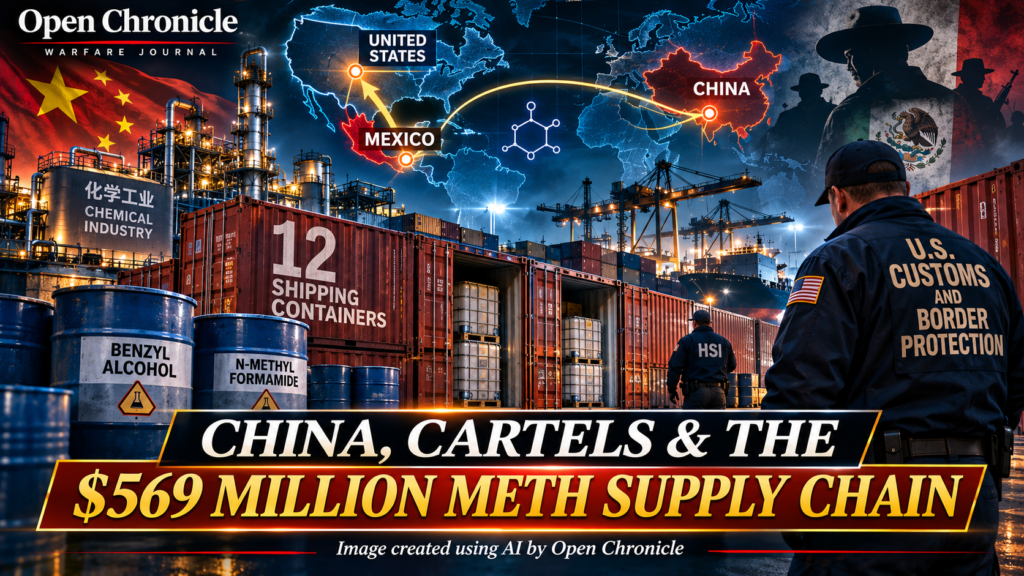
MEXICO CITY / WASHINGTON / BEIJING. More than 300 tonnes of chemicals shipped from China, twelve maritime containers, a suspected destination linked to one of Mexico’s most powerful criminal organizations and an estimated $569 million in potential illicit drug sales.
These are the figures at the center of a renewed diplomatic confrontation between the United States and China.
On November 19, 2026, the United States Embassy in Mexico publicly accused China of being a major source of chemicals used by Mexican criminal organizations to manufacture synthetic drugs, including methamphetamine.
The embassy cited a record seizure conducted by American authorities in September 2025, when investigators intercepted two shipments allegedly destined for laboratories controlled by the Sinaloa Cartel.
China’s diplomatic mission in Mexico rejected the accusations, arguing that Washington was distorting the international chemicals trade and attempting to shift responsibility for America’s drug crisis.
The confrontation emerged at a particularly sensitive moment, as Mexican President Claudia Sheinbaum was pursuing new cooperation agreements with Beijing.
What initially appeared to be another dispute over drug trafficking has therefore become part of a much broader geopolitical contest involving three countries, international commerce and the criminal exploitation of legitimate industrial supply chains.
The Seizure Behind the Accusation
The evidence cited by the American embassy was not a new seizure in November 2026.
It concerned an operation announced by the US Department of Justice on September 3, 2025, involving chemicals that authorities said originated in China and were intended for the Sinaloa Cartel in Mexico.
Investigators from Homeland Security Investigations intercepted two shipments at sea. With assistance from international law enforcement partners, the cargo was consolidated in Panama and subsequently transported to the Port of Houston, Texas.
The Department of Justice described the operation as the largest US law enforcement seizure of chemicals intended for methamphetamine production.
The shipments contained twelve maritime containers carrying two industrial chemicals. The combined quantity exceeded 316,000 kilograms.
According to American prosecutors, the materials could have been used to manufacture approximately 190,000 kilograms of methamphetamine, with an estimated illicit market value of $569 million.
The Record Seizure
SEPTEMBER 2025 | KEY FIGURES
Metric Tonnes Seized
Combined weight of the two chemical shipments
Shipping Containers
Six containers of each chemical
Kilograms of Potential Methamphetamine
Approximate US government estimate
Estimated Illicit Market Value
Hypothetical production value, not seized drugs
SOURCE & METHODOLOGICAL NOTE
Source: US Department of Justice, September 3, 2025. The production and valuation figures are estimates, not quantities of finished drugs recovered.
The distinction is important.
American authorities seized industrial chemicals, not 190 tonnes of finished methamphetamine. The larger drug production figure represents what prosecutors estimated could have been manufactured if the materials had reached their alleged destination.
The seizure also does not, by itself, establish that the Chinese government authorized, directed or knowingly facilitated the suspected criminal shipment.
Inside the Twelve Containers
The Department of Justice provided a detailed breakdown of the cargo.
Seized Industrial Chemicals
OFFICIAL WEIGHTS | SEPTEMBER 2025 SEIZURE
Breakdown of the two industrial chemicals identified in the shipment seized by United States authorities.
Benzyl Alcohol
52.1% of total seized weight
6 CONTAINERS
N-methylformamide
47.9% of total seized weight
6 CONTAINERS
316.44 metric tonnes | 12 maritime containers
Legitimate Industrial Applications
Each substance was transported in six containers. Both have legitimate industrial applications.
Benzyl alcohol is used in several lawful industrial and pharmaceutical applications. N-methylformamide is also used as an industrial chemical.
IMPORTANT DISTINCTION
Their presence in international commerce is not inherently evidence of criminal activity.
The Central Investigative Question
The central issue is diversion: whether chemicals traded through legitimate commercial channels are deliberately supplied or redirected to clandestine drug production.
For investigators, establishing that connection requires evidence concerning buyers, intermediaries, shipping records, financial transactions and intended recipients.
The Department of Justice attributed the seized shipments to the Sinaloa Cartel, but the public announcement does not establish that all commercial actors involved knowingly participated in drug trafficking.
EDITORIAL NOTE
The quantities shown represent industrial chemicals seized by US authorities, not finished methamphetamine. The stated criminal destination reflects the Department of Justice’s allegations. Legitimate chemical production and commercial distribution should not be conflated with knowing participation in illicit drug manufacturing.
Why Washington Is Targeting China
The embassy’s November 19 statement expanded an existing diplomatic dispute.
Washington had already accused China of being a major source of chemicals used to manufacture fentanyl. Its latest intervention emphasized that the concern extended to methamphetamine.
This distinction matters because fentanyl and methamphetamine are different substances, with different effects and patterns of use, even though their illicit production can involve overlapping international procurement networks.
The American argument is that Chinese chemical suppliers occupy a significant position at the beginning of the supply chain, while Mexican criminal organizations conduct much of the illicit manufacturing and trafficking.
That assessment is supported by several US government investigations.
The Drug Enforcement Administration’s 2025 National Drug Threat Assessment identified companies based in China as a major source of chemicals used in methamphetamine production.
A December 2025 report by the US Government Accountability Office similarly described Mexican transnational criminal organizations purchasing precursor chemicals primarily from China, manufacturing synthetic drugs in Mexico and distributing them into the United States.
The GAO also documented the use of electronic transfers, virtual currencies and money laundering networks in the wider trade.
These findings provide a broader evidentiary basis for Washington’s concerns.
They do not, however, mean that every Chinese chemical exporter is involved in criminal activity, nor do they establish direct responsibility by the Chinese state for every illicit shipment.
Beijing Responds: A Dispute Over Evidence and Responsibility
China’s embassy in Mexico responded forcefully to the American allegations.
According to Mexican newspaper La Jornada, Chinese diplomats accused their US counterparts of misrepresenting the global chemicals trade and making misleading accusations.
Beijing’s representatives argued that Washington was overlooking domestic regulatory weaknesses and the demand for illicit drugs within the United States.
China also maintained that it has implemented strict controls on fentanyl-related substances.
The disagreement reflects two different explanations of the same international problem.
Washington emphasizes the overseas sourcing of chemicals and the responsibility of suppliers and intermediaries to prevent diversion.
Beijing emphasizes American drug demand, domestic enforcement and what it regards as politically motivated attempts to blame China.
Both explanations address parts of a complex supply chain, but neither removes the need to investigate specific transactions and criminal organizations.
The exchange was not isolated. Mexican reporting documented several public confrontations between the two diplomatic missions during November, involving trade practices, Chinese investment and narcotics.
Mexico Caught Between Two Powerful Partners
The timing of the allegations made the dispute especially sensitive for Mexico.
The renewed American accusations coincided with President Claudia Sheinbaum’s visit to Shenzhen, where Mexico and China pursued cooperation in areas including energy, science and environmental policy.
According to the South China Morning Post, Sheinbaum also met Chinese President Xi Jinping during the APEC summit.
However, Mexico did not agree to a comprehensive free trade arrangement with China, and significant tariff barriers remained in place.
Mexico’s position is complicated by its close economic integration with the United States and its interest in maintaining commercial and diplomatic relationships with China.
The country must simultaneously address several distinct challenges: the presence of powerful criminal organizations, the movement of chemicals through legitimate ports, pressure from Washington to disrupt drug trafficking and the economic consequences of relations with Beijing.
The diplomatic dispute also places Mexican authorities in a difficult position.
Accepting every American accusation without examining the evidence could complicate relations with China. Rejecting legitimate concerns about chemical diversion could weaken cooperation against criminal networks.
The practical question is whether all three countries can establish effective systems to distinguish lawful industrial trade from shipments intended for illicit production.
How a Global Supply Chain Becomes a Criminal Enterprise
The case illustrates why modern synthetic drug trafficking is difficult to combat.
Unlike agricultural drugs, synthetic narcotics can be manufactured in clandestine facilities using chemicals obtained through international commercial networks.
The criminal activity may involve several jurisdictions, even when the chemicals themselves are lawful.
The Transnational Supply Chain
SIMPLIFIED OVERVIEW | FIVE INTERCONNECTED STAGES
Industrial Chemical Suppliers
Legitimate chemical manufacturing and international commercial distribution, including suppliers operating in China and other countries.
Brokers and Shipping Intermediaries
Commercial networks through which chemicals may be purchased, resold, transported or unlawfully diverted.
Criminal Procurement Networks
Cartel-associated intermediaries allegedly acquire materials for illicit manufacturing.
Clandestine Production in Mexico
Criminal organizations manufacture synthetic drugs in facilities outside lawful regulatory oversight.
Trafficking and Distribution
Finished narcotics enter illicit markets, including the United States, generating revenue for criminal organizations.
METHODOLOGICAL NOTE
Conceptual overview based on DEA and GAO reporting. This is not a reconstruction of the specific intercepted shipments.
The financial dimension is particularly important.
The GAO found that drug trafficking networks use various payment methods and money laundering arrangements to transfer funds and conceal criminal proceeds.
A chemical shipment may therefore be only one visible component of a much larger operation involving commercial businesses, financial intermediaries and criminal distributors.
The Sinaloa Cartel and the Economics of Synthetic Drugs
The Sinaloa Cartel has long been one of the most influential transnational drug trafficking organizations operating from Mexico.
Its activities extend beyond the production and distribution of any single drug.
According to the DEA, cartel networks have developed international relationships to procure chemicals, finance operations, transport narcotics and distribute illicit products.
The agency’s 2025 assessment identified the organization as a major producer and trafficker of methamphetamine, alongside its involvement in the fentanyl trade.
The DEA also reported that methamphetamine samples analyzed by its laboratories had reached exceptionally high purity levels, illustrating the scale and sophistication of industrialized illicit production.
The September 2025 chemical seizure is important in this context because it targeted the alleged supply chain before the materials could be used in clandestine laboratories.
From an enforcement perspective, disrupting access to materials can affect production capacity without requiring authorities to locate every manufacturing facility.
However, the broader history of synthetic drug trafficking also demonstrates the adaptability of criminal organizations.
When particular substances become more tightly regulated, traffickers may seek alternative materials, suppliers and distribution arrangements.
This means that even a record seizure does not necessarily produce a permanent reduction in drug availability.
The Legal Dimension: Why the Cartel’s Terrorism Designation Matters
The September 2025 operation also had a significant legal component.
The Department of Justice stated that the US designation of the Sinaloa Cartel as a Foreign Terrorist Organization enabled prosecutors to pursue the seizure through legal authorities connected to terrorism-related forfeiture.
American officials described the case as an important application of those powers to chemicals allegedly intended for a designated criminal organization.
The designation expanded the legal framework available to investigators pursuing the cartel’s international networks.
Nevertheless, an organization’s designation does not establish that every commercial transaction involving a potentially diverted chemical constitutes terrorism-related conduct.
Individual cases still depend on the applicable law, the evidence and the relationship between the parties involved.
For international businesses, the development increases the importance of understanding customers, commercial intermediaries and potential sanctions or enforcement exposure.
The Numbers That Need Context
The headline figures are substantial, but they describe different things.
| Figure | What it establishes |
|---|---|
| More than 300 tonnes | Quantity of chemicals seized in September 2025 |
| 12 containers | Maritime cargo units containing the seized chemicals |
| Nearly 190 tonnes | Estimated potential methamphetamine production |
| $569 million | Estimated value of hypothetical finished drugs |
| November 19, 2026 | Date of the renewed US embassy allegations |
| September 3, 2025 | Date of the original Department of Justice announcement |
The figures should not be interpreted as proof that 190 tonnes of methamphetamine had already been manufactured or that $569 million in drug proceeds had been recovered.
Nor does the interception of shipments originating in China automatically establish direct involvement by the Chinese government.
Those distinctions are essential when evaluating the evidence and the diplomatic arguments surrounding the case.
Strategic Assessment: Four Questions Beyond the Seizure
Four Questions Beyond the Seizure
Global Supply Chains, International Competition and the Fight Against Organized Crime
Can Governments Stop Criminal Diversion Without Disrupting Legitimate Trade?
Chemical industries supply pharmaceuticals, manufacturing and other lawful sectors. Broad restrictions can impose costs on legitimate businesses, while weak oversight creates opportunities for criminal procurement.
Will Drug Enforcement Become Another Arena of US–China Competition?
The public exchange suggests that narcotics policy is increasingly intertwined with wider disagreements over trade, diplomatic influence and international responsibility.
How Much Pressure Will Fall on Mexico?
Mexican authorities face demands to strengthen controls over chemical imports and cartel operations while maintaining economically important relationships with both Washington and Beijing.
Can Financial Investigations Be as Important as Physical Seizures?
Following payments, identifying intermediaries and investigating money laundering networks may help authorities disrupt the commercial infrastructure supporting illicit drug production.
EDITORIAL METHODOLOGY
These are editorial questions arising from the documented events and official assessments, not predictions of future government actions.
The Bigger Picture: A Drug Crisis With Three International Dimensions
The controversy is often framed as a disagreement about which country bears responsibility for synthetic drugs reaching the United States.
In reality, the problem involves at least three interconnected dimensions.
The first is industrial. Chemicals produced for lawful purposes can enter international supply chains and become vulnerable to criminal diversion.
The second is criminal. Organized trafficking networks exploit commercial infrastructure, corruption, illicit finance and the ability to operate across national borders.
The third is political. Governments disagree over enforcement responsibilities, regulatory standards and the extent to which one country’s failures contribute to another country’s public health and security problems.
The American embassy’s intervention brought all three dimensions into public view.
It also demonstrated how a law enforcement operation conducted in 2025 can acquire renewed diplomatic significance more than a year later.
Conclusion | The Seized Chemicals Are Only Part of the Story
The record seizure cited by the US Embassy in Mexico was a significant law enforcement operation.
American authorities intercepted more than 316 tonnes of industrial chemicals that they alleged were intended for the Sinaloa Cartel, potentially preventing their diversion into illicit drug production.
But the renewed controversy in November 2026 is about more than the intercepted cargo.
It concerns the relationship between global manufacturing and organized crime, the responsibilities of governments and commercial suppliers, and the growing difficulty of separating drug enforcement from geopolitical competition.
Washington has presented the seizure as evidence of China’s importance in the illicit chemical supply chain.
Beijing has rejected the accusations and challenged America’s interpretation of the drug crisis.
Mexico remains central to the dispute, both as a country affected by organized criminal violence and as an important commercial partner of the two powers.
The most important question may not be where the seized chemicals originated, but whether governments can identify and disrupt the criminal networks that transform legitimate international trade into a source of illicit drugs.
That is the challenge extending far beyond the twelve containers intercepted in 2025.
Sources and Further Reading
Official government documentation, international reporting and investigative assessments supporting this article.
U.S. Seizes 300,000 Kilos of Meth Precursor Chemicals
September 3, 2025
Primary official source for the seizure, the cargo quantities, the alleged destination and the estimated production value.
US Embassy Steps Up Attack on China Over Cartel Meth
November 21, 2026
Reporting on the renewed diplomatic accusations and Mexico’s cooperation agreements with Beijing.
US Embassy Accuses China Over Drug Precursors
November 19, 2026
Coverage of the American allegations and the response from China’s embassy in Mexico.
Illicit Synthetic Drugs
December 2025
Government analysis of international chemical procurement, drug trafficking, financial networks and enforcement coordination.
2025 National Drug Threat Assessment
May 2025
Official assessment of Mexican criminal organizations, synthetic drugs and the international supply of chemical precursors.
Ambassador Johnson Calls for Action Against Precursor Trafficking
November 20, 2026
Reporting on US Ambassador Ronald Johnson’s appeal for private sector cooperation against illicit chemical diversion.
Editorial Transparency
This article was prepared by Open Chronicle News Desk using official documentation from the United States Department of Justice, Drug Enforcement Administration and Government Accountability Office, supplemented by reporting from the South China Morning Post, La Jornada and other news organizations. The September 2025 chemical seizure is a documented US law enforcement operation, while claims concerning the intended recipient and criminal purpose are attributed to American authorities. China’s rejection of the accusations is presented as its stated diplomatic position. Estimated methamphetamine production and market value figures do not represent finished drugs recovered or confirmed criminal proceeds. Strategic interpretations concerning international supply chains, diplomatic relations and enforcement challenges represent independent editorial analysis. Information reflects reporting available on November 23, 2026.
Explore International Relations
Discover more reporting and analysis on diplomacy, international security, global governance and the changing balance of power.
Return to International Relations →