
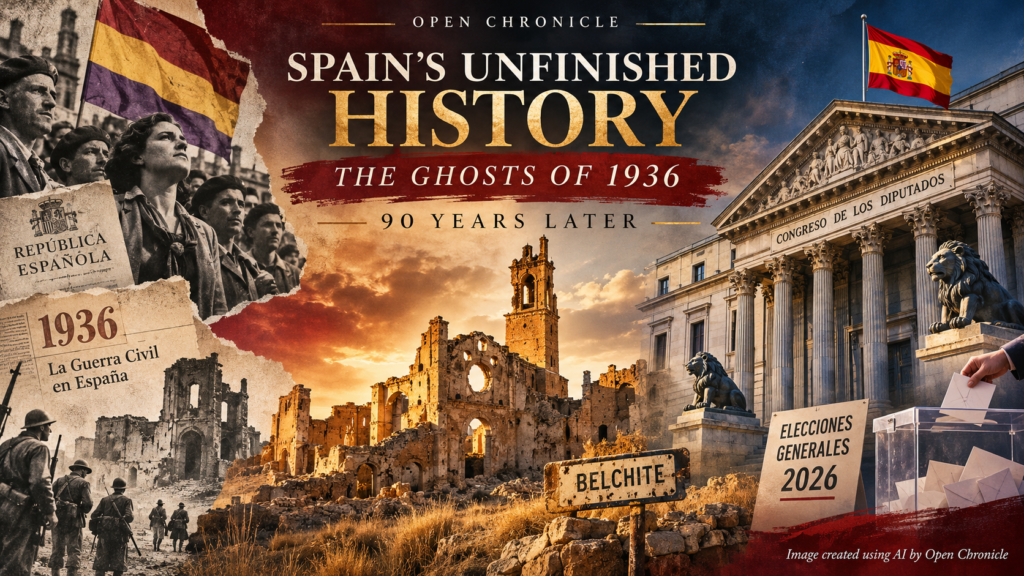
Ninety years after the outbreak of the Spanish Civil War, the campaign for the November 29 election is reopening a profound national debate about historical memory, political identity, democratic institutions and the legacy of Francisco Franco’s dictatorship.
By Open Chronicle News Desk
November 24, 2026
POLITICS & GEOPOLITICS | EUROPE | HISTORY | SOCIETY
Spain is approaching an election in which the language of the past has become an increasingly prominent instrument of contemporary political competition.
Slogans once heard during the defence of Republican Madrid are returning to Socialist rallies. Conservative and nationalist politicians are invoking the Popular Front, the political coalition that governed Spain immediately before the military uprising of July 1936.
Meanwhile, the possibility of a national governing arrangement involving the conservative People’s Party (PP) and the far right Vox has brought disagreements over the legacy of Francisco Franco back into the political spotlight.
Yet beneath the electoral rhetoric lies a much deeper question.
Nearly half a century after the adoption of Spain’s democratic Constitution, has the country genuinely reconciled itself with its twentieth century history, or has it simply learned to coexist with its unresolved divisions?
The election campaign described in recent reporting offers an opportunity to examine the relationship between historical memory, democratic competition and the everyday concerns of contemporary Spanish society.
1. When the Language of 1936 Returns
At a campaign meeting in Puerto de la Cruz, Tenerife, Prime Minister Pedro Sánchez reportedly encouraged Socialist supporters to chant ¡No pasarán!, meaning They shall not pass.
The expression became internationally associated with the Republican resistance during the Spanish Civil War and remains one of the most recognizable slogans of European antifascism.
On the opposite side of the political spectrum, Vox leader Santiago Abascal and Madrid’s regional president, Isabel Díaz Ayuso, have invoked the term Popular Front when describing their political opponents.
The original Popular Front was an alliance of leftist and Republican political organisations that won the February 1936 parliamentary election, several months before the military uprising against the Second Republic.
The contemporary use of these expressions illustrates a phenomenon known in Spain as guerracivilismo, the revival of political language associated with the divisions of the Civil War.
Such rhetoric can transform ordinary political disagreement into a confrontation between competing historical identities.
However, historical parallels require considerable caution. Contemporary Spain possesses democratic institutions, constitutional guarantees, an independent judicial system and membership of the European Union. Its political circumstances are fundamentally different from those of 1936.
The return of historical language does not, by itself, demonstrate that Spain is approaching another civil conflict.
2. Understanding Spain’s Historical Wounds
To understand the significance of the current debate, it is necessary to examine the sequence of events that shaped modern Spain.
The declaration of the Second Spanish Republic in 1931 opened a period of ambitious political and social reform. Attempts to modernize education, redistribute agricultural land, redefine relations between the Church and the state and reform the military generated considerable political resistance.
The country became increasingly divided over competing visions of its future.
In July 1936, a military uprising against the Republican government developed into a prolonged civil war. The conflict acquired an international dimension through the involvement of Nazi Germany, Fascist Italy, the Soviet Union and foreign volunteers.
Franco’s victory in 1939 established an authoritarian dictatorship that survived until his death in November 1975.
Spain’s subsequent democratic transition transformed the country’s political institutions, but many questions concerning repression, disappeared persons and historical responsibility remained unresolved.
3. A Society Increasingly Aware of Its Divisions
Political polarization is not unique to Spain. Across Europe and North America, traditional political loyalties are changing, while disagreements concerning immigration, national identity, economic inequality and institutional trust are becoming more visible.
Spain’s particular historical experience, however, provides these disagreements with an additional dimension.
According to a September survey by More in Common, cited in the original reporting, approximately 70% of Spaniards consider their country divided. This reportedly represents the highest proportion recorded by the organisation since it began monitoring the issue in 2021.
SPAIN | PERCEPTIONS OF NATIONAL DIVISION
Seven in ten Spaniards
Approximately 70% of respondents reportedly consider Spanish society divided.
Source: More in Common, September 2026 survey, as cited by Politico Europe. The remaining proportion includes other responses and should not automatically be interpreted as considering Spain united. The original survey methodology has not been independently examined for this article.
Political scientist Pedro Riera, of Madrid’s Carlos III University, argues that historical references have become less taboo since the democratic transition.
Nevertheless, he emphasizes that practical concerns such as housing affordability and the cost of living remain more immediate priorities for much of the population.
This distinction is particularly important. The prominence of historical disputes in political speeches does not necessarily reflect their relative importance in voters’ everyday lives.
4. Belchite: The Town Where the War Never Entirely Ended
In the northeastern region of Aragón stands one of Spain’s most extraordinary historical landscapes.
The abandoned town of Belchite contains ruined churches, shattered buildings and streets that have remained largely untouched by reconstruction.
Devastated during the Civil War, the old settlement was preserved under Franco as a monument intended to communicate the Nationalist interpretation of the conflict.
A replacement town was constructed nearby, while the original buildings gradually became an enduring symbol of wartime destruction.
Today, Belchite attracts historians, tourists, photographers and filmmakers.
For some families, however, it represents something much more personal.
Their relatives disappeared during the conflict, and their remains have never been recovered.
José Vidal, president of the Mariano Castillo Association for the Recovery of Democratic Memory, is among those seeking answers. His grandfather disappeared in 1936, and the family continues to search for his remains.
According to the reporting supplied for this article, Vidal’s association has excavated 11 burial sites and recovered the remains of 105 individuals.
Other burial sites remain difficult to access because of subsequent construction and changes to the landscape.
For these families, historical memory is not an abstract political argument. It concerns identification, documentation and the possibility of finally providing relatives with a dignified burial.
5. The Human Dimension of Historical Memory
The recovery of human remains involves considerably more than archaeological excavation.
Historical documents must be examined, potential burial locations identified, forensic specialists consulted and genetic material compared with surviving relatives.
The advanced age of surviving family members also creates practical urgency, particularly where direct testimony and DNA samples could assist identification.
These processes require institutional continuity, specialist expertise and predictable financial support.
6. The Democratic Transition and the Pact of Silence
Spain’s transition from dictatorship to democracy is frequently regarded as one of the most significant political transformations in modern European history.
Rather than attempting an immediate and comprehensive judicial reckoning with the dictatorship, the principal political actors concentrated on establishing democratic institutions and reducing the risk of renewed confrontation.
The 1977 Amnesty Law became associated with what historians and political commentators commonly describe as the Pacto del Olvido, or Pact of Forgetting.
The expression does not refer to a single formal agreement requiring Spanish society to forget its history. Instead, it describes the broader political approach through which confronting certain aspects of the dictatorship was subordinated to democratic stabilization.
This approach remains contested.
Supporters emphasize the importance of compromise during a period of considerable institutional uncertainty. Critics argue that the absence of accountability and insufficient recognition of victims left serious historical injustices unresolved.
Both perspectives form part of the continuing debate over how Spain should understand its democratic transition.
7. The Democratic Memory Law: What Is Actually at Stake?
Spain adopted its national Democratic Memory Law in October 2022.
The legislation establishes measures concerning the recognition of victims, historical research, the recovery of disappeared persons and the preservation of democratic memory.
Its stated principles include truth, justice, reparation and the prevention of future abuses. It explicitly condemns the military uprising of July 1936 and the dictatorship that followed.
The law represents an institutional approach to questions that previous generations frequently addressed through family initiatives and local historical associations.
8. Aragón: A Regional Experiment With National Implications
The experience of Aragón demonstrates how disagreements concerning historical memory can translate into practical government decisions.
Following the establishment of a regional coalition involving the PP and Vox in 2023, Aragón repealed its regional democratic memory legislation.
According to the original reporting, the changes also affected the official inventory of burial sites and a dedicated historical research centre.
Regional historical memory organisations argue that these decisions have complicated their activities and affected previously discussed commemorative projects.
The regional administration disputes this interpretation.
Its spokesperson, Carlos Villanova Mutilva, stated that funding for exhumations had increased by 10% in 2024 and 2025, with annual allocations reaching €110,000.
The controversy therefore involves competing assessments of whether changes to legal frameworks and institutional arrangements have improved or weakened practical support for victims’ families.
The repeal is reportedly under review by Spain’s Constitutional Court.
The Aragón experience has acquired national significance because similar legislative changes have been discussed during the current general election campaign.
9. Three Political Approaches to Historical Memory
Historical memory represents an area of significant disagreement between Spain’s principal political movements.
Based on campaign positions described in the supplied reporting, the differences can be summarized as follows.
10. A Generation That Never Experienced Franco
One of the more complex aspects of Spain’s historical debate concerns younger generations.
For Spaniards born after the democratic transition, the Civil War and dictatorship are historical experiences rather than personal memories.
Their understanding of Francoism is consequently influenced by education, family narratives, cultural production, political discussion and digital media.
A 2025 survey by Spain’s Centre for Sociological Research, cited in the original article, reportedly found that almost 20% of respondents aged between 18 and 24 regarded Franco’s dictatorship positively.
This finding should be interpreted with appropriate methodological caution, particularly because responses to historical questions do not necessarily establish support for authoritarian government in contemporary Spain.
The reported finding raises important questions about how historical knowledge is transmitted between generations.
It does not mean that younger Spaniards collectively favour authoritarianism. Rather, it suggests that the historical understanding of dictatorship cannot be assumed to remain unchanged indefinitely.
For historians and educators, the challenge is to communicate the complexity of the period while ensuring that documented historical facts remain distinguishable from political mythology.
11. Cinema, Culture and the Persistence of Historical Memory
Spain’s Civil War continues to occupy a remarkable position within the country’s cultural imagination.
Novelists, filmmakers, historians and artists have repeatedly explored subjects such as exile, family separation, political violence, personal loyalty and reconciliation.
According to the supplied reporting, the film La Bola Negra has attracted more than five million cinema viewers since its release.
The historical drama follows a relationship between two men associated with opposing sides of the conflict, placing individual identity and human relationships within the wider tragedy of civil war.
Its reported commercial success demonstrates the continuing cultural relevance of Spain’s twentieth century history.
Meanwhile, commemorations marking the anniversary of Franco’s death have reportedly attracted participants expressing admiration for elements of the former regime.
These contrasting cultural expressions demonstrate that the historical past continues to carry different meanings across contemporary Spanish society.
12. Why Today’s Spain Is Not the Spain of 1936
Historical comparisons can illuminate political developments, but they can also obscure essential differences.
Spain’s contemporary institutional environment bears little resemblance to that of the period preceding the Civil War.
| Dimension | Spain in 1936 | Spain in 2026 |
|---|---|---|
| Political institutions | Young Republican system under severe pressure | Established constitutional parliamentary democracy |
| International environment | Growing confrontation between European authoritarian powers and democracies | Membership of the European Union and NATO |
| Military institutions | Deep political divisions within the armed forces | Armed forces within an established constitutional framework |
| Economic structure | Predominantly agricultural society undergoing uneven modernization | Diversified economy integrated into international markets |
| Political participation | Electoral competition accompanied by severe instability and political violence | Constitutional elections and established mechanisms of political competition |
| Institutional safeguards | Relatively fragile democratic arrangements | Constitutional Court, parliamentary institutions and European legal frameworks |
| Historical experience | Approaching a devastating civil conflict | Decades of democratic government following the dictatorship |
The comparison does not eliminate contemporary concerns about polarization or extremist rhetoric.
It does, however, provide necessary context.
Spain’s present political disagreements should be examined according to existing institutions, documented developments and contemporary social conditions rather than assuming that history will repeat itself.
13. The Economic Reality Behind the Historical Debate
While the Civil War provides powerful historical symbolism, Spain’s election also takes place against a background of contemporary socioeconomic pressures.
Housing affordability has become an increasingly visible issue. Younger households face difficulties entering property markets, while rental costs place pressure on urban populations.
Other important concerns include employment opportunities, purchasing power, immigration policy, public services and regional governance.
Historical rhetoric may help political organisations mobilize supporters who identify strongly with particular traditions.
However, future governments will also be assessed through their ability to address practical public policy challenges.
The relationship between these two dimensions is significant. Questions of national identity and historical interpretation coexist with economic concerns rather than replacing them.
A complete understanding of Spain’s election therefore requires attention to both its historical divisions and the material circumstances of contemporary voters.
14. Open Chronicle Strategic Assessment
15. The Wider European Significance
Spain is not the only European democracy confronting disagreements over the interpretation of twentieth century history.
Across the continent, governments and societies continue to debate monuments, national anniversaries, historical education, political repression and the legacy of authoritarian regimes.
These discussions frequently reflect differences over contemporary questions of national identity and institutional legitimacy.
Spain’s experience is particularly relevant because its transition became an internationally recognized example of negotiated democratization.
The current debate demonstrates that successful institutional transformation does not necessarily resolve every historical disagreement.
Democratic societies may continue confronting their past for generations, even after establishing stable constitutional systems.
The European significance of Spain’s election consequently extends beyond the composition of its next government. It also concerns the interaction between historical responsibility, political pluralism and the continuity of democratic institutions.
16. What to Watch After November 29
Spain’s official election decree establishes November 29 as the date for elections to both parliamentary chambers, with the campaign concluding on November 27.
Several developments will merit attention following the election.
| Development | Why it matters |
|---|---|
| Parliamentary composition | Determines the legislative possibilities available to political parties. |
| Coalition negotiations | Could establish the next government’s approach to historical memory. |
| Democratic Memory Law | Potential legislative changes may affect existing institutional responsibilities. |
| Exhumation funding | Financial commitments could influence ongoing forensic and archaeological projects. |
| Constitutional Court proceedings | Judicial decisions concerning Aragón may clarify the legal boundaries of regional memory policies. |
| Historical education | Future education policies may influence how younger generations encounter the Civil War and dictatorship. |
| Political rhetoric | Changes in political language may offer indications of the nature of post election debate. |
| Housing and economic policy | Contemporary socioeconomic concerns remain important to public confidence. |
No electoral outcome or legislative change should be considered established before voting, parliamentary negotiations and the relevant institutional procedures have taken place.
Conclusion: The Past Is Not Finished
The ruins of Belchite represent a paradox at the heart of modern Spain.
The physical destruction belongs to a war that ended in 1939. Yet the questions associated with those ruins remain part of the country’s contemporary social and political landscape.
Spain has undergone an extraordinary transformation since Franco’s death. It has developed democratic institutions, integrated into Europe and experienced profound economic, cultural and social change.
Nevertheless, the legacy of the Civil War continues to influence political language, family histories and competing interpretations of national identity.
For some Spaniards, preserving historical memory represents recognition of past injustice. For others, existing memory policies risk perpetuating political divisions and should be replaced by different approaches to reconciliation.
For families searching for disappeared relatives, the question is often more immediate and personal than either political interpretation suggests.
Their search concerns a name, a burial place, a family history and the possibility of obtaining answers that have remained elusive for decades.
Spain’s election of November 29 will determine the composition of its next parliament. It will not necessarily resolve the historical disagreements that have survived successive generations.
The Spanish Civil War ended in 1939. The conversation about its place in Spain’s national memory remains unfinished.