
OPEN CHRONICLE | AMERICA IN FOCUS
The Price of Protection
International Trade • American Industry • Household Economy • Consumer Affairs
INFORMATION • CONTEXT • UNDERSTANDING
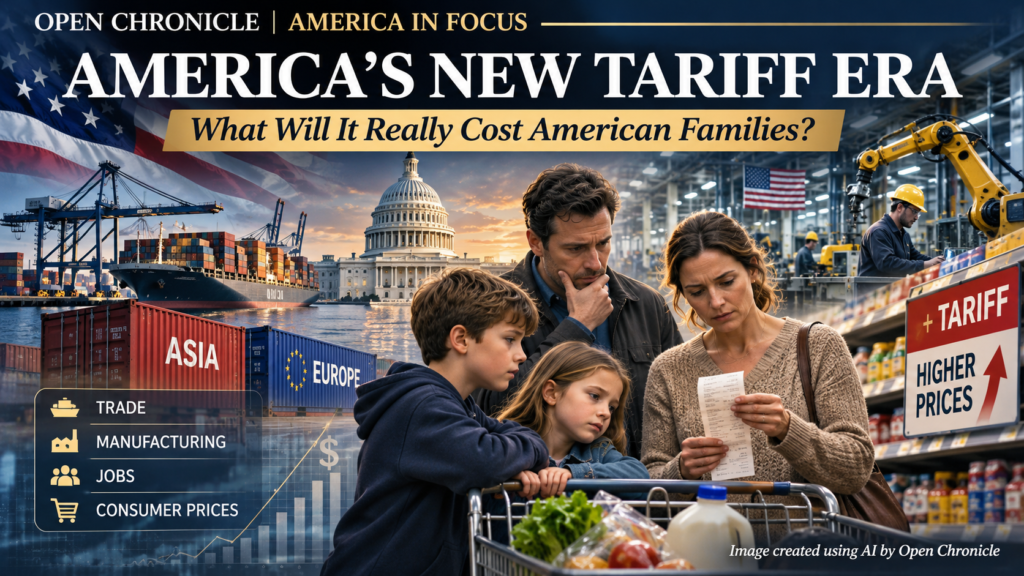
Washington’s latest trade proposals targeting 14 major economies could reshape international supply chains, influence consumer prices and redefine the relationship between American manufacturing and the global economy.
By Open Chronicle News Desk
November 26, 2026 | United States
01. A New Trade Confrontation Begins
As millions of Americans celebrate Thanksgiving and prepare for the holiday shopping season, Washington is opening another chapter in its campaign to reshape international trade.
On November 25, the Office of the United States Trade Representative (USTR) announced proposed trade measures following investigations into industrial policies and manufacturing capacity across 14 economies.
The initiative reflects the Trump administration’s argument that foreign industrial support and market distortions have undermined American manufacturing competitiveness.
However, the proposals also raise a fundamental economic question: can the United States protect its industrial base without increasing the financial pressure on American households?
The answer depends not only on government policy but also on the decisions of manufacturers, importers, retailers and consumers.
Importantly, the newly announced measures remain proposals subject to public consultation. They should not be confused with tariffs already in force.
Washington’s new tariff offensive
|
🌐︎
14
Economies targeted by the proposals
|
%
35%
Highest proposed rate, for Vietnam
|
|
📅︎
JAN 05
Public comment deadline in 2027
|
🏛︎
JAN 25
Public hearings scheduled to begin
|
02. Which Trading Partners Are Being Targeted?
The proposals cover economies that occupy important positions in global manufacturing, including major American allies and strategic competitors.
The measures could influence commercial relationships across Asia and Europe, affecting industries ranging from clothing and consumer electronics to automobiles and pharmaceuticals.
Washington’s proposed tariff rates
| Vietnam | 35% |
| India | 25% |
| China | 20% |
| Singapore | 20% |
| Bangladesh | 18% |
| Cambodia | 18% |
| Indonesia | 18% |
| Malaysia | 18% |
| Thailand | 18% |
| European Union | 15% |
| Japan | 15% |
| South Korea | 15% |
| Switzerland | 15% |
| Taiwan | 15% |
The proposed framework includes differentiated treatment for particular goods and possible adjustments linked to future trade agreements. Consequently, the headline rates cannot simply be added to every existing import duty.
03. Who Actually Pays an American Tariff?
One of the most misunderstood aspects of international trade is the distinction between the legal payment of a tariff and its ultimate economic cost.
A tariff is a customs duty imposed on imported merchandise.
In the United States, the importer of record is generally responsible for paying the applicable customs duties. Foreign governments do not ordinarily send payments to the United States Treasury when their products enter American territory.
However, the economic burden can be distributed across several participants in the supply chain.
Foreign manufacturers may reduce their prices to remain competitive. American importers may accept lower profit margins. Retailers may increase prices, while consumers may respond by purchasing fewer goods or choosing alternative products.
How a tariff reaches the American consumer
|
🏭︎
|
Foreign manufacturerProduces goods intended for the American market.
|
|
🚢︎
|
International transportationMerchandise enters the United States through global supply chains.
|
|
🏛︎
|
US customsApplicable import duties are collected from the importer of record.
|
|
📦︎
|
American importerAbsorbs, negotiates or transfers additional costs.
|
|
🏪︎
|
Retail distributionBusinesses adjust pricing, sourcing and profit margins.
|
|
🛒︎
|
American consumerMay encounter higher prices or changes in product availability.
|
The central issue is known as tariff incidence: the distribution of the economic burden created by an import duty.
The importer may legally pay the tariff, but the ultimate financial consequences can extend far beyond the company responsible for bringing the merchandise into the country.
04. What History Tells Us About Tariffs
The United States has considerable experience with tariffs as instruments of economic and industrial policy.
During the nineteenth century, customs duties provided an important source of federal revenue while protecting emerging American industries from international competition.
In the twentieth century, the Smoot-Hawley Tariff Act of 1930 became one of the most controversial examples of American protectionism. Enacted during the Great Depression, it contributed to international trade tensions and retaliatory measures.
Following World War II, the United States increasingly supported international trade liberalization, although protective measures remained an important component of industrial policy.
The return of tariffs to the center of American economic strategy during the first Trump administration represented a significant change in direction.
America’s evolving tariff strategy
|
●
|
1789
The Tariff ActCustoms duties become an important instrument of federal revenue and industrial protection.
|
|
●
|
1930
Smoot-Hawley Tariff ActProtectionism intensifies amid the Great Depression and international economic instability.
|
|
●
|
1947
General Agreement on Tariffs and TradeThe international community begins building a framework for reducing trade barriers.
|
|
●
|
1995
World Trade OrganizationA new institutional framework for international commerce enters into operation.
|
|
●
|
2018
Renewed American protectionismWashington introduces significant tariffs affecting China, steel and aluminum imports.
|
|
●
|
2026
A broader industrial confrontationNew Section 301 proposals extend the debate over manufacturing capacity to 14 economies.
|
Selected milestones in the historical evolution of American trade policy.
Historical experience suggests that tariffs can support production in protected industries while simultaneously creating additional costs elsewhere in the economy.
A study published by the United States International Trade Commission in March 2023 examined the consequences of selected American tariffs during the period from 2018 to 2021.
The commission concluded that American importers absorbed almost the entire initial burden of the tariffs examined.
However, the same study also identified increases in domestic production within several protected industries.
The findings illustrate the complexity of protectionist policies. Higher domestic production and higher prices can occur simultaneously.
05. How Much Could Tariffs Cost an American Family?
For most American households, international trade policy becomes relevant when it affects the price of everyday purchases.
The financial impact of a tariff depends on the customs value of imported merchandise, the applicable duty, the proportion of the cost transferred to consumers and the availability of alternative products.
A tariff of 20 percent does not necessarily mean that a product’s retail price will increase by 20 percent.
Consider an imported household appliance with a customs value of $200 and an original retail price of $300.
If a new incremental tariff of 20 percent applies to its customs value, the importer faces an additional cost of $40.
The eventual retail price depends on how much of that additional cost reaches the consumer.
The American tariff cost calculator
Three possible pricing scenarios
| Economic scenario | Additional consumer cost | Final retail price |
|---|---|---|
| Business absorbs the entire duty | $0 | $300 |
| Consumer pays half the additional duty | $20 | $320 |
| Consumer pays the entire additional duty | $40 | $340 |
The example demonstrates why the relationship between tariffs and inflation is rarely straightforward.
Even when an importer faces a substantial increase in costs, the final consumer price may rise by a smaller percentage than the headline tariff rate.
06. Which Products Could Become More Expensive?
American consumers purchase goods manufactured through complex international supply chains.
A smartphone may contain components produced in several Asian economies. An automobile assembled in the United States may incorporate imported electronic systems, transmission components and specialized materials.
Consequently, the economic consequences of tariffs are not necessarily limited to products carrying foreign brand names.
Six areas of potential household exposure
|
📱︎
|
Consumer electronicsSmartphones, computers, televisions and electronic components.
|
|
👕︎
|
Clothing and footwearApparel, shoes and textiles sourced through international manufacturing networks.
|
|
🚘︎
|
Automobiles and spare partsImported vehicles, replacement components and internationally sourced automotive systems.
|
|
⚙︎
|
Household appliancesRefrigerators, washing machines and other domestic equipment.
|
|
🛋︎
|
Furniture and home furnishingsImported furniture, decorative products and household materials.
|
|
💊︎
|
Healthcare productsSelected medical equipment and pharmaceutical supply chains, depending on applicable exemptions.
|
Consumer electronics
The technology sector is particularly dependent on internationally distributed production.
Tariffs affecting imported components could increase manufacturing costs even when final assembly takes place inside the United States.
Clothing and footwear
American retailers frequently rely on manufacturing centers in South and Southeast Asia.
The potential exposure of these supply chains makes clothing and footwear an important area to monitor as the proposed trade measures develop.
Automobiles
The automotive industry illustrates the difficulty of separating domestic manufacturing from international commerce.
Protective measures could improve the competitiveness of some American producers while increasing component costs for others.
Household appliances and furniture
Purchases of durable household goods may be postponed when prices increase. This creates potential consequences for retailers, manufacturers and household consumption.
The actual impact across these categories will depend on the final tariff schedules rather than the headline announcements alone.
07. The Challenge for American Small Businesses
Large multinational corporations often possess resources that allow them to negotiate with suppliers, diversify manufacturing operations and reorganize international logistics.
Smaller businesses generally have fewer options.
An independent clothing retailer, electronics distributor or automotive repair business may depend on a limited number of suppliers.
When import costs increase, these companies face several difficult choices.
The small business tariff dilemma
Higher import costs
|
↘
Absorb the costAccept lower profit margins.
|
↗
Increase pricesRisk losing customers.
|
|
🚚︎
Change suppliersReorganize sourcing and logistics.
|
📦︎ −
Reduce inventoryLimit product availability.
|
Businesses may also delay investment decisions while waiting for greater clarity about future trade policy.
Uncertainty itself can become an economic cost, particularly when companies must make purchasing commitments months before merchandise reaches American consumers.
08. Can Tariffs Bring Manufacturing Back to America?
The central argument supporting protective tariffs is that domestic manufacturers should not be forced to compete against foreign producers benefiting from unfair industrial advantages.
Supporters argue that tariffs can encourage companies to establish factories inside the United States, create employment opportunities and reduce dependence on strategically important foreign suppliers.
These objectives are particularly relevant in industries connected to national security, energy infrastructure, semiconductors and advanced manufacturing.
However, establishing new industrial capacity requires more than changes in customs duties.
Factories need investment, skilled employees, reliable electricity, transportation infrastructure, access to raw materials and predictable regulatory conditions.
The foundations of American manufacturing
|
🏭︎
Industrial investmentCapital for factories and production equipment.
|
🎓︎
Skilled workforceTechnical education and specialized training.
|
|
⚡︎
Energy infrastructureReliable and competitively priced electricity.
|
⚙︎
TechnologyAutomation, innovation and advanced production.
|
|
🚚︎
Supply chainsReliable access to components and raw materials.
|
🛡︎
Policy stabilityPredictable conditions for long term investment.
|
Tariffs may alter the financial incentives behind manufacturing decisions, but they cannot independently resolve shortages of skilled labor, infrastructure limitations or technological disadvantages.
Furthermore, modern factories increasingly rely on automation. An increase in domestic manufacturing output does not necessarily produce a proportional increase in employment.
09. The Risk of International Retaliation
International trade is a relationship between economies rather than a one directional commercial transaction.
When Washington imposes restrictions on imported goods, affected trading partners may respond through negotiations, legal challenges or retaliatory measures.
American exporters could consequently face additional barriers in foreign markets.
Agriculture, industrial equipment, aerospace and other export industries may become exposed to the consequences of escalating trade disputes.
10. Who Could Benefit and Who Could Face Additional Costs?
The consequences of tariffs are rarely distributed equally throughout society.
Different businesses, industries and households may experience significantly different outcomes.
Cria um código que crie a imagem que geraste para estes dados e que fique igual
11. What Could American Households Do?
Consumers cannot directly control international trade negotiations, but they can make informed decisions about their own spending.
Rather than responding to tariff announcements with panic buying, households can evaluate whether purchases are necessary, compare prices and consider the availability of alternatives.
Six practical considerations for American consumers
|
01
🔍︎
|
Compare pricesMonitor prices across different retailers before making major purchases.
|
|
02
📅︎
|
Plan major purchasesEvaluate the timing of necessary purchases without assuming immediate price increases.
|
|
03
🔧︎
|
Consider repair optionsCompare the cost of repairing existing appliances and equipment with replacement costs.
|
|
04
💳︎
|
Protect household budgetsMaintain financial flexibility for unexpected changes in essential expenses.
|
|
05
📦︎
|
Evaluate alternativesCompare domestic and imported products based on quality, price and long term value.
|
|
06
📄︎
|
Follow official announcementsDistinguish proposed tariffs from measures that have legally entered into force.
|
The most important distinction is between anticipated economic developments and changes that have already occurred.
The November 25 announcement does not, by itself, establish that American retail prices will immediately increase.
12. What Happens Next?
The proposed trade measures will now move through a public consultation process.
The outcome could be influenced by business submissions, diplomatic negotiations, industry concerns and the administration’s assessment of economic consequences.
The road toward a final tariff decision
|
◉
|
MARCH 11, 2026
Section 301 investigations initiatedWashington begins examining industrial practices across 16 economies.
|
|
◉
|
NOVEMBER 25, 2026
Proposed trade measures announcedDeterminations issued concerning 14 economies.
|
|
◉
|
JANUARY 5, 2027
Public comment deadlineDeadline for written submissions and requests to participate in hearings.
|
|
◉
|
JANUARY 25, 2027
Public hearingsScheduled commencement of hearings concerning the proposed measures.
|
|
◉
|
DATE NOT ESTABLISHED
Final decisionsFinal rates, exemptions and implementation arrangements remain subject to determination.
|
Developments to watch
| Development | What to monitor |
|---|---|
| Trade negotiations | Potential agreements that modify proposed tariff rates. |
| Product exemptions | Treatment of essential goods and strategically important components. |
| Consumer inflation | Changes in retail prices and household purchasing power. |
| American manufacturing | New investment commitments and production capacity. |
| Small businesses | Import costs, profitability and employment decisions. |
| International retaliation | Potential restrictions affecting American exports. |
| Federal revenue | Changes in customs duty collections following implementation. |
| Monetary policy | Federal Reserve assessments of inflationary pressures. |
| Employment | Developments across protected industries and businesses using imported inputs. |
13. Open Chronicle Strategic Assessment
The United States is confronting one of the most important economic debates of the modern era: how to balance industrial sovereignty with the benefits of international commerce.
The global economy has become increasingly interconnected. American prosperity depends both on domestic productive capacity and access to international goods, services and markets.
Reducing strategic dependencies may strengthen national resilience. However, broad trade restrictions can also create additional costs for domestic manufacturers and consumers.
The challenge is to develop an industrial strategy that delivers measurable economic benefits without imposing disproportionate financial burdens on American families.
Four dimensions of America’s tariff challenge
|
🏭︎
Industrial sovereigntyStrengthening domestic production and reducing strategic dependencies.
|
💳︎
Household affordabilityProtecting purchasing power and limiting additional consumer costs.
|
|
🌐︎
International competitivenessPreserving access to foreign markets and global supply chains.
|
⚖︎
Economic stabilityBalancing investment, employment, inflation and fiscal objectives.
|
Ultimately, the success of America’s tariff strategy should not be measured solely by the amount of customs revenue collected or the number of foreign products affected.
It should also be evaluated through improvements in industrial competitiveness, sustainable employment, productivity, household purchasing power and national economic resilience.
The defining question is not simply whether America can produce more of what it consumes. It is whether it can achieve that objective while preserving the prosperity and economic security of the people it seeks to protect.
14. Sources and Further Reading
|
01
|
PRIMARY GOVERNMENT DOCUMENTATION
Office of the United States Trade RepresentativeNovember 25, 2026. Official announcement concerning the 14 Section 301 determinations, proposed trade measures and public consultation timetable. |
|
02
|
INDEPENDENT FEDERAL ECONOMIC RESEARCH
United States International Trade CommissionMarch 2023. Historical assessment of the economic effects of Section 232 and Section 301 tariffs. |
|
03
|
DETAILED ECONOMIC STUDY
Economic Impact of Tariffs Under Sections 232 and 301 on U.S. IndustriesUSITC Publication 5405. Detailed retrospective analysis of import prices, domestic production and international trade. |
|
04
|
OFFICIAL CUSTOMS GUIDANCE
U.S. Customs and Border ProtectionOfficial guidance concerning importer responsibilities, customs declarations and payment of applicable duties. |
|
05
|
OFFICIAL IMPORT PROCEDURES
U.S. Customs and Border Protection | Entry Summary and Post-Release ProcessDocumentation concerning customs clearance and the payment of estimated import duties. |
|
06
|
SUPPLEMENTARY ECONOMIC RESEARCH
The Budget Lab at Yale | The State of U.S. TariffsNovember 25, 2026. Additional research resource for monitoring American tariff policy and its economic implications. |
Editorial Note
This article was prepared by Open Chronicle News Desk using official United States government documentation, customs guidance and historical economic research.
The proposed tariff measures announced on November 25, 2026, have been distinguished from existing duties and legally implemented measures. Historical economic estimates are not presented as forecasts of future outcomes.
The household cost calculator and illustrative pricing scenarios represent simplified economic models developed for educational purposes. Potential sectoral consequences, consumer guidance and strategic conclusions constitute independent editorial analysis.