Philosophy
Philosophy explores what exists, what can be known, how we ought to live and how reason can illuminate the human condition. Across cultures and centuries, philosophers have examined reality, knowledge, morality, consciousness, language, politics and the nature of a meaningful life.
Explore the history of philosophical thought, its major branches, influential thinkers and enduring questions, from ancient traditions to contemporary debates.
Explore the World of Philosophy
Explore the ten principal subject areas of the Open Chronicle Encyclopedia Philosophy taxonomy. Each area leads to a dedicated WordPress category and its specialized subjects.
History of Philosophy
Explore philosophical development across historical periods.
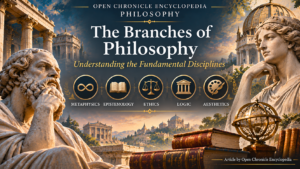
Branches of Philosophy
The fundamental disciplines and methods of philosophical inquiry.
Philosophers & Thinkers
Biographies, intellectual achievements and enduring legacies.
Philosophical Schools & Movements
Explore traditions, arguments and philosophical movements.
World Philosophical Traditions
Philosophical traditions across regions, languages and cultures.
Political & Social Philosophy
Justice, freedom, law, social institutions and political thought.
Applied Philosophy
Philosophical reflection on real-world ethical challenges.
Philosophical Concepts & Problems
Concepts, paradoxes and enduring philosophical problems.
Philosophical Works & Texts
Interpretations and historical contexts of philosophical texts.
Philosophy & Contemporary Debates
New questions arising from technological and social change.
Browse by Subject
Explore every principal category and its specialist subcategories. Links follow the standard WordPress category permalink structure and should be checked against the live slugs.
History of Philosophy
Explore philosophical development across historical periods.
Branches of Philosophy
The fundamental disciplines and methods of philosophical inquiry.
Philosophers & Thinkers
Biographies, intellectual achievements and enduring legacies.
Philosophical Schools & Movements
Explore traditions, arguments and philosophical movements.
World Philosophical Traditions
Philosophical traditions across regions, languages and cultures.
Political & Social Philosophy
Justice, freedom, law, social institutions and political thought.
Applied Philosophy
Philosophical reflection on real-world ethical challenges.
Philosophical Concepts & Problems
Concepts, paradoxes and enduring philosophical problems.
Philosophical Works & Texts
Interpretations and historical contexts of philosophical texts.
Philosophy & Contemporary Debates
New questions arising from technological and social change.
History of Philosophy
Explore major periods of philosophical development. The divisions below are navigational guides rather than a single universal chronology for all philosophical traditions.
Ancient Philosophy
Early philosophical traditions, classical Greek and Roman philosophy, and intellectual developments across ancient Asia.
Medieval Philosophy
Philosophical inquiry in Christian, Islamic, Jewish, South Asian and other intellectual settings.
Early Modern Philosophy
Rationalism, empiricism, scientific transformation and debates over knowledge and political authority.
Modern Philosophy
Enlightenment thought, German idealism, utilitarianism, existential currents and social critique.
Contemporary Philosophy
Analytic and continental approaches, philosophy of mind, language, science and technology.
Global Intellectual Histories
Connected and distinct philosophical developments that challenge exclusively European periodization.
Branches of Philosophy
Foundational disciplines and specialized fields that organize philosophical investigation.
Being, existence, causation, identity, time and the fundamental structure of reality.
Knowledge, justification, belief, evidence, skepticism and the limits of understanding.
Right and wrong, virtue, moral responsibility, duty and the good life.
Valid reasoning, arguments, inference, formal systems and fallacies.
Justice, liberty, authority, rights, equality and the legitimacy of political institutions.
Beauty, art, taste, interpretation and aesthetic experience.
Consciousness, perception, personal identity and the relation between mind and body.
Scientific explanation, methods, evidence, models and the nature of scientific knowledge.
Meaning, reference, communication, interpretation and linguistic understanding.
Faith, reason, religious experience, arguments about divinity and the problem of evil.
Philosophers & Thinkers
A starting directory of figures whose ideas transformed philosophical inquiry. Names are reference topics and will receive links as encyclopedia entries are published.
Philosophical Traditions
Philosophical traditions have developed through distinctive languages, institutions, texts and forms of debate, while also influencing one another through exchange and translation.
Traditions and intellectual worlds
- Ancient Greek and Roman Philosophy
- Indian Philosophy
- Chinese Philosophy
- Islamic Philosophy
- Jewish Philosophy
- Christian Philosophy
Further fields of inquiry
- African Philosophical Traditions
- Indigenous Philosophies
- European Enlightenment Philosophy
- Analytic Philosophy
- Continental Philosophy
- Comparative and Intercultural Philosophy
The Great Questions
A thematic entry point for readers approaching philosophy through its most persistent problems.
What is real?
Reality, existence, appearance and the nature of the universe.
What can we know?
Truth, certainty, evidence, skepticism and rational belief.
What makes an action right?
Moral principles, consequences, duties and virtues.
Do we have free will?
Choice, determinism, agency and moral responsibility.
What is consciousness?
Subjective experience, selfhood and the mind–body problem.
What is a just society?
Freedom, equality, power, rights and political obligation.
Philosophy Through the Ages
A broad orientation to philosophical history. Dates and categories are approximate, and developments across regions were often simultaneous.
Philosophy Library
Browse the complete Philosophy category or explore specialist subjects through the taxonomy directory. The automatic article feed can be activated as soon as its Content Views shortcode is available.
Browse All Philosophy Articles →