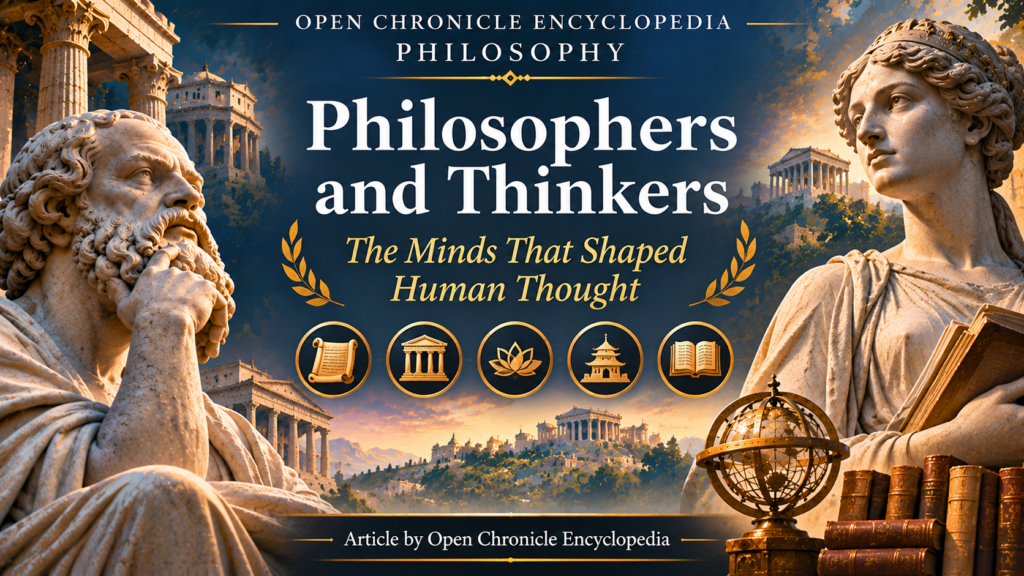
OPEN CHRONICLE ENCYCLOPEDIA | PHILOSOPHY | PHILOSOPHERS & THINKERS
Across civilizations and centuries, philosophers have challenged inherited beliefs, developed new methods of reasoning and transformed humanity’s understanding of reality, knowledge, morality, politics and existence. Their intellectual legacy is a history of arguments, disagreements and ideas that continue to shape the modern world.
By Open Chronicle Encyclopedia
Quick Facts
| Field | Information |
|---|---|
| Subject | Philosophers and Thinkers |
| Academic field | History of Philosophy, Intellectual History |
| Chronological scope | Ancient civilizations to the twenty first century |
| Geographical scope | Global |
| Major traditions | Greek, Indian, Chinese, Islamic, Jewish, European, African and Indigenous philosophies |
| Central subjects | Reality, knowledge, ethics, logic, politics, consciousness and human existence |
| Principal forms of philosophical expression | Dialogues, treatises, commentaries, essays, debates and oral traditions |
| Related disciplines | History, science, religion, mathematics, law, political theory and literature |
1. Introduction: The People Behind the History of Ideas
The history of philosophy is inseparable from the individuals and intellectual communities that developed its questions, methods and arguments.
Philosophers have investigated what exists, how knowledge is possible, what makes actions right or wrong and how human societies should be organized. Their work has influenced political institutions, religious traditions, scientific inquiry, education and cultural life.
Yet the history of philosophical thought cannot be reduced to a collection of exceptional individuals.
Ideas emerge within particular historical circumstances. Philosophers inherit languages, concepts, intellectual problems and institutional traditions. They respond to earlier arguments, criticize established authorities and develop theories that later generations reinterpret.
The philosophical achievements of Plato, Aristotle, Confucius, Nāgārjuna, Ibn Sīnā, René Descartes, Immanuel Kant and Simone de Beauvoir cannot be understood independently of the intellectual worlds in which they worked.
Nor can the global history of philosophy be adequately represented by a single sequence of European thinkers.
Classical Indian philosophy developed sophisticated theories of knowledge, consciousness and liberation. Chinese philosophical traditions examined ethical cultivation, political legitimacy and the relationship between human conduct and cosmic order. Philosophers working in Arabic and Persian transformed metaphysics, logic and philosophical theology. African and Indigenous philosophical traditions developed distinctive approaches to personhood, community, knowledge and moral responsibility.
Women also participated in philosophical inquiry throughout history, despite barriers to education, publication and institutional recognition.
A comprehensive history must therefore examine both celebrated philosophers and the broader intellectual environments that made philosophical development possible.
This article introduces major figures across different civilizations and periods, explains their principal contributions and examines the ways in which their ideas continue to influence contemporary thought.
It is necessarily selective. Philosophical significance cannot be measured through a universally agreed ranking, and the surviving historical record is uneven.
The objective is not to establish a definitive hierarchy of thinkers but to provide a structured introduction to the diversity and development of philosophical inquiry.
2. What Makes Someone a Philosopher?
The definition of a philosopher has changed considerably throughout history.
In classical Greek culture, philosophy was associated with the pursuit of wisdom through rational investigation and ethical reflection.
In ancient India, philosophical inquiry developed within traditions concerned with knowledge, debate, reality and liberation.
In China, thinkers frequently combined ethical teaching, political analysis, textual interpretation and personal cultivation.
Medieval philosophers often worked within religious institutions, examining metaphysical and logical questions alongside theological problems.
Modern philosophy became increasingly associated with universities, academic publications and specialized research.
However, professional academic status is not a necessary condition for philosophical activity.
Socrates left no known philosophical writings. Epictetus taught philosophy within the context of practical ethical instruction. Some Indigenous philosophical traditions preserve and develop intellectual knowledge through oral teaching, narrative and communal practices.
A broad but historically sensitive understanding of philosophy includes sustained reflection on fundamental questions, the development or critical examination of concepts, and attempts to justify positions through methods recognized within particular intellectual traditions.
2.1 Philosophers, sages and intellectual traditions
Terms such as philosopher, sage, scholar and religious teacher do not possess identical meanings across cultures.
Confucius is often described as a philosopher, although his teachings also involve ethical education and political cultivation.
The Buddha is a central figure in philosophical histories of India, but Buddhist traditions do not always separate philosophical reasoning from religious practice.
Maimonides and Thomas Aquinas developed philosophical arguments within theological contexts.
These examples demonstrate that the boundary between philosophy and other intellectual activities is historically variable.
2.2 The problem of historical attribution
Not every philosophical doctrine attributed to an ancient thinker can be reconstructed with certainty.
Socrates is known primarily through accounts written by others.
The historical identity of Laozi remains disputed.
Many Indian philosophical texts developed through complex processes of composition, commentary and transmission.
Historical scholarship must therefore distinguish between documented authorship, traditional attribution and later interpretation.
3. The Earliest Philosophical Thinkers
The intellectual foundations of philosophy emerged in several ancient civilizations.
Written traditions in Mesopotamia and Egypt preserved reflections on justice, mortality, social order and the limits of human understanding.
The Epic of Gilgamesh explores mortality and the human desire to overcome death.
Egyptian wisdom literature examines moral conduct, political responsibility and the relationship between truth and social harmony.
Although these works address philosophical questions, scholars disagree about how they should be classified in relation to later systematic philosophical traditions.
The first millennium BCE witnessed the development of several influential intellectual movements in South Asia, China and the Greek speaking Mediterranean.
Their emergence did not constitute a single coordinated philosophical revolution.
Each tradition developed within distinctive political, religious, linguistic and social circumstances.
Nevertheless, they produced arguments and concepts that became foundational to later philosophical inquiry.
4. Ancient Greek Philosophers
Ancient Greek philosophy became one of the principal sources of later European philosophical traditions.
Its development involved debates about nature, existence, knowledge, ethics and political organization.
4.1 Thales of Miletus
Traditionally active in the sixth century BCE | Natural philosophy
Thales is conventionally regarded as one of the earliest Greek philosophers.
Ancient sources attribute to him the view that water is a fundamental principle of nature.
However, no philosophical writings by Thales survive, and later reports about his ideas must be treated cautiously.
His historical importance lies partly in the tradition of seeking general explanations of natural phenomena.
4.2 Heraclitus
Active around 500 BCE | Change, order and reality
Heraclitus of Ephesus developed influential reflections on change, opposition and the underlying order of reality.
His surviving fragments emphasize the complexity of a world characterized by transformation.
The concept of logos occupies an important place in interpretations of his philosophy, although its precise meaning remains contested.
4.3 Parmenides
Early fifth century BCE | Being and metaphysics
Parmenides challenged ordinary assumptions about change and plurality.
His philosophical poem distinguishes between a path associated with truth and accounts based upon mortal opinion.
His arguments concerning being influenced Plato, Aristotle and subsequent metaphysical inquiry.
4.4 Socrates
Approximately 469 to 399 BCE | Ethics and philosophical dialogue
Socrates became one of the most influential figures in the history of Western philosophy.
He is especially associated with the examination of ethical concepts through questioning and dialogue.
In Plato’s writings, Socrates challenges claims to knowledge and investigates justice, courage, virtue and the good life.
The historical Socrates remains difficult to reconstruct because he left no known philosophical writings.
His trial and execution in Athens in 399 BCE became a defining event in the philosophical literature of antiquity.
4.5 Plato
Approximately 427 to 347 BCE | Metaphysics, knowledge and political philosophy
Plato developed a wide-ranging philosophical project through dialogues addressing reality, knowledge, ethics, education and politics.
His theory of Forms became especially influential in later metaphysics.
In the Republic, Plato examined justice, political order, education and the relationship between philosophical knowledge and political authority.
He established the Academy in Athens, an institution associated with philosophical study for centuries.
Plato’s influence extended into Neoplatonism, Christian philosophy, Islamic philosophy and modern metaphysical debates.
4.6 Aristotle
384 to 322 BCE | Logic, metaphysics, ethics and natural philosophy
Aristotle studied in Plato’s Academy before developing an extensive philosophical and scientific program.
His surviving works examine logic, causation, substance, ethics, politics, biology and literary theory.
Aristotle’s logical writings shaped traditions of reasoning for many centuries.
His ethics emphasized virtue, practical wisdom and eudaimonia, commonly translated as flourishing.
His metaphysical investigations concerned substance, change, causation and the relationship between actuality and potentiality.
Aristotle’s influence was especially significant in medieval Islamic, Jewish and Christian philosophy.
5. Hellenistic and Roman Thinkers
The Hellenistic and Roman periods witnessed the development of philosophical schools emphasizing practical wisdom, ethical discipline and the conditions of a good life.
5.1 Epicurus
341 to 270 BCE | Epicureanism
Epicurus developed a philosophy in which pleasure, properly understood, is central to human well-being.
His ethical ideal emphasized freedom from unnecessary fear and disturbance.
Epicurean philosophy rejected the assumption that happiness requires luxury or unlimited gratification.
5.2 Zeno of Citium
Approximately 334 to 262 BCE | Stoicism
Zeno founded the Stoic school in Athens.
Stoicism emphasized virtue, rational judgment and living in accordance with nature.
Later Stoics developed sophisticated theories of logic, physics and ethics.
5.3 Seneca
Approximately 4 BCE to 65 CE | Roman Stoicism
Seneca combined philosophical reflection with political and literary activity.
His writings examine anger, mortality, moral responsibility and the proper use of time.
5.4 Epictetus
Approximately 50 to 135 CE | Stoic ethics
Epictetus emphasized the distinction between matters within an individual’s control and those beyond it.
His teachings were preserved through the work of his student Arrian.
Epictetus became influential in later discussions of resilience, freedom and moral self-discipline.
5.5 Marcus Aurelius
121 to 180 CE | Stoicism and political responsibility
Marcus Aurelius, Roman emperor from 161 to 180 CE, composed the reflections known as the Meditations.
The work explores moral discipline, impermanence, duty and the relationship between individual judgment and the wider world.
5.6 Plotinus
Approximately 204/205 to 270 CE | Neoplatonism
Plotinus developed an influential metaphysical system centered on the One, intellect and soul.
His philosophy transformed later Platonism and influenced Christian, Islamic and other philosophical traditions.
6. Philosophers of Ancient India
Indian philosophy developed through Vedic, Buddhist, Jain and other intellectual traditions. Its history includes sophisticated debates about knowledge, perception, causation, language, consciousness and liberation.
Many early Indian philosophical works cannot be attributed securely to a single historical author. Later philosophical schools also developed through successive generations of teachers and commentators.
6.1 Yājñavalkya
Traditionally associated with the early Upanishadic period | Selfhood and ultimate reality
Yājñavalkya is an important figure in the Bṛhadāraṇyaka Upaniṣad, where dialogues attributed to him investigate the self, consciousness, immortality and ultimate reality.
His exchanges with other intellectual figures, including Gargī Vācaknavī and Maitreyī, became influential in later Vedānta traditions.
The historical details of his life remain uncertain.
6.2 Gautama Buddha
Generally situated in the fifth century BCE, with chronology disputed | Buddhist philosophy
Siddhārtha Gautama, traditionally known as the Buddha, became the foundational teacher of Buddhism.
His teachings address suffering, impermanence, dependent origination and the possibility of liberation.
The doctrine of anātman, or nonself, challenges the notion of a permanent and independently existing personal self.
Buddhist philosophical traditions subsequently developed elaborate theories of causation, perception, consciousness and knowledge.
6.3 Mahāvīra
Traditionally sixth to fifth century BCE | Jain philosophy
Mahāvīra is traditionally regarded as the twenty fourth tīrthaṅkara of Jainism.
Jain philosophy emphasizes nonviolence, ethical discipline and liberation.
Later Jain thinkers developed influential accounts of the complexity of reality and the limitations of individual perspectives.
The doctrines of anekāntavāda and syādvāda became important in Jain philosophical discussions of truth and predication.
6.4 Nāgārjuna
Approximately second to third century CE | Madhyamaka Buddhism
Nāgārjuna is among the most influential philosophers in Buddhist intellectual history.
His arguments examine dependent origination and śūnyatā, commonly translated as emptiness.
He challenged the assumption that entities possess independent, intrinsic existence.
His work became foundational to the Madhyamaka tradition and influenced Buddhist philosophy across Asia.
6.5 Vasubandhu
Approximately fourth to fifth century CE | Buddhist metaphysics and philosophy of mind
Vasubandhu contributed to major Buddhist debates concerning consciousness, causation and the classification of phenomena.
His Abhidharmakośa became an influential work in Buddhist scholastic philosophy.
Other writings associated with him contributed to the development of Yogācāra thought.
6.6 Dignāga and Dharmakīrti
Approximately fifth to seventh centuries CE | Logic and epistemology
Dignāga and Dharmakīrti made important contributions to Buddhist theories of knowledge.
Their investigations of perception, inference and the justification of beliefs influenced debates across Indian philosophical schools.
Their work demonstrates the sophistication of classical Indian epistemology.
6.7 Śaṅkara
Traditionally eighth century CE | Advaita Vedānta
Śaṅkara became a major interpreter of the Upanishads, the Brahma Sūtras and the Bhagavad Gītā.
He is particularly associated with Advaita Vedānta, a nondualistic philosophical tradition.
His writings examine the relationship between ultimate reality, individual selfhood and ignorance.
6.8 Rāmānuja
Approximately 1017 to 1137 CE, traditional dates | Viśiṣṭādvaita Vedānta
Rāmānuja developed an influential interpretation of Vedānta that differs from Śaṅkara’s nondualism.
His philosophy emphasizes a qualified nondual relationship between ultimate reality, individual selves and the world.
He became an important figure in the intellectual and devotional history of Hindu traditions.
7. Philosophers of Ancient China
Chinese philosophical traditions developed through debates about moral character, government, social order, language and the relationship between humanity and the natural world.
The period associated with the Hundred Schools of Thought produced several influential intellectual movements.
7.1 Confucius
Traditionally 551 to 479 BCE | Confucian philosophy
Confucius, known in Chinese as Kongzi, became one of the most influential thinkers in East Asian history.
His teachings emphasize moral cultivation, education, ritual propriety and responsible participation in human relationships.
The concept of ren, commonly translated as humaneness, occupies a central position in Confucian ethics.
The Analects preserves teachings and conversations attributed to Confucius, although the text developed through a complex history of transmission.
His influence extended into Chinese political institutions, education and philosophical traditions across East Asia.
7.2 Laozi
Traditional figure of uncertain historicity | Daoist philosophy
Laozi is traditionally associated with the Daodejing, a foundational text of Daoist thought.
The historical identity of Laozi and the composition of the text remain disputed.
The Daodejing examines the dao, naturalness, political authority and the limitations of coercive action.
Its influence extends across philosophy, religion, literature and political thought.
7.3 Mozi
Approximately fifth century BCE | Mohism
Mozi founded or inspired the philosophical movement known as Mohism.
Mohist thought emphasizes impartial concern, merit, social welfare and opposition to aggressive warfare.
Mohist writings also contain significant discussions of language, reasoning and standards of judgment.
7.4 Mencius
Traditionally 372 to 289 BCE | Confucian moral philosophy
Mencius, known as Mengzi, developed an influential account of human moral potential.
He argued that human beings possess beginnings or tendencies toward moral development that require cultivation.
His philosophy emphasizes benevolent government and the moral responsibilities of political rulers.
7.5 Zhuangzi
Conventionally fourth century BCE | Daoist philosophy
Zhuangzi is associated with a collection of philosophical writings examining perspective, spontaneity, language and human understanding.
The text challenges rigid distinctions and questions whether conventional categories adequately represent reality.
Its literary and philosophical influence has been substantial.
7.6 Xunzi
Approximately third century BCE | Confucian ethics and political thought
Xunzi emphasized education, ritual and deliberate moral transformation.
Unlike Mencius, he defended an account of human nature in which moral excellence requires sustained cultivation and social discipline.
His writings also investigate language, knowledge and political institutions.
7.7 Han Fei
Approximately 280 to 233 BCE | Legalist political philosophy
Han Fei developed influential arguments concerning political authority, law, administrative techniques and the organization of government.
His writings became associated with Legalist approaches to political order.
His philosophy contrasts sharply with traditions emphasizing moral virtue as the principal foundation of effective government.
8. Women Philosophers of Antiquity
The surviving history of ancient philosophy contains important contributions by women, although the evidence is frequently incomplete.
8.1 Gargī Vācaknavī
Gargī appears in the Bṛhadāraṇyaka Upaniṣad as a participant in philosophical debate.
Her questions concern the foundations of reality and the ultimate conditions of existence.
Her presence in the text demonstrates the participation of female intellectual figures in the philosophical traditions represented by early Upanishadic literature.
8.2 Diotima of Mantinea
Diotima appears in Plato’s Symposium as a teacher whose account of love is presented through Socrates.
Her historical existence is uncertain.
Nevertheless, the philosophical teaching attributed to her became important in the history of Platonic thought.
8.3 Hypatia of Alexandria
Approximately 355 to 415 CE | Neoplatonism, mathematics and astronomy
Hypatia was a philosopher, mathematician and teacher in late antique Alexandria.
She participated in the intellectual traditions of Neoplatonism and mathematical scholarship.
Her murder in 415 CE occurred within a complex environment of political and religious conflict.
Hypatia later became a powerful symbol of intellectual inquiry, although popular accounts sometimes simplify the historical circumstances of her life and death.
9. Philosophers of the Islamic Intellectual World
Philosophy developed extensively in Arabic and Persian intellectual cultures from the early medieval period onward.
Thinkers working within Islamic societies engaged with Greek philosophy, theology, medicine, mathematics and original philosophical problems.
Their work cannot be understood simply as the preservation of ancient Greek texts.
They developed influential theories of logic, metaphysics, knowledge, political order and the relationship between reason and revelation.
9.1 Al-Kindī
Approximately 801 to 873 CE | Early Arabic philosophy
Al-Kindī became one of the earliest major philosophers associated with the Arabic philosophical tradition.
He participated in an intellectual environment shaped by translations of Greek scientific and philosophical works.
His writings addressed metaphysics, mathematics, knowledge and the relationship between philosophy and religious belief.
9.2 Al-Fārābī
Approximately 870 to 950 CE | Logic and political philosophy
Al-Fārābī developed influential interpretations of Aristotle and Plato.
His writings examine logic, political organization, knowledge and the classification of the sciences.
He became particularly important for later Islamic political philosophy.
9.3 Ibn Sīnā, Avicenna
Approximately 980 to 1037 CE | Metaphysics, logic and philosophy of mind
Ibn Sīnā was one of the most influential philosophers of the medieval world.
His philosophical system examined existence, necessity, causation, knowledge and the nature of the soul.
His distinction between essence and existence became particularly influential.
The thought experiment commonly called the Flying Man explores self-awareness and the relationship between consciousness and bodily experience.
Avicenna’s writings influenced Islamic philosophy and Latin scholasticism.
9.4 Al-Ghazālī
1058 to 1111 CE | Theology, epistemology and philosophical criticism
Al-Ghazālī critically examined major philosophical doctrines in his Incoherence of the Philosophers.
His criticism focused particularly on selected metaphysical positions associated with earlier philosophers.
He also engaged extensively with logic, ethics, theology and Sufi intellectual traditions.
It would be misleading to portray his work as a wholesale rejection of rational inquiry.
9.5 Ibn Rushd, Averroes
1126 to 1198 CE | Aristotelian philosophy
Ibn Rushd became famous for his extensive commentaries on Aristotle.
He defended the importance of philosophical demonstration and examined the relationship between philosophical reasoning and religious interpretation.
His writings became influential in Latin European philosophy.
9.6 Ibn Khaldūn
1332 to 1406 CE | History, political society and social explanation
Ibn Khaldūn developed a major analysis of historical change, political authority and social organization.
His Muqaddimah examines the development of societies and the relationships between political power, economic conditions and social cohesion.
His concept of ʿasabiyyah, often interpreted as group solidarity, occupies a central role in his historical theory.
Although frequently described as a precursor to modern sociology, his work should be understood within its own intellectual and historical context.
10. Jewish Philosophers and Intellectual Traditions
Jewish philosophy developed through sustained engagement with scriptural interpretation, Greek philosophy, Arabic intellectual culture and later European philosophical movements.
10.1 Saadia Gaon
882 to 942 CE | Reason, revelation and philosophical theology
Saadia Gaon developed influential arguments concerning religious knowledge, creation, the soul and the relationship between reason and revelation.
His writings contributed to the development of medieval Jewish philosophy.
10.2 Solomon ibn Gabirol
Approximately 1021 to 1058 CE | Metaphysics and Neoplatonism
Ibn Gabirol developed an influential metaphysical system in The Fountain of Life.
His work became important in both Jewish intellectual history and Latin scholastic philosophy.
10.3 Moses Maimonides
1138 to 1204 CE | Metaphysics and philosophy of religion
Maimonides became one of the most influential Jewish philosophers.
His Guide for the Perplexed examines philosophical theology, divine attributes, interpretation and the relationship between reason and revelation.
His thought engaged extensively with Aristotle and philosophical developments in the Islamic world.
10.4 Baruch Spinoza
1632 to 1677 CE | Rationalism, metaphysics and ethics
Spinoza developed a comprehensive philosophical system in which reality is understood through a single substance.
His Ethics investigates God or nature, human emotions, freedom and the possibility of rational understanding.
Spinoza also contributed to biblical criticism and political philosophy.
His work profoundly influenced later European thought.
11. Medieval European Philosophers
Medieval European philosophy developed within institutions of education, religious scholarship and textual interpretation.
Its intellectual history involved sustained engagement with ancient Greek philosophy and philosophical works transmitted through Arabic and Latin scholarly networks.
11.1 Augustine of Hippo
354 to 430 CE | Time, memory, freedom and philosophical theology
Augustine developed influential reflections on time, human will, evil, memory and the relationship between divine knowledge and human understanding.
His Confessions and The City of God became foundational works in Christian intellectual history.
11.2 Anselm of Canterbury
1033/1034 to 1109 CE | Faith, reason and metaphysics
Anselm is especially associated with the argument later called the ontological argument for God’s existence.
His writings examine the relationship between rational understanding and religious belief.
11.3 Peter Abelard
1079 to 1142 CE | Logic, ethics and dialectic
Abelard developed influential approaches to logical argument and the interpretation of conflicting authorities.
His Sic et Non illustrates the importance of structured questioning in medieval intellectual life.
11.4 Thomas Aquinas
Approximately 1225 to 1274 CE | Aristotelian philosophy and theology
Thomas Aquinas developed a comprehensive philosophical and theological system.
His writings examine causation, natural law, ethics, knowledge and the relationship between reason and faith.
He became a central figure in scholastic philosophy and later Catholic intellectual traditions.
11.5 John Duns Scotus
Approximately 1265/1266 to 1308 CE | Metaphysics and individuation
Duns Scotus developed influential arguments concerning being, individuality, knowledge and freedom.
His concept of haecceity, often translated as thisness, became important in metaphysical discussions of individuation.
11.6 William of Ockham
Approximately 1287 to 1347 CE | Logic, nominalism and political thought
Ockham contributed to logic, metaphysics and debates concerning universals.
The principle commonly called Ockham’s razor is associated with the avoidance of unnecessary explanatory assumptions, although the familiar modern formulation is not a direct quotation from his writings.
His political works also examined the limits of ecclesiastical and political authority.
12. Renaissance and Early Modern Philosophers
The Renaissance and early modern periods brought major changes to European intellectual life.
The recovery and critical study of classical texts, religious controversies, expanding commercial networks and developments in natural science transformed philosophical inquiry.
12.1 Niccolò Machiavelli
1469 to 1527 | Political philosophy
Machiavelli examined political power, statecraft, conflict and the conditions under which governments maintain authority.
His The Prince and Discourses on Livy became foundational texts in modern political thought.
His philosophy challenged conventional assumptions about the relationship between political effectiveness and moral virtue.
12.2 Michel de Montaigne
1533 to 1592 | Skepticism and philosophical humanism
Montaigne developed the essay as a distinctive form of philosophical reflection.
His writings investigate human judgment, custom, education, mortality and the limitations of certainty.
His skepticism influenced later discussions of tolerance and human self-understanding.
12.3 Francis Bacon
1561 to 1626 | Scientific method and knowledge
Bacon advocated reforms in the investigation of nature.
He criticized intellectual habits that obstructed inquiry and emphasized systematic observation and the correction of error.
His work contributed to the philosophical development of modern empirical science, although the emergence of scientific methodology involved many thinkers and institutions.
12.4 Thomas Hobbes
1588 to 1679 | Political authority and materialism
Hobbes developed an influential theory of political sovereignty in Leviathan, published in 1651.
He argued that political authority could be understood through an account of human interests, conflict and the need for social order.
His philosophy remains central to debates about the social contract and the legitimacy of government.
12.5 René Descartes
1596 to 1650 | Rationalism and philosophy of mind
Descartes sought secure foundations for knowledge through systematic doubt.
His Meditations on First Philosophy examines certainty, the existence of God and the relationship between mind and body.
His account of thinking subjectivity became influential in epistemology and metaphysics.
Cartesian dualism also shaped later debates about consciousness and the physical world.
12.6 Margaret Cavendish
1623 to 1673 | Natural philosophy and metaphysics
Margaret Cavendish developed original arguments concerning matter, motion, knowledge and the natural world.
She criticized aspects of mechanical philosophy and participated in major seventeenth century debates about scientific explanation.
Her work has received renewed attention in scholarship on women philosophers and early modern natural philosophy.
12.7 John Locke
1632 to 1704 | Empiricism and political philosophy
Locke investigated the origins and limits of human knowledge in An Essay Concerning Human Understanding.
His political writings examined natural rights, government, consent and the limits of political authority.
His ideas became influential in later liberal political traditions, although their historical relationship to colonialism and property has also generated significant criticism.
12.8 Gottfried Wilhelm Leibniz
1646 to 1716 | Logic, metaphysics and mathematics
Leibniz developed influential theories of substance, necessity, possibility and the principles of explanation.
His metaphysics included the theory of monads.
He also made major contributions to mathematics and logic.
12.9 Émilie du Châtelet
1706 to 1749 | Natural philosophy and metaphysics
Émilie du Châtelet contributed to debates about Newtonian physics, metaphysics and scientific explanation.
Her Institutions de physique examined foundational questions in natural philosophy.
Her French translation and commentary on Newton’s Principia became an important contribution to eighteenth century scientific scholarship.
12.10 David Hume
1711 to 1776 | Empiricism, skepticism and moral philosophy
Hume investigated human understanding, causation, induction, personal identity and moral judgment.
His arguments challenged assumptions about necessary causal connections and the foundations of knowledge.
His work influenced Immanuel Kant and remains central to contemporary epistemology and philosophy of science.
13. Enlightenment Philosophers
The Enlightenment involved diverse intellectual movements concerned with criticism, reason, scientific inquiry, political authority and social reform.
Its thinkers disagreed about religion, morality, government and the nature of human progress.
13.1 Montesquieu
1689 to 1755 | Political institutions and constitutional thought
Montesquieu investigated political systems, laws and the distribution of institutional power.
His The Spirit of the Laws became particularly influential in constitutional theory.
13.2 Jean-Jacques Rousseau
1712 to 1778 | Political legitimacy and education
Rousseau examined inequality, political freedom and the relationship between individuals and collective authority.
The Social Contract and Emile became influential in political and educational philosophy.
13.3 Immanuel Kant
1724 to 1804 | Epistemology, ethics and metaphysics
Kant developed one of the most influential philosophical systems of the modern period.
His Critique of Pure Reason, first published in 1781, investigated the conditions of human knowledge.
His moral philosophy emphasized autonomy, duty and rational obligation.
His work transformed subsequent debates about knowledge, freedom, ethics and aesthetics.
13.4 Mary Wollstonecraft
1759 to 1797 | Political philosophy and women’s rights
Wollstonecraft challenged arguments used to justify women’s exclusion from education and political equality.
Her A Vindication of the Rights of Woman, published in 1792, became a foundational text in the history of feminist political thought.
She argued that women’s apparent intellectual and social limitations were substantially shaped by unequal educational opportunities.
14. Philosophers of the Nineteenth Century
The nineteenth century brought major philosophical developments concerning history, freedom, morality, capitalism, individuality and scientific knowledge.
14.1 Georg Wilhelm Friedrich Hegel
1770 to 1831 | German idealism
Hegel developed a comprehensive philosophical system examining consciousness, history, logic, social institutions and freedom.
His work influenced Marxism, phenomenology, political philosophy and later continental thought.
14.2 Arthur Schopenhauer
1788 to 1860 | Metaphysics and philosophical pessimism
Schopenhauer developed a metaphysical system emphasizing the will and the pervasive role of striving in human existence.
His philosophy engaged with Kant and with European interpretations of Indian philosophical traditions.
He influenced later thinkers including Nietzsche.
14.3 John Stuart Mill
1806 to 1873 | Utilitarianism and liberalism
Mill developed influential arguments concerning liberty, representative government, moral reasoning and women’s equality.
His works On Liberty, Utilitarianism and The Subjection of Women remain important in political and ethical philosophy.
14.4 Søren Kierkegaard
1813 to 1855 | Existence, faith and individuality
Kierkegaard examined anxiety, despair, personal commitment and the difficulties of authentic existence.
His writings became major sources for later existential philosophy.
14.5 Karl Marx
1818 to 1883 | Social philosophy and historical materialism
Marx developed a critique of capitalist society centered on labor, class relations and historical transformation.
His work challenged approaches that separated human thought from material and social conditions.
Marx’s influence extended into political movements, economics, sociology and critical social theory.
14.6 Charles Sanders Peirce
1839 to 1914 | Pragmatism, logic and signs
Peirce became a foundational figure in pragmatism and modern semiotics.
His philosophical investigations concerned inquiry, belief, logic and the relationship between concepts and practical consequences.
14.7 Friedrich Nietzsche
1844 to 1900 | Morality, values and cultural criticism
Nietzsche criticized inherited moral systems and examined the historical development of values.
His writings explore power, interpretation, nihilism and the possibility of creating new forms of human self-understanding.
He influenced existentialism, genealogy and later continental philosophy.
14.8 William James
1842 to 1910 | Pragmatism and psychology
James developed influential approaches to truth, experience, religious belief and practical reasoning.
His work helped establish pragmatism as a major philosophical tradition.
He also contributed substantially to the early development of psychology.
15. Philosophers of the Twentieth Century
Twentieth century philosophy became increasingly specialized and internationally connected.
Analytic philosophy, phenomenology, existentialism, pragmatism, critical theory and feminist philosophy produced major intellectual developments.
15.1 Gottlob Frege
1848 to 1925 | Logic and philosophy of language
Frege made foundational contributions to modern symbolic logic.
His investigations of sense, reference and mathematical foundations helped shape analytic philosophy.
15.2 Bertrand Russell
1872 to 1970 | Logic, epistemology and analytic philosophy
Russell contributed to mathematical logic, theories of knowledge and the philosophy of language.
His collaboration with Alfred North Whitehead produced Principia Mathematica.
Russell also became an influential public intellectual and political commentator.
15.3 Edmund Husserl
1859 to 1938 | Phenomenology
Husserl developed phenomenology as an investigation of consciousness and the structures of experience.
His work influenced Heidegger, Merleau-Ponty and numerous later thinkers.
15.4 Ludwig Wittgenstein
1889 to 1951 | Logic, language and meaning
Wittgenstein became one of the most influential philosophers of the twentieth century.
His Tractatus Logico-Philosophicus examined logical structure and the relationship between language and reality.
His later Philosophical Investigations emphasized language use, rules and social practices.
15.5 Martin Heidegger
1889 to 1976 | Ontology and phenomenology
Heidegger’s Being and Time, published in 1927, investigated the meaning of being through an analysis of human existence.
His philosophy profoundly influenced phenomenology, existentialism and hermeneutics.
His involvement with National Socialism remains an essential subject of historical and philosophical criticism.
15.6 John Dewey
1859 to 1952 | Pragmatism, democracy and education
Dewey developed philosophical approaches to inquiry, education and democratic life.
He emphasized the relationship between experience, learning and social institutions.
15.7 Hannah Arendt
1906 to 1975 | Political thought
Arendt examined totalitarianism, political action, freedom, responsibility and the conditions of public life.
Her works include The Origins of Totalitarianism, The Human Condition and Eichmann in Jerusalem.
Her interpretations of political responsibility and evil remain influential and contested.
15.8 Simone de Beauvoir
1908 to 1986 | Existentialism and feminist philosophy
Beauvoir investigated freedom, embodiment, oppression and the social construction of gender.
Her The Second Sex, published in 1949, became foundational to modern feminist philosophy.
Her work also made significant contributions to existentialist ethics.
15.9 Jean-Paul Sartre
1905 to 1980 | Existentialism
Sartre developed influential arguments concerning freedom, responsibility, consciousness and human existence.
His Being and Nothingness became a major work of existential philosophy.
15.10 W. V. O. Quine
1908 to 2000 | Analytic philosophy and epistemology
Quine challenged influential distinctions in analytic philosophy, particularly the division between analytic and synthetic statements.
His work transformed debates about language, knowledge and the relationship between philosophy and natural science.
15.11 Karl Popper
1902 to 1994 | Philosophy of science and political philosophy
Popper developed influential arguments concerning falsifiability, scientific criticism and the growth of knowledge.
His political philosophy defended the open society and criticized historicist approaches that claimed to predict necessary historical developments.
15.12 Thomas Kuhn
1922 to 1996 | Philosophy and history of science
Kuhn’s The Structure of Scientific Revolutions transformed debates about scientific change.
His concepts of paradigms, normal science and scientific revolutions became influential in philosophy and the history of science.
15.13 John Rawls
1921 to 2002 | Political philosophy and justice
Rawls developed a major theory of justice based upon fairness and principles that free and equal persons might accept under appropriately impartial conditions.
His A Theory of Justice, published in 1971, became one of the most influential works of contemporary political philosophy.
15.14 Michel Foucault
1926 to 1984 | Power, knowledge and historical criticism
Foucault investigated the relationships between knowledge, institutions, power and the formation of human subjects.
His historical studies examined medicine, punishment, sexuality and the development of modern disciplinary practices.
15.15 Jacques Derrida
1930 to 2004 | Deconstruction
Derrida developed deconstructive approaches to philosophical texts, meaning and conceptual oppositions.
His work influenced literary theory, philosophy, legal scholarship and cultural criticism.
16. African and Africana Philosophers
African philosophy encompasses diverse intellectual traditions concerned with knowledge, personhood, community, ethics and political life.
Modern African philosophy has also examined the intellectual consequences of colonialism and the relationship between inherited traditions and contemporary philosophical methods.
16.1 Anton Wilhelm Amo
Approximately 1703 to after 1753 | Early modern philosophy
Amo was an African-born philosopher who studied and taught in German universities.
His writings examined the relationship between mind and body, knowledge and philosophical method.
His work has become increasingly important in efforts to reconstruct the diversity of early modern philosophy.
16.2 W. E. B. Du Bois
1868 to 1963 | Social philosophy and Africana thought
Du Bois investigated race, identity, social inequality and political freedom.
His concept of double consciousness became influential in philosophical and sociological discussions of identity.
16.3 Frantz Fanon
1925 to 1961 | Colonialism, identity and liberation
Fanon examined the psychological and political consequences of colonial domination.
His works Black Skin, White Masks and The Wretched of the Earth became foundational to postcolonial thought.
16.4 Kwasi Wiredu
1931 to 2022 | African philosophy and conceptual analysis
Wiredu investigated knowledge, truth, political consensus and the relationship between philosophical concepts and linguistic traditions.
He argued for the importance of critically examining inherited philosophical categories.
16.5 Paulin Hountondji
1942 to 2024 | African philosophy and epistemology
Hountondji criticized approaches that treated African philosophy as an anonymous and collectively uniform worldview.
He emphasized individual argumentation, critical debate and the institutional development of philosophical scholarship.
16.6 Sophie Oluwole
1935 to 2018 | African and Yoruba philosophy
Oluwole contributed to the study of African philosophical traditions, especially Yoruba intellectual thought.
Her work challenged assumptions that African oral traditions lacked philosophical significance.
17. Philosophers of East Asia in the Modern Period
East Asian philosophy continued to develop through engagement with Buddhist, Confucian and other intellectual traditions.
Modern thinkers also responded to Western philosophical systems and changing political institutions.
17.1 Zhu Xi
1130 to 1200 | Neo-Confucianism
Zhu Xi developed a highly influential Neo-Confucian philosophical system.
His writings examine moral cultivation, principle, human nature and the investigation of things.
His interpretations shaped educational and intellectual traditions across East Asia.
17.2 Wang Yangming
1472 to 1529 | Neo-Confucian moral philosophy
Wang Yangming emphasized the unity of knowledge and action.
His philosophy investigated moral understanding and the relationship between reflection and practical conduct.
17.3 Nishida Kitarō
1870 to 1945 | Japanese philosophy and the Kyoto School
Nishida became a foundational figure in modern Japanese academic philosophy.
His writings examine experience, selfhood and reality.
His philosophical project drew upon Buddhist intellectual traditions and European philosophical thought.
17.4 Nishitani Keiji
1900 to 1990 | Kyoto School and philosophy of religion
Nishitani investigated nihilism, emptiness and the relationship between human existence and ultimate reality.
His work became influential in comparative philosophy and philosophy of religion.
18. Women Who Transformed Modern Philosophy
The historical exclusion of women from many educational and scholarly institutions shaped the conventional philosophical canon.
Modern scholarship has recovered neglected writings and demonstrated the importance of women philosophers across numerous periods.
18.1 Elisabeth of Bohemia
1618 to 1680 | Philosophy of mind
Elisabeth’s correspondence with Descartes raised important objections concerning the interaction between an immaterial mind and a physical body.
Her questions remain significant in the history of the mind and body problem.
18.2 Harriet Taylor Mill
1807 to 1858 | Political philosophy and women’s equality
Harriet Taylor Mill contributed to debates about marriage, liberty and women’s rights.
Her intellectual collaboration with John Stuart Mill has become an important subject of historical scholarship.
18.3 Elizabeth Anscombe
1919 to 2001 | Ethics, action and philosophy of mind
Anscombe made major contributions to action theory, moral philosophy and the philosophy of mind.
Her book Intention became influential in contemporary philosophy of action.
Her essay Modern Moral Philosophy helped renew philosophical interest in virtue ethics.
18.4 Philippa Foot
1920 to 2010 | Moral philosophy
Foot contributed to the revival of virtue ethics and debates concerning moral reasoning.
Her philosophical work includes discussions that became associated with the trolley problem.
18.5 Judith Jarvis Thomson
1929 to 2020 | Ethics and rights
Thomson developed influential arguments in moral philosophy, including discussions of abortion, rights and the trolley problem.
Her work helped shape contemporary debates about moral obligations and permissible actions.
18.6 Judith Butler
Born 1956 | Gender, identity and political philosophy
Butler’s work examines gender, performativity, power and social recognition.
Gender Trouble, published in 1990, became influential in feminist philosophy, gender studies and critical theory.
18.7 Martha Nussbaum
Born 1947 | Ethics and political philosophy
Nussbaum has contributed to moral philosophy, political justice, emotions and the capabilities approach.
Her work examines human dignity, education and the conditions required for flourishing.
19. Contemporary Philosophers and Emerging Debates
Contemporary philosophy is characterized by methodological diversity, increasing specialization and debates shaped by global political and technological developments.
The following thinkers illustrate several influential approaches rather than a definitive ranking.
19.1 Jürgen Habermas
Born 1929 | Critical theory and political philosophy
Habermas developed influential theories of communicative action, public reason and democratic legitimacy.
His work investigates how rational communication contributes to social coordination and political institutions.
19.2 Hilary Putnam
1926 to 2016 | Philosophy of mind, language and science
Putnam contributed to debates about meaning, realism, mental representation and scientific knowledge.
His writings influenced several major areas of analytic philosophy.
19.3 Saul Kripke
1940 to 2022 | Logic and philosophy of language
Kripke transformed debates about naming, necessity and reference.
His Naming and Necessity became a landmark in contemporary analytic philosophy.
19.4 Peter Singer
Born 1946 | Applied ethics
Singer has contributed to debates concerning animal ethics, global poverty and moral responsibility.
His arguments helped shape contemporary discussions of the ethical treatment of nonhuman animals.
19.5 David Chalmers
Born 1966 | Consciousness and philosophy of mind
Chalmers is particularly associated with the hard problem of consciousness.
His work investigates subjective experience, the relationship between mind and physical reality, and philosophical questions raised by virtual environments and artificial intelligence.
19.6 Miranda Fricker
Born 1966 | Epistemology and social philosophy
Fricker developed an influential account of epistemic injustice.
Her work examines how prejudice and unequal social relationships can undermine individuals in their capacities as knowers.
19.7 Achille Mbembe
Born 1957 | Political theory and postcolonial thought
Mbembe has contributed to debates concerning sovereignty, colonialism, violence and political power.
His concept of necropolitics became influential in contemporary critical theory.
20. Philosophers and Their Principal Contributions
| Philosopher | Tradition or period | Principal contribution |
|---|---|---|
| Confucius | Ancient Chinese | Moral cultivation and political ethics |
| Socrates | Ancient Greek | Ethical inquiry and philosophical questioning |
| Plato | Ancient Greek | Forms, knowledge and political philosophy |
| Aristotle | Ancient Greek | Logic, metaphysics and virtue ethics |
| Nāgārjuna | Buddhist | Emptiness and dependent origination |
| Augustine | Late antique Christian | Time, memory and freedom |
| Ibn Sīnā | Islamic intellectual world | Essence, existence and metaphysics |
| Maimonides | Medieval Jewish | Reason, revelation and philosophical theology |
| Thomas Aquinas | Medieval European | Natural law and scholastic metaphysics |
| Descartes | Early modern European | Methodological doubt and mind and body dualism |
| Spinoza | Early modern European | Substance monism and ethics |
| Hume | Enlightenment | Causation, induction and skepticism |
| Kant | Enlightenment | Critical philosophy and moral autonomy |
| Wollstonecraft | Enlightenment | Equality and women’s education |
| Hegel | Nineteenth century | Idealism, recognition and history |
| Marx | Nineteenth century | Capitalism, labor and social criticism |
| Nietzsche | Nineteenth century | Genealogy of morality and values |
| Frege | Modern analytic | Formal logic and meaning |
| Husserl | Phenomenology | Structures of consciousness |
| Wittgenstein | Analytic philosophy | Language, meaning and philosophical method |
| Beauvoir | Existentialism and feminism | Freedom, gender and oppression |
| Rawls | Contemporary political | Justice as fairness |
| Wiredu | African philosophy | Conceptual decolonization and critical inquiry |
| Nussbaum | Contemporary ethics | Capabilities, dignity and human flourishing |
The table summarizes selected contributions. None of these thinkers can be adequately represented by a single philosophical doctrine.
21. How Philosophers Influence One Another
Philosophical thought develops through criticism, reinterpretation and intellectual exchange.
Plato responded to Socrates and earlier Greek philosophers. Aristotle studied under Plato but challenged important aspects of his teacher’s metaphysics.
Later Platonists transformed Platonic thought through new metaphysical systems.
Medieval philosophers working in Arabic, Hebrew and Latin engaged with Aristotle and Neoplatonic traditions, developing original arguments that influenced subsequent generations.
Kant responded to earlier rationalist and empiricist debates.
Hegel developed his philosophical system in critical engagement with Kant.
Marx transformed elements of German philosophy through his analysis of material and social relations.
Nietzsche challenged established moral and metaphysical assumptions.
Twentieth century philosophers developed new methods through engagement with earlier intellectual traditions.
These relationships are not always direct.
Philosophical ideas may pass through translations, commentaries, educational institutions and complex networks of scholarly exchange.
The transmission of Greek philosophy into Arabic intellectual cultures and later Latin Europe illustrates the importance of translation in philosophical history.
The spread of Buddhism from South Asia into East Asia similarly transformed philosophical debates concerning consciousness, causation and reality.
Understanding philosophical influence therefore requires attention to institutions, languages and historical circumstances, not simply the succession of individual authors.
22. Philosophical Schools and Intellectual Communities
Philosophical development has frequently depended upon communities rather than isolated thinkers.
Plato’s Academy became an important institution of philosophical education.
Aristotle’s Lyceum supported inquiry across several disciplines.
The Stoic and Epicurean schools developed intellectual traditions that continued beyond their founders.
Buddhist monastic institutions preserved and developed philosophical texts through teaching and commentary.
Indian philosophical schools sustained debates through scholarly lineages and traditions of argumentation.
Chinese Confucian traditions developed through education, commentary and institutions associated with political and ethical cultivation.
Medieval universities helped institutionalize philosophical disputation.
The Frankfurt School contributed to the development of critical social theory.
The Kyoto School became influential in modern Japanese philosophy.
Contemporary universities, scholarly journals and international research networks continue these institutional forms of philosophical inquiry.
The history of philosophers is consequently also a history of intellectual communities.
23. The Philosophical Canon and Its Limitations
A philosophical canon consists of thinkers and texts regarded as especially important within a particular intellectual tradition.
Canons provide useful frameworks for education and historical study.
They can also obscure significant contributions.
Traditional Western philosophical histories have frequently emphasized a sequence extending from ancient Greece through medieval European philosophy to modern European and North American thinkers.
That sequence captures important developments but does not adequately represent global philosophical history.
Indian, Chinese, Islamic, African and other traditions have sometimes been treated as peripheral or excluded entirely.
Women philosophers have also been underrepresented in many historical accounts.
These omissions reflect a combination of historical barriers, institutional priorities, language differences and the uneven preservation of texts.
Contemporary scholarship increasingly examines how philosophical canons were constructed and how they might be expanded.
A more inclusive history does not require abandoning established thinkers.
It requires recognizing that philosophical significance extends beyond a single geographical or institutional tradition.
24. Philosophy and the Modern World
The ideas developed by philosophers continue to influence contemporary institutions and public debates.
Political philosophy informs discussions of democracy, constitutional government, human rights and social justice.
Ethical philosophy contributes to debates concerning medicine, environmental responsibility, business practices and emerging technologies.
Epistemology helps clarify questions about scientific evidence, expertise and misinformation.
Philosophy of mind informs debates about consciousness, cognition and artificial intelligence.
Philosophy of language contributes to linguistics, communication studies and theories of meaning.
Logic provides foundations for mathematics, computer science and formal reasoning.
The influence of philosophers is not always direct.
Political institutions and scientific practices develop through complex historical processes involving many actors.
Nevertheless, philosophical concepts frequently provide frameworks through which societies understand and criticize their own practices.
The continuing relevance of philosophy lies partly in its capacity to examine assumptions that might otherwise remain unquestioned.
25. Chronology of Major Philosophical Thinkers
A selective global timeline. Ancient dates are approximate, and some traditional chronologies remain disputed.
| Period | Selected thinkers and developments |
|---|---|
| First millennium BCE | Early Upanishadic thinkers and the development of major Indian traditions |
| Sixth to fifth centuries BCE | Confucius, early Greek philosophers and early Buddhist and Jain traditions |
| Fifth to fourth centuries BCE | Socrates, Plato, Mozi, Mencius and Aristotle |
| Fourth to third centuries BCE | Zhuangzi, Epicurus, Zeno of Citium and Hellenistic philosophy |
| First to third centuries CE | Epictetus, Marcus Aurelius, Nāgārjuna and Plotinus |
| Fourth to fifth centuries | Augustine, Hypatia and major Buddhist scholastic developments |
| Eighth to tenth centuries | Śaṅkara, al-Kindī and al-Fārābī |
| Eleventh to twelfth centuries | Ibn Sīnā, al-Ghazālī, Anselm, Rāmānuja and Maimonides |
| Thirteenth to fourteenth centuries | Thomas Aquinas, Duns Scotus, Ockham and Ibn Khaldūn |
| Fifteenth to sixteenth centuries | Machiavelli, Montaigne and Renaissance humanism |
| Seventeenth century | Hobbes, Descartes, Cavendish, Spinoza, Locke and Leibniz |
| Eighteenth century | Hume, Rousseau, Kant, du Châtelet and Wollstonecraft |
| Nineteenth century | Hegel, Schopenhauer, Mill, Kierkegaard, Marx, Nietzsche and Peirce |
| Early twentieth century | Frege, Russell, Husserl, Dewey, Wittgenstein and Heidegger |
| Mid twentieth century | Beauvoir, Sartre, Arendt, Popper and the development of critical theory |
| Late twentieth century | Rawls, Foucault, Derrida, Wiredu, Hountondji and major feminist philosophical developments |
| Twenty first century | Expanding global philosophical scholarship and debates about technology, justice, consciousness and ecological responsibility |
26. Did You Know?
Five fascinating insights into the lives, ideas and intellectual traditions of philosophers throughout history.
Socrates left no known philosophical writings.
His ideas are reconstructed principally through texts written by other ancient authors.
Ancient Indian philosophy included sophisticated debates about logic and knowledge.
Buddhist and Nyāya thinkers developed competing theories of perception, inference and justification.
Medieval philosophers working in Arabic transformed Aristotelian philosophy.
Their original theories influenced later intellectual developments in both Islamic societies and Latin Europe.
Women contributed to philosophy throughout recorded history.
Figures such as Gargī, Hypatia, Elisabeth of Bohemia and Émilie du Châtelet are increasingly recognized in historical scholarship.
Philosophical traditions did not always develop through written books.
Oral teaching, debate, commentary and communal intellectual practices have also transmitted philosophical knowledge.
OPEN CHRONICLE ENCYCLOPEDIA | KNOWLEDGE & DISCOVERY
27. Open Chronicle Perspective: The Human Legacy of Philosophical Thought
The history of philosophy is often presented through the achievements of a relatively small number of celebrated individuals.
Their contributions are significant, but the development of philosophical knowledge has always been more complex.
Philosophers work within intellectual traditions. They inherit questions, languages and methods. Their arguments are shaped by historical circumstances and transformed through debate.
The most influential philosophical ideas frequently survive because later generations reinterpret them.
Aristotle’s metaphysics became part of medieval Islamic and European philosophical debates.
Buddhist philosophical arguments developed across different Asian intellectual cultures.
Confucian philosophy was repeatedly transformed through commentary, political change and interaction with other traditions.
Modern European philosophy emerged through sustained engagement with ancient, medieval and early modern intellectual developments.
Contemporary philosophers continue to investigate questions that earlier thinkers approached through very different conceptual frameworks.
The history of philosophy is therefore not simply a collection of answers.
It is a record of humanity’s efforts to understand the world through questioning, reasoning, interpretation and criticism.
The importance of philosophers does not lie in their immunity from error.
Many influential thinkers defended positions that later generations rejected or substantially revised.
Their enduring significance lies in the arguments they developed, the problems they clarified and the intellectual possibilities they opened.
Philosophical history demonstrates that ideas can outlive civilizations, cross linguistic boundaries and acquire new meanings across centuries. The minds that shaped human thought continue to matter because their questions remain part of our own intellectual world.
28. Sources and Further Reading
The following bibliography brings together academic histories, original philosophical texts and specialist reference resources. It provides further reading on the lives, intellectual contributions and historical contexts of major philosophers across different traditions.
Anthony Kenny | A New History of Western Philosophy
Oxford University Press, 2010, single volume edition. A comprehensive historical survey of major Western philosophers and philosophical movements.
Peter Adamson | A History of Philosophy Without Any Gaps
Oxford University Press. A series examining philosophical traditions and thinkers, including figures frequently omitted from conventional histories.
Bryan W. Van Norden | Introduction to Classical Chinese Philosophy
Hackett Publishing, 2011. An introduction to influential Chinese philosophers, schools and intellectual debates.
Jonardon Ganeri | Philosophy in Classical India: The Proper Work of Reason
Routledge, 2001. An academic examination of reasoning and philosophical inquiry within classical Indian traditions.
Richard H. Popkin, editor | The Columbia History of Western Philosophy
Columbia University Press, 1999. A reference history covering major thinkers and developments in Western philosophy.
Frederick Copleston | A History of Philosophy
A multivolume history examining philosophical thinkers, movements and intellectual controversies, particularly within Western traditions.
Kwasi Wiredu, editor | A Companion to African Philosophy
Blackwell Publishing, 2004. A collection of scholarly studies concerning African philosophical traditions, methods and major debates.
Margaret Atherton, editor | Women Philosophers of the Early Modern Period
Hackett Publishing, 1994. A collection of writings that documents significant contributions by early modern women philosophers.
Stanford Encyclopedia of Philosophy | Ancient Greek Philosophy
Specialist academic entries covering major Greek philosophers, their arguments and historical contexts.
Internet Encyclopedia of Philosophy | History of Philosophy
Scholarly entries on philosophical thinkers and traditions from antiquity to contemporary philosophy.
Stanford Encyclopedia of Philosophy | Feminist History of Philosophy
Academic research concerning the philosophical canon, neglected women thinkers and historical interpretation.
Stanford Encyclopedia of Philosophy | Contemporary Africana Philosophy
Specialist scholarship concerning African and Africana philosophical traditions, methods and intellectual debates.
Bibliographical Note:
These publications and reference resources are provided for further study. Individual online entries and their current availability have not been independently verified during preparation of this article.
29. Editorial Transparency
This article was prepared by Open Chronicle Encyclopedia as a global historical overview of influential philosophers and intellectual traditions. It draws upon established academic scholarship, historical reference works and specialist philosophical literature. The selection of thinkers is necessarily representative rather than exhaustive and does not constitute a definitive ranking of philosophical importance. Dates associated with ancient figures are frequently approximate, and some traditional attributions remain disputed. The article distinguishes documented historical information from conventional attribution and later philosophical interpretation. Its purpose is educational and reflects the diversity of philosophical inquiry across civilizations, languages and historical periods.
Explore this subject
Continue exploring related Open Chronicle Encyclopedia entries through the categories associated with this article.

Staff Writers at Open Chronicle produce trusted journalism, strategic analysis and authoritative reference content across global affairs, geopolitics, defense, science, history, technology, business, culture and sport. Their work combines accurate reporting with historical perspective and analytical depth, helping readers understand not only what is happening, but why it matters. Beyond daily news coverage, Staff Writers contribute to the Open Chronicle Encyclopedia, investigative features, original research projects and long-form reports, building a comprehensive knowledge platform designed to inform, educate and preserve reliable information for a global audience.