OPEN CHRONICLE ENCYCLOPEDIA | PHILOSOPHY | BRANCHES OF PHILOSOPHY
From the nature of reality to the foundations of moral responsibility, philosophy encompasses a wide range of disciplines concerned with the fundamental questions of human knowledge, reasoning, existence and experience.
By Open Chronicle Encyclopedia
Quick Facts
| Field | Information |
|---|---|
| Subject | Branches of Philosophy |
| Academic discipline | Philosophy |
| Traditional core branches | Metaphysics, epistemology, logic, ethics, aesthetics |
| Additional major fields | Philosophy of mind, language, science, religion, mathematics, history and education |
| Principal methods | Conceptual analysis, argumentation, logical reasoning, interpretation, thought experiments |
| Historical scope | Ancient philosophy to contemporary scholarship |
| Geographical scope | Global philosophical traditions |
| Related fields | Mathematics, science, law, politics, psychology, theology and the arts |
1. Introduction: The Architecture of Philosophical Inquiry
Philosophy is not a single field of inquiry organized around one question or method. It encompasses a collection of interconnected disciplines concerned with reality, knowledge, reasoning, morality, beauty, consciousness, language and the fundamental assumptions underlying human thought.
These disciplines are commonly known as the branches of philosophy.
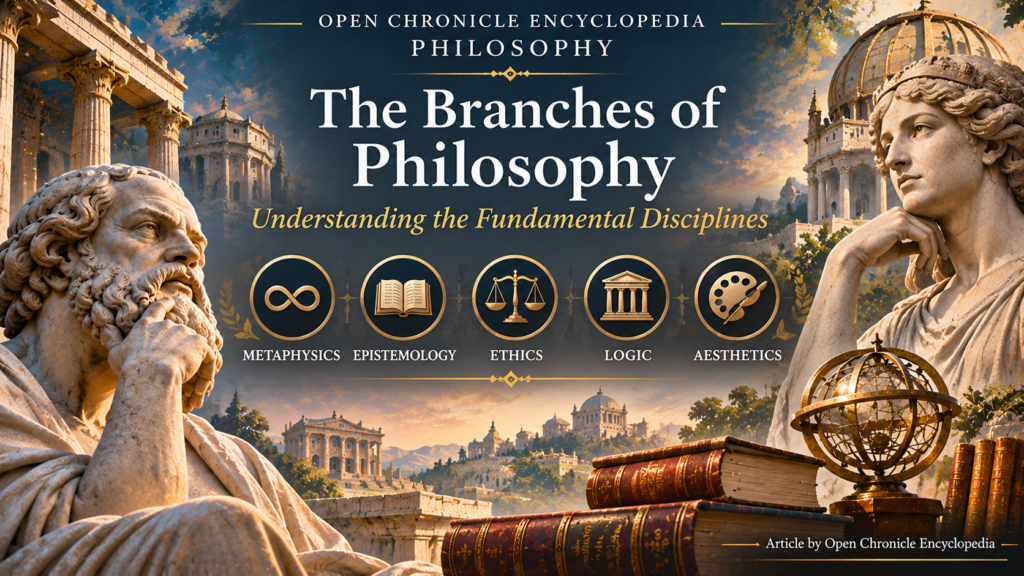
Each branch investigates a particular group of problems. Metaphysics asks what exists and what it means for something to exist. Epistemology examines the nature and limits of knowledge. Logic investigates the principles of valid reasoning. Ethics studies moral judgment and human conduct, while aesthetics explores beauty, art and aesthetic experience.
Other branches focus on particular domains of human activity or understanding. Philosophy of mind investigates consciousness and mental states. Philosophy of language examines meaning and communication. Philosophy of science analyzes scientific methods and explanations. Political philosophy investigates justice, authority and the legitimacy of institutions.
The boundaries between these fields are not absolute.
A philosophical investigation of artificial intelligence, for example, may involve metaphysical questions about the nature of minds, epistemological questions about knowledge, ethical questions about responsibility and political questions about regulation.
Similarly, debates about free will involve metaphysics, philosophy of mind, ethics and sometimes philosophy of science.
The branches of philosophy should therefore be understood as overlapping areas of inquiry rather than isolated intellectual territories.
Their organization has also changed throughout history.
Ancient Greek philosophers did not divide their work according to the same disciplinary categories used in contemporary universities. Indian philosophical schools often organized debates around knowledge, liberation, language and reality. Chinese traditions frequently integrated moral philosophy, political thought, cosmology and personal cultivation.
The modern classification of philosophical branches reflects centuries of intellectual development and academic specialization.
Understanding these branches provides a framework for exploring philosophy as a whole.
2. How Philosophy Became Divided into Branches
The classification of philosophy into distinct fields developed gradually.
In ancient Greece, Aristotle distinguished several kinds of intellectual inquiry, including theoretical, practical and productive forms of knowledge.
Theoretical inquiry investigated truth and the nature of reality. Practical inquiry concerned action and ethical life. Productive inquiry examined activities directed toward making or creating things.
Aristotle’s own investigations ranged across logic, metaphysics, ethics, politics, biology and literary theory, demonstrating how closely connected these subjects remained.
Later Hellenistic philosophers, particularly the Stoics, developed influential divisions of philosophy into logic, physics and ethics.
In this classification, physics included the study of nature and the fundamental structure of reality, while logic encompassed reasoning and aspects of the theory of knowledge.
Medieval philosophers working in Islamic, Jewish and Christian intellectual traditions developed sophisticated classifications of knowledge, often drawing upon Aristotelian categories while adapting them to different intellectual and theological contexts.
Indian philosophical traditions developed their own classifications, frequently emphasizing valid means of knowledge, metaphysical principles, liberation and methods of debate.
In China, distinctions between ethical cultivation, cosmology, political order and theories of knowledge existed, but the relationships among them were often conceived differently from modern Western disciplinary divisions.
During the early modern period, developments in experimental science and mathematics gradually transformed the relationship between philosophy and the natural sciences.
Subjects previously investigated under natural philosophy became increasingly independent scientific disciplines.
The nineteenth and twentieth centuries brought further specialization.
Logic became closely connected with mathematics. Philosophy of language emerged as a central field of analytic philosophy. Philosophy of mind developed new relationships with psychology, neuroscience and cognitive science.
Today, philosophy includes both traditional branches and specialized areas addressing medicine, technology, artificial intelligence, environmental responsibility and global justice.
The result is a discipline that combines historical continuity with continuous intellectual diversification.
3. Metaphysics: The Study of Reality and Existence
Metaphysics investigates the fundamental nature and structure of reality.
Its central questions concern existence, identity, causation, time, space, possibility and the relationships between different kinds of entities.
At its most general level, metaphysics asks what there is and how what exists is organized.
3.1 Ontology and the question of being
Ontology is the branch of metaphysics concerned with being and existence.
It asks what kinds of things exist and what it means to say that something is real.
Do only physical objects exist? Are numbers real? Do properties such as redness or justice exist independently of the objects and situations in which they appear?
These questions have generated competing theories.
Materialist and physicalist approaches emphasize physical reality. Idealist traditions assign a fundamental role to mind, consciousness or intelligible structures. Dualist theories distinguish between fundamentally different kinds of existence.
These classifications are broad and encompass many different positions.
3.2 Substance, properties and identity
Metaphysicians investigate the relationship between objects and their properties.
A tree changes as it grows, loses leaves and ages. Yet it is ordinarily regarded as the same tree.
What makes something persist through change?
The problem of identity over time has influenced philosophical discussions of objects, organisms and persons.
Aristotle’s theories of substance and change became particularly influential in Western metaphysics.
Other traditions developed different accounts of persistence and identity.
Buddhist philosophical approaches, for example, frequently challenge assumptions about permanent, independently existing substances.
3.3 Causation and necessity
Causation concerns the relationships through which events or states of affairs bring about other events.
Philosophers ask whether causal connections are necessary, whether causation is fundamentally physical and how causal relationships can be known.
David Hume famously questioned whether experience reveals necessary connections between causes and effects.
Contemporary metaphysics continues to investigate causation through counterfactual theories, causal powers and other approaches.
3.4 Time, space and possibility
Is time an objective feature of reality or dependent upon relations between events?
Does the past exist in the same sense as the present?
Could the universe have developed differently?
Such questions connect metaphysics with physics, cosmology and the philosophy of science.
Modal metaphysics, which investigates possibility and necessity, has become particularly important in contemporary philosophical debate.
Metaphysics remains one of philosophy’s broadest and most contested branches.
4. Epistemology: The Nature and Limits of Knowledge
Epistemology investigates knowledge, belief, justification and the conditions under which human beings can reasonably claim to understand the world.
Its central question is deceptively simple:
What does it mean to know something?
4.1 Knowledge and justified belief
A traditional analysis associated with interpretations of Plato holds that knowledge involves true belief supported by justification.
However, twentieth century philosopher Edmund Gettier presented influential examples suggesting that justified true belief may not be sufficient for knowledge.
The resulting debate transformed contemporary epistemology.
Philosophers proposed alternative theories emphasizing reliability, intellectual virtues, appropriate causal relationships and other conditions.
No single analysis has achieved universal acceptance.
4.2 Rationalism and empiricism
Rationalism and empiricism represent two influential approaches to the sources of knowledge.
Rationalist traditions emphasize the role of reason and, in some accounts, knowledge that does not depend upon particular sensory experiences.
Empiricist traditions emphasize experience and observation.
René Descartes, Gottfried Wilhelm Leibniz, John Locke and David Hume became central figures in later historical accounts of these debates.
Nevertheless, the distinction is not absolute. Many philosophers recognize important roles for both reason and experience.
4.3 Skepticism
Skepticism challenges claims to knowledge or certainty.
A skeptic may ask whether sensory experience can establish the existence of an external world or whether our beliefs might be systematically mistaken.
Skeptical arguments have appeared in ancient Greek, Indian and other philosophical traditions.
Some philosophers regard skepticism as a serious threat to knowledge. Others consider it a method for examining assumptions and improving standards of justification.
4.4 Social epistemology
Contemporary epistemology increasingly examines knowledge as a social activity.
Much of what individuals know depends upon testimony, education, scientific institutions and the reliability of information networks.
Social epistemology investigates expertise, trust, disagreement, misinformation and the distribution of epistemic authority.
It has become especially relevant to debates about digital media, artificial intelligence and public knowledge.
5. Logic: The Principles of Valid Reasoning
Logic studies the structure of arguments and the principles governing valid inference.
It asks whether conclusions follow from premises and how reasoning can be evaluated independently of the particular subject being discussed.
5.1 Deductive reasoning
A deductively valid argument is one in which the conclusion cannot be false if all the premises are true.
Consider the following example:
All human beings are mortal.
Socrates is a human being.
Therefore, Socrates is mortal.
The validity of this argument depends upon its logical structure.
Validity does not guarantee that the premises are true. A sound deductive argument is both valid and based on true premises.
5.2 Inductive reasoning
Inductive arguments support conclusions with varying degrees of probability rather than deductive necessity.
Scientific reasoning frequently involves inductive inference.
Observing repeated patterns may justify expectations about future events, but it does not logically guarantee that those patterns will continue.
Hume’s analysis of induction remains central to philosophical discussions of scientific knowledge.
5.3 Formal logic
Formal logic investigates reasoning through symbolic systems.
Modern developments include propositional logic, predicate logic, modal logic and numerous specialized systems.
The work of Gottlob Frege, Bertrand Russell, Alfred North Whitehead, Kurt Gödel and Alfred Tarski contributed to major transformations in mathematical and philosophical logic.
Formal logic is now important in mathematics, computer science, linguistics and artificial intelligence.
5.4 Logic across philosophical traditions
The history of logic extends beyond ancient Greece.
Indian Nyāya philosophers developed sophisticated theories of inference and debate.
Buddhist logicians, including Dignāga and Dharmakīrti, made major contributions to theories of reasoning and knowledge.
Ancient Chinese Mohist texts contain important discussions of distinctions, language and standards of argument.
The history of logic is therefore global, although different traditions developed different formal systems and philosophical objectives.
6. Ethics: The Study of Morality and the Good Life
Ethics investigates moral values, human conduct and the principles by which actions and institutions may be evaluated.
It asks what makes actions right or wrong, what obligations individuals possess and what constitutes a good human life.
6.1 Normative ethics
Normative ethics develops theories about how people ought to act.
Three influential approaches are virtue ethics, deontology and consequentialism.
Virtue ethics emphasizes moral character and the cultivation of dispositions such as courage, justice and practical wisdom.
Aristotle’s ethical philosophy is an important historical example.
Deontological theories emphasize duties, principles or constraints that may apply independently of the consequences of particular actions.
Immanuel Kant’s moral philosophy is a prominent example.
Consequentialist theories evaluate actions according to their outcomes.
Utilitarianism, associated with thinkers such as Jeremy Bentham and John Stuart Mill, is one influential consequentialist tradition.
These approaches are not exhaustive, and each contains substantial internal disagreements.
6.2 Metaethics
Metaethics examines the meaning and status of moral judgments.
Are moral truths objective?
Do moral statements describe facts, express attitudes or perform other functions?
Can moral knowledge be justified?
Metaethical theories include moral realism, various forms of antirealism, expressivism and constructivism.
6.3 Applied ethics
Applied ethics examines moral problems in specific areas of human activity.
Examples include medical decisions, environmental responsibilities, animal welfare, business conduct and technological development.
Applied ethics does not merely apply fixed rules to practical situations.
Real-world cases can also expose weaknesses in general ethical theories and generate new philosophical questions.
6.4 Global ethical traditions
Ethical philosophy has developed in many intellectual cultures.
Confucian ethics emphasizes moral cultivation and relationships.
Buddhist traditions investigate suffering, compassion and the ethical significance of intention.
African philosophical traditions include important discussions of personhood, community and responsibility.
These approaches should not be treated as interchangeable. Their differences contribute to contemporary comparative ethics.
7. Aesthetics: Beauty, Art and Human Experience
Aesthetics examines beauty, artistic expression, taste and the nature of aesthetic experience.
Its questions include:
What makes something beautiful?
What distinguishes art from ordinary objects?
Can aesthetic judgments be objective?
Why do works of art produce emotional responses?
7.1 The philosophy of beauty
Classical philosophical discussions frequently connected beauty with harmony, proportion and order.
Plato and Aristotle developed influential but different approaches to beauty and artistic representation.
In the eighteenth century, philosophers including David Hume and Immanuel Kant investigated aesthetic judgment and the relationship between subjective experience and claims to broader validity.
Kant’s Critique of Judgment, published in 1790, became especially important for later aesthetics.
7.2 The nature of art
Modern philosophy of art investigates what makes an object or activity artistic.
Some theories emphasize representation, expression or formal properties.
Others emphasize historical context, institutional recognition or the interpretation of artistic practices.
Marcel Duchamp’s readymades and later conceptual art challenged traditional definitions of artistic creation.
Arthur Danto and George Dickie contributed influential theories concerning art, interpretation and the institutional contexts in which objects are recognized as artworks.
7.3 Aesthetics beyond European traditions
Aesthetic thought has developed in Indian, Chinese, Japanese, Islamic, African and numerous other intellectual settings.
Indian theories of rasa examine aesthetic experience and emotional response.
Chinese traditions have investigated painting, calligraphy and the relationship between artistic practice and cultivated perception.
Japanese aesthetic concepts such as wabi-sabi and mono no aware have become influential in discussions of impermanence, sensitivity and artistic experience, although their historical meanings should not be reduced to simplified modern definitions.
Aesthetics therefore encompasses multiple traditions of artistic and philosophical reflection.
8. Philosophy of Mind: Consciousness, Thought and Personal Identity
Philosophy of mind investigates the nature of mental states and their relationship to the physical world.
Its central subjects include consciousness, perception, emotion, thought, intentionality and personal identity.
The field is closely connected with psychology, neuroscience, cognitive science and artificial intelligence research, but its questions are not exclusively scientific.
Even a complete description of neural activity might leave philosophical questions about the nature of subjective experience.
8.1 The mind and body problem
One of the oldest problems in philosophy of mind concerns the relationship between mental and physical phenomena.
René Descartes defended a form of substance dualism according to which mind and body are fundamentally distinct.
Physicalist theories instead maintain that mental phenomena are ultimately physical, although physicalists disagree about how mental states should be understood.
Other positions include idealism, property dualism and forms of panpsychism.
The debate remains unresolved.
8.2 Consciousness and subjective experience
Consciousness involves the subjective character of experience.
A person does not merely process information about the world. There is also something it is like to see a color, experience pain or hear music.
Thomas Nagel’s influential 1974 essay, What Is It Like to Be a Bat?, challenged the idea that objective physical descriptions necessarily capture subjective experience.
David Chalmers later popularized the distinction between relatively tractable scientific problems concerning cognitive functions and the so-called hard problem of consciousness.
The hard problem asks why and how physical processes are accompanied by subjective experience.
Not all philosophers accept this distinction or agree that consciousness presents a fundamentally separate explanatory problem.
8.3 Intentionality and mental representation
Intentionality is the property through which mental states are directed toward, or about, something.
A belief may concern tomorrow’s weather. A memory may concern an event in the past. A desire may concern a possible future situation.
Philosophers investigate how mental states acquire such content and whether intentionality can be explained through physical or computational processes.
8.4 Personal identity
What makes a person the same individual over time?
Is personal identity determined by bodily continuity, psychological connections, memory or something else?
John Locke’s account of personal identity became especially influential in early modern philosophy.
Contemporary debates examine memory, psychological continuity, bodily identity and the possibility of radical transformations in consciousness.
Buddhist philosophical traditions also offer important perspectives through their critiques of permanent selfhood.
8.5 Artificial minds
The development of artificial intelligence has renewed philosophical questions about whether machines can possess beliefs, understanding or consciousness.
Alan Turing’s 1950 paper Computing Machinery and Intelligence became a landmark in debates about machine intelligence.
John Searle’s Chinese Room argument later challenged certain claims about computation and understanding.
Contemporary philosophers disagree about whether artificial consciousness is possible and what evidence would establish its existence.
The performance of an artificial system on intellectual tasks does not, by itself, settle whether that system has subjective experience.
9. Philosophy of Language: Meaning, Reference and Communication
Philosophy of language investigates how language represents reality, communicates ideas and contributes to human understanding.
It examines meaning, reference, truth, interpretation and the relationships between words, thoughts and objects.
9.1 Meaning and reference
How does a word refer to something in the world?
Does the meaning of a name consist entirely in the object it identifies?
Gottlob Frege distinguished between sense and reference, developing an influential explanation of how expressions can refer to the same object while conveying different information.
Bertrand Russell examined descriptions and the logical structure of language.
Saul Kripke later challenged several established assumptions about naming and reference.
9.2 Language and logical analysis
Early analytic philosophers regarded the examination of language as central to resolving philosophical problems.
Wittgenstein’s Tractatus Logico-Philosophicus explored the relationship between language, logic and the world.
His later Philosophical Investigations emphasized language use, social practices and the diversity of linguistic activities.
These works contributed to major transformations in twentieth century philosophy.
9.3 Speech acts and communication
Language does more than describe reality.
People make promises, issue commands, ask questions, apologize and establish obligations through speech.
J. L. Austin and John Searle developed influential theories of speech acts.
Paul Grice examined how speakers communicate meanings that extend beyond the literal content of their words.
Such investigations connect philosophy of language with linguistics, communication studies and the philosophy of mind.
9.4 Language in global philosophical traditions
Philosophical inquiry into language is not exclusive to modern analytic philosophy.
Indian traditions developed sophisticated debates about linguistic meaning, sentence interpretation and the relationship between words and reality.
Bhartṛhari became particularly influential through his philosophy of language.
Classical Chinese philosophers examined naming, distinctions and the relationship between language and appropriate conduct.
The Mohist tradition and thinkers associated with the School of Names contributed to debates about classification and reasoning.
These traditions demonstrate that the philosophical investigation of language has a long and diverse history.
10. Philosophy of Science: Understanding Scientific Knowledge
Philosophy of science investigates the foundations, methods and implications of scientific inquiry.
It asks what distinguishes scientific investigation from other forms of knowledge, how theories are justified and whether scientific explanations accurately describe reality.
10.1 The problem of demarcation
One influential question concerns the distinction between science and non-science.
Karl Popper argued that falsifiability provides an important criterion for scientific theories.
According to this approach, scientific claims should be formulated in ways that expose them to possible refutation.
However, philosophers have questioned whether falsifiability alone adequately describes scientific practice.
Scientific theories often depend upon auxiliary assumptions, complex instruments and networks of supporting hypotheses.
10.2 Scientific revolutions
Thomas Kuhn’s The Structure of Scientific Revolutions, published in 1962, transformed debates about scientific change.
Kuhn argued that scientific communities often work within established paradigms that guide normal scientific research.
Periods of crisis may eventually lead to major transformations in accepted theories and methods.
His account challenged overly simple descriptions of science as a continuous accumulation of facts.
Imre Lakatos and Paul Feyerabend developed other influential approaches to scientific methodology and historical change.
10.3 Scientific realism
Scientific realists generally maintain that successful scientific theories provide knowledge about aspects of reality, including entities that cannot be directly observed.
Antirealist approaches challenge or qualify such commitments.
Bas van Fraassen’s constructive empiricism, for example, emphasizes empirical adequacy rather than the truth of every theoretical claim about unobservable entities.
10.4 Explanation, models and evidence
Scientific inquiry frequently relies upon models, idealizations and mathematical representations.
Philosophers examine why simplified models can produce reliable knowledge and how evidence supports competing explanations.
They also investigate scientific objectivity, the influence of social values and the relationship between scientific expertise and public policy.
These questions have become increasingly significant in debates about climate science, medicine, artificial intelligence and emerging technologies.
11. Philosophy of Religion: Faith, Reason and Ultimate Reality
Philosophy of religion investigates religious beliefs, experiences and concepts through philosophical argument.
Its questions include the existence of divinity, the nature of religious knowledge, the relationship between faith and reason, and the philosophical implications of religious diversity.
11.1 Arguments concerning divine existence
Philosophers have developed several families of arguments concerning the existence of God.
Cosmological arguments investigate whether the existence or contingency of the world requires an ultimate explanation.
Ontological arguments attempt to establish divine existence through the analysis of particular concepts.
Teleological arguments appeal to features of order, purpose or apparent design.
These arguments have been defended, revised and criticized across centuries.
11.2 The problem of evil
The problem of evil asks how the existence of suffering and wrongdoing can be reconciled with certain conceptions of an all-powerful, all-knowing and perfectly good deity.
Different versions distinguish logical compatibility from questions about the evidential significance of suffering.
Philosophers have proposed responses involving freedom, moral development, limitations of human understanding and other considerations.
11.3 Religious experience and knowledge
Can religious experience provide knowledge?
What is the relationship between revelation, testimony and rational justification?
Philosophers disagree about whether religious beliefs require the same forms of evidence as other claims.
The field also investigates religious language, mystical experience and the limits of human concepts when applied to ultimate reality.
11.4 Comparative philosophy of religion
Philosophy of religion encompasses far more than philosophical arguments concerning monotheism.
Buddhist traditions raise questions about liberation, suffering and ultimate reality without necessarily relying upon a creator deity.
Hindu philosophical schools offer different understandings of divinity, consciousness and ultimate existence.
Chinese religious and philosophical traditions present further approaches to cosmology, ritual and spiritual cultivation.
A global philosophy of religion must therefore avoid treating the assumptions of one tradition as universally applicable.
12. Philosophy of Mathematics: Numbers, Proof and Abstract Objects
Philosophy of mathematics investigates the nature of mathematical entities, the foundations of mathematical knowledge and the relationship between mathematics and reality.
Its central questions include whether numbers exist independently of human thought and why mathematical reasoning is so effective in describing the physical world.
12.1 Mathematical Platonism
Mathematical Platonism generally holds that mathematical objects exist independently of human minds and linguistic conventions.
On this view, mathematical truths are discovered rather than invented.
However, the precise nature of mathematical existence and the possibility of knowing abstract objects remain controversial.
12.2 Logicism
Logicism seeks to explain mathematics through logical principles.
Frege and Russell made influential contributions to this project.
Their work helped transform modern logic and the foundations of mathematics, although attempts to derive mathematics entirely from logic encountered major philosophical and technical difficulties.
12.3 Formalism and intuitionism
Formalist approaches emphasize mathematical systems, symbolic rules and formal derivations.
David Hilbert became a central figure in foundational programs associated with formal mathematical methods.
Intuitionism, associated with L. E. J. Brouwer, emphasizes mathematical construction and challenges some classical principles of reasoning, particularly unrestricted uses of the law of excluded middle.
12.4 Mathematical knowledge and incompleteness
Kurt Gödel’s incompleteness theorems, published in 1931, demonstrated important limitations affecting sufficiently powerful, consistent formal systems capable of expressing elementary arithmetic.
These results transformed discussions of mathematical foundations.
They do not establish that mathematical reasoning is unreliable or that all truths are beyond formal proof.
Rather, they reveal precise limitations on what particular formal systems can demonstrate about themselves and the mathematical statements expressible within them.
13. Philosophy of History: Understanding the Human Past
Philosophy of history examines historical knowledge, explanation, interpretation and the possibility of identifying meaningful patterns in historical development.
It is commonly divided into critical or analytical philosophy of history and speculative or substantive philosophy of history.
13.1 Historical knowledge
How can historians know what happened in the past?
Historical events cannot ordinarily be reproduced experimentally.
Historians rely upon documents, archaeological evidence, testimony and interpretations of surviving material.
Philosophers investigate how such evidence supports historical claims and how historians distinguish explanation from speculation.
13.2 Historical causation
Historical events often arise from complex combinations of political, economic, cultural and individual factors.
Can a revolution be explained through general laws?
What role should historians assign to individual decisions, social structures and contingent events?
These questions connect philosophy of history with social science and historiography.
13.3 Progress and historical direction
Some philosophical systems have interpreted history as a process possessing an intelligible direction.
Hegel’s philosophy became particularly influential in debates about historical development.
Marx developed a different approach emphasizing material conditions, class relations and social transformation.
Other thinkers have criticized the assumption that history follows a necessary trajectory toward progress.
The catastrophes of the twentieth century intensified skepticism toward universal narratives of inevitable human improvement.
13.4 Historical interpretation
R. G. Collingwood emphasized the importance of reconstructing historical thought and action.
Contemporary philosophers investigate narrative explanation, historical objectivity, collective memory and the relationship between evidence and interpretation.
Philosophy of history is especially important for understanding how societies construct and contest accounts of their past.
14. Philosophy of Education: Knowledge, Learning and Human Development
Philosophy of education investigates the purposes, values and methods of education.
It asks what education should accomplish, what knowledge deserves to be taught and how learning contributes to individual and collective life.
14.1 The purposes of education
Education may be understood as preparation for employment, the transmission of cultural knowledge, the cultivation of intellectual capacities or the development of autonomous individuals.
These objectives are not necessarily incompatible, but they can produce conflicting priorities.
Philosophers examine how educational institutions should balance individual development, social responsibility and economic needs.
14.2 Knowledge and the curriculum
What should students learn?
Should education emphasize specialized expertise or broad intellectual formation?
How should scientific knowledge, literature, history, philosophy and practical skills be integrated?
These questions involve epistemology, ethics and political philosophy.
14.3 Education and democracy
John Dewey argued that education plays a central role in democratic life.
His philosophy emphasized experience, inquiry and participation in social practices.
Other thinkers, including Paulo Freire, investigated the relationship between education, political power and emancipation.
Freire’s Pedagogy of the Oppressed, first published in Portuguese in 1968, became influential in critical educational theory.
14.4 Education in the digital age
Digital technologies have introduced new philosophical problems.
What happens to learning when information is immediately accessible?
How should educational institutions evaluate work produced with artificial intelligence?
Can automated systems support intellectual development without undermining independent reasoning?
Such questions demonstrate the continuing importance of philosophy of education.
15. The Relationship Between the Branches of Philosophy
Although philosophical branches are often taught separately, many of the discipline’s most important problems require several forms of inquiry.
Consider the question of human freedom.
Metaphysics investigates whether determinism is compatible with alternative possibilities.
Philosophy of mind examines the relationship between conscious decisions and physical processes.
Ethics considers whether individuals can be morally responsible for their actions.
Political philosophy asks what freedom means within social and institutional arrangements.
Philosophy of science investigates whether scientific explanations of behavior have implications for human agency.
These approaches address different aspects of the same general problem.
15.1 A comparative overview
| Branch | Central question | Example of a philosophical problem |
|---|---|---|
| Metaphysics | What exists? | Is reality entirely physical? |
| Epistemology | What can we know? | Can perception justify knowledge? |
| Logic | What makes reasoning valid? | Does a conclusion follow from its premises? |
| Ethics | How ought we to act? | What makes an action morally right? |
| Aesthetics | What is beauty or art? | Can artistic judgments be objective? |
| Philosophy of Mind | What is consciousness? | Can subjective experience be explained physically? |
| Philosophy of Language | How does meaning arise? | How do words refer to objects? |
| Philosophy of Science | How does science produce knowledge? | What makes a theory scientifically justified? |
| Philosophy of Religion | Can religious claims be justified? | What arguments support or challenge divine existence? |
| Philosophy of Mathematics | What are mathematical objects? | Do numbers exist independently of minds? |
| Philosophy of History | How can the past be understood? | Are historical explanations objective? |
| Philosophy of Education | What is education for? | Should education prioritize autonomy or social needs? |
The table provides a general orientation. Each field encompasses a much broader range of questions than the examples indicate.
16. Political and Social Philosophy: A Closely Related Field
Political and social philosophy are sometimes classified among the principal branches of philosophy, although they are also treated as specialized areas within ethics and practical philosophy.
Their historical significance warrants particular attention.
Political philosophy investigates the legitimacy of political authority, the nature of justice and the proper organization of collective life.
Plato’s Republic explored justice, education and political order.
Aristotle’s Politics examined constitutions, citizenship and the relationship between political communities and human flourishing.
Confucian political philosophy emphasized moral leadership, social relationships and responsible government.
Later thinkers such as Hobbes, Locke, Rousseau, Mill and Marx developed competing accounts of authority, rights, liberty and social organization.
In the twentieth century, John Rawls’s A Theory of Justice, published in 1971, renewed debates about distributive justice and liberal political institutions.
Robert Nozick, Michael Sandel, Charles Taylor, Iris Marion Young and numerous other philosophers developed competing approaches to justice, freedom, community and political obligation.
Social philosophy also investigates institutions, inequality, recognition, collective identity and the conditions of social life.
Feminist philosophy, critical race theory, postcolonial thought and contemporary theories of recognition have challenged established assumptions about power and the organization of society.
Political and social philosophy demonstrate that philosophical inquiry is not limited to abstract theoretical questions.
It also addresses the institutions and practices through which people live together.
17. Applied Philosophy and Emerging Fields
The expansion of modern scientific and technological capabilities has generated specialized philosophical fields.
These areas often combine traditional philosophical methods with knowledge from other disciplines.
17.1 Bioethics and medical ethics
Bioethics investigates moral questions involving medicine, biology and the life sciences.
Its subjects include informed consent, end-of-life decisions, organ transplantation, genetic technologies and the allocation of healthcare resources.
Medical ethics focuses particularly on moral responsibilities arising within healthcare practice.
17.2 Environmental philosophy
Environmental philosophy examines the moral significance of ecosystems, nonhuman organisms and future generations.
It asks whether nature possesses intrinsic value and how human responsibilities should be understood in the context of ecological change.
Climate ethics addresses the distribution of responsibility for greenhouse gas emissions, the protection of vulnerable populations and obligations across generations.
17.3 Philosophy of technology
Philosophy of technology investigates how technological systems shape human action, knowledge and social relationships.
It considers whether technologies are neutral instruments or whether their design and operation embody particular values and assumptions.
17.4 Artificial intelligence ethics
Artificial intelligence raises questions about responsibility, fairness, transparency, autonomy and human control.
Who should be accountable when an automated system causes harm?
Can decisions made by algorithms be meaningfully explained?
How should societies balance innovation with individual rights and collective security?
These questions draw upon ethics, epistemology, philosophy of mind and political philosophy.
17.5 Business and professional ethics
Business ethics examines responsibilities within commercial institutions, including conflicts of interest, corporate accountability, fair treatment and the moral implications of economic activity.
Professional ethics investigates the obligations associated with specialized roles, including those of lawyers, engineers, journalists and researchers.
These fields demonstrate how philosophical inquiry can illuminate practical decisions without eliminating the need for empirical evidence and professional judgment.
18. Philosophical Methods Across the Disciplines
Philosophy does not possess a single universally accepted method.
Different branches and traditions employ a range of intellectual practices.
18.1 Conceptual analysis
Conceptual analysis investigates the meanings, implications and relationships of concepts.
A philosopher examining knowledge may ask what distinguishes knowledge from true belief.
A political philosopher may investigate whether different uses of the word freedom refer to the same concept.
18.2 Argumentation
Philosophical arguments present reasons supporting conclusions.
They may employ deductive reasoning, inductive inference, analogies or other forms of justification.
Evaluating an argument requires attention to its premises, logical structure and possible objections.
18.3 Thought experiments
Thought experiments use hypothetical situations to examine philosophical assumptions.
Examples include Plato’s allegory of the cave, Descartes’ skeptical scenarios, the trolley problem and philosophical cases involving personal identity.
Their usefulness and limitations remain subjects of debate.
18.4 Phenomenological investigation
Phenomenology investigates the structures of lived experience.
It seeks to describe how phenomena appear to consciousness and how human beings experience themselves and the world.
18.5 Historical and textual interpretation
Many philosophical traditions place substantial importance on interpreting inherited texts.
Commentary, debate and the reconstruction of earlier arguments have been central to Greek, Indian, Chinese, Islamic, Jewish and Christian intellectual histories.
18.6 Experimental philosophy
Experimental philosophy uses empirical methods, often including surveys and behavioral studies, to investigate philosophical intuitions and patterns of judgment.
Its development has generated debates about the relationship between philosophical reflection and empirical research.
The diversity of philosophical methods reflects the diversity of philosophical problems.
19. Are the Branches of Philosophy Universal?
The classification of philosophy into branches is useful, but its historical and cultural scope requires careful examination.
The modern division into metaphysics, epistemology, logic, ethics and aesthetics emerged through particular intellectual and institutional developments.
It should not be assumed that every philosophical tradition organized knowledge in precisely the same way.
Indian philosophers frequently investigated pramāṇas, or reliable means of knowledge, within broader debates about reality and liberation.
Classical Chinese thinkers often examined ethical cultivation, political legitimacy and cosmological order as closely related concerns.
Buddhist philosophical traditions integrated investigations of consciousness, causation, knowledge and liberation.
European scholastic philosophy developed distinctive relationships between logic, metaphysics and theology.
These examples do not mean that comparison is impossible.
They demonstrate that comparisons require attention to historical context and conceptual differences.
A contemporary scholar may legitimately compare Nyāya epistemology with Western theories of justification or Buddhist metaphysics with debates about identity.
However, the comparison should not erase the original purposes and assumptions of the traditions involved.
The branches of philosophy are therefore best understood as a practical intellectual map, not a universal classification imposed by the structure of reality itself.
20. Philosophy and Other Academic Disciplines
Philosophy has historically maintained close relationships with other fields of knowledge.
Many contemporary sciences emerged from investigations once classified as natural philosophy.
Physics, psychology, biology and political science gradually developed specialized methods and institutions.
Nevertheless, their philosophical foundations remain open to investigation.
Philosophy of physics examines questions about space, time, causation and the interpretation of physical theories.
Philosophy of biology investigates evolutionary explanation, biological individuality and the nature of species.
Philosophy of psychology considers mental representation, cognition and the interpretation of psychological evidence.
Philosophy of law examines legal authority, interpretation, rights and the relationship between law and morality.
Philosophy also contributes to debates in mathematics, economics, history, literature and the arts.
These relationships do not imply that philosophical reasoning can replace empirical investigation.
Rather, philosophy frequently examines the concepts, assumptions and standards of justification that other disciplines employ.
21. Chronology of the Development of Philosophical Disciplines
| Historical period | Major developments |
|---|---|
| First millennium BCE | Philosophical inquiry develops across several ancient intellectual traditions |
| Fifth to fourth centuries BCE | Greek debates concerning nature, knowledge, ethics and politics |
| Fourth century BCE | Aristotle develops influential classifications of intellectual inquiry |
| Hellenistic period | Stoic distinctions between logic, physics and ethics become influential |
| Classical and medieval India | Development and refinement of epistemological, logical and metaphysical schools |
| Medieval centuries | Systematic developments in logic, metaphysics, ethics and philosophical theology |
| Seventeenth century | Transformations in epistemology, metaphysics and natural philosophy |
| Eighteenth century | Major developments in moral philosophy, aesthetics and theories of knowledge |
| Nineteenth century | Expansion of political philosophy, social philosophy and philosophical approaches to history |
| Late nineteenth and early twentieth centuries | Major developments in formal logic and philosophy of language |
| Twentieth century | Growth of analytic philosophy, phenomenology, philosophy of science and philosophy of mind |
| Late twentieth century | Expansion of bioethics, environmental ethics and applied philosophy |
| Twenty first century | Increasing attention to artificial intelligence, digital society, climate ethics and global philosophical traditions |
This chronology is selective and does not imply that philosophical developments followed a single universal sequence.
22. Did You Know?
Did You Know?
Five fascinating insights into the history and development of philosophical inquiry.
Metaphysics was not originally the name of a clearly defined scientific discipline.
Its historical association with Aristotle developed through the organization and interpretation of his writings.
The Stoics divided philosophy into logic, physics and ethics.
Their classification differed from the familiar modern division into five principal branches.
Indian philosophers developed sophisticated systems of logic and epistemology.
Nyāya traditions investigated perception, inference, testimony and philosophical debate.
Modern symbolic logic helped shape computer science.
Developments in mathematical logic contributed to the theoretical foundations of computation.
Philosophy of mind now intersects with neuroscience and artificial intelligence.
Yet the relationship between physical processes and subjective experience remains contested.
23. Open Chronicle Perspective: Why the Branches of Philosophy Still Matter
The division of philosophy into specialized branches may suggest that its questions belong to separate intellectual worlds.
In practice, the opposite is often true.
The most difficult contemporary problems cross the boundaries between metaphysics, knowledge, ethics, science and political life.
Artificial intelligence illustrates this convergence.
Determining whether an artificial system can understand language requires philosophical analysis of meaning and cognition.
Evaluating its reliability requires epistemology and philosophy of science.
Assessing its social consequences requires ethics and political philosophy.
Questions about artificial consciousness return to metaphysics and philosophy of mind.
Climate change offers another example.
Scientific evidence is essential for understanding environmental processes, but evidence alone cannot determine how responsibilities should be distributed between generations, nations and individuals.
Those decisions involve moral reasoning, political legitimacy and competing conceptions of justice.
The branches of philosophy provide distinct intellectual tools for addressing such problems.
Their value lies not in offering automatic solutions but in clarifying what is being asked, which assumptions are involved and what kinds of arguments may justify a conclusion.
Philosophy becomes most powerful when its branches illuminate one another. The study of reality informs the study of knowledge; the study of knowledge shapes ethical judgment; and ethical judgment influences how societies choose to live.
The branches of philosophy are therefore not merely categories in an academic curriculum.
They represent different dimensions of humanity’s continuing effort to understand existence, reason and the responsibilities that accompany knowledge.
24. Sources and Further Reading
The following bibliography brings together established academic publications and specialist philosophical reference works. It provides further reading on the historical development, methods and principal disciplines of philosophy.
Nicholas Bunnin and E. P. Tsui-James, editors | The Blackwell Companion to Philosophy
Wiley-Blackwell. A comprehensive academic introduction to the principal philosophical disciplines, including metaphysics, epistemology, ethics, logic and specialized fields.
Simon Blackburn | The Oxford Dictionary of Philosophy
Oxford University Press. A reference work explaining philosophical concepts, schools, methods and terminology.
Bertrand Russell | The Problems of Philosophy
1912. A classic introduction to philosophical problems concerning knowledge, appearance, reality and justification.
Thomas Nagel | What Does It All Mean? A Very Short Introduction to Philosophy
Oxford University Press, 1987. An accessible introduction to knowledge, consciousness, freedom, morality and the meaning of life.
Stanford Encyclopedia of Philosophy | Metaphysics
An academic overview of metaphysical inquiry, including existence, identity, reality and the organization of metaphysical problems.
Stanford Encyclopedia of Philosophy | Epistemology
An introduction to the nature of knowledge, justification, evidence and central epistemological theories.
Stanford Encyclopedia of Philosophy | Classical Logic
A specialist examination of the logical systems and principles underlying classical deductive reasoning.
Stanford Encyclopedia of Philosophy | Moral Theory
Academic resources examining normative ethical theories, moral judgment and philosophical approaches to morality.
Stanford Encyclopedia of Philosophy | Philosophy of Science
Reference material concerning scientific explanation, theory evaluation and the philosophical foundations of scientific inquiry.
Internet Encyclopedia of Philosophy
A peer-reviewed reference resource covering major philosophical disciplines, intellectual traditions and historical thinkers.
Editorial Note:
The bibliographic works and academic reference resources are provided for further consultation. Individual article URLs have not been independently checked during preparation of this entry.
25. Editorial Transparency
This article was prepared by Open Chronicle Encyclopedia as a comprehensive introduction to the principal branches of philosophical inquiry. It draws upon established philosophical scholarship, historical classifications and specialist reference literature. The division of philosophy into branches reflects influential academic conventions rather than a universally accepted or historically fixed system. Different philosophical traditions have organized intellectual inquiry according to distinct concepts, methods and objectives. The article distinguishes established historical developments from continuing philosophical controversies and does not present contested theoretical positions as settled conclusions.
Explore this subject
Continue exploring related Open Chronicle Encyclopedia entries through the categories associated with this article.

Staff Writers at Open Chronicle produce trusted journalism, strategic analysis and authoritative reference content across global affairs, geopolitics, defense, science, history, technology, business, culture and sport. Their work combines accurate reporting with historical perspective and analytical depth, helping readers understand not only what is happening, but why it matters. Beyond daily news coverage, Staff Writers contribute to the Open Chronicle Encyclopedia, investigative features, original research projects and long-form reports, building a comprehensive knowledge platform designed to inform, educate and preserve reliable information for a global audience.