
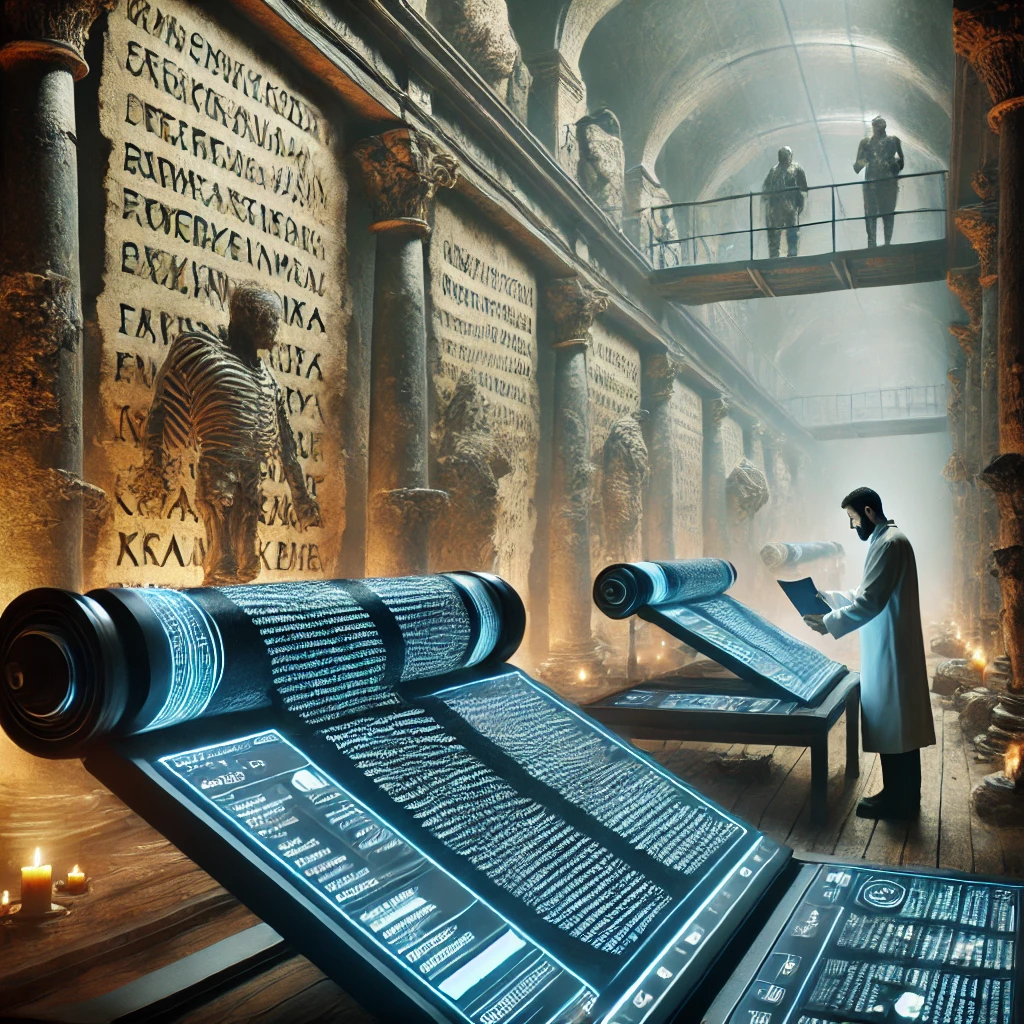
Image Credentials: Generated with AI DALL·E 2025-02-25 07.28.24
By Staff Writer
The largest surviving library from the Greco-Roman world—virtually the only one—is made up of ancient scrolls turned black by time and disaster. These are the Herculaneum Papyri, an enigma that has puzzled scientists for centuries. Recently, they have gained global attention for two reasons: researchers have successfully opened one digitally, and tech billionaire Elon Musk has taken a keen interest in their decoding.
A Library Frozen in Time
In 79 A.D., the Roman city of Herculaneum, like its more famous neighbor Pompeii, was buried under volcanic ash following the catastrophic eruption of Mount Vesuvius. Between 1752 and 1754, Swiss engineer and archaeologist Karl Weber led an excavation that unearthed approximately 1,800 fragments of ancient papyrus scrolls—remnants of around 1,000 original volumes.
However, the volcanic disaster that preserved them also turned them into delicate, charcoal-like relics. When past researchers attempted to unroll them, many disintegrated into dust, making the texts almost impossible to access.
According to The Herculaneum Society, “The scrolls were cut in half vertically, causing great loss of text. The inner layers were exposed and somewhat readable, but in many cases, one layer had to be scraped away—destroying it—to reveal the text beneath.”
Ironically, the intense heat of the eruption prevented the papyri from being completely burned. The volcanic mud that encased them created an oxygen-free environment, preserving them in a fragile carbonized state rather than reducing them to ashes.
The @bodleianlibs and the Vesuvius Challenge have announced a historic breakthrough in the endeavour to decipher text preserved on papyrus scrolls from the ancient site of Herculaneum. pic.twitter.com/XxDOxRdJR5
— University of Oxford (@UniofOxford) February 7, 2025
A Breakthrough in Digital Reading
For the first time in 2,000 years, researchers have managed to digitally open one of these blackened scrolls using a combination of X-ray imaging and artificial intelligence. The Vesuvius Challenge, an initiative dedicated to unlocking the secrets of the Herculaneum Papyri, recently announced its success.
“We are confident that we will be able to read nearly the entire scroll, and this is the first time we can say that with certainty,” said Stephen Parsons, director of the Vesuvius Challenge.
The fragments that have been decoded so far are written in Greek and are believed to contain unknown works by the philosopher Philodemus (110 B.C. – 35 B.C.), who was a proponent of Epicurean philosophy. His writings discuss the pleasures of beauty, music, and food—core themes of Epicurean thought.
Still, researchers have a long way to go. Scientists at the University of Kentucky developed a virtual unrolling program capable of piecing together tiny ink patterns from the fragile scrolls, allowing them to reconstruct about 5% of one document.
Elon Musk’s Involvement
In 2024, the University of Kentucky launched a competition offering a cash prize to anyone who could create advanced tools for reading ancient texts. This caught the attention of Elon Musk, who donated $2.084 million to fund the next phase of the Vesuvius Challenge.
Additionally, according to Wired, Musk recruited one of the competition’s top researchers to join his DOGE (Department of Government Efficiency).
Luke Farritor, a 21-year-old computer science student at the University of Nebraska-Lincoln, made headlines for his pioneering work in this field. Passionate about both technology and ancient civilizations—he studied Latin in school—Farritor developed an AI-based program capable of detecting patterns in the papyrus fibers, identifying faint traces of ancient letters.
Farritor had previously interned at SpaceX in early 2023, following in the footsteps of his father, Shane Farritor, a professor of mechanical engineering and co-founder of the surgical robotics company Virtual Incision. His groundbreaking work on the Vesuvius Challenge may now shape the future of digital archaeology.
A New Era for Ancient Texts
With Musk’s funding and cutting-edge technology, researchers are now more optimistic than ever about unlocking the full contents of these mysterious texts. If successful, the digital decoding of the Herculaneum Papyri could reshape our understanding of the ancient world, bringing long-lost philosophical and literary works back to life.
For now, the scrolls remain a tantalizing mystery, but with AI and scientific ingenuity, the past may soon be readable once more.