
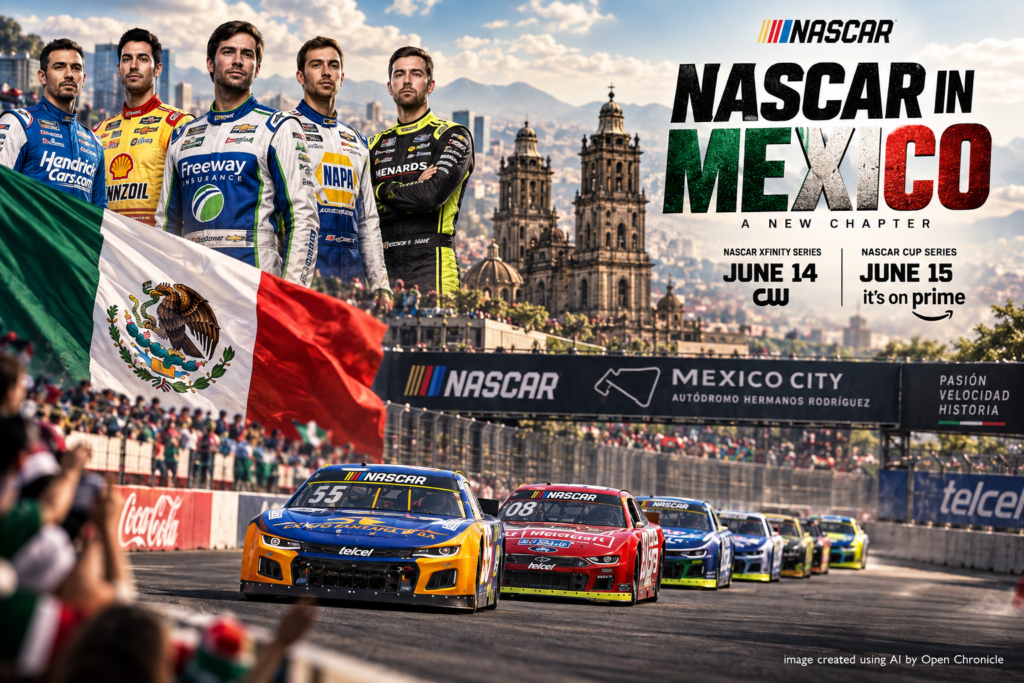
By Open Chronicle Sports
NASCAR Cup Series | Mexico City | February 26, 2025
MEXICO CITY — Months before engines fired in anger at Autódromo Hermanos Rodríguez, before packed grandstands welcomed NASCAR’s premier division and before Shane van Gisbergen drove into the record books, four Cup Series stars came to Mexico City to see the future for themselves.
Daniel Suárez knew the place.
Christopher Bell, Ryan Blaney and Chase Elliott were discovering it.
Together, the four drivers walked the circuit, toured one of the world’s largest cities, met Mexican media, sampled the local culture and began to understand that NASCAR’s trip south of the border was going to be considerably more than another road-course weekend.
For Suárez, it was something more personal still.
It was NASCAR coming home with him.
“I feel like you are coming to my house for the very first time,” Suárez told NASCAR during the visit.
That was the emotional center of the trip.
But surrounding it was something bigger: NASCAR was preparing to take one of the most ambitious international steps in the modern history of the Cup Series.
Four Drivers, One Very Different Reconnaissance Trip
This wasn’t the traditional NASCAR track walk.
Bell, Blaney, Elliott and Suárez traveled to Mexico City in late February as ambassadors, competitors and, in some ways, scouts.
They toured Autódromo Hermanos Rodríguez by golf cart and examined the configuration NASCAR intended to use. The Cup layout would differ from the Formula One configuration, eliminating some of its corners and presenting drivers with a circuit different from the one NASCAR’s Xfinity Series had raced between 2005 and 2008.
But NASCAR wanted the drivers to understand more than apexes and braking zones.
The trip included Mexican food, a visit to Lucha Libre and an opportunity to experience the city itself. Suárez and Blaney even stepped into the wrestling ring for photographs with a luchador.
It was reconnaissance, NASCAR style.
And the reaction from the drivers suggested the scale of the event was beginning to sink in.
The Track Got Their Attention
Autódromo Hermanos Rodríguez is not merely a race track dropped somewhere on the outskirts of a metropolitan area.
The circuit sits within the enormous Magdalena Mixhuca sports complex and carries decades of international racing history.
The Cup drivers saw its huge grandstands, paddock and famous stadium section. Approximately 30,000 spectators could be accommodated around Turns 11 through 14 alone, while organizers were preparing for crowds approaching 80,000 people per day during the three-day NASCAR weekend.
Elliott came away impressed by the versatility of the entire facility.
Blaney had never previously visited Mexico City. Seeing the circuit only increased his anticipation for returning as a competitor.
For drivers accustomed to America’s great stock-car temples — Daytona, Talladega, Bristol, Martinsville, Darlington — Hermanos Rodríguez offered something fundamentally different.
That was precisely the point.
NASCAR wasn’t trying to recreate Charlotte in Mexico.
It was taking NASCAR to Mexico.
For Daniel Suárez, This Was Home
Nobody carried more emotional weight into the visit than Suárez.
The Monterrey native had built his career by leaving Mexico and chasing an opportunity in the United States. He learned English, moved to North Carolina and climbed NASCAR’s development ladder before becoming the first Mexican-born driver to win a Cup Series race.
Hermanos Rodríguez was part of his story long before the Cup Series arrived.
Suárez had raced there.
He had won there.
And now he was returning as one of NASCAR’s biggest stars, bringing the premier division of American stock-car racing with him.
During the media program, NASCAR showed a preview from its Full Speed documentary series in which Suárez reflected on the extraordinary odds he had overcome.
He also recalled seeking advice when deciding whether to leave Mexico for the United States. Of 10 people he trusted, eight advised him not to make the move.
He listened to the other two.
Years later, NASCAR was following him back across the border.
Mexico Was Already Waiting
The enthusiasm wasn’t confined to NASCAR.
More than 200 Mexican journalists packed a media event during the visit to hear from Suárez, Bell, Blaney, Elliott, NASCAR executives and local organizers.
NASCAR executive Steve O’Donnell opened his remarks in Spanish.
The drivers then faced an extensive round of interviews from Mexican media ahead of ticket sales for the June event.
It provided NASCAR with an early indication that the audience was already there.
Mexico wasn’t being introduced to stock-car racing from scratch.
NASCAR had sanctioned racing in the country for years. The NASCAR México Series had provided a development path for Mexican competitors, while Hermanos Rodríguez had hosted Xfinity Series races from 2005 through 2008.
Kyle Busch and Denny Hamlin were among the drivers who had already won NASCAR races at the circuit.
What was changing in 2025 was the scale.
This time, the Cup Series was coming.
More Than Another Road Course
NASCAR’s expansion into Mexico City was also part of a broader transformation of its calendar.
For decades, NASCAR’s identity had been overwhelmingly associated with American oval racing.
That foundation remained essential.
But Chicago had demonstrated that the Cup Series could race successfully through the streets of a major city. Mexico represented the next frontier.
And Hermanos Rodríguez offered something Chicago could not.
An established international racing venue.
A major global city.
A substantial existing NASCAR fan base.
And a Mexican Cup star capable of connecting the entire event to the local audience.
The June race therefore carried consequences far beyond one weekend.
If Mexico worked, NASCAR’s international possibilities suddenly became much larger.
Then June Arrived
Looking back from today makes that February visit even more significant.
The speculation became reality on June 15.
A massive crowd filled Autódromo Hermanos Rodríguez for the first points-paying Cup Series race outside the United States in half a century.
And the race produced a dominant winner.
Shane van Gisbergen put the No. 88 Trackhouse Racing Chevrolet on pole and led 60 of 100 laps, including the final 32.
He beat Christopher Bell by an extraordinary 16.567 seconds, the largest Cup Series margin of victory since Texas in November 2009. Chase Elliott finished third.
The New Zealander had won NASCAR’s inaugural Chicago Street Race in his Cup debut two years earlier.
Now he had won NASCAR’s first modern Mexico City Cup race.
But that wasn’t even the only story of the weekend.
Suárez Got His Moment
One day before the Cup race, the home crowd received the result it desperately wanted.
Suárez crashed during qualifying for the Xfinity Series race and was forced into a backup car.
That meant starting at the rear.
He then drove through the field.
Suárez led 19 of 65 laps and survived a late restart before beating Taylor Gray by 0.598 seconds to win the Chilango 150.
The Mexican driver climbed onto the roof of his Chevrolet after the race, celebrating in front of his home crowd.
The man who had spent years promoting NASCAR’s return to Mexico had won at home.
It was difficult to script something better.
NASCAR Found Something Bigger Than a Race
That is what makes the February trip important in retrospect.
Bell, Blaney, Elliott and Suárez weren’t simply conducting promotional appearances.
They were witnessing the early stages of an experiment that would answer a significant question for NASCAR:
Could America’s most distinctive racing championship translate beyond America without losing what made it NASCAR?
Mexico City suggested that it could.
The cars were still heavy stock cars.
The racing still depended on strategy, contact, restarts and driver aggression.
But the surroundings were different.
Spanish echoed through the grandstands.
Mexican flags filled the circuit.
One of NASCAR’s most important international drivers became the emotional center of the weekend.
And an audience outside the traditional American heartland embraced the show.
The View From February
Back in February, none of that was guaranteed.
The grandstands were empty.
The Cup cars had not turned a competitive lap.
Bell, Blaney and Elliott were tourists as much as racers.
Suárez was showing his colleagues around a place he already understood.
Four months later, they returned wearing helmets.
The grandstands were full.
Suárez won.
Van Gisbergen made history.
And NASCAR discovered that crossing a border did not necessarily mean leaving its identity behind.
That February trip was supposed to introduce four drivers to Mexico City.
Instead, it became the first glimpse of NASCAR’s international future.
Historical Snapshot
Location: Mexico City, Mexico
Circuit: Autódromo Hermanos Rodríguez
Driver reconnaissance visit: February 2025
Drivers: Daniel Suárez, Christopher Bell, Ryan Blaney and Chase Elliott
Cup race weekend: June 13–15, 2025
Cup winner: Shane van Gisbergen
Runner-up: Christopher Bell
Third: Chase Elliott
Xfinity winner: Daniel Suárez
Significance: First points-paying NASCAR Cup Series race outside the United States in half a century.