
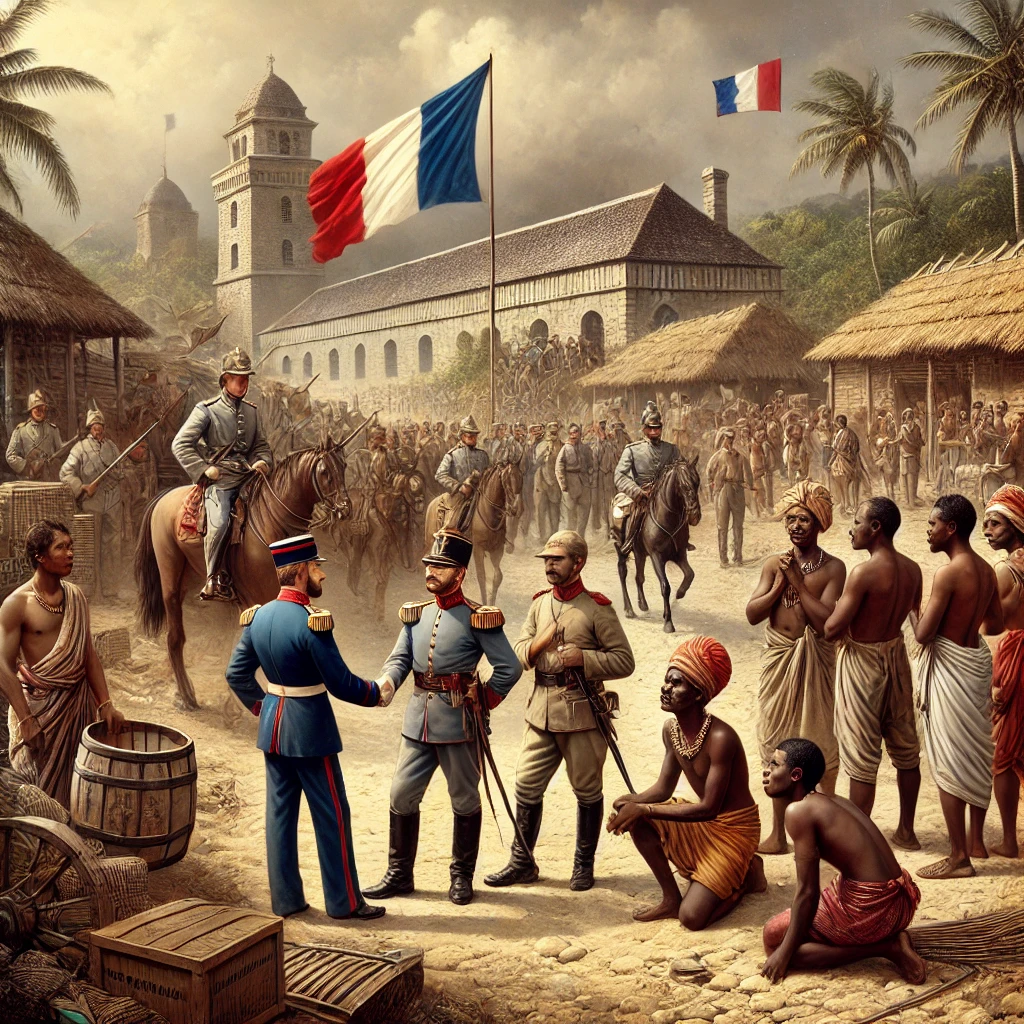
Image Credentials: Generated by Open Chronicle AI DALL·E
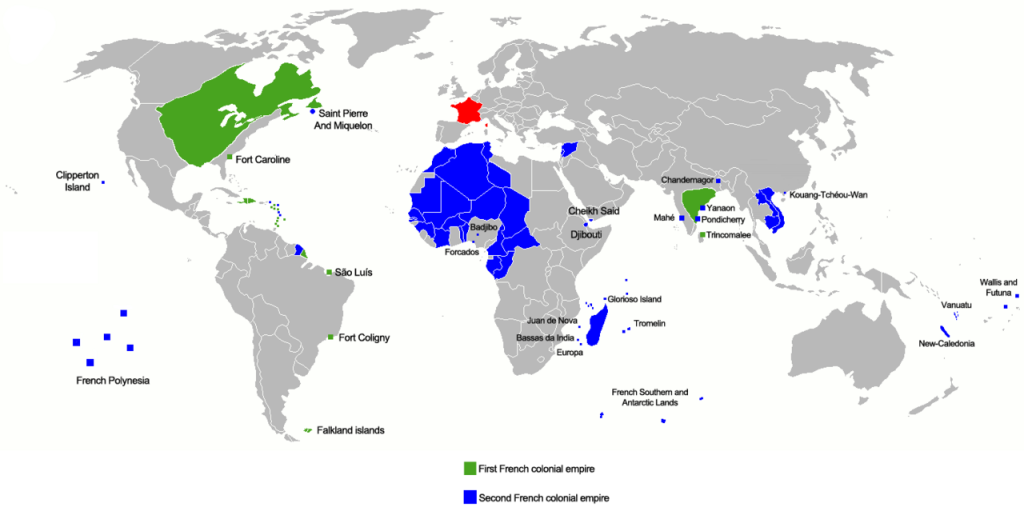
French colonial imperialism refers to the overseas expansion and administration of territories by France, primarily undertaken from the early 17th century to the mid-20th century. It can be broadly divided into two major eras: the first phase (early 17th century–mid-18th century), during which France established colonies in North America, the Caribbean, and India; and the second phase (early 19th century–mid-20th century), marked by France’s conquest in Africa, the expansion into Indochina, and its administration of a wide range of territories across multiple continents.

1. Background and Early Motivations
1.1 Economic and Political Drivers
From the late 16th century onward, European powers such as Spain, Portugal, England, and France vied for global influence and resources. France’s pursuit of a colonial empire was motivated by:
- Economic interests: Access to raw materials, including fur in North America and sugar in the Caribbean.
- Strategic competition: Rivalry with other European powers (notably England, later Great Britain) pushed France to acquire new territories.
- Religious and cultural factors: Missionary activity by Catholic orders and the spread of French language and culture were often intertwined with trade and military conquest.
1.2 Early Ventures and Settlements
France’s initial forays into colonial ventures began in the early 17th century. Notable examples include:
- Acadia (in present-day Canada): French settlers arrived in 1604, establishing one of the earliest permanent European settlements in North America.
- New France (Quebec): Founded by Samuel de Champlain in 1608, it became a major center of the fur trade.
- Caribbean Islands: France targeted lucrative sugar-producing islands, with Saint-Domingue (modern-day Haiti) eventually becoming one of the world’s richest colonies.
2. First Phase of Expansion (Early 17th Century–Mid-18th Century)
2.1 North America, the Caribbean, and India
During this period, French imperial efforts focused on:
- North America: The colony of New France stretched from the Gulf of St. Lawrence to the Great Lakes and down the Mississippi River basin, where France established trading posts and forts.
- The Caribbean: French settlers and planters occupied Guadeloupe, Martinique, and part of Hispaniola (Saint-Domingue). Sugar, coffee, and other tropical crops were grown on plantations, often using enslaved labor.
- India: The French East India Company established trading posts (factories) in Pondicherry, Chandernagore, and other coastal cities, contending with the British and Dutch for influence in the subcontinent.
2.2 Military Backing and Commercial Ventures
These colonial outposts were usually under the aegis of royal charters or trading companies that wielded significant autonomy. Backed by the French navy and expeditionary forces, they expanded their territories and secured commercial monopolies.
2.3 The Seven Years’ War and Loss of Territories
France’s first colonial empire suffered a significant blow following the Seven Years’ War (1756–1763):
- North American Losses: Under the 1763 Treaty of Paris, France ceded most of its North American possessions to Britain, including Canada.
- Indian Holdings: French influence in India was drastically reduced, retaining only a handful of trading posts.
- Caribbean Islands Retained: France managed to keep the highly profitable islands of Saint-Domingue, Guadeloupe, and Martinique, which continued to produce sugar and other exports.
3. Second Phase of Expansion (Early 19th Century–Mid-20th Century)
3.1 Conquest of Algeria (1830)
The second phase began with France’s invasion of Algeria in 1830, marking the start of a renewed imperial drive. Algeria became a settler colony, with significant numbers of French migrants establishing themselves along the coast.
3.2 French Indochina
In Southeast Asia, France gradually formed French Indochina, comprising:
- Cochinchina (southern Vietnam), Annam (central Vietnam), and Tonkin (northern Vietnam)
- Laos
- Cambodia
By the late 19th century, France had consolidated its rule in the region, exploiting local resources and establishing a colonial administrative system that significantly impacted local societies.
3.3 Scramble for Africa
As European powers raced to partition Africa in the late 19th century, France seized large territories:
- West Africa: Including modern-day Senegal, Mali, Ivory Coast, Benin, and Niger.
- Central Africa: Such as Chad, Gabon, and the Congo regions.
- Maghreb: Tunisia became a French protectorate in 1881, joining Algeria under French control.
By 1914, France’s empire covered approximately 13 million km² (5 million square miles), with a population of about 110 million people under French rule.
3.4 Post-World War I Expansion
After World War I, France acquired mandates over:
- Togo and most of Cameroon, taken from Germany.
- Syria and Lebanon, under the League of Nations mandate system.
Between 1870 and 1945, France was often considered the third largest territorial power—after Britain and Russia (later the Soviet Union)—and the second largest overseas empire, behind Britain.
4. Decolonization and the End of Empire
4.1 Challenges After World War II
The aftermath of World War II saw a shift in global attitudes against colonialism. France faced growing resistance in its overseas territories:
- First Indochina War (1946–1954): France’s defeat at the Battle of Dien Bien Phu led to the Geneva Accords and the eventual withdrawal from Vietnam, paving the way for later conflicts involving the United States.
- Algerian War (1954–1962): One of the most brutal and divisive conflicts in French colonial history. The war ended with Algeria gaining independence in 1962.
4.2 Other Independence Movements
France also granted independence to many of its sub-Saharan African colonies in the late 1950s and 1960s. Most joined the Communauté française (French Community) before opting for full sovereignty.
4.3 Legacy of French Overseas Territories
Despite decolonization, France continues to maintain several overseas departments and territories, including:
- Guadeloupe and Martinique in the Caribbean (now overseas departments).
- French Guiana in South America.
- Réunion and Mayotte in the Indian Ocean.
- French Polynesia and New Caledonia in the Pacific.
Collectively, these remnants of the empire are administratively integrated into France to varying degrees, yet they represent only a fraction of the once-sprawling colonial domain.
5. Administration and Governance
5.1 Colonial Bureaucracy
During both phases of empire-building, France employed a centralized administrative approach. A Governor-General typically oversaw large territories, with governors in individual colonies. Local elites sometimes served in advisory roles, but real power rested with French officials.
5.2 Economic Policies
Colonies were expected to provide:
- Raw materials: Minerals, agricultural products, and other resources.
- Markets: French goods enjoyed privileged access in colonial markets, bolstering domestic industries.
These policies often spurred infrastructure projects—such as railways, ports, and roads—primarily aimed at resource extraction and military control.
5.3 Cultural Assimilation
French colonial ideology often emphasized the “mission civilisatrice” (civilizing mission), which aimed to spread French language, culture, and institutions. Schools, missions, and legal frameworks promoted French assimilation policies, although their success and reception varied widely.
6. Impact and Legacy
6.1 Cultural and Linguistic Influence
The French language remains a major unifying factor in former colonies, especially in parts of Africa and Indochina, where it continues to serve as an official or administrative language. Francophone culture, encompassing literature, media, and academic institutions, has left an enduring mark.
6.2 Social and Economic Consequences
Colonial exploitation, forced labor, and unequal trade relationships have had lasting effects on local economies and societies. Post-independence, many former colonies grapple with developmental challenges partly rooted in the colonial era’s economic structures.
6.3 Geopolitical Legacy
France’s ongoing ties to its former colonies manifest through the Francophonie, defense pacts, and cultural agreements. Critics argue that these connections perpetuate a form of neo-colonialism, while others see them as a means of continued cooperation and development.
8. References
- “Treaty of Paris (1763)” – Historical Documentation, Public Archives.
- “The French Colonial Empire: A Statistical Overview” – Academic Journal on Colonial Studies.
- “France and Algeria: Colonial Ties and the Road to Independence” – University Press.
- “Decolonization after 1945” – Scholarly Analysis, International History Review.
Continue exploring related Open Chronicle Encyclopedia entries through the categories associated with this article.
Explore this subject

Staff Writers at Open Chronicle produce trusted journalism, strategic analysis and authoritative reference content across global affairs, geopolitics, defense, science, history, technology, business, culture and sport. Their work combines accurate reporting with historical perspective and analytical depth, helping readers understand not only what is happening, but why it matters. Beyond daily news coverage, Staff Writers contribute to the Open Chronicle Encyclopedia, investigative features, original research projects and long-form reports, building a comprehensive knowledge platform designed to inform, educate and preserve reliable information for a global audience.